

AI transformation is often framed as a technology upgrade.
New tools, systems and vendors.
In reality, it is one of the most demanding leadership transformations companies will face in the coming decade.
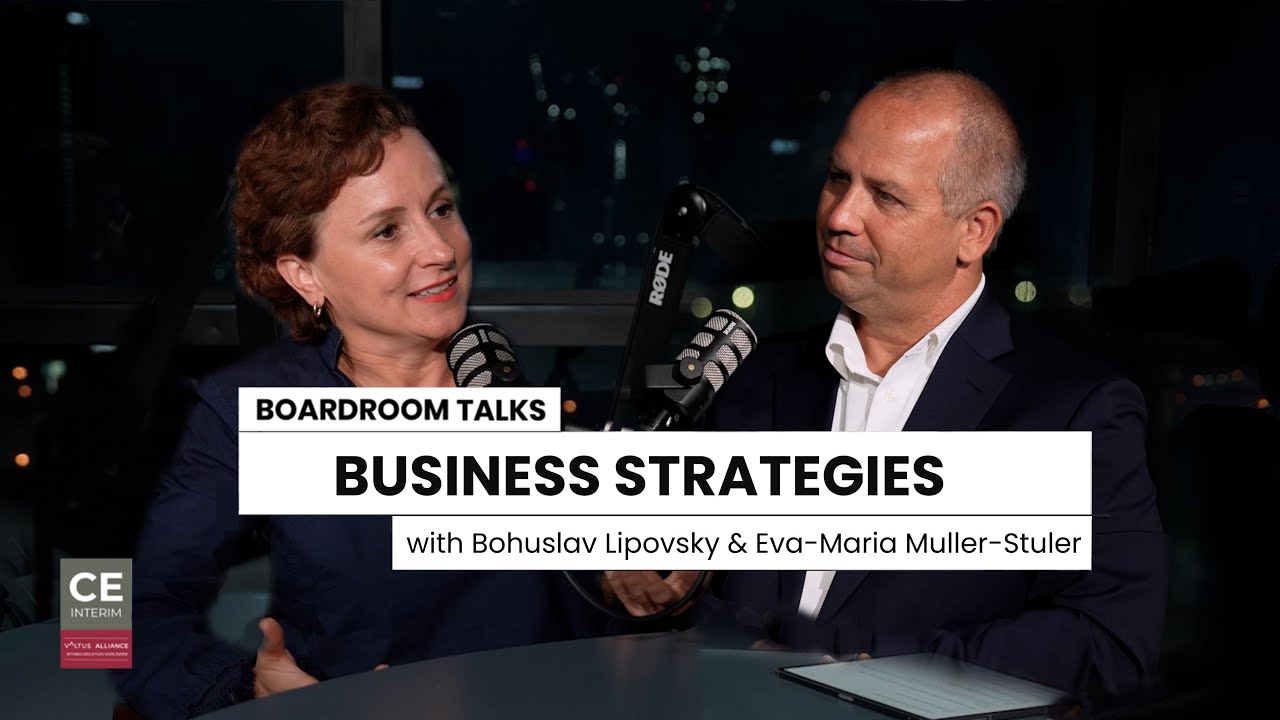
In this episode of Boardroom Talks, Bohuslav Lipovsky speaks with Dr. Eva-Marie Muller-Stuler, one of Europe’s most respected data scientists and a recognized global leader in artificial intelligence, about what AI transformation really means for executives, boards, family offices, and interim leaders.
Her message is clear.
AI transformation is not about replacing people.
It is about whether leaders are willing to adapt fast enough.
Here is the complete podcast
From Mathematics to AI Transformation Leadership
Eva’s journey into AI transformation started long before the current hype cycle.
With a background in mathematics, computer science, and business, she built Europe’s first data science and AI teams in consulting, long before AI became a boardroom topic. Later, she led major AI transformation initiatives at IBM across international markets, including the Middle East.
At the time, combining mathematics, coding, and business understanding seemed unconventional. In hindsight, it became the foundation for scalable AI transformation.
AI does not live in isolation.
It only creates value when technology, data, and business models are connected.
AI Is Accelerating Faster Than Leaders Expect
One of the strongest themes in the conversation is speed.
AI is not progressing linearly.
It is accelerating exponentially.
Eva recalls how predictions about artificial general intelligence kept shrinking, from decades, to years, to now realistic short-term scenarios. What was once theoretical is now operational, with generative AI tools reshaping how people code, write, analyze, and decide, powering everything from automated workflows to AI generated content across industries.
AI transformation is no longer a future discussion.
It is already reshaping daily work across functions.
The challenge is that governance, regulation, and leadership capability are lagging behind the technology.
Why Family Offices and Private Equity Are Behind
Despite their capital strength, many family offices and private equity firms remain slow in AI transformation.
Eva finds this surprising.
While these investors often back technology companies, their own operating models still rely heavily on intuition, legacy processes, and manual decision-making.
She identifies three areas where AI transformation could create immediate value:
- Investment sourcing and due diligence
- Portfolio value creation and turnaround strategies
- Internal knowledge management and forecasting
AI transformation allows firms to move faster, reduce bias, and make better-informed decisions, yet many hesitate due to cultural resistance rather than technical barriers.
Culture Is the Real Bottleneck in AI Transformation
Technology is rarely the hardest part.
People are.
Eva emphasizes that AI transformation requires a cultural shift across the entire organization, from CEO to assistant. Tools like Copilot, automation, and predictive systems fundamentally change how work is done, how decisions are made, and how productivity is measured.
Fear is the dominant emotion.
Employees worry about relevance.
Executives worry about loss of control.
HR struggles to redefine roles fast enough.
AI transformation fails when leaders underestimate how deeply it challenges identity, not just workflows.
Will AI Replace Us? The Wrong Question
The question Eva hears most often is simple.
Will AI replace us?
Her answer is nuanced.
AI will not replace people.
But people who refuse to learn will be replaced.
Even roles once considered safe, such as software developers, are being reshaped by generative tools that accelerate coding, testing, and optimization. The value shifts from execution to critical thinking, judgment, and direction.
AI systems hallucinate.
They are not error-free.
They require human oversight.
The winners of AI transformation will be those who learn how to work with AI, challenge its outputs, and apply it responsibly.
Why Interim Leaders Matter in AI Transformation
AI transformation is difficult to lead internally, especially when organizations lack prior experience.
Eva highlights why interim managers play a critical role:
- They bring cross-industry experience
- They operate outside internal politics
- They can challenge assumptions quickly
- They help define what good actually looks like
Many companies fail when hiring internal AI leaders because they cannot assess quality properly. Without technical understanding, boards and CEOs struggle to evaluate candidates, often selecting the wrong profiles.
Experienced interim leaders reduce this risk by accelerating setup, governance, and early execution.
Regulation Enables Trust, Not Fear
Eva strongly challenges the idea that regulation stifles innovation.
She compares AI to aviation.
People fly because safety standards exist.
The same logic applies to AI transformation.
Clear frameworks around explainability, bias, transparency, and accountability build trust for investors, boards, and society. At the foundation of these frameworks is AI Data Classification, which determines how data is handled, protected, and used across AI systems. Without trust, large-scale adoption will stall.
Responsible AI is not optional.
It is a prerequisite for sustainable transformation.
Diversity Is Not Optional in AI Teams
One of the most striking insights in the discussion is the role of diversity.
AI systems reflect the people who build them.
Homogeneous teams create blind spots.
Eva shares real examples where early AI systems failed to recognize female voices, darker skin tones, or non-dominant demographics. These were not technical failures. They were human design failures.
AI transformation without diversity amplifies bias instead of reducing it.
What CEOs Should Do Now
Eva’s advice to CEOs considering AI transformation is direct.
Do not start alone, outsource blindly or delay learning.
Leaders must:
- Define a realistic AI roadmap
- Invest in data quality first
- Upskill themselves, not just teams
- Bring experienced guidance early
- Build internal capability over time
AI transformation is not about becoming a tech company. It is about staying relevant in a world where decision-making speed and quality determine survival.
The Future Belongs to Those Who Keep Learning
Eva closes with a warning and a reassurance.
The era of learning once and executing forever is over.
Continuous learning is now a leadership requirement.
Those who adapt will thrive.
Those who resist will fall behind.
AI transformation is not a threat.
It is a mirror.
It reflects whether leaders are willing to evolve.