Interim CRO Restructuring vs. Interim Managing Director: Choosing Leadership for a Loss-Making Czech Subsidiary

In Brief An interim CRO restructuring mandate is the right answer for a loss-making Czech subsidiary. Liquidity, in that situation, runs to weeks, not months. Banks and suppliers have already moved to defensive terms. The statutory director carries personal exposure under the Czech Insolvency Act for delaying an insolvency filing. An Interim Managing Director mandate fits instead when the plant is fundamentally viable. Cash covers twelve to sixteen weeks of operations. The loss traces to operational execution, not balance-sheet distress. The two mandates carry different statutory authority and a different definition of success. Appointing the wrong one compounds the problem it was meant to solve. Evaluating a Turnaround or Closure Decision When a Foreign Subsidiary Incurs Losses Boards rarely decide, in a single meeting, that a foreign plant has become an existential risk. The pattern is usually slower. A Central European manufacturing subsidiary reports another quarter of losses. The board discusses it. That discussion tends to focus on people, not structure. Directors consider replacing the expatriate plant director. Or they ask the regional commercial director to oversee the site, alongside their existing job. That instinct is understandable. Owners have often invested tens of millions of euros in land, machinery and tooling. They naturally want to believe better local leadership can fix the plant. They resist accepting that the entity itself may be at risk. The difficulty is that this instinct answers an operational question. Increasingly, though, the real question is a statutory one. It needs an interim CRO restructuring mandate to answer it properly, not a management reshuffle. Boards lose time when they conflate operational inefficiency with structural insolvency. Scrap rates, machine downtime and late deliveries describe an operational problem. Depleted liquidity, covenant breaches, negative equity and director liability describe a different one. A brief that does not separate the two usually produces an ambiguous appointment. Ambiguous appointments are where executive turnover and continued value loss tend to start. Understanding the Czech Insolvency Act and Personal Liability for the Statutory Jednatel In the Czech Republic, this choice is not only an organisational preference. Czech corporate and insolvency law shapes the decision directly. That law applies to the local entity, wherever its owner sits. The Czech Insolvency Act (Act No. 182/2006 Coll.) sets three duties. Boards should understand each before making this appointment: Why Parent Headquarters Misjudges Balance-Sheet Risk and Solvency in Foreign Subsidiaries A parent board based in Germany, Austria or Switzerland can misread this framework easily. Group finance functions often treat the Czech entity as an internal cost centre. They assume the parent’s balance sheet and treasury function protect the local entity from legal consequence. Czech law assesses the subsidiary on its own footing, not the parent’s. Two legal tests decide this. The entity may carry too much debt relative to its assets (over-indebted, předlužení). Or it may be unable to meet matured obligations (platební neschopnost). Either test bars the statutory body from lawfully continuing to trade without a credible recovery plan. That holds true whatever informal support the parent believes it is providing. An interim CRO restructuring mandate exists precisely to close this gap. A capable operator cannot close it simply by working harder. McKinsey’s analysis of when companies appoint a Chief Restructuring Officer names two reasons boards look outside the existing management team. The first is independent credibility with lenders and directors. The second is the ability to hold competing stakeholder interests together under sustained pressure. An Interim Managing Director, however capable operationally, does not carry that specific statutory and stakeholder role. Diagnostic Matrix: Identifying When You Need an Interim CRO or an Interim Managing Director The diagnostic below exists to answer one question. Does this subsidiary need an interim CRO restructuring mandate, or an Interim Managing Director? Five dimensions separate the two situations in practice. Dimension Interim MD mandate Interim CRO mandate Liquidity and solvency At least twelve to sixteen weeks of operating cash. The business is legally solvent and meets payroll and tax on time. Liquidity runs to days or weeks. Banks have frozen credit lines and the balance sheet shows negative equity. Stakeholder conflict Customer and bank relationships remain intact. Stakeholders want production recovery, not legal guarantees. Local banks have assigned the account to a workout team. Key suppliers have filed enforcement actions. Operational viability The plant has solid technical capability and a viable order book. Losses stem from execution, not structure. The plant faces structural overcapacity or obsolescence. Survival requires material capacity reduction. Statutory authority The executive holds appointment as Managing Director with operational control. The group may still share statutory authority. The executive holds formal registration as jednatel, or an irrevocable power of attorney with unrestricted authority over liquidity. Strategic deliverable Stabilise plant performance and return the P&L to positive operating contribution. Preserve liquidity, protect the board from personal exposure, and deliver a turnaround or closure decision within roughly 120 days. A subsidiary can sit closer to one column on most dimensions and still need a closer look on the others. Treat the diagnostic as a starting point for the board’s own assessment, not a substitute for it. Key Strategic Trade-Offs Between Chief Restructuring Officer and Managing Director Roles One trade-off sits underneath this table. A CRO mandate buys statutory protection and centralised crisis authority. It costs the plant some of its existing commercial relationships and day-to-day operational momentum. An MD mandate protects those relationships and that momentum. It does nothing to reduce a director’s personal exposure if the diagnostic turns out to be wrong. Defining Mandate Scope and Objectives Before Appointing Executive Leadership Once the board works through the diagnostic, the mandate itself needs the same precision. Neither an interim CRO restructuring mandate nor an Interim MD mandate should be written as a hybrid. A mandate that reads as part-time turnaround leadership and part-time commercial growth rarely succeeds. Both halves compete for the same hours. The executive ends up accountable for outcomes without the authority to control either one. Structuring an Effective Interim CRO Restructuring Mandate for Financial Turnarounds Where
When Polish Plant Closure Affects Czech Restructuring Timeline: Why Parallel Decisions Become Impossible

A German industrial group with manufacturing operations in Poland and the Czech Republic encounters a board decision within six weeks. The Polish plant is loss-making and consuming cash. The Czech site is underperforming but operationally recoverable. Available capital for restructuring totals approximately EUR 35 million across both countries. Here is the critical issue: deciding to close the Polish operation immediately triggers a restructuring choice in Czechia that cannot be delayed, resequenced, or independently managed. When one country faces closure and the other requires restructuring, the multi-country closure restructuring CEE cascade creates executive deadlock. This forces an unprepared board into a choice nobody planned to make. Understanding why parallel decisions become impossible is essential for any DACH industrial leader managing CEE operations. The first 30 days: how multi-country closure restructuring CEE cascade begins Once the board approves Polish plant closure, notification requirements across both countries activate simultaneously. Most importantly, both timelines overlap. Neither can be deferred without legal risk. This concurrent trigger sets in motion the cascade that characterizes multi-country closure restructuring CEE situations. Notification timelines collide simultaneously The Polish Labour Code requires employers to notify the District Employment Office within 20 days of the collective redundancy decision. Simultaneously, trade union consultation must occur within the same 20-day window. In addition, the Czech Labour Code imposes a 30-day minimum notice period to the Labour Office and to employee representatives before any termination notices take effect. The result is clear: both notifications must happen. Both timelines run in parallel. Executive capacity splits across two decisions Closure requires distinct actions: redundancy terms, severance calculations, asset inventory, production wind-down sequencing, creditor notification, and customer continuity planning. Restructuring requires different actions: function elimination, productivity investment decisions, working capital forecasts, and performance targets. Consequently, in the overlapping 20 to 30-day window, the Polish closure consumes the operational team’s full attention. Meanwhile, the Czech restructuring decision gets forced onto an already-saturated agenda. This is precisely why multi-country closure restructuring CEE scenarios create capacity problems at the leadership level. Weeks 4 – 8: cash flow pressure arrives before restructuring capital is deployed Once the notification phase concludes, financial reality accelerates rapidly. Severance obligations transform into concrete liabilities. Creditors and suppliers recognize the closure signal. Additionally, manufacturing payment cycles tighten at precisely the moment when cash is most constrained. Payment cycle pressures and cash flow tightening Standard manufacturing payment terms typically run Net 60 to Net 90 days in industrial B2B relationships. When suppliers detect closure signals, they reduce credit exposure. Many demand advance payment or accelerate invoice collection schedules. As a result, accounts payable shorten while accounts receivable collection slows. The CFO must address creditor pressure immediately and preserve access to working capital lines of credit. Meanwhile, Czech restructuring investment still awaits approval. Capital allocation shortfall: EUR 35 million insufficient for both countries This capital arithmetic was not on the board agenda six weeks earlier. By week 8, the CFO has already committed capital to Polish closure. Now the CFO must inform the board that Czech restructuring cannot be funded as originally planned. This situation typifies multi-country closure restructuring CEE conflicts. Weeks 8 – 16: the second country’s restructuring window closes irreversibly By this stage, the Polish closure becomes public. Employees work through notice periods. Customer orders get transferred or cancelled. Asset sales enter negotiation phase. Critically, in Czechia, the workforce message becomes unmistakable: headquarters is contracting the portfolio. Czechia could be next. Retention risk hardens and technical capability erodes The Czech Plant Manager fields weekly calls from skilled technical staff who have received job offers elsewhere. Simultaneously, the CFO has not released Czech capital commitment. The COO has not published a recovery plan. Consequently, uncertainty extends from days into weeks. By week 12, the plant loses two senior technicians and three junior engineers. Production quality deteriorates. Customer complaints increase substantially. Delay converts turnaround potential into operational deterioration Solutions that cost EUR 12 million to implement in week 2 now cost EUR 18 million in week 10. Each week of restructuring delay erodes performance systematically. Morale declines because commitment has not been made. Customers reduce order volume because delivery performance is degrading. Supplier payment terms worsen because payment history is deteriorating. By week 14, the Czech site shifts from restructuring candidate to closure candidate. The board faces a different choice than anticipated: restructure at high cost with uncertain outcomes, or close to preserve capital. This deterioration is not inevitable. It results directly from the multi-country closure restructuring CEE cascade. The sequencing choice: sequential or parallel execution in multi-country closure restructuring The board faces a binary choice. Neither option is attractive. Both carry material cost and risk. Essentially, the choice is between acceptable outcomes and worse outcomes. Option 1: Sequential execution (close Poland first, then Czech) Option 2: Parallel execution (manage both simultaneously) Who decides sequencing, and when does authority break down Formally, the Board or Supervisory Board decides sequencing for multi-country closure restructuring CEE decisions. In practice, the CFO, COO, and Board must align. When alignment fails, authority breaks down into operational reality versus strategic preference. Board preference versus operational reality Board position: Parallel execution is preferred. Parallel execution reduces total timeline and preserves Czech restructuring optionality. COO assessment: Parallel execution is operationally unmanageable. Two major portfolio actions cannot be executed with excellence simultaneously. Quality deficit in one or both initiatives is certain. CFO concern: Capital adequacy is insufficient. CFO advocates sequential execution: complete Polish closure first, preserve capital buffer, then Czech restructuring only if capital is available and creditor pressure is relieved. Cross-border authority gaps when decisions cannot align The Polish Country Manager advocates rapid closure sequencing. Conversely, the Czech Country Manager advocates clear restructuring commitment with visible capital backing. Both positions are correct operationally. Both cannot be simultaneously satisfied. EU Directive 98/59/EC and Directive 2019/2121 on cross-border restructuring establish legal frameworks but do not resolve execution sequencing. The CFO controls capital release. When the CFO withholds Czech restructuring capital pending Polish creditor resolution, the Board’s parallel execution decision becomes sequential execution in practice. Authority disintegrates.
How to restructure a Polish manufacturing plant without losing its technical capability

In brief Margin pressure often pushes a Swiss parent to cut costs in a Polish manufacturing plant. The instruction that reaches the site is usually the same: cut every department by the same percentage. It feels fair. It is easy to communicate. But it treats a toolmaker and an administrative role as if they cost the business the same, and they do not. The plant loses capability, not cost. A capability-led restructuring works differently. It runs a value-stream review and rationalises the product portfolio first. Then it puts one accountable executive on-site to protect the roles the plant needs to keep running. Why Uniform Cost Targets Often Fail in Polish Manufacturing Industrial order volumes fall across European capital goods markets. Swiss boards overseeing subsidiaries in Lower Silesia, Katowice or Poznań then come under pressure. They need to protect group EBITDA to a set timetable. The instruction that reaches the plant is usually the same. Cut costs by fifteen to twenty per cent, across every department. A uniform target is an understandable response to this kind of pressure. It avoids a lengthy board debate about which product lines, functions or legacy processes should close. The board can also explain it to the works council and the wider organisation as consistent and fair. The difficulty appears once the target reaches the shop floor. An hour of toolmaker time costs the business something different from an hour of administrative reporting. A uniform percentage treats them as the same. Challenges in Managing Polish Plants from Overseas Headquarters Switzerland is one of Poland’s largest non-EU sources of direct manufacturing investment. Its footprint spans precision mechanics, medical technology and electrical engineering, according to trade data from the Polish-Swiss Chamber of Commerce. These plants combine Swiss quality requirements with Polish technical flexibility. A uniform cost target puts exactly that combination at risk. Operational Factors Complicating Plant Restructuring in Poland Key Indicators That Cost Reduction Is Causing Capability Loss When two or more of the following signs appear together, the question changes. It is no longer whether the reduction is delivering its target saving. It is where the cost of that saving has actually gone. Core Requirements for an Effective Manufacturing Restructuring Mandate First, map the value stream before headcount changes. A granular review classifies every role as value-creating, value-enabling or non-value-adding. It does this before applying any reduction target. The review ring-fences toolmakers, maintenance specialists and certified welders from the outset. Duplicate reporting layers and administrative overhead absorb the reduction instead. Before headcount, rationalise the product and customer portfolio. Restructuring should start with the commercial order book. Closing low-margin, high-complexity legacy lines frees up the tooling and changeover time these lines consume. This reduces footprint and complexity. It does not touch the technical capability the plant needs to serve its remaining, more profitable book. Once the board makes the portfolio decision, structure the social dialogue early. The mandate engages Polish trade unions and employee councils with transparent operational data from the outset. It offers a structured voluntary departure programme (Program Dobrowolnych Odejść), and reserves the right to decline applications from critical technical staff. This lets the reduction proceed as a negotiated process, not a contested one. Throughout, one executive needs to be accountable for the sequence. An interim CRO holds that accountability on-site. The CRO pauses further indiscriminate cuts and protects the roles the value-stream review identified. The CRO also runs the portfolio and workforce decisions as one coordinated programme, rather than three separate ones. Only a few decisions escalate to the Swiss board. These include a change to the approved savings target, or a departure from the agreed statutory process. The mandate ends with a structured handover. At that point, the retained management team can run the stabilised operating model on its own. Cross-Border Leadership Strategies for Polish Operations Zurich needs reliable, verified information. It needs to know what capability actually exists on the site. Also, it needs to know what the reduction will cost in delivery and quality risk. It needs assurance that the plant has followed the statutory process correctly. The Polish plant needs something different. It needs one clear voice with the authority to protect critical roles and negotiate departures fairly. That voice must also keep the value stream moving while the review is underway. Neither need is unreasonable. Neither side can meet its own need alone. An interim CRO closes that gap. The board appoints this executive with a defined mandate and reporting structure, accountable to both the Swiss board and the plant leadership. The CRO does not become either side’s advocate. CE Interim identifies and assesses that executive against the specific mandate. A Partner stays engaged in the governance of the assignment as it progresses. The CRO hands over a stabilised, rightsized operation once the work is done. Case Study: Successful Capability-Led Turnaround in Lower Silesia A Swiss precision metal components group operated a manufacturing subsidiary in Lower Silesia employing 320 people. Facing a 25% drop in European industrial machinery demand, the board mandated an immediate 20% across-the-board budget cut. Six months later, the plant had lost seven of its top nine CNC setup technicians. Scrap had risen from 2.8% to 7.4%. Quarterly operating losses had deepened from 400,000 CHF to 1.1 million CHF. An on-site review found that the across-the-board cuts had reduced the toolroom and maintenance shifts. Middle-management administrative structures remained largely intact. The plant was turning away profitable precision orders for lack of setup capability. CE Interim identified and mobilised an Interim Chief Operations Officer, on-site within 72 hours of the completed mandate brief. The interim COO halted further indiscriminate cuts and retained the remaining critical CNC specialists on retention terms. It also closed two structurally unprofitable low-margin product lines and consolidated factory floor space by 35%. Within four months, fixed overheads had reduced by 1.6 million CHF annually. Scrap had fallen back to 2.1% within ninety days. OEE on the core lines had risen to 84%. The plant had returned to positive operating cash flow, with
High-Risk Merchant Account Providers: A CFO’s Checklist

A high-risk merchant account is a liquidity position, not a procurement line item. Reserves, settlement terms and termination rights decide how much cash your business can actually access. Here is how six specialist providers compare, and what boards and CFOs should establish before signing anything.
Ransomware Attack Manufacturing: Six Weeks to Insolvency

A ransomware attack manufacturing crisis can stop production, drain cash, and force a board to restructure, sell, or close within weeks.
Automotive Supplier Insolvency Starts When the OEM Cancels

Automotive supplier insolvency often begins when an OEM withdraws the programme carrying a plant’s fixed costs. This article explains how lost volume turns into a liquidity crisis, when legal filing duties arise, and how boards must decide whether to restructure, sell or close.
The First 72 Hours After a Hungarian Plant Enters Customer Escalation

The first 72 hours after a customer escalation determine whether the issue stays operational or becomes an enterprise risk. Here is what boards must do first.
Interim Plant Manager, COO, or CEO: Who Should Lead a Hungarian Recovery

A plant recovery fails when authority is smaller than the problem. Learn when a Hungarian operation needs an Interim Plant Manager, COO or CEO.
Restructuring & Turnaround in Belgium: Expert Insights
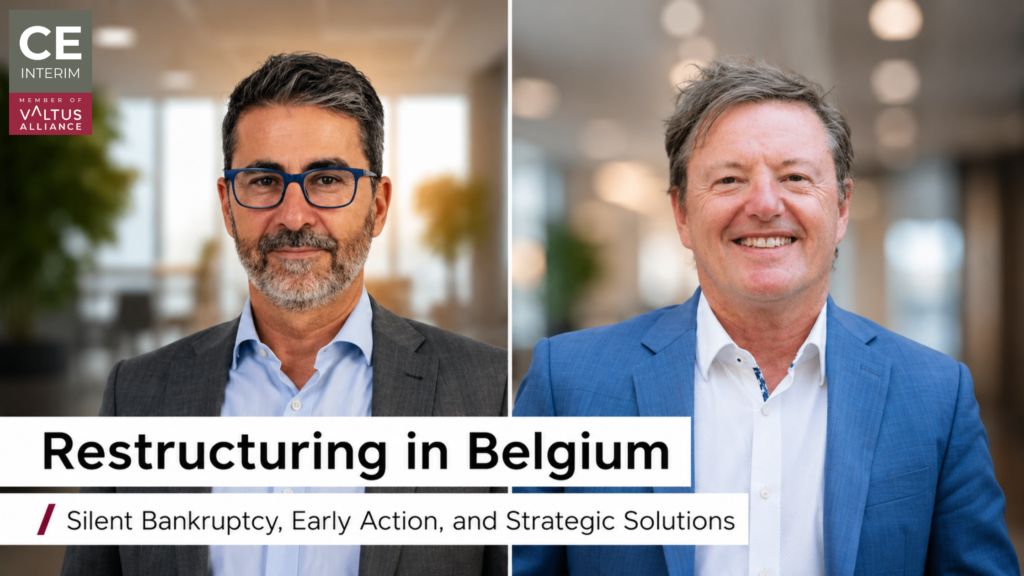
Restructuring in Belgium: silent bankruptcy, CRO-led turnarounds, and how early action preserves value in financial distress.
Interim CFO Support During ERP and Reporting Recovery

Learn how Interim CFOs stabilize ERP and reporting recovery through governance control, reporting visibility, and operational leadership.
 EN
EN  DE
DE  FR
FR  IT
IT  PL
PL  RO
RO  CS
CS  SK
SK  HU
HU  ES
ES  RU
RU  AR
AR  SL
SL