Interim CFO or restructuring advisor: who rebuilds cash control in a distressed Polish factory?

In brief A Polish manufacturing subsidiary hits a sudden liquidity crisis. The corporate CFO then faces a decision: start an Interim CFO cash control mandate on site, or engage a restructuring advisory firm. Advisors build strong financial models. They brief lender syndicates well. But they do not sign bank payments. They do not negotiate with aggressive local creditors. They do not fix cash leakage on the shop floor. When the cash runway shrinks to days, the business needs an executive with the authority to act. It does not need a report recommending one. Navigating Liquidity Crises: When Polish Manufacturing Plants Face a Cash Cliff Liquidity distress rarely builds slowly. The Group Treasurer tells the executive committee that the Polish plant has drawn its overdraft facility to the limit. At the same time, raw material suppliers in Silesia and Wielkopolska move the plant onto cash-in-advance terms. They threaten to stop deliveries within 48 hours. Headquarters looks closely, and the numbers do not hold up. Month-end reporting has hidden a growing accounts payable backlog. It has hidden disputed customer deductions and cash trapped in work in progress. The plant needs emergency funding from the parent company just to meet Friday’s payroll. At this point, the corporate CFO must choose a delivery model. Bringing in a familiar advisory brand feels like the safe first move. A comprehensive diagnostic report reassures a supervisory board, and lenders expect to see one. But an advisory engagement answers a different question to the one the business now faces. Advisors observe, analyse and present options to committees. They do not hold banking signatory authority. They do not execute inside the business. When only days of cash remain, the Board does not need more analysis of why the plant is burning cash. It needs an executive on site instead. That executive takes control of the banking portal, negotiates directly with creditors, and enforces payment discipline from day one. Overcoming Cross-Border Insolvency Risks: The Gap Between Headquarters and Local Operations The gap between the corporate CFO and the Polish plant is not only geographic. Polish law places personal liability for a late insolvency filing on the members of the local management board (członkowie zarządu). That board may not include anyone from group finance. A parent company can authorise emergency funding. It cannot discharge that statutory exposure on its own. From a distance, it often cannot tell whether the plant’s board has already crossed the filing threshold. This is also why a remote diagnostic falls short. Local creditors and the Polish tax authority will not negotiate with a report. They expect a named executive who holds signatory authority and can commit to a plan in person. A foreign parent needs reliable facts fast and sound corporate governance. The local operation needs someone with real authority to act on those facts. It cannot wait for headquarters to approve every step. An Interim CFO on site, carrying a clear mandate from the parent and formal authority in Poland, connects the two. Navigating Polish Insolvency and Bankruptcy Law: Key Statutory Compliance Risks Polish law sets two insolvency triggers. The Restructuring Law (Prawo restrukturyzacyjne) and the Bankruptcy Law (Prawo upadłościowe) both apply. A business is insolvent once it cannot meet liabilities more than three months overdue. It is also insolvent once liabilities have exceeded assets for more than 24 months. Once either threshold is reached, the board must file for bankruptcy within 30 days, or open formal restructuring proceedings. Article 299 of the Commercial Companies Code (Kodeks spółek handlowych) goes further. It lets creditors pursue board members personally, with their own assets, for unpaid company debts if the filing deadline slips. A restructuring advisor (doradca restrukturyzacyjny) carries no personal statutory liability for the board’s decisions. The corporate CFO and the local statutory directors stay exposed while a diagnostic report is still in draft. Cash decisions on the shop floor carry the same weight. Missing employee income tax (PIT) or Social Insurance Institution (ZUS) payments carries a further risk. It can trigger personal criminal fiscal liability under the Fiscal Penal Code (Kodeks karny skarbowy). Someone has to decide, every day, which payments go out first. That decision needs a person who understands Polish statutory precedence, and is willing to be held accountable for it. Strategic Delivery Models: Interim CFO Mandates vs. Restructuring Advisory Engagements Criteria Engage a restructuring advisor Deploy an Interim CFO Daily liquidity 12 to 16 weeks of confirmed runway. Goal: an independent valuation or refinancing. Under 30 days of runway. Suppliers refuse shipments. Treasury needs ring-fencing now. Execution need Headquarters wants an independent business review for lenders or a sale process. The recovery plan is clear. The local team lacks authority to act on it. Stakeholder expectations Creditors want accredited third-party validation before granting waivers. Suppliers and tax authorities want direct talks with a signatory. Local team capability The controller is competent and trusted, but lacks financial engineering depth. The finance lead is overwhelmed or defensive. Headquarters needs a replacement now. This table is a judgement call, not a checklist. The two delivery models answer different questions. An advisor is right when the question is what the business is worth, or how to approach a lender syndicate. An Interim CFO is right when the question is who can stop this week’s cash outflow. Confuse the two, and the plant often loses weeks of runway to a process built for a different problem. Operational Cash Control: A 90-Day Interim CFO Roadmap for Distressed Subsidiaries An Interim CFO placed into a distressed Polish plant does not start with another diagnostic. The mandate begins operational, from day one. It means building a cash command centre on site, and taking personal responsibility for the plant’s survival. Phase 1 (Days 1–10): Establishing Banking Control and Treasury Lockdown The Interim CFO takes sole or joint banking signature rights. All unmonitored payment access across local accounts stops immediately. Forecasting shifts from accounting projections to a direct cash flow model. It tracks receipts and disbursements, reconciled daily against the real
Why a French headquarters loses control of an acquired Romanian subsidiary

In brief A French headquarters Romanian subsidiary integration usually stalls for one reason. The deal model assumes decision rights and reporting habits will align on their own. They rarely do. Paris keeps reporting synergy capture on the steering deck. The plant keeps running on legacy contracts and local systems. An Interim Integration Director placed on site changes this. Reporting directly to the French executive committee, the director builds one verified fact base. The mandate then converts deal logic into real operational change, not an open-ended cultural adjustment. The Trigger: Uncaptured Deal Synergies and Factory Floor Disconnects Cross-border acquisitions of Romanian industrial assets by French groups usually begin with a clear commercial case. France remains one of Romania’s largest sources of foreign direct investment. French groups have built industrial relationships across automotive, aerospace and energy for decades. Board papers highlight linguistic proximity and cost competitiveness as natural enablers of fast integration. Six to twelve months after closing, the pattern looks different. The French group’s steering committee reviews a monthly deck. It shows duplicate purchasing contracts still running at the Romanian plant. It shows ERP workflows the plant has not adopted. Reported progress and operational reality have started to diverge. Executive committees in Paris or Lyon often hesitate to intervene directly at this stage. They reasonably assume a well-run acquisition target will adopt group standards on its own schedule. The plant, meanwhile, keeps running under its established practices. No one has yet told local leadership, with clear executive authority, to do otherwise. The moment usually turns financial. The procurement synergies built into the deal case have not materialised. Financial reporting reconciliations run overdue. At that point, headquarters recognises a hard truth. Ownership of the entity is not the same as control over how it operates. Why Cross-Border Post-Merger Integration Stalls Between Paris and Romania French industrial groups and Romanian manufacturing subsidiaries often share a reasonable but incomplete assumption. They expect linguistic and historical proximity to smooth the transition faster than in a market with no shared reference points. That assumption is not wrong. It is incomplete. The friction that follows a Franco-Romanian acquisition has little to do with culture. It comes from two operating systems for decision rights that nobody reconciled at closing. French corporate groups typically govern through layered committee structures, such as the Comité de Direction and the Comex. They run dual reporting lines: a legal-entity chain and a functional chain covering procurement, quality and HR. Once headquarters approves a policy centrally, it expects that policy to apply uniformly, with limited local discretion to adapt it. Understanding the Governance Structure and Operating Logic of a Romanian Plant Many Romanian manufacturing businesses operate under a different, equally coherent logic. Many began as state-owned plants, or as privately built mid-market suppliers. A General Manager typically holds direct, personal accountability for the plant’s output, workforce and supplier relationships. That authority builds up over years, not months. Local purchasing managers rely on long-standing supplier relationships that have kept production running reliably. Shifting volume to a group-negotiated contract looks like a real operational risk from that vantage point. It is not simply a change to resist. Romanian statutory law adds a further layer. A headquarters memo cannot override it on its own. Restructuring, employee transfers and works council consultation carry legal obligations. Those obligations sit with the local entity’s own management, whoever holds it, not with the parent’s instructions alone. Neither model is wrong. Both operating models exist to manage risk in their own environment. The acquisition changes that environment. It does not automatically change either side’s operating habits. As documented in research cited by Harvard Business Review, 70% to 90% of mergers fail to capture planned synergies. Cultural and governance misalignment represents the single largest driver of value destruction in cross-border deals. Warning Signs That Your Foreign Subsidiary Integration Has Stalled Executives and Group Integration Leaders do not need to wait for margin deterioration. A stalled integration shows itself earlier, through a set of specific, recurring signals. Local management confirms adoption of group initiatives in review calls. Day-to-day execution on the factory floor, meanwhile, still runs on the systems already in place. This is not concealment. It reflects a genuine gap between what headquarters approved and what the plant has actually implemented. The subsidiary keeps its statutory books in local software. It reconciles them into the group reporting package through manual spreadsheets, adding time and error risk to every cycle. Purchasing continues through established local suppliers, at prices above the group’s negotiated contracts. Switching often carries a short-term delivery risk nobody has assessed centrally. Bilingual engineers, quality leads and production supervisors sit at the centre of the integration workload. They begin to leave, citing the administrative burden of parallel reporting rather than disagreement with the acquisition itself. French functional heads in IT, HR and procurement, meanwhile, reduce direct contact with the subsidiary. They cite slower response times, without a clear escalation route to resolve why. According to insights on post-merger integration from McKinsey & Company, synergy capture requires direct, on-the-ground operational alignment within the first 100 days post-closing. Once parallel structures solidify, dismantling them becomes significantly more expensive and politically contested. Sustained for more than one cycle, any two of these signals justify a Board-level decision, not another quarter of monitoring. Core Requirements for an Effective On-Site Integration Mandate A head-office audit does not resolve this friction. Neither does a series of short factory visits. A visiting functional manager can spot the same duplicate contracts and unreconciled spreadsheets the monthly deck already shows. What actually changes the plant is continuous, on-site executive authority. That means a defined mandate, and a direct reporting line to the French executive committee. An Interim Integration Director with genuine Franco-Romanian industrial experience gives the acquisition that authority immediately. The organisation does not have to wait for a permanent Managing Director search to conclude. This is an integration mandate, not a plant turnaround or a stand-alone governance review. Neither side lacks competence. What is missing is one accountable executive
Interim managing director for a foreign subsidiary: protecting customer delivery in a Hungarian plant

In brief An interim managing director foreign subsidiary mandate exists for one moment. The managing director of a Hungarian manufacturing plant resigns without warning. The board has no one on site. A permanent replacement typically takes four to six months to recruit, negotiate and release from a competing employer. An interim managing director foreign subsidiary appointment closes that gap. The interim executive takes statutory signatory authority under Hungarian company law. The interim executive holds customer delivery commitments on site and stabilises the local management team. The permanent successor then inherits an intact business, not a recovery project. Managing a sudden managing director resignation and the six-month leadership gap A managing director rarely resigns from a Central European plant at a convenient moment. A competitor sometimes makes a stronger offer. A dispute with headquarters sometimes becomes unworkable. A compliance issue sometimes forces an abrupt exit. Whatever the cause, the board faces an immediate gap across legal, operational and commercial authority. An interim managing director foreign subsidiary appointment is usually the fastest way to close it. The instinctive response is understandable. The plant has experienced department heads and capable shift supervisors. It has modern, largely automated equipment. Headquarters assumes the plant can hold its own for a few months. A search firm, meanwhile, works through a proper process. Hungary’s industrial labour market rarely allows that assumption to hold. Hungarian labor market dynamics accelerating executive vacancy risks Experienced plant leadership is scarce in corridors such as Győr, Debrecen, Tatabánya and Székesfehérvár. Every rival employer and headhunter in the region already knows the names that matter. A managing director’s departure reads locally as a signal, not a rumour. Within weeks, operations managers, toolroom specialists and quality heads start taking calls from competitors. Capital requests sit unsigned. Supplier disputes go unresolved. By around the eighth week without a named executive on site, that drift usually reaches customers. Delayed shipments follow, and difficult calls from procurement follow with them. Why an interim managing director foreign subsidiary mandate is essential for operational continuity Two separate pressures compound each other once a Hungarian plant loses its managing director. One is statutory. One is a labour-market pressure. Statutory representation and legal authority under Hungarian corporate law Under the Hungarian Civil Code (Act V of 2013), the managing director (ügyvezető) holds the company’s registered executive-officer role. That role sits with the Court of Registration (Cégbíróság). Major commercial contracts, tax filings, customs declarations and local bank payments all need the signature of a registered executive officer. A managing director can tender resignation at any time. Where the company’s operation requires it, though, the resignation takes effect only once the company appoints a new executive. Otherwise it takes effect on the sixtieth day after notice. Until the Court of Registration formally registers a qualified executive, or grants full commercial power of attorney (cégvezető), the subsidiary struggles to execute routine contracts. It also struggles to engage local trade unions and deal with authorities. Managing the six-month executive search timeline during leadership transitions A conventional executive search in Hungary is not a quick process. The delay is structural, not a sign that the search firm is underperforming. Mapping bilingual industrial leaders across Hungary, Austria and Slovakia takes time. Running a proper competency and board-approval process typically takes eight to twelve weeks on its own. Negotiating compensation, governance expectations and a formal offer adds two to four weeks. Senior Hungarian industrial executives then usually serve three- to six-month notice periods. Enforceable non-compete agreements often reinforce those notice periods. That adds a further twelve to twenty-four weeks before the successor can start. Add those figures together. The honest range for an interim managing director foreign subsidiary gap is four to six months, sometimes longer. No one at the plant holds full authority for that entire span. That cost rarely appears as one number on a board pack. It accumulates instead, in the departures, delayed shipments and stalled decisions described below. Most of it has already happened by the time it shows up in the numbers. Warning signs of an unmanaged executive vacancy in manufacturing plants A plant without executive leadership rarely fails all at once. Not every signal deserves the same weight. Interdepartmental friction: the primary operational signal for interim leadership The most diagnostic sign is also the earliest: friction between departments that no one has the authority to resolve. Production, maintenance and quality meetings turn into disputes rather than decisions. An experienced executive treats that friction as the moment to act. It is not a pattern to keep watching. Downstream risks of prolonged managing director vacancies in local subsidiaries Everything that follows this first signal is largely confirmation, not new information. Quality engineers, continuous-improvement leads and shift supervisors start handing in notice. They cite uncertainty about the plant’s future leadership. On-time, in-full delivery performance drifts from a typical 98% toward the low 90s or below. Unmanaged bottlenecks and rising expedited-freight costs drive that drift. Supplier invoices needing a managing director’s sign-off pile up unpaid. Local trade union and works council (üzemi tanács) representatives eventually raise grievances directly with regional headquarters, rather than resolving them locally. By the time that last signal appears, the plant has already lacked functioning local authority for some time. Continuity through a leadership change depends on one thing. Someone needs to be visibly and immediately accountable on site, not reassuring the board from a distance. Acting on the first signal usually costs less than waiting for the later ones to confirm it. Core requirements of an interim managing director foreign subsidiary mandate An emergency interim managing director is not a caretaker holding the seat warm. The mandate carries full accountability for the plant’s performance, customer relationships and statutory obligations from day one. It follows a sequence that puts the most time-sensitive decisions first. Before the executive arrives, a CE Interim Partner agrees the reporting cadence directly with the board. The Partner also agrees the escalation threshold, and reviews progress every two weeks throughout the mandate. That cadence means oversight never
European automotive supply chain escalations: when customer quality audits demand immediate leadership replacement in Poland
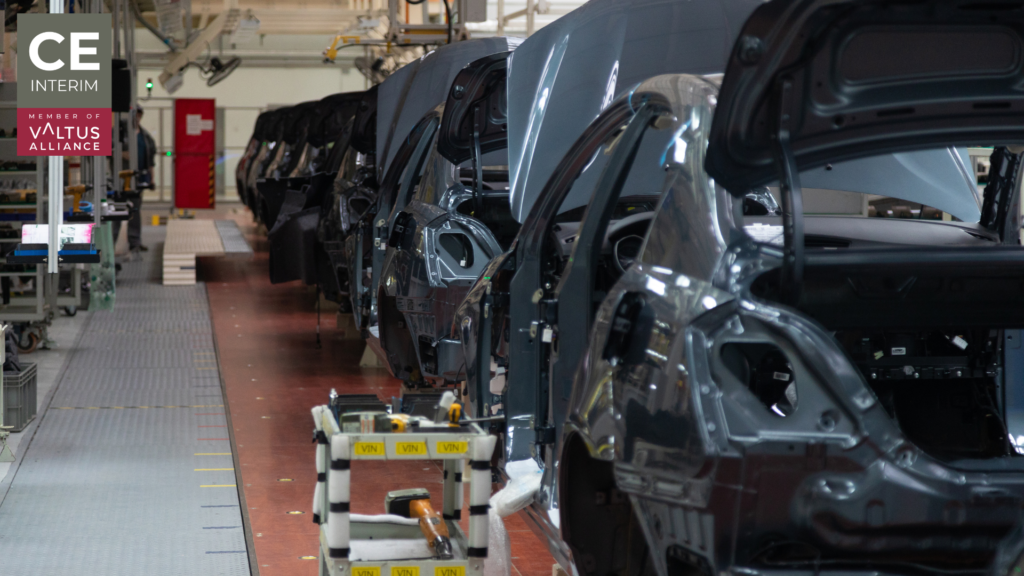
In brief A European OEM has escalated repeated quality failures at a Polish Tier 1 plant to Controlled Shipping Level 2. A VDA 6.3 audit has failed. At that point, automotive quality recovery depends on leadership, not another root-cause review. Five conditions mark that shift: the same defect returning after a closed 8D, containment that will not lift, customer escalation to the group CEO, a VDA 6.3 downgrade, and a defensive response from plant management. Once two or more appear together, automotive quality recovery becomes the COO’s task. An interim executive with turnaround authority goes on site. From Technical Failure to Leadership Crisis: The Trigger for OEM Escalation Corporate COOs rarely replace a subsidiary plant director after one failed audit. The path to automotive quality recovery through a leadership change usually follows the same sequence. It starts with isolated parts-per-million spikes or minor dimensional variances in the customer portal. The Polish plant director assures group headquarters that the team understands the cause. Raw material variation or tooling wear usually gets the blame. Headquarters accepts this. It is a reasonable response. The plant is running at volume and the explanations are plausible. Intervening from a distance also risks undermining a director who may still be right. Automotive quality recovery depends on catching the pattern before it hardens. That patience has a cost that only becomes visible later. Group leadership keeps relying on monthly dashboards and remote quality reviews. It assumes the plant can close its own 8D reports. Behind the containment promises, the shop floor is not holding basic process tolerances. Defective parts start reaching OEM assembly lines in Germany, France or the Czech Republic. This is the blind spot automotive quality recovery has to close first. The turning point is procedural, not emotional. The customer invokes Controlled Shipping Level 2 (CS2) and places third-party inspectors on site at the supplier’s expense. A subsequent VDA 6.3 process audit then returns a failing score. At that point the OEM’s quality director issues an ultimatum: replace on-site leadership, or lose the business. The technical question and the leadership question have now separated. The shop floor can still answer only one of them. From this point, automotive quality recovery runs through leadership, not through another engineering review. Managing Cross-Border Automotive Quality: Structural and Operational Challenges Navigating VDA 6.3 Process Audit Compliance and Supplier Ratings German, French and other European OEMs enforce supplier conformance through the VDA 6.3 Process Audit Standard. It scores defined project and production elements against strict downgrading rules. Scoring below 80 per cent automatically downgrades a supplier to a C rating. So does failing a starred question on process risk. Automotive quality recovery has to work inside that standard, not around it. A C rating triggers New Business On Hold. It blocks the plant from future platform awards and invites further unannounced audits. Sustained non-conformance escalates further, to Controlled Shipping Level 2 (CS2) containment, which requires an accredited external agency to inspect every outgoing part. Once triggered, none of this leaves room to negotiate, and a phone call to the customer’s account manager reverses none of it. This rigidity is exactly why automotive quality recovery leaves no room for after-the-fact negotiation. Bridging the Visibility Gap Between Headquarters and Manufacturing Plants In many cross-border manufacturing groups, headquarters receives a thinner account of severity. The customer is living a fuller one on the assembly line. This is rarely deliberate concealment. Plant leadership under production pressure has a genuine reason to treat each new OEM notice as another routine complaint. It files the 8D report that closes the ticket, not the one that fixes the underlying process gap. This is why automotive quality recovery cannot rely on the plant’s own account alone. Headquarters itself is tracking the daily output number. Meeting it can quietly outrank holding every quality gate, especially before a customer escalation makes the tension obvious. Language and cultural distance add to this. A German or French supplier-quality manager visiting the Polish site can hear a machine-capability explanation as resistance to accountability. That can be true even when the plant is describing a genuine constraint. Neither side is acting in bad faith. Both sides are working from different information and different incentives. The gap widens for as long as nobody outside the plant has direct visibility of it. This is also why customer patience is shorter than it used to be. BCG’s 2026 Global Automotive Supplier Study points to sustained automotive manufacturing margin pressure across the OEM base. That pressure is pushing vehicle manufacturers to enforce stricter cost and quality pass-through terms on their supplier tiers. An OEM managing its own margins has less room to absorb repeated non-conformance. It also has less patience for a plant that treats an OEM customer escalation as a communications problem. The problem is operating, not communications. Automotive quality recovery now depends on speed as much as substance. Key Indicators for COOs: When Automotive Quality Recovery Requires Leadership Change The same defect returns after a verified 8D closure. The plant submits a formal corrective action. The customer accepts it. The identical defect then reappears in serial production within thirty to sixty days. This is the clearest signal available. The containment and corrective-action discipline on site cannot yet hold a fix, whatever the root-cause analysis says on paper. CS2 containment does not lift within roughly eight weeks. Third-party inspection costs accumulate quickly, often into hundreds of thousands of euros a month. A plant that cannot exit CS2 within that window has lost control of its own quality system. It has not simply encountered a difficult defect. The customer’s quality or procurement leadership contacts the group CEO directly. An OEM that bypasses the account relationship to reach the group CEO or COO is signalling something specific. The existing structure has exhausted its patience, and the customer now expects a personnel consequence, not another status update. A VDA 6.3 audit returns a C rating. The audit provides external, structured confirmation that the operational failure is systemic. Findings at
Managing tooling transfer and inventory burn-down during an automotive plant closure in Hungary
In brief Tooling transfer during plant closure is a sequencing problem, not a logistics problem. Closing an automotive component plant in Hungary means running two clocks at once. One clock tracks how fast certified tooling can move to the receiving site. The other tracks how fast raw material and finished stock must reach zero. Misjudge the sequence, and the business faces an OEM line stop on one side. On the other side, it faces stranded inventory. Protecting customer delivery requires a single on-site executive, usually an Interim Plant Manager or Closure Director. That executive needs direct authority over production sequencing, retention and every purchase order until the final tool ships. The Strategic Challenges of Automotive Plant Closure and Production Consolidation When an automotive Tier 1 supplier decides to consolidate its footprint, board discussion tends to concentrate on the future. Leaders picture lower labour cost at the receiving site, fewer fixed sites to run, and a cleaner balance sheet. Closing a plant near an established Hungarian automotive cluster, such as Győr or Székesfehérvár, can look financially straightforward on paper. Execution is where the plan meets resistance. Once word of a closure reaches the shop floor, certified toolmakers, setters and quality engineers start looking elsewhere. Hungary’s dense automotive supplier base gives them plenty of options. Absenteeism rises. Preventive maintenance on ageing presses slips. Scrap increases on previously stable lines. None of this signals a poorly run plant. It is what happens once a workforce knows its site has an end date. At the same time, the OEM customer moves to protect itself. Under IATF 16949 and AIAG PPAP requirements, an OEM will not authorise a certified die, mould or progressive tool to leave. It waits until the plant secures an agreed buffer of finished components, and until the receiving site passes its own qualification. The cost case assumed a clean handover. The operational reality is a narrow window between two dates. One is when the safety stock reaches completion. The other is when the receiving plant is actually ready to build. Managing Conflicting Timelines: Labour Regulations vs. OEM Quality Standards Tooling transfer during plant closure only works when the labour timeline and the OEM quality timeline share one schedule. Right now, they usually do not. Under the Hungarian Labour Code (Act I of 2012), a redundancy affecting a large share of the workforce triggers formal consultation. The employer must give the works council or union seven days’ notice before negotiations open. It must then continue those negotiations for at least fifteen days, or until it reaches agreement. The employer must also notify the employment agency thirty days before dismissal notices reach employees. These are statutory minimums, not planning targets. A closure built to the letter of the law leaves no margin for error. Specialist toolmakers start leaving the day the announcement lands. In parallel, the OEM’s quality system runs on its own clock. PPAP treats a tooling move as a significant manufacturing site change. The receiving plant cannot ship production parts until the OEM approves its initial samples. Suppliers typically build a safety stock of 45 to 90 days of confirmed customer volume before disconnecting a tool. The exact range depends on tooling complexity and how quickly the receiving site reaches a stable cycle time. The real factory closure cost sits in the gap between these two clocks, not in the headline restructuring charge. Stopping production before the safety bank is complete exposes the group to OEM line-down penalties. Overcorrecting, and building stock past what the receiving plant needs, leaves working capital idle in a factory trying to close. Neither error is a manufacturing problem. Both come from managing the labour timeline and the quality timeline separately, against different dates. Early Warning Signs of Operational Failure During Factory Closure Operational failure during a closure becomes visible weeks before a single tool leaves the building. The corporate team just needs to know where to look. The plant falls behind the run-rate needed to complete the safety bank. Machine breakdowns or scrap on neglected, ageing lines usually cause this. Voluntary resignation among certified toolmakers and die-setters is a sharper warning than general attrition. These are the few people who can keep a tool running and ready it for a clean transfer. Losing even one leaves specific tools exposed. Procurement sometimes keeps placing orders against historic ERP parameters instead of a burn-down calculation tied to the final safety runs. That habit is how a shrinking plant ends up with stranded stock. A receiving site reporting delays in foundation work, utilities or crane capacity sends its own signal. Tools due to leave on schedule will have nowhere to go. A Four-Phase Framework for Seamless Tooling Transfer and Shutdown Closing a factory and transferring production without disrupting customers is a sequencing exercise. The order matters as much as the steps themselves. Phase 1: Establishing Operational Control and Workforce Retention The incoming executive needs one integrated schedule. It must reconcile the statutory labour timeline with the customer tooling and PPAP timeline, part number by part number. The schedule tracks tool condition, run rate and required buffer. Two decisions cannot wait. First, the Interim Plant Manager switches off automated purchase order generation. From this point, every raw material commitment needs that executive’s personal sign-off against the burn-down plan. The ERP system’s historic parameters no longer decide anything. Second, a retention structure goes to the works council alongside the statutory consultation. Bonuses tie to attendance, quality and completion of the final safety runs. The statutory notice period alone rarely keeps a certified toolmaker from taking the next offer. A cash-to-close forecast then gives the Board one number to manage the closure against. It covers retention cost, logistics, disposal proceeds and the wind-down timetable. Phase 2: Building and Managing OEM Component Safety Stock The plant runs at the rate needed to complete the agreed customer buffer. Maintenance focuses on the dies and moulds still required, not the whole tool population. As the plant produces stock, it moves to a bonded,
When a Swiss group loses visibility of its Romanian operation: restoring financial control under pressure

In brief A Swiss group Romanian subsidiary under strain follows a familiar pattern. Margins look healthy on paper. Cash requests keep arriving that those margins should not explain. The Swiss Code of Obligations places a non-delegable duty on the board. It must supervise corporate finance, wherever that finance actually sits. Restoring control starts with an interim CFO taking direct, on-site authority over banking, procurement and reporting. The next step is rebuilding one fact base that the board and local management both trust. How a Swiss group Romanian subsidiary reaches this point For a Swiss industrial group, or a family-owned precision manufacturer, financial visibility rarely fails all at once. It erodes through a pattern that looks manageable one month at a time. The subsidiary’s monthly management pack shows steady gross margins. Production runs to schedule. In the same period, local management asks Zurich or Zug for an unbudgeted treasury advance. The advance covers payroll or value-added tax. Either fact alone looks normal. Together, across several closing cycles, they describe a business the board can no longer see clearly. Swiss boards usually give this the benefit of the doubt, and that instinct is reasonable. Extended supplier credit terms, a slow customer payment, a tax-timing issue: each explanation sounds plausible on its own. Swiss governance culture also favours delegation over remote intervention. The board waits for a clearer picture before it acts. Article 716a keeps ultimate direction and supervision of management with the board. The board cannot delegate this duty. In practice, boards usually meet it through trust in local leadership, not daily involvement in a subsidiary’s finances. Extending that trust for one more quarter is a fair response to a pattern nobody has proven serious yet. The real risk sits in what happens while the board waits. Without functioning financial guardrails on site, a plant can drift. Informal supplier deals appear, and maintenance spending gets deferred. Inventory values can quietly absorb production scrap instead of reporting it. None of this needs bad intent behind it. This is what happens when a subsidiary manages its own financial discipline for too long. Its systems and authority cannot keep up. Navigating two governance systems: Swiss Code of Obligations vs. Romanian statutory reporting A Swiss parent and its Romanian subsidiary sit inside two different governance frameworks. The visibility gap usually starts there. This is a large part of why a Swiss group Romanian subsidiary becomes hard to manage from a distance. Article 716a of the Swiss Code of Obligations does not let the board delegate its duties. Ultimate direction of the company, and supervision of management, stay with the board. This holds true whatever reporting structure sits underneath it. The Romanian subsidiary operates inside a separate, demanding statutory regime. Law 31/1990 and the accounting rules in OMFP 1802/2014 set a mandatory chart of accounts. They also set strict invoice archiving requirements. Local finance teams spend much of their time keeping the entity compliant with the National Agency for Fiscal Administration. Statutory compliance and managerial controlling are related skills. They are not the same skill, though. A team that handles the first will not automatically deliver the second. Key drivers of reporting gaps: ERP systems, currency volatility, and informal authority Technology adds a further layer. Swiss headquarters usually consolidates through a platform such as SAP S/4HANA. The Romanian plant often keeps its statutory books on local software. It bridges the two systems through manually maintained spreadsheets. Currency adds another distortion. Transactions move across Romanian leu, euro and Swiss francs. When the finance team does not consistently maintain hedging and intercompany recharges, a margin can look accurate in the local ledger. It can still mislead the board in the currency it actually manages. Authority gaps tend to close themselves informally, and that is understandable. Someone has to keep the plant running day to day. Without an explicit sign-off structure, local leadership builds its own. Often a plant manager takes personal control of procurement decisions. The result is rarely concealment. A local team is usually solving its own problems with the tools and authority it actually has. Headquarters, meanwhile, keeps managing it through a reporting format built for a level of real-time visibility it no longer has. Warning signs that a foreign manufacturing plant has lost financial visibility Several recurring patterns tell a Swiss owner that the gap has moved from friction to a governance problem. It now needs direct intervention. The clearest signal is a subsidiary that reports acceptable EBITDA. At the same time, operating cash flow stays persistently negative. It repeatedly needs unplanned funding from the parent. A second signal is intercompany reconciliation that will not close cleanly across several periods. Balances build up in suspense accounts instead of resolving. A third signal is local finance answering specific questions with narrative explanations instead of reconciled general ledger data. That usually means the data itself does not yet exist in a trusted form. Finished goods or raw material inventory that looks disproportionate to actual throughput can hide obsolescence or unrecorded scrap. The single clearest test of financial control is simple: can the subsidiary produce a reliable thirteen-week rolling cash forecast? It should reflect real contractual commitments. If it cannot, headquarters is managing the business on trust, not on facts, whatever the monthly pack says. Financial control recovery: Deploying an interim CFO to restore operational oversight A three-day inspection by corporate internal audit produces only a historic snapshot. It does not establish who controls today’s bank transfers. Nor does it stay on site long enough to change how the subsidiary operates. Restoring control needs an executive with authority to act, not a team with authority to report. An interim CFO with cross-border European manufacturing experience takes direct command of local finance, treasury and procurement. The board defines this mandate before the assignment starts. The sequence below matters more than any single action. It is the sequence that restores control in a Swiss group Romanian subsidiary time and again, and each stage depends on the one before it holding.
Unreliable management reporting in a Polish manufacturing subsidiary: how headquarters rebuilds a single verified fact base

In brief Unreliable management reporting inside a Polish manufacturing subsidiary is rarely a one-off error. It is a pattern that builds quietly, quarter after quarter. Eventually the Board can no longer trust the numbers the plant reports. The task at that point is not to renegotiate targets or request another reconciliation. It is to establish one verified fact base. That means a single, reconciled view of cash, inventory and margin that headquarters and the local finance team both accept as fact. An Interim CFO with banking and ERP authority from day one can secure cash quickly. Within two weeks, the CFO typically also freezes informal reporting bridges. The statutory-to-management reconciliation follows, before the Board makes any structural decision. When unreliable management reporting problems in foreign subsidiary reveal inaccurate management data Group finance teams rarely discover a single, catastrophic false number. Unreliable management reporting typically erodes in increments, and each one looks explainable on its own. A month-end close runs a few days late. Local finance attributes a manual adjustment to exchange rates or a raw material spike. Work-in-progress values drift. Margin softens, then softens again. Headquarters usually tolerates this for two or three quarters. That patience is understandable, not a lapse in oversight. Challenging a local finance team directly, mid-production-run, is a reasonable instinct. The variance could still have an innocent explanation, and disrupting a plant that is still shipping to customers carries its own risk. The difficulty is that the same patience gives an unresolved variance time to compound. Under sustained pressure to meet budgeted margin, a local finance team can start building informal reconciliation bridges. These sit outside the core ledger: spreadsheets that defer scrap recognition, smooth inventory write-downs, or capitalise variances the team should have expensed. Nobody necessarily sets out to misstate the business. The bridges usually start as a way to explain a gap to headquarters, then become the mechanism that hides it. The trigger for intervention is rarely an accounting debate. It is the moment the Group CFO realises that consolidated margin and actual cash generation no longer agree. That gap becomes too wide to support external guidance, a bank covenant conversation, or a capital allocation decision with confidence. Why unreliable management reporting takes hold in a Polish manufacturing subsidiary Polish statutory and group management reporting are frequently two separate systems, bridged by hand. They are not one system wearing two labels. An entity must maintain formal statutory books (księgi rachunkowe) against a standardised chart of accounts (plan kont). Article 4(5) of the Polish Accounting Act places direct legal responsibility for those books on the head of the entity, the kierownik jednostki. That responsibility is personal, and delegating the work to a chief accountant does not discharge it. This creates a natural compliance bias toward Polish statutory and tax authorities, not the group consolidation template. In practice, local finance teams keep statutory books in local software, commonly Symfonia, Comarch Optima or a local SAP configuration. A manual mapping layer then bridges those figures into the group’s consolidation platform, whether OneStream, Tagetik or Hyperion. Every manual bridge is a place distortion can enter unchallenged, because nobody owns the reconciliation end to end. Where manufacturing distortion causes inaccurate management reporting In a manufacturing operation, that distortion concentrates in four places. Work-in-progress and scrap is one. Under yield pressure, a plant may defer scrap recognition rather than expense it through cost of goods sold. Standard costing is another. When line efficiency drops, finance can capitalise negative absorption variances into finished goods instead of expensing them, which quietly inflates book margin. Cut-off and accrual timing is a third. Controllers sometimes hold invoices outside the system at month end to protect a budgeted opex line. Intercompany transfer pricing is a fourth. When teams book mark-ups between headquarters and the Polish entity inconsistently, the reconciliation breaks never fully resolve. None of this requires bad faith on either side. It requires a system where two sets of books exist. Only one is subject to statutory audit discipline, with an invisible bridge connecting them. How boards identify conflicting management reports and reporting problems A qualified audit opinion is a lagging indicator. By the time it arrives, the Board has usually sat inside a reporting breakdown for several quarters. The earlier signs sit inside routine month-end workflows, and none individually looks alarming. Persistent manual adjustments in the consolidation tool are the clearest signal. This matters especially when they do not trace back to the ERP ledger: finance is constructing the numbers to meet a target, not pulling them from the system of record. A widening gap between reported EBITDA and the actual cash balance is the next signal. Cash does not lie the way an accrual can. Inventory ageing that outpaces production volume often points to obsolete stock or unrecorded scrap. The local controller should produce a reconciled bridge between the statutory filing and the group report within a couple of days. If not, no one currently holds both pictures at once. High turnover among plant accountants is a softer but real signal, especially paired with a controller unusually protective of transactional access. The reconciliation has become one person’s private responsibility, not the organisation’s shared discipline. Any one of these signs can have an innocent explanation. Two or three together, over consecutive quarters, mean the Board is already inside the problem, not approaching it. How an interim CFO restores reporting control and builds a single verified fact base External audit rarely fixes unreliable management reporting. Auditors test compliance on a sample basis at year end. They do not rebuild a daily cost allocation process. Restoring control requires an executive on site. That executive needs the authority to change how the plant produces its numbers, not only to review them afterwards. Weeks 1–2: Interim CFO reporting recovery, securing cash, and freezing bridges An Interim CFO takes direct control of banking mandates, dual-signature payment release and ERP posting rights. The CFO freezes, rather than deletes, the offline spreadsheets that bridge statutory figures into the group
Customer escalation is the last signal, not the first: restoring control in a Romanian automotive plant

In brief When an automotive OEM places a Romanian Tier 1 plant into formal customer escalation, such as Controlled Shipping Level 2 or Special Status, the decision has usually been building for months, not weeks. Boards in Paris or Lyon often read the notice as a commercial move. Operationally, it means a customer-approved inspector now sorts every part before it ships, at the plant’s expense. Reversing that requires an accountable executive on site who can establish verified containment, drive genuine root-cause resolution, and manage the OEM relationship directly, typically within 72 to 96 hours of arrival. OEM Escalation Notices: Operational Reality vs. Commercial Negotiation When a vehicle manufacturer issues a formal Quality Notification or a Level 2 Controlled Shipping escalation to a Tier 1 plant in Pitești, Craiova or Timișoara, the first reaction at headquarters is often to treat it as commercial pressure: a step toward a pricing discussion or a warranty cost-share negotiation. That reading is understandable. Local teams typically describe the trigger as an isolated batch defect, confirm that containment is holding, and commit to closing the topic with an 8D report before the next platform audit. Under pressure, headquarters has every reason to trust that account of events. The operational position is different. Once an OEM confirms Controlled Shipping Level 2, a customer-approved external inspection company sorts one hundred percent of outgoing parts at the supplier’s expense before they leave the gate. As detailed in automotive governance standards published by the International Automotive Quality Standards on Controlled Shipping, this is a structured customer process, not a warning shot. Supplier ratings are downgraded, bidding rights on future platforms are frozen, and line-stoppage penalties can accrue at several thousand euros per minute of a stopped customer line. Recognising this distinction early is the first executive judgement the situation requires: an escalation letter is rarely the opening move of a negotiation. It is confirmation that the customer no longer trusts the plant’s own quality system. Challenges in Cross-Border Automotive Quality Management: France and Romania The French-Romanian automotive corridor is one of the more established supply networks in European manufacturing, built on a long industrial relationship and a dense Tier 1 base, as documented in published academic analysis on automotive upgrading in Romania. Romanian plants supply wiring harnesses, injection-moulded interiors, braking components and electronic control units into assembly lines across the continent. Cross-border oversight between a French headquarters and a Romanian plant tends to break down in four specific places, and each one delays the moment the Board sees the real picture: Warranty and defect data usually lags the shop floor by thirty to sixty days. As research on automotive quality and warranty management sets out, a governance model built on retrospective scorecards will always be reading yesterday’s process, not today’s. Internal containment, known as CSL 1, is often set up correctly in principle but fails in practice. Line operators are assigned to sort parts without any change to tooling, maintenance or process parameters, so an intermittent defect continues to escape the inspection table undetected. Reporting is filtered as it travels. Plant management, the regional quality director and the corporate operations team each summarise the situation for the level above them. None of this is dishonest; each summary is a reasonable compression of a complex situation. By the time a recurring defect in Muntenia reaches an executive committee in France, three weeks of drift can read as a minor, resolved anomaly. Once escalation hits, the plant moves into constant expediting: buffer stock, air freight, dedicated vans to protect the customer’s line. This absorbs the same supervisors and technicians who are meant to be fixing the underlying process, which is often when a second line starts showing new escapes. Treating the OEM’s letter as the starting point misreads the timeline. The process drift that produced it usually began months before the first formal notice arrived in Paris. Early Indicators of Impending Automotive OEM Escalation A French operations director or group quality executive does not need a Controlled Shipping Level 2 letter to know a Romanian plant is heading toward customer escalation. The internal signals are usually visible months in advance, and they tend to appear together rather than alone. Recurring 8D reports that cite “operator error” or “retrained workforce” against the same defect category, batch after batch, are the clearest signal that root cause has not been established. A steadily rising monthly bill for third-party sorting or in-house rework shows the standard process can no longer produce first-pass quality on its own; the plant is paying to compensate for a capability gap rather than closing it. Growing use of premium freight and dedicated transport, authorised repeatedly to protect the customer’s build schedule, shows logistics is now absorbing a quality problem rather than a genuine supply disruption. Process parameters changed by shift technicians, such as injection pressure or weld settings, without an update to the PFMEA, mean the documented process and the actual process have diverged, often invisibly to anyone above the shop floor. Supervisors and quality engineers moving off an escalated cell, by transfer or resignation, usually means the daily pressure of customer crisis calls has become unsustainable at the level closest to the problem. Any one of these, alone, can have an innocent explanation. When three or more persist for sixty days, formal OEM escalation is close to certain, and a two-day review visit from a corporate quality manager will not satisfy the customer. By then, the plant needs a structural, on-site change in how it is run. Strategies for Reversing Customer Escalation and Restoring Plant Control Reversing customer escalation is a sequencing problem before it is a technical one, built on a trade-off an experienced plant leader recognises immediately: full traceability on every corrective action takes weeks to build properly, but the OEM will not wait weeks to see the gate closed. The sequence accepts a narrow, verifiable fix at the gate on day one, while the fuller investigation runs in parallel behind it. The first priority is containment
Why post-merger integration stalls in German-owned Polish plants

In brief Post-merger integration between German owners and acquired Polish plants frequently stalls within the first year, not because of technology, but because centralised German reporting and approval structures are introduced faster than local operational authority can absorb them. Synergy assumptions quietly fail while both sides believe integration is on track. Restoring momentum requires an on-site executive with the authority to translate group governance into daily plant decisions, a clear delegation of authority from day one, and a sequence that stabilises operational flow before back-office systems are harmonised. Early friction signs in Polish plant acquisitions that boards ignore The friction usually starts quietly. Monthly integration reports from a plant in Poznań, Katowice or Bydgoszcz begin to show missed milestones: an ERP migration delayed by local system complexity, a procurement saving pushed back because existing supplier contracts need review, a dip in delivery performance attributed to post-deal reorganisation. None of these explanations is unreasonable on its own. Having defended the valuation and the synergy case to an investment committee, a board’s instinct is to treat early friction as normal adjustment, not as a signal. That instinct is understandable. The risk is that each individually reasonable explanation delays the point at which headquarters asks a harder question. Is the plant actually integrating, or is it running two parallel systems that both look acceptable from a distance? Research on post-merger synergy realisation from McKinsey & Company points to a pattern consistent with this: acquirers routinely overestimate the speed of synergy capture and underestimate one-off integration friction, and more than sixty percent of industrial mergers fail to deliver the operating margins assumed at signing. Value erosion in manufacturing acquisitions tends to happen gradually rather than as a single visible event, which is exactly what makes it hard for a board to act on in month three or four. Structural causes of post-merger failure in German-Polish operations Poland is one of Germany’s most significant manufacturing partners, and bilateral industrial ties run deep. That closeness can make the operational distance easier to underestimate. The difficulty is rarely language. It is the relationship between how decisions were made before the acquisition and how the new owner expects them to be made afterwards. Many acquired Polish industrial businesses were built by founder-owners who ran the plant through direct shopfloor relationships and fast verbal decisions. When a German parent introduces matrix reporting lines that require functional sign-off from headquarters for routine matters such as a tooling repair or a shift change, local decision-making does not become more disciplined. It becomes slower, and the people who previously carried that authority start to lose the ability to act on what they see on the floor. A second, quieter problem follows close behind. Corporate reporting can create the appearance of alignment without the substance of it. Local teams learn to complete the templates headquarters expects while continuing to manage day-to-day operations through informal records that better reflect what is actually happening. Neither side is acting in bad faith. Headquarters needs standard reporting to manage a portfolio; the plant needs a way of running production that the standard template was not built to capture. The result is two versions of the truth, both maintained sincerely. Two further effects compound this. Skilled production managers, automation engineers and toolmakers are in high demand across manufacturing hubs such as Lower Silesia and Greater Poland. When integration adds administrative load and removes decision rights without replacing them with clarity, this is exactly the talent most able to leave for a competitor. And centrally designed ERP or process rollouts, built without close involvement from the shopfloor, often assume machine configurations, supplier lead times and workforce patterns that do not match the specific plant. Research from Boston Consulting Group on post-merger integration frameworks makes a related point: a target operating model designed without shopfloor involvement tends to create the operational bottlenecks it was meant to prevent. Key warning indicators of stalled manufacturing post-merger integration A board does not need to wait for a formal review to see whether an acquired plant has drifted into this pattern. A small number of signs, appearing together, are a reliable indicator. Synergy curves flatten after the first hundred days: early procurement discounts are captured, but planned production reallocation, shared services and tooling rationalisation show no further progress. Reporting starts to diverge, with one set of figures prepared for the German head office and a separate, informal set used to run the plant day to day. Incumbent local leaders shift from active ownership to passive compliance, attending video calls but no longer taking personal responsibility for operational deviations. Customers on established product lines, previously served reliably, begin to see volatility as production is disrupted by process changes or centralised purchasing decisions. And headquarters starts sending its own controllers and functional specialists on repeat visits to manage basic plant functions, adding cost without building capability locally. When three or more of these signs are present within the first year, the underlying integration model needs to change. A further round of central reporting, or a strategy consultancy engaged to rewrite the integration plan, addresses the paperwork rather than the authority gap that is actually slowing recovery. Turnaround strategies to restore momentum in post-acquisition plants Restoring momentum means replacing remote supervision with on-site leadership that can hold both sides of the relationship at once: accountable to group governance, and close enough to the plant to make the decisions the plant actually needs made. Managing cross-border governance and local operational autonomy Neither side of this relationship is at fault for the drift, and neither can resolve it alone. Headquarters is working from aggregated, delayed information and is right to want reliable reporting, capital discipline and a fast path to escalation. The local team is working under a reporting structure it was not built for, and its request for realistic timelines and functioning decision rights is equally reasonable. The role of an on-site executive is to build one shared fact base and one decision structure that both sides
Turnaround, restructuring or closure: choosing the right future for a Czech site

In brief When a Czech manufacturing subsidiary consistently misses its financial targets, a Swiss owner faces one of three paths: operational turnaround, structural restructuring, or orderly closure. The right choice depends on product competitiveness, unit economics and cash runway, weighed against the statutory obligations of the Czech Labour Code and Insolvency Act. Each path requires a different executive mandate and a different kind of authority on the ground. The risk is not choosing wrongly. It is not choosing at all, and losing the cash and the time needed to choose well. Why Swiss boards delay Czech plant turnaround decisions In boardrooms across Zurich, Basel and Winterthur, an underperforming Czech plant rarely gets discussed with detachment. A Swiss industrial group or private equity owner that invested in acquiring, modernising or expanding a facility in Plzeň, Brno or Liberec has good reason to believe in the original investment case. Reversing that view, in public, in front of colleagues and investors, is genuinely difficult. The instinct to give the site more time is reasonable. One more capital injection, a change in sales leadership, or another quarter for European industrial demand to recover can each look like the responsible, patient choice. Industrial sector analysis from PwC Switzerland on manufacturing restructuring points to a pattern behind that instinct: export weakness and persistent cost inflation can turn a small monthly cash shortfall into a balance-sheet problem before management has fully registered the shift. The difficulty is that delay is not a neutral position. Every month a board postpones a decision between recovery, resizing or closure, the subsidiary consumes liquidity that could otherwise fund severance, customer re-tooling or a controlled wind-down. Left long enough, the choice makes itself: cash reserves run out, and control passes from the Swiss parent to Czech banks, creditors and the insolvency courts. The task for the board is to make the decision while it still has options, not after the options have narrowed to one. Key challenges in Swiss-owned plant turnaround strategies across the corridor Czech manufacturing operations are often technically strong and deeply embedded in European supply chains, which makes the decision more consequential, not simpler. Four structural factors make it harder to call correctly from Zurich. Diagnostic criteria: Operational turnaround, capacity restructuring, or plant closure The diagnostic is not about how bad the numbers look. It is about what is causing them. Four questions, assessed together, point to a different pathway. Diagnostic criterion Operational turnaround Capacity restructuring Orderly closure Market demand and order book Core product demand is strong; backlog exists but is unfulfilled because of plant bottlenecks. Demand has permanently shifted; specific legacy lines are structurally unprofitable. Demand has collapsed or moved to lower-cost geographies; no viable long-term market remains. Operational health Machine breakdowns, weak daily cadence, high scrap, inconsistent shopfloor supervision. Overcapacity; fixed overheads exceed current and forecast volumes by more than 40 per cent. Production technology is obsolete; the capital required to modernise cannot clear the corporate hurdle rate. Unit contribution margins Positive gross margin per unit; losses driven by scrap, overtime and premium freight. Variable margins positive on core lines, negative on secondary lines; overhead absorption is failing. Negative gross margin even at full theoretical capacity; rising input costs cannot be passed to customers. Cash runway Adequate working capital; cash burn can be stopped within 60 to 90 days of shopfloor stabilisation. Three to six months of liquidity to fund severance, lease termination and line consolidation. Liquidity is severely constrained; continuation risks director liability and insolvency under Czech law. When gross margins hold and the order book is intact, the site needs an operational turnaround. When specific lines are obsolete or the footprint no longer matches demand, it needs restructuring. When unit economics are negative and the technology is beyond economic repair, the board is looking at an orderly closure, whether or not it has said so yet. Matching executive authority to the Czech site restructuring mandate The three pathways are not different intensities of the same job. Each requires a distinct mandate, a distinct scope of authority and a different tolerance for risk, and the diagnostic above is what should determine which one the board commissions. Assign authority before the diagnostic is complete and the mandate will be built around an assumption rather than the facts of the site. As McKinsey’s research on turnaround leadership sets out, execution speed and decision authority have to match the stakes of the specific mandate, not a generic interim brief. Assigning the wrong authority to the wrong mandate is one of the more common ways a board loses time it cannot get back: a turnaround specialist without statutory authority cannot execute a closure, and a closure-oriented executive will read every operational problem as terminal, even where recovery is genuinely available. How interim management bridges Zurich headquarters and Czech operations None of the three pathways can be executed from Zurich alone, and none should be left entirely to the local team to interpret on its own. Headquarters needs a reliable, granular fact base: unit costs, scrap data, cash runway, customer risk, expressed in terms the board can act on rather than a monthly summary that arrives too aggregated to be useful. The local operation needs one accountable executive with clearly defined authority, so that plant leadership is not managing a recovery, a restructuring or a wind-down under contradictory instructions from multiple stakeholders at once. CE Interim’s role is to establish that shared fact base and that single line of accountability, then place the executive whose authority matches the mandate the diagnostic actually points to. That means confirming, before mobilisation, which decisions stay with the Swiss board, which move to the interim executive, and what would trigger escalation back to Zurich: for example, unit economics deteriorating past the thresholds set in the mandate brief, or a customer signalling it will invoke a line-stoppage clause. Those triggers are agreed before the executive starts, not improvised once the mandate is under way. Once the mandate is defined, a proven, mandate-matched executive can
 EN
EN  DE
DE  FR
FR  IT
IT  PL
PL  RO
RO  CS
CS  SK
SK  HU
HU  ES
ES  RU
RU  AR
AR  SL
SL