Plant Security During Operational Turnarounds
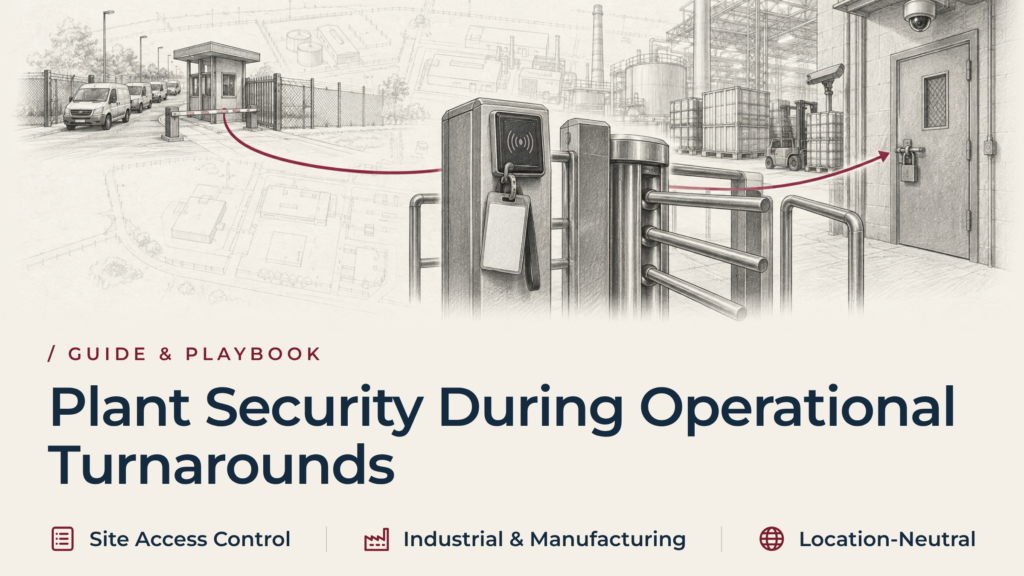
Learn how plant leaders can strengthen security during operational turnarounds by controlling contractor access, restricted areas, credentials and site risks.
What UAE investment means for German industrial operations

A German industrial business that has accepted Gulf capital notices the change in its month end close. UAE investment in German industry has moved from announcement into execution. The Federal Government press office confirmed the announcement on 10 September 2026. Both leaders welcomed a UAE investment package of EUR 40 billion in Germany. The figure tells a board nothing about the delivery agenda it has inherited. Three forms of UAE investment in German industry, three delivery agendas The sum is a declaration of intent, not an itemised commitment. The joint declaration reported by WAM records 29 business to business agreements worth more than EUR 9.356 billion, which sit alongside the package rather than inside it. Minister Sultan Ahmed Al Jaber called the sum additional to roughly EUR 34 billion already invested, Handelsblatt reported on 10 September 2026. What matters operationally is the form UAE investment in German industry takes. An acquisition makes controlling integration the first constraint Covestro is the clearest case, and it predates the September package. XRG, the international arm of ADNOC, completed its takeover of Covestro AG on 10 December 2025, with a EUR 1.17 billion capital increase at closing. Emirates Global Aluminium shows a different pattern, expanding a German recycling asset it already owns. In both cases the owner sets the reporting standard, and the German finance function runs two closes. Control also brings a regulatory sequence. A non EU acquirer falls under screening by the Außenwirtschaftsgesetz and Außenwirtschaftsverordnung, administered by the Bundesministerium für Wirtschaft und Energie. Regulation (EU) 2019/452 runs alongside. Merger control sits with the Bundeskartellamt or, under the EU Merger Regulation, the European Commission. The EU Foreign Subsidies Regulation, Regulation (EU) 2022/2560, can attach commitments shaping how the owner runs the asset. Boards read these as closing conditions. They set the operating terms for two years. A minority position moves the question from control to information Minority capital adds a reporting obligation to a company that never carried one. Partners Group announced on 14 July 2025 that a consortium had agreed to acquire Techem of Eschborn, with Mubadala Investment Company joining as a minority investor. Parity co-determination under the Mitbestimmungsgesetz of 1976 applies above 2,000 employees, the Drittelbeteiligungsgesetz between 500 and 1,999. A minority shareholder gains visibility into a supervisory board it cannot reshape, and the load falls on controlling rather than the plant. Project funding makes milestone reporting the operating discipline Project capital is the most demanding of the three, because it carries dates. RWE announced on 6 February 2026 a memorandum with Masdar. Masdar would explore investing by 2030 in existing RWE owned battery storage assets of up to 1 GW in Germany, with a further 1 GW by 2035. That establishes intent, not completion. The pattern holds where the investor is not the counterparty. GlobalFoundries, the US headquartered group in which Mubadala Investment Company holds a large stake, announced on 28 October 2025 a EUR 1.1 billion expansion of its Dresden site, taking it beyond one million wafers a year by the end of 2028, with expected support from the federal government and the Free State of Saxony under the European Chips Act. That is corporate capital, not part of the September package. Public co-funding adds audit and milestone evidence, so the reporting calendar becomes a production constraint, not a finance task. The headquarters to site interface decides German industrial operations after foreign investment Decision rights before reporting formats Distance changes the mechanics, not only the atmosphere. A shareholder committee in the Gulf works a different week, so a Thursday capital question waits for the next one. An investment council used to monthly operating detail meets a controlling function built for a supervisory board that meets quarterly. Neither expectation is unreasonable, and the two pull against each other. That is the trade-off a board is actually managing. Meeting the owner’s information needs quickly tends to slow local decisions, and protecting decision speed leaves the owner uncertain for longer. The board decides how much decision latency it accepts, and for how long. Sequence matters here. Decision rights come first, because formats agreed before authority produce fast figures nobody on site can act on. The capital authorisation path comes second, because a stalled project is the first cost a customer notices. Controlling harmonisation comes last. In German industrial operations after foreign investment that order is often reversed. Past the second quarter it shows in delivery before it shows in the accounts, a pattern CE Interim sets out in its work on post merger integration. Works council timelines set the clock Under section 106 of the Betriebsverfassungsgesetz, a company above 100 employees must inform its economic committee, the Wirtschaftsausschuss, of material commercial change. Any change qualifying as a Betriebsänderung triggers the reconciliation of interests and social plan process under sections 111 to 113. The works council calendar sets the achievable pace of change, not the investment committee paper. An execution readiness check for the first 180 days A board can measure most of this before the first owner close. Three questions establish where a site stands, and each carries a threshold. The decision now in front of the board UAE investment in German industry is not by itself an operational risk. The risk sits in the gap between new governance load and existing management capacity, while the plant holds its delivery commitments. The EUR 10 billion indicated for the Free State of Bavaria has no named recipient, so boards should plan against structures rather than headlines. The choice is narrower than the announcement suggests. A board can carry the new load with its existing team, rebuild finance and operations leadership to hold it permanently, or accept that the site cannot meet the commitments made on its behalf and reopen the question of scope, ownership or closure. Where the gap is specific and time limited, an interim chief financial officer or chief operating officer can hold it, under a written mandate. It sets out who holds the reporting line to the new owner,
When a European Group Closes a US Automotive Plant: The Board Decisions That Cannot Be Delegated

A European Group Board approves a US automotive plant closure and authorizes local execution. Soon, headquarters receives decisions that can alter the exit. An OEM asks for continued supply, a supplier seeks a settlement, or an environmental obligation survives production. The Board must decide which matters remain reserved and which belong with the US closure executive. The legal timetable starts before many of those decisions reach headquarters. The U.S. Department of Labor says the federal Worker Adjustment and Retraining Notification Act (WARN Act) generally applies to employers with 100 or more employees. It generally requires at least 60 calendar days of advance written notice for qualifying plant closings or mass layoffs. Under 20 CFR Part 639, a covered plant closing generally involves at least 50 employment losses at one site. The Board must define what a US automotive plant closure means before authority moves locally Closure scope needs a defined end condition Stopping production covers only one part of the exit. The Board should define the end condition before execution starts. That definition can cover employee separation, tooling transfer, equipment sale, property exit, environmental work, benefit actions, and legal entity treatment. An automotive plant shutdown USA program can finish production while other obligations continue. Workforce sequencing can move the legal timetable The DOL WARN Advisor says a WARN plant closing can arise when at least 50 employees lose employment at a site, facility, or operating unit during 30 days. The threshold excludes part-time employees. For a mass layoff involving 50 to 499 employees, the affected group generally must equal at least 33% of the active site workforce. At 500 or more employees, the 33% threshold does not apply. Those thresholds make workforce sequencing a governance issue. Board governance plant closure rules should identify who can approve changes to the workforce plan. Reserved matters should exist before local execution starts A decision-rights map should separate scope changes from ordinary execution. The Board can retain customer extensions, total closure funding, major liability assumptions, property decisions, and changes to the final end state. The US closure executive can control daily execution inside those limits. Final OEM commitments stay with the Board when they change exit economics Customer requests can extend the approved perimeter An OEM request to extend production can change labor, inventory, maintenance, logistics, and supplier needs. New service-parts commitments can create the same effect. Delayed tooling transfer or extra premium freight can also move cash and timing. In an OEM customer and Tier-1 automotive supplier relationship, local management should not create a new obligation that changes the approved exit. Four commercial decisions should cross the escalation line Formal closure dates create hard coordination points Virginia Works records that Continental Automotive Systems filed a WARN notice on 1 July 2024 for its Culpeper closure. The notice listed an impact date of 4 October 2024 and 150 affected employees. This example does not suggest a governance failure at Continental. It shows that a US manufacturing plant closure creates formal dates that must match the commercial exit plan. European automotive groups such as Continental and ZF Group, including ZF Active Safety, operate within connected customer and plant schedules. The Board needs visibility when a customer request alters that schedule. The Board owns the cash-to-close envelope, while local management controls approved spending Funding authority should follow the approved closure case The Board should approve the total cash envelope and its core assumptions. Local management then needs authority over normal closure spending inside that envelope. This can include supplier settlements, required staff, site services, inventory disposal, and approved decommissioning. A European company closing US plant operations loses time when routine payments repeatedly return to Europe. Escalation should start when the economics move Benefit obligations can run on a separate clock The Pension Benefit Guaranty Corporation (PBGC) sets a separate timetable for a standard termination of a covered single-employer defined-benefit plan. The Notice of Intent to Terminate generally goes out at least 60 days before the proposed termination date. The same notice generally cannot go out more than 90 days before that date. PBGC rules, ERISA Section 4041, and 29 CFR Part 4041 then require additional notices and filings. The last production day cannot serve as a universal financial completion date. The cash-to-close case should reflect the separate benefit timetable. Employee, environmental and contractual exposure must be quantified before authority moves locally Federal WARN does not cover the full notification analysis The Employment and Training Administration within the U.S. Department of Labor says some states impose their own plant-closing requirements. Those rules can add obligations beyond federal WARN. The facility location therefore matters before management approves announcements, phased exits, or workforce changes. Representation issues require a separate legal check. Local counsel should test actions against the National Labor Relations Act (NLRA) and National Labor Relations Board (NLRB) jurisdiction. Environmental obligations can survive manufacturing The U.S. Environmental Protection Agency (EPA) sets financial assurance rules under the Resource Conservation and Recovery Act (RCRA) for applicable hazardous-waste treatment, storage, and disposal facilities. Regulated facilities must demonstrate financial resources for proper closure. Closure-cost estimates can include safe shutdown and contamination work. Post-closure duties can include monitoring, maintenance, and record keeping. Those rules do not apply in the same way to every automotive factory. The group must establish the environmental status of the specific site. The Board should not assume that production cessation or a property sale ends the exposure. The Barnesville record shows why diligence belongs before the final shift The Georgia Environmental Protection Division site summary identifies the General Tire-Aldora Plant at 160 Aldora Street in Barnesville as Hazardous Site Inventory No. 10057. The record notes regulated-substance releases and required corrective action. This example applies to that site only. It does not imply that other automotive closures carry comparable contamination. For board governance plant closure purposes, residual obligations can affect property decisions, closure funding, and the final end condition. The Board needs those facts before an asset exit. A closure case study separates site activity from group control A
When Polish Plant Closure Affects Czech Restructuring Timeline: Why Parallel Decisions Become Impossible

A German industrial group with manufacturing operations in Poland and the Czech Republic encounters a board decision within six weeks. The Polish plant is loss-making and consuming cash. The Czech site is underperforming but operationally recoverable. Available capital for restructuring totals approximately EUR 35 million across both countries. Here is the critical issue: deciding to close the Polish operation immediately triggers a restructuring choice in Czechia that cannot be delayed, resequenced, or independently managed. When one country faces closure and the other requires restructuring, the multi-country closure restructuring CEE cascade creates executive deadlock. This forces an unprepared board into a choice nobody planned to make. Understanding why parallel decisions become impossible is essential for any DACH industrial leader managing CEE operations. The first 30 days: how multi-country closure restructuring CEE cascade begins Once the board approves Polish plant closure, notification requirements across both countries activate simultaneously. Most importantly, both timelines overlap. Neither can be deferred without legal risk. This concurrent trigger sets in motion the cascade that characterizes multi-country closure restructuring CEE situations. Notification timelines collide simultaneously The Polish Labour Code requires employers to notify the District Employment Office within 20 days of the collective redundancy decision. Simultaneously, trade union consultation must occur within the same 20-day window. In addition, the Czech Labour Code imposes a 30-day minimum notice period to the Labour Office and to employee representatives before any termination notices take effect. The result is clear: both notifications must happen. Both timelines run in parallel. Executive capacity splits across two decisions Closure requires distinct actions: redundancy terms, severance calculations, asset inventory, production wind-down sequencing, creditor notification, and customer continuity planning. Restructuring requires different actions: function elimination, productivity investment decisions, working capital forecasts, and performance targets. Consequently, in the overlapping 20 to 30-day window, the Polish closure consumes the operational team’s full attention. Meanwhile, the Czech restructuring decision gets forced onto an already-saturated agenda. This is precisely why multi-country closure restructuring CEE scenarios create capacity problems at the leadership level. Weeks 4 – 8: cash flow pressure arrives before restructuring capital is deployed Once the notification phase concludes, financial reality accelerates rapidly. Severance obligations transform into concrete liabilities. Creditors and suppliers recognize the closure signal. Additionally, manufacturing payment cycles tighten at precisely the moment when cash is most constrained. Payment cycle pressures and cash flow tightening Standard manufacturing payment terms typically run Net 60 to Net 90 days in industrial B2B relationships. When suppliers detect closure signals, they reduce credit exposure. Many demand advance payment or accelerate invoice collection schedules. As a result, accounts payable shorten while accounts receivable collection slows. The CFO must address creditor pressure immediately and preserve access to working capital lines of credit. Meanwhile, Czech restructuring investment still awaits approval. Capital allocation shortfall: EUR 35 million insufficient for both countries This capital arithmetic was not on the board agenda six weeks earlier. By week 8, the CFO has already committed capital to Polish closure. Now the CFO must inform the board that Czech restructuring cannot be funded as originally planned. This situation typifies multi-country closure restructuring CEE conflicts. Weeks 8 – 16: the second country’s restructuring window closes irreversibly By this stage, the Polish closure becomes public. Employees work through notice periods. Customer orders get transferred or cancelled. Asset sales enter negotiation phase. Critically, in Czechia, the workforce message becomes unmistakable: headquarters is contracting the portfolio. Czechia could be next. Retention risk hardens and technical capability erodes The Czech Plant Manager fields weekly calls from skilled technical staff who have received job offers elsewhere. Simultaneously, the CFO has not released Czech capital commitment. The COO has not published a recovery plan. Consequently, uncertainty extends from days into weeks. By week 12, the plant loses two senior technicians and three junior engineers. Production quality deteriorates. Customer complaints increase substantially. Delay converts turnaround potential into operational deterioration Solutions that cost EUR 12 million to implement in week 2 now cost EUR 18 million in week 10. Each week of restructuring delay erodes performance systematically. Morale declines because commitment has not been made. Customers reduce order volume because delivery performance is degrading. Supplier payment terms worsen because payment history is deteriorating. By week 14, the Czech site shifts from restructuring candidate to closure candidate. The board faces a different choice than anticipated: restructure at high cost with uncertain outcomes, or close to preserve capital. This deterioration is not inevitable. It results directly from the multi-country closure restructuring CEE cascade. The sequencing choice: sequential or parallel execution in multi-country closure restructuring The board faces a binary choice. Neither option is attractive. Both carry material cost and risk. Essentially, the choice is between acceptable outcomes and worse outcomes. Option 1: Sequential execution (close Poland first, then Czech) Option 2: Parallel execution (manage both simultaneously) Who decides sequencing, and when does authority break down Formally, the Board or Supervisory Board decides sequencing for multi-country closure restructuring CEE decisions. In practice, the CFO, COO, and Board must align. When alignment fails, authority breaks down into operational reality versus strategic preference. Board preference versus operational reality Board position: Parallel execution is preferred. Parallel execution reduces total timeline and preserves Czech restructuring optionality. COO assessment: Parallel execution is operationally unmanageable. Two major portfolio actions cannot be executed with excellence simultaneously. Quality deficit in one or both initiatives is certain. CFO concern: Capital adequacy is insufficient. CFO advocates sequential execution: complete Polish closure first, preserve capital buffer, then Czech restructuring only if capital is available and creditor pressure is relieved. Cross-border authority gaps when decisions cannot align The Polish Country Manager advocates rapid closure sequencing. Conversely, the Czech Country Manager advocates clear restructuring commitment with visible capital backing. Both positions are correct operationally. Both cannot be simultaneously satisfied. EU Directive 98/59/EC and Directive 2019/2121 on cross-border restructuring establish legal frameworks but do not resolve execution sequencing. The CFO controls capital release. When the CFO withholds Czech restructuring capital pending Polish creditor resolution, the Board’s parallel execution decision becomes sequential execution in practice. Authority disintegrates.
When the numbers do not add up: investigating a Czech plant without triggering chaos

In brief Financial registers, scrap logs and inventory valuations in a Czech plant stop reconciling. German boards then face a real governance choice. An informal call to the plant manager or finance controller gives a compromised manager time to adjust the records. Formal scrutiny loses its element of surprise. Waiting also compounds fraud exposure and statutory director liability under Czech law. The approach that works is different: a discreet, dual-track investigation. An interim executive with genuine operational authority secures the facts on site within days. Production, customer deliveries and supplier payments continue without interruption. Audit triggers: why German executive boards hesitate to launch investigations A whistleblower alert or an anonymous tip can surface at any time. So can an inventory variance that will not reconcile, from a Czech plant in Plzeň, Liberec or Brno. Executive committees in Munich, Stuttgart or Frankfurt then face a genuine dilemma. A formal forensic investigation run visibly from headquarters carries real risks. It can not only destabilise customer deliveries but can also alienate a trusted local managing director, the jednatel. It can also become public in a way that damages the parent company’s reputation. Under that pressure, an informal call to the local plant manager feels like the cautious first step. It is understandable: nobody wants to escalate a discrepancy that might turn out to be a clerical error. The problem is different: even a well-intentioned call gives a compromised manager time to act. The manager can adjust production logs, correct stock counts, or delete electronic communications before investigators arrive. Unreconciled inventory, unexplained scrap, and unapproved scrap sales are rarely accidental. They usually mask a production yield problem, an unauthorised commercial arrangement, or margin diversion. McKinsey & Company’s research on data-quality investigations in manufacturing makes the same point. Boards need to isolate and resolve operational discrepancies through structured root-cause protocols, not a phone call. Each week an anomaly goes uninvestigated, financial exposure compounds and the evidentiary trail degrades. Cross-border manufacturing governance: German-Czech supply chain risks Manufacturing networks between Germany and Czechia operate on a highly integrated, often just-in-time basis. Organisations such as the German-Czech Chamber of Industry and Commerce (DTIHK) support that integration. A single plant disruption can affect German assembly lines within forty-eight hours. Investigating inside that network carries four distinct complications. 4 operational challenges in cross-border plant audits Local politics can reframe the investigation. An unannounced corporate audit team, arriving with visible legal scrutiny, changes how the plant reads the investigation. Local management can present it as headquarters acting against local workers, not as a specific financial question. That framing can trigger trade union resistance, work-to-rule behaviour, and the loss of hard-to-replace technical staff. The risk is real, but avoidable. The investigation needs an on-site posture that does not read as an attack from a distance. Manufacturing fraud is physical, not only digital. Falsified scrap logs can cover unauthorised overtime or off-the-books metal sales to local recyclers. Unrecorded work-in-progress can inflate a subsidiary’s balance sheet to hit bonus hurdles. Establishing what actually happened requires shopfloor knowledge, not a spreadsheet review alone. Statutory duties sit under Czech law, not German law. Under the Czech Act on Business Corporations (Act No. 90/2012 Coll.), a managing director, the jednatel, carries a statutory duty of care and loyalty. Czech law names this duty the péče řádného hospodáře. If the investigation confirms a statutory breach, the team must collect evidence carefully. It has to be admissible under Czech civil procedure from the outset, not retrofitted afterwards. Production cannot pause while investigators establish the facts. Customer orders still need fulfilling, raw materials still need receiving, and suppliers still need paying while the investigation proceeds. Accountants cannot simply review five years of invoices from Germany with the plant on hold. That is not realistic for a facility feeding OEM assembly lines. Balancing corporate governance with subsidiary operational realities None of this is a story about an unreliable local operation versus a vigilant headquarters. Local plant leadership usually works under its own pressures. Headquarters sets production targets centrally and margins stay thin. The plant often has no clear route to raise a concern before it becomes a visible discrepancy. Most supervisors and shopfloor staff have no part in a reporting scheme. Nobody should treat them as suspects by association. Both sides need the same thing: one verified set of facts, confirmed before anyone can alter them. Detecting financial anomalies: red flags in inventory and scrap reporting Three or more of these patterns, appearing together, signal deliberate distortion more strongly than any single anomaly alone. When several of these appear together, the situation has moved past a reporting query. It calls for on-site operational authority, not another round of emails. Interim management intervention: executing a dual-track forensic audit The sequence matters more than the individual steps. An interim executive needs genuine statutory authority from day one. That authority should not arrive gradually, once trust has grown. Securing plant evidence and establishing executive authority The first move is to place an interim Managing Director or interim CFO on site under a genuine operational mandate. The most credible mandate connects to a real business priority, such as a performance diagnostic or a planned capacity review. The executive actually leads plant performance and continuity from day one. Fact-finding then happens naturally from inside that authority. Announcing it as a separate exercise would only give a compromised manager time to alter the record. Within the first twenty-four to forty-eight hours, the priority is to secure the evidence. That means electronic records, ERP data, email servers and physical production logs, all without creating shopfloor alarm. It also means an unannounced physical inventory count of raw materials, work-in-progress and finished goods, checked against the general ledger. The count typically runs over a weekend, when it will not interrupt production. Reconciling physical inventory with ERP production data Reconciliation begins only once that evidence base is secure. The team checks machine runtime and energy consumption data against reported output. This shows whether equipment ran off-the-books batches, or whether someone
Stop Managing the Plant from France: How Shadow Management Destroys Local Accountability in Polish Plants

In brief When a French group’s functional leaders begin instructing a Polish plant’s supervisors directly, the site loses the authority it needs to run daily operations. Headquarters loses the accountability it was trying to strengthen. The answer is not less group involvement. It is a clearer division of it. Standards, capital and escalation thresholds stay at headquarters. Daily production decisions stay on site, under one accountable executive on the ground. Where local leadership has already weakened, an interim plant manager or managing director can carry that authority while the group rebuilds its permanent team. How Fragmented Decision-Making and Dual Ownership Erode Plant Efficiency Picture a single decision: a press goes down mid-shift near Katowice, and the supervisor needs to authorise overtime to protect tomorrow’s delivery to a French assembly plant. Eighteen months ago, that decision belonged to the Polish plant manager, taken in minutes. Today it also belongs, informally, to a group operations director in Paris, copied on every shift report since a delivery miss put the site under scrutiny. Neither person asked for this. When performance first slipped, increasing oversight was reasonable. A group quality director asking for daily scrap data instead of weekly is doing exactly what the situation calls for. Procurement retaining a supplier decision where the commercial exposure sits is sound governance too. Each step, alone, is defensible. The difficulty is what happens when several accumulate on the same plant at once. A daily call here, a request for raw data there. Eighteen months later, that overtime decision has two owners. A shift supervisor now takes direction from three people in France and one on site, and none of the four sees what the others have said. The plant manager, still accountable for the numbers, is no longer the person the shop floor actually asks. This is what is usually meant by shadow management: a second, informal instruction line from group functions into the plant’s operating layer, alongside the formal one. Research by McKinsey & Company on breaking up matrix complexity describes the mechanism. As decision rights spread across matrix lines, coordination work goes up while individual ownership goes down. A decision with two owners takes twice as long to make, or does not get made at all. Cross-Border Operational Challenges Between French HQ and Polish Subsidiaries Distance and time zones are the least of it. Three structural features of the corridor make the same drift more consequential than inside a single country. The Polish plant is a legal entity, not a department. Its managing director is a statutory officer with duties a group function in France cannot assume on their behalf. When instructions arrive from people holding no formal role in that entity, the person carrying legal responsibility is executing decisions they did not make. It is a common reason strong operational leaders resign from otherwise attractive roles. Customer and audit accountability attaches to the site, not the function that advised it. Under IATF and customer-specific requirements, the plant must demonstrate control of its own processes. A group function can set the standard, but only the site can prove it meets that standard. Group functions see the result but rarely the constraint behind it. A cycle-time target set in France is reasonable. Whether the plant can hit it this week depends on which press is down, which operator qualification has lapsed, and which container is late. That reaches headquarters, if at all, after the shift in which it mattered. Add the local consultation required before shift patterns change, and the pattern is clear. The instruction from France is usually sound. The route it travels to the shop floor is what causes the damage. The Operational and Business Costs of Unchecked Shadow Management The first thing lost is not a metric. It is the people who would have executed the recovery. Capable production heads, engineers and quality managers leave roles where accountability and authority have separated. They leave early, since good people are easy to place in Poland. A group that lets this run for a year often still has the original problem, and no leadership left to solve it. The second cost is harder to reverse. Once a customer’s programme manager learns that France, not the site, now decides on their parts, they escalate to France and stop calling the site. Local authority then must be rebuilt in front of the customer, a slower process than restoring it internally. Key Symptoms Indicating Centralized HQ Interference in Local Plant Operations The clearest sign is a change in how local management answers a performance question. When the answer points to a group instruction rather than a root cause, this can look like defensiveness. In fact, it precisely shows who made the decision, and where. Alongside it, group functional specialists find much of their week spent with the plant’s supervisory layer rather than its management. Few set out for this; it arrived one call at a time. Two symptoms tend to follow. Maintenance and tooling decisions that once took an hour now take two days. Nobody can name the approval step that added the delay, because no one ever wrote it into a process. Disputes once settled on the shop floor travel up two functional lines in France and return unresolved. The judgement is not how many are present, but whether the site’s operating layer has stopped absorbing normal variation on its own. Once it has, more reporting will not restore it. What is missing is a single point of authority both the group and the shop floor recognise. Initial Decision Mapping and Escalation Strategies for Operational Leaders An experienced operations executive does not start with scrap or OEE. Those are outputs, and by now both sides dispute what they mean. The first task is a decision map: for the twenty or so decisions that recur weekly, who actually takes them today, and how long does each take? Not who the organisation chart says. Who the supervisor calls. It takes two or three days, and is often
High-Risk Merchant Account Providers: A CFO’s Checklist

A high-risk merchant account is a liquidity position, not a procurement line item. Reserves, settlement terms and termination rights decide how much cash your business can actually access. Here is how six specialist providers compare, and what boards and CFOs should establish before signing anything.
When DACH Headquarters Must Manage Turnarounds in Poland, Czech Republic and Romania Simultaneously

A German automotive supplier holds controlling stakes across Poland, Romania, and Czech Republic. Polish output is strong but wage pressure is rising. Romanian manufacturing contracted 5 percent since 2021. Czech capacity is stable but labour is tightening. A multi-country portfolio turnaround CEE is under discussion at board level. What the board does not yet grasp is that three individually sound recovery plans, executed simultaneously, will collide at the governance level and destroy value even if each site improves operationally. The CEO’s Dilemma: Consolidated Narrative Versus Operational Reality A Chief Executive Officer running a multi-country portfolio faces a fundamental problem. The CEO holds ultimate accountability for consolidated financial performance, return on invested capital, and strategic coherence. These metrics demand a single narrative: the portfolio is underperforming for X reasons, recovery requires Y interventions, and consolidated EBITDA will improve by 15 percent. Operating reality tells three separate stories According to XYZ analysis from July 2026, Polish industrial production in June 2026 was nearly 16 percent higher than in 2021, the strongest performance in the region. The Polish operation manages demand successfully while absorbing wage inflation. The recovery story in Poland is about margin protection, not operational rescue. Romania presents a different operating problem. According to Institutul Național de Statistică, Romanian industrial output has contracted by approximately 5 percent since 2021. Manufacturing specifically declined 6.0 percent year-on-year in January 2026. This is the visible consequence of structural demand loss. The automotive industry accounts for approximately 10 percent of GDP and nearly 50 percent of total exports. Romania’s turnaround requires capital deployment and a multi-year recovery timeline with uncertain cash generation in the near term. The Czech Republic operation produces stable financial results. Yet behind those results, tight labour availability is creating deferred maintenance and hidden capacity constraints. A consolidated recovery narrative that treats all three sites as components of a single turnaround plan obscures these incompatible realities. The COO’s Bandwidth Problem: One Executive Cannot Hold Three-Country Authority The operational plan for a multi-country portfolio turnaround CEE typically assigns responsibility to a single Chief Operating Officer, who is expected to hold line authority over all three countries, ensure reporting consistency, and drive decision velocity. This is a design flaw that appears rational in an organisation chart but fails in execution. Labour shortage creates country-specific constraints In Poland, according to the Voivodeship Labour Office in Kraków’s Occupational Barometer 2026, shortage occupations include electricians, electromechanics, electrical fitters, welders, and CNC machine operators. A COO responsible for Poland must spend disproportionate time on labour retention, wage negotiation, and tactical headcount decisions. The same executive cannot simultaneously hold the same quality of attention on Romania, where the problem is demand stabilisation and cash preservation, or on the Czech Republic, where the problem is capacity planning under labour tightness. Decision velocity collapses across three countries Multi-plant restructuring creates competing demands: The CFO’s Capital Deployment Choice: When Investment Becomes a Hierarchy A CFO managing capital allocation across a multi-country portfolio turnaround CEE must answer: which country gets investment capital, which gets restructuring capital, which gets managed for cash? If Poland requires €15 million to protect margin, Romania requires €25 million to stabilise operations, and Czech Republic requires €10 million to address deferred maintenance, the total requirement is €50 million. Most mature industrial groups do not have €50 million available when capital competes with dividends, strategic investments, and debt service. The CFO faces a hierarchy of incompatible choices Each choice has different outcomes for consolidated EBITDA and portfolio resilience. Yet no choice is presented as such to the board. Instead, the CFO constructs a narrative of “efficiency” or “phased investment” that conceals an operating hierarchy where one country is being prioritised over others. The PE Partner’s Thesis Challenge: Portfolio Targets Collide with Recovery If the portfolio is backed by private equity, a PE partner has a simple mandate: improve consolidated portfolio EBITDA by a target percentage within 18 to 36 months. This is the core investment thesis. When a multi-country portfolio turnaround CEE is proposed, the PE partner is agreeing to improve EBITDA across three countries through operational intervention. The reality is far more complex. All three countries face the same structural headwind According to the European Trade Union Confederation data from March 2024, the EU lost approximately 1 million manufacturing jobs between 2019 and 2023. Poland recorded 278,000 job losses, Romania recorded 144,000, and Germany recorded 129,000. These losses reflect structural changes in industrial capacity and labour economics, not temporary market weakness. Resolving Competing Authority: Regional Executive Accountability Becomes Necessary The governance failure across these competing roles is not solved by adding process or improving reporting templates. It is solved by establishing clear, singular executive authority for the portfolio as a whole, separate from daily management of individual country operations. What a regional executive authority must hold This is not a coordinating role. It is an executive authority role. A coordinator transmits decisions; an executive authority makes them. How this authority should be governed determines whether the role succeeds or becomes a bottleneck that slows portfolio recovery. This role cannot be permanent When manufacturing employment is contracting across the region and individual sites are pulling in different directions, the regional executive cannot be a permanent addition to the cost base. The role exists to establish facts, sequence decisions, and force alignment. Once that work is done, the role typically migrates away or consolidates with permanent country leadership. The Board’s Decision: Three Distinct Operational Paths The board must now choose what a multi-country portfolio turnaround CEE actually means. This is not a binary decision. It is a sequence of choices across different timeframes. DACH market context: portfolios are being refocused According to ARC Group’s February 2026 analysis, DACH industrial M&A activity has pivoted toward carve-outs, minority stakes, and restructurings. German industrial deal volume reached 551 transactions in 2025. Total deal value moderated to EUR 16.5 billion, a 40 percent decline from the previous year. This shift reflects deliberate portfolio choices: selling non-core assets and concentrating capital on businesses where recovery
When a Slovak Plant Becomes the Least-Watched Site in a DACH-Owned Portfolio

A concrete scenario. A plant with 2,800 employees producing €90 million in annual revenue sits quietly inside a Tier 2 governance Slovakia manufacturing structure. The site reports through a regional cluster manager to headquarters in Stuttgart or Vienna. Quarterly board meetings review the cluster aggregate: headcount, output, cost, quality. The Slovak plant’s profit and loss statement is stable. On-time delivery runs at 96%. EBITDA hits forecast. The plant manager submits his monthly report on schedule. Nobody at the Board level has visited in eighteen months. Then, in month 13 of this stability, a customer escalation arrives. A quality issue has been accumulating for 90 days. An engineer left unexpectedly and was never replaced. A machine that should have been serviced is operating out of specification. The Board’s first question is not why the plant failed. It is why this problem was not seen coming. The answer lies in how Tier 2 governance Slovakia manufacturing actually works across DACH-headquartered industrial portfolios. It is not negligence. It is architecture. The governance model that protects flagship sites, where plant size justifies active board oversight, does not extend effectively to medium-sized secondary operations. The result is a blind spot: a plant performing adequately on quarterly metrics becomes invisible to the decision-makers who control capital, headcount, and escalation authority. The Governance Model Was Built for Flagship Sites, Not Medium Operations When DACH headquarters CEE plant oversight systems were designed, they reflected the realities of the 1990s and early 2000s: centralised manufacturing in major Tier 1 markets. A German automotive supplier headquartered in Stuttgart owned plants in Poland with 5,000 workers, in Czechia with 4,200 workers, and secondary sites elsewhere. The Board established a governance framework around the large sites. A dedicated Tier 1 plant manager reported directly to the regional director. Capital investment decisions were controlled at the plant level. Monthly operational reviews included the plant’s sales team, engineering lead, and plant director. Governance was active and granular. That architecture worked for 5,000-person facilities producing 40 percent of group output. What has changed. As portfolios expanded through acquisition and greenfield investment, the model was stretched. Companies acquired secondary facilities with 2,500 to 3,500 employees. They built regional clustering to simplify reporting. Instead, they created invisibility. The governance framework that worked for five large plants does not scale to twenty plants across seven countries without fundamental redesign. Middle-sized operations producing €80 million to €150 million in annual revenue now exist in a governance gap. Why Medium Plants Disappear: The Governance Threshold Effect The inflection point arrives when a plant becomes too small to warrant individual board attention yet too large to be managed at arm’s length. 1000-person plant: managed as a cost centre | 5000-person plant: requires active board oversight | 3000-person plant: falls in the gap This is where Tier 2 governance Slovakia manufacturing begins to fail. At a 3,000-person facility, the Board does not justify monthly operating reviews. They impose quarterly reporting. The regional cluster manager, who oversees three plants (Hungary with 4,800 workers, Czechia with 3,200, and Slovakia with 2,800), focuses most of his engagement on the largest operation. What happens to the secondary site: The problem is not that the oversight is intentionally light. It is that the governance architecture never defined what adequate oversight means for a medium-sized plant. The default is to apply the model designed for flagship sites, then scale back intensity based on plant size. The result is a plant flying on autopilot. Competitive Pressure Inside Portfolios Pulls Resources Away From Tier 2 Operations Multi-country portfolio management creates internal competition for capital, headcount, and management attention. When headquarter budgets tighten, the largest plants receive protection first. The scale of concentration is real. According to Zväz automobilowego priemyslu Slovenskej republiky, Slovakia produced 1.07 million vehicles in 2025. Volkswagen Bratislava generated 336,905 units; Stellantis Trnava produced 330,000 units; Kia Žilina delivered 296,550 units; Jaguar Land Rover Nitra contributed 107,000 units. The Volkswagen Bratislava facility employs 14,800 workers and produces the VW e-up, Škoda Citigo iV, and Seat Mii Electric. That facility receives governance intensity proportional to its scale and strategic importance. The Stellantis Trnava plant, with 3,300 employees and €3,786 million revenue, receives cluster-level attention. The secondary site absorbs cost-cutting pressure while the flagship carries growth investment. This creates a cascade: The Regional Cluster Trap: How Grouping Three Plants Obscures Individual Risk DACH and French headquarter operate CEE sites through regional governance clusters. A single cluster manager owns profit responsibility for three countries and three plants of different scales. The cluster reports to the board on aggregate performance: workforce utilisation, output, cost per unit, quality metrics. Individually, all three metrics are sound. Collectively, they mask deterioration at the smallest facility. This regional supervision breakdown is structural, not accidental. It emerges from the way cluster reporting is designed. How the trap works: If the Hungarian plant’s performance drifts and threatens cluster profit, the cluster manager focuses there. He cannot afford to lose Hungary. If the Czech plant’s cost structure needs reshaping, capital and attention flow there. The Slovak plant, showing stable performance in all quarterly metrics, becomes the source of free capacity. When the Board asks for €2 million in cost reductions, the Slovak plant absorbs it because the region manager knows it is the only facility he can cut without triggering immediate risk. The plant shrinks. Headcount declines. The plant becomes more efficient on paper. But it has no slack. It is running at the edge. When Tier 2 Stops Mattering: The Moment a Plant Becomes Steady State in Corporate Memory Corporate memory is selective. The Board remembers the plants that have created problems, the sites requiring intervention, the operations that demanded investment. The Slovak plant has not. It has delivered forecast, shipped on time, and stayed within cost budget for seven quarters. It has become classified as steady state in corporate memory. Steady state is code for does not require our attention. The moment a plant earns this classification: When problems emerge, this slower cycle becomes a liability.
How should a cross-border interim executive mandate be governed?

A cross-border interim mandate succeeds only when governance is clear. Learn how Boards should define sponsorship, decision rights, reporting cadence, escalation rules, and 30-60-90 day reviews before deploying an executive into a foreign subsidiary.
 EN
EN  DE
DE  FR
FR  IT
IT  PL
PL  RO
RO  CS
CS  SK
SK  HU
HU  ES
ES  RU
RU  AR
AR  SL
SL