Staffing a separation without breaking what remains
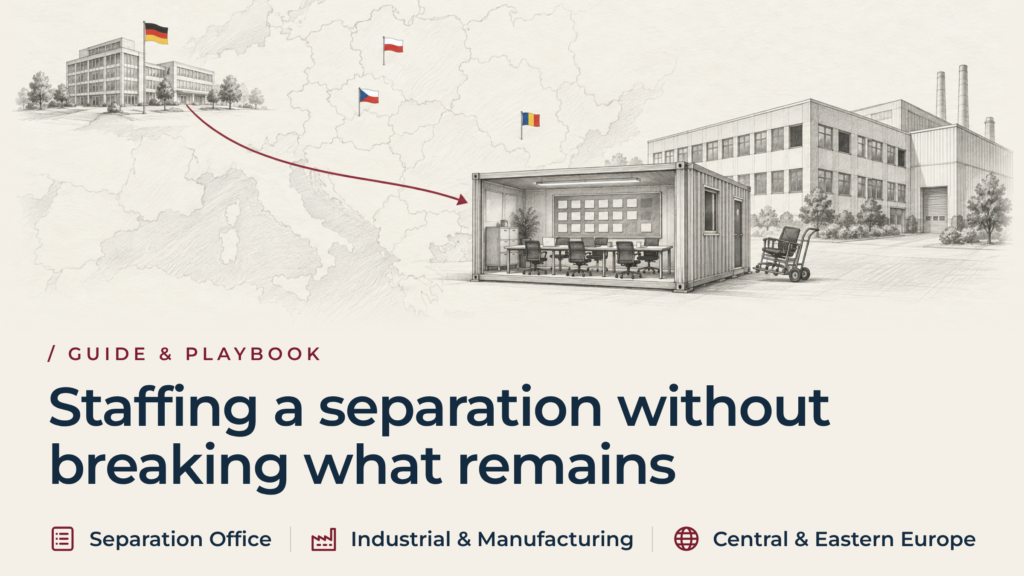
A divestment needs the people the retained business relies on. How a separation management office settles each seat: second, backfill, or resource from outside.
Zetor Brno Production Transfer: Managing Cross-Border Manufacturing Without Losing Engineering Control
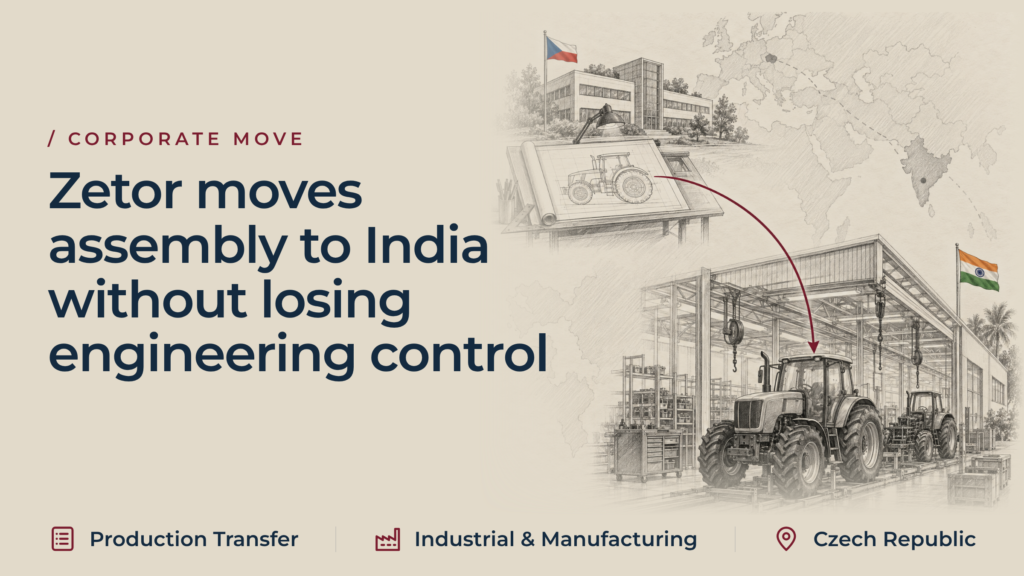
Zetor’s production transfer from Brno to India tests whether a tractor brand can protect quality and control while assembly moves abroad.
Keeping CEE Plants Running Through a Cross-Border Carve-Out
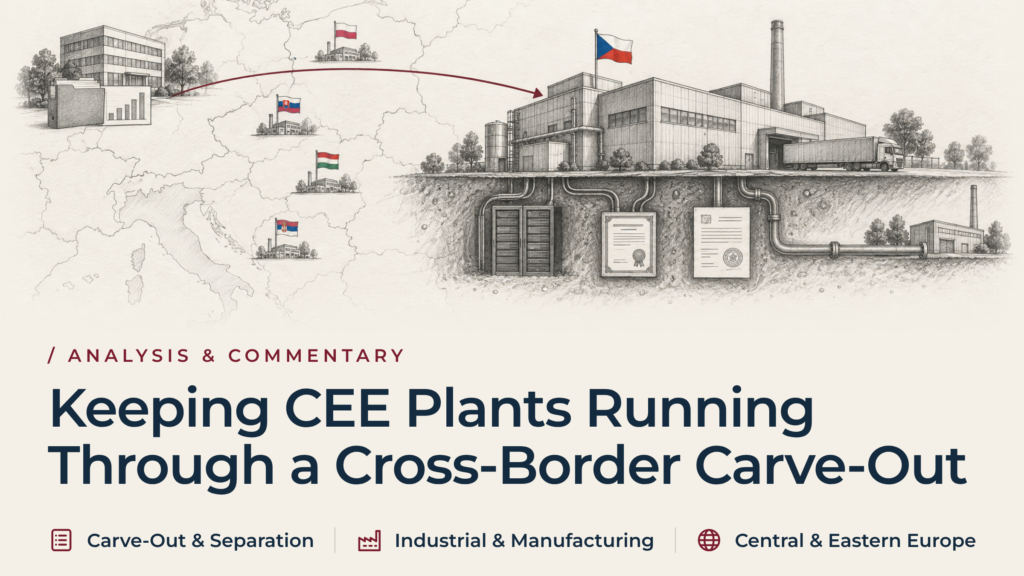
A cross-border carve-out moves a CEE plant’s ownership, not its dependencies. What group reporting misses, what fails first, and who should run the site.
Nestlé’s Diósgyőr Production Exit: Key Insights for Protecting Plant Value and Workforce Retention

Nestlé’s Diósgyőr production exit shows how to protect a plant’s certifications, staff and delivery record while a buyer is found.
When production moves into a CEE plant, the receiving site becomes the real risk
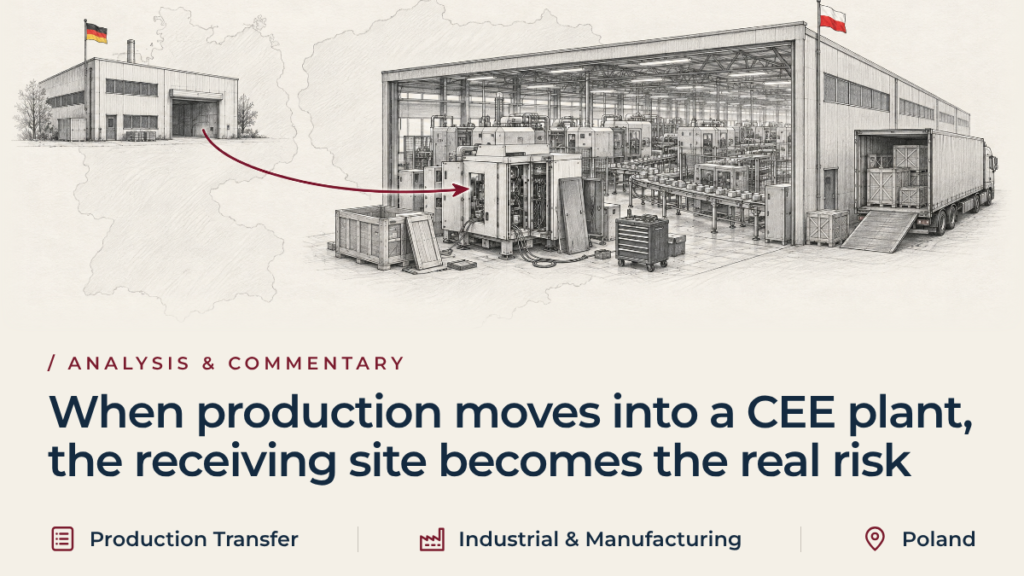
In brief A production transfer CEE plant ramp-up succeeds or fails at the receiving site, not at the plant that is closing. Relocating manufacturing into Central and Eastern Europe shifts real risk. It moves from the departing facility to the plant that receives the lines. The receiving subsidiary absorbs unfamiliar machinery, recruits scarce technical specialists, and protects existing customer deliveries at the same time. Most receiving plants already run near capacity, and local managers rarely challenge an unrealistic schedule set by headquarters. A safe transfer needs dedicated executive authority on site. That authority separates transfer milestones from daily production. It also audits machine capability honestly and protects stability before customer commitments become irreversible. Inherited transfer deadlines and silent CEE receiving plants Inherited transfer deadlines and silent CEE receiving plants create significant operational risks through several key factors: Nearshoring production to Central Europe: High interest, missing operational roadmaps Nearshoring production to Central Europe highlights a clear gap between strategic intent and execution readiness: Why receiving transferred production in CEE plants carries higher operational risk Executing a cross-border production transfer demands far more than moving machinery across a border, as structural differences between sending and receiving sites drive operational risk: Early warning signs of a failing CEE plant production transfer ramp-up Executive committees rarely receive early warning of transfer distress through standard monthly reporting. Subsidiary dashboards tend to stay green until customer deliveries fail. Leadership can look instead for shop-floor signals that a production transfer CEE plant ramp-up is already in trouble. Any one of these signs justifies treating the production transfer CEE plant ramp-up as already in trouble, not still on track. Executing a successful plant ramp-up leadership intervention Recovering a compromised ramp-up needs clear operational boundaries and dedicated leadership. When a plant absorbs a major transferred programme inside its existing structure, delivery pressure collides with commissioning discipline. Every production transfer CEE plant ramp-up needs this separation from day one. Separating daily plant operations from production transfer governance The primary governance requirement is separation. Incumbent plant leadership should stay focused on current customer orders, safety and baseline productivity. An independent programme authority should own the transfer corridor and provide plant ramp-up leadership on site. This calls for an experienced interim plant manager or a seasoned ramp-up director. That person reports directly to the group operations director or the board. The role carries explicit decision rights over milestones, expenditure and technical acceptance. This is the single most important governance choice in any production transfer CEE plant ramp-up. Four critical operational controls for CEE plant ramp-up leadership A programme authority enforces four controls in any production transfer CEE plant ramp-up. Case study: Stabilising a EUR 45 million production transfer to a CEE plant The following mandate shows what a production transfer CEE plant ramp-up looks like in practice, involving a German Tier 1 powertrain supplier and its receiving plant in Poland. The mandate: Managing an inherited sixteen-week production transfer schedule The group faced escalating manufacturing costs at its domestic facility in Lower Saxony. Its board approved transferring two automated transmission component machining lines and an automated robotic sub-assembly cell. The destination was its subsidiary near Wroclaw, Poland. The programme represented EUR 45 million in annualised customer revenue, supplying critical transmission housings to three German vehicle assembly plants. That scale is what turns an ordinary equipment move into a full production transfer CEE plant ramp-up. Domestic plant closure timelines and social plan deadlines in Germany drove the schedule. Corporate project management set a sixteen-week timeline from German decommissioning to start of production in Poland. On paper the case looked straightforward: modern CNC machinery was moving to an existing facility with lower overheads. In reality, the receiving site in Lower Silesia was already running at 91 per cent capacity utilisation. It carried 7.8 per cent worker absenteeism. It also faced severe regional recruitment constraints, with local unemployment for qualified CNC operators below one per cent. Incumbent Polish plant leadership accepted the sixteen-week deadline without objection, because challenging group leadership carried a career cost. These conditions meant the production transfer CEE plant ramp-up was already at risk before a single truck arrived. Shop-floor realities: Unlabelled tooling, calibration failure, and delivery risk When the transfer began, physical reality overwhelmed the plant. Thirty-two unlabelled flatbed trucks arrived carrying dismantled robotic cells, uncatalogued tooling dies and incomplete PLC wiring documentation. The German lines had relied heavily on undocumented operator adjustments and manual overrides that nobody had recorded in engineering manuals. Once the plant reassembled the lines on the Polish shop floor, they failed basic calibration. This is the moment a production transfer CEE plant ramp-up stops being a plan and becomes a live operational problem. To meet the milestone, local management pulled seven senior maintenance technicians and process engineers off running production lines. Their job was to troubleshoot the incoming equipment. The consequences showed immediately. Preventative maintenance on existing customer lines collapsed. Unscheduled downtime on mature programmes jumped from three per cent to fourteen per cent. Scrap rates on existing customer lines rose to 8.2 per cent. On-time in-full delivery fell to 76 per cent. To keep German OEM assembly lines running, the Polish plant began booking dedicated express road transit. That transit cost EUR 180,000 a month in premium freight. A primary vehicle manufacturer issued a formal red-flag supplier escalation notice. It assessed EUR 45,000 a day in delivery disruption penalties and threatened to cancel the contract entirely. The intervention: Four operational moves to secure plant ramp-up leadership The supervisory board engaged CE Interim. Within 72 hours of completing the mandate brief, an experienced interim Manufacturing Programme Director arrived on site in Lower Silesia. The director assumed full executive authority over the relocation corridor. First, operational ring-fencing. The interim director established absolute governance separation immediately. Daily production lines returned exclusively to the incumbent Polish plant manager. That team focused entirely on existing customer orders, which eliminated scrap and restored basic shop-floor discipline. Second, securing critical sending-plant expertise. The interim executive negotiated financial retention packages in Germany. The
Mondi Brzeźno and Szada Closures: Managing Customer Transfer and Asset Relocation in Packaging Plant Restructuring
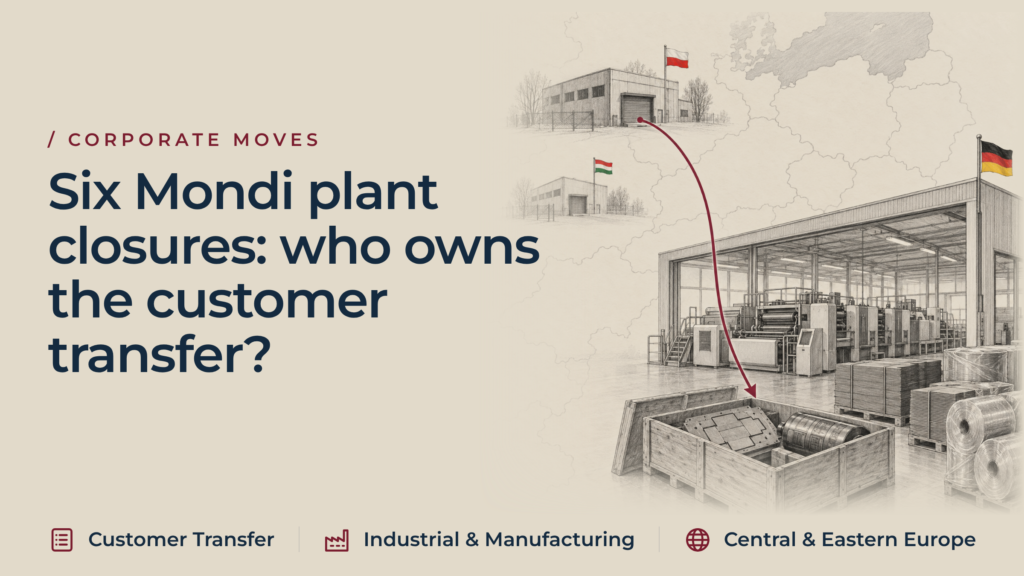
Mondi’s Brzeźno and Szada closures show why customer transfer during a packaging plant closure decides whether the group protects value.
Romania changed wages and taxes. Which changes actually hit your operating case?

In brief Romania changed its statutory wage floor, VAT rate and dividend withholding tax within twelve months. Industrial energy tariffs moved sharply in the same period. Not every change reaches a foreign-owned Romanian subsidiary the same way. The wage floor and energy costs can hit direct payroll and margin. The VAT increase mainly affects domestic sales and working capital timing, not export margin. The dividend tax often does not apply at all to an established EU parent, under the EU Parent-Subsidiary Directive. Four tests establish which changes are real before the board debates closure. Three fiscal shifts in Romania impacting corporate planning cycles When updated projections from a Romanian subsidiary deviate from the annual plan, group finance must evaluate three distinct statutory shifts that landed within a single twelve-month planning cycle: Why group headquarters misreads a Romanian subsidiary’s cost structure Headquarters often misreads a fiscal package by applying a single blended assumption across the business rather than evaluating how individual changes affect specific operations: Four financial tests for evaluating a Romanian subsidiary’s operating case Before any board debates absorbing costs, restructuring or exit, group finance has work to do first. It should run four tests on the Romanian subsidiary, in sequence. Each test uses primary payroll, customs or shareholding records, not a single blended group assumption. Test 1: Assessing the Romanian wage floor increase and pay band compression The government froze the gross minimum wage at RON 4,050 through 30 June 2026. It rises to RON 4,325 from 1 July 2026, under Government Decision 146/2026. This applies to every employer in the country. What varies is how much of the workforce actually sits near that floor. The test is simple. Check what share of headcount earns at or near the floor. Then check how much the new floor compresses the pay bands above it. In a high-volume assembly plant, thirty to forty per cent of headcount may sit on baseline wages. Direct cost then rises immediately. In a precision or electronics plant, entry pay often exceeds RON 5,000 already, so the direct effect stays small. The harder cost is compression. When entry wages rise by decree, technicians and shift supervisors expect a proportional increase too. Grant it, and payroll inflates across the whole structure. Refuse it, and skilled operators leave for local competitors. For a Romanian subsidiary, the wage floor test has to examine the pay structure, not only the headline rate. Test 2: Analyzing the Romania VAT increase on working capital and exports Romania raised standard VAT from 19 to 21 per cent on 1 August 2025, under Law 141/2025. Corporate controllers often fold this straight into margin forecasts. They assume it cuts profitability directly. For an export-focused Romanian subsidiary, that assumption usually does not hold. VAT is a consumption tax that falls on the domestic buyer. The Romanian subsidiary may export finished components to parent assembly lines in Germany, Austria or France, or to European OEMs. Those intra-community supplies carry a zero VAT rate, so the plant does not carry VAT on those sales. Where the increase does bite is domestic procurement, utilities and local contractor invoices. The subsidiary reclaims this later through monthly VAT returns. If the tax authority delays refunds, working capital tightens in the meantime. For an exporting plant, this is a cash-timing problem, not a margin problem, and the two need different responses. Test 3: Evaluating Romanian dividend withholding tax and EU directive exemptions On 1 January 2026, the dividend withholding tax rose from 10 to 16 per cent. Commentators widely reported this as a direct cut to investor returns. For a German, French or Austrian group holding a Romanian subsidiary, the headline rate may not apply at all. This test means checking the shareholding register against the EU Parent-Subsidiary Directive, Council Directive 2011/96/EU. PwC Romania summarises the rule in its statutory guidance. A parent resident in another EU or EEA member state can receive dividends free of withholding tax. The parent must have held at least 10 per cent of the Romanian entity for an uninterrupted year. It also needs valid tax residency certification. A group holding 100 per cent of its Romanian subsidiary for several years keeps an effective rate of zero. The 16 per cent rate reaches private individuals and minority holders below the 10 per cent threshold. It also reaches non-EU structures without a comparable treaty, or entities that have not yet passed the one-year mark. Most groups skip this test on their Romanian subsidiary. They simply assume a six-point cut to repatriated cash, and that assumption is often wrong. Test 4: Measuring industrial energy tariff volatility and technical energy intensity A Romanian industrial manufacturer’s managing director has named volatile electricity tariffs the sharpest pressure on manufacturing competitiveness in 2026. That ranks the tariffs above statutory tax changes. A proposed minimum turnover tax added to the concern. It drew sustained opposition from twelve national employer associations, including the French Chamber of Commerce and Industry in Romania (CCIFER). The test here evaluates a Romanian subsidiary’s technical energy intensity, not a national average. In a foundry, injection-moulding shop or glass line, power can account for twelve to twenty per cent of operating cost. A tariff surge then changes the unit economics directly. In manual assembly or light packaging, energy rarely exceeds three per cent of cost. The same tariff move barely registers there. A single national energy figure hides where the real exposure sits. Key warning signs that a Romanian subsidiary is under financial pressure A board does not need to wait for the annual review to see whether these tests matter. Five signs usually appear first, often in this order. Any one sign on its own is manageable. Two or more together usually mean the Romanian subsidiary needs an independent, on-site review before the board decides anything. First priority for group finance: Establishing verified operational facts Before corporate boards evaluate major strategic choices such as absorbing costs, contract renegotiation, or plant closure, group finance must establish verified operational facts: Deploying
When the CFO says close it and the COO says invest, who breaks the tie?
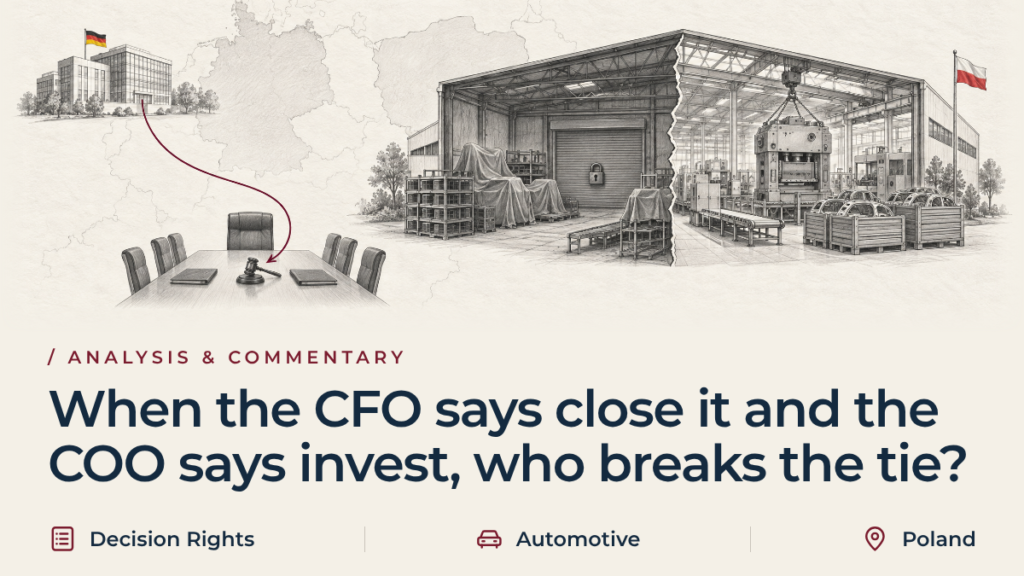
In brief An underperforming foreign plant splits the Group CFO and the Group COO. The CFO wants closure, while the COO wants investment. This is a CFO COO deadlock, and the board is the only body that can break it. Facts alone cannot decide a strategic question, so boards decide. Resolving a CFO COO deadlock therefore takes four steps, always in the same order. First, an independent fact base. Second, a stress test of both cases against cash, customers and recoverability. Third, a single board vote. Finally, an executive placed on site to execute whichever mandate the board approves. A consultancy resolves the analysis, whereas an executive carries the outcome. How four quarters of CFO COO disagreement cause strategic paralysis The asset first reached the board last year, in the third quarter. It then returned in December and resurfaced again in spring. Today it still sits on the same table, largely unchanged. In other words, this is a CFO COO deadlock that returns every quarter without moving. Both positions hold up, and that is the real CFO COO deadlock in its purest form. Deferring the decision is the one choice neither executive has to own personally. Consequently, faced with two credible cases, the board commissions another sensitivity analysis instead of deciding. Deferral then becomes the policy, and it carries a cost every quarter it continues. Cross-border governance: Why distance worsens a CFO COO deadlock On a domestic site, a director can walk the floor in an afternoon and settle the question directly. The cross-border corridor, however, changes this. A German, Austrian, Swiss or French parent may own a plant in Czechia, Poland, Hungary or Romania. Distance limits what headquarters can actually verify, and that is exactly where a CFO COO deadlock takes root. Why CEE wage pressure deepens a CFO COO deadlock Wage pressure across Central and Eastern Europe adds to the CFO COO deadlock. KPMG and the Committee on Eastern European Economic Relations found something clear. Low labour costs alone no longer justify a CEE plant. Technical labour is tightening and wages are rising, so a mediocre operation can no longer hide behind cost arbitrage. When margins compress, the CFO sees a location failure, whereas the COO sees a fixable shortfall. Both readings can hold some truth. That is exactly why the board, rather than either function, has to decide which one governs. 5 key warning signs of a board deadlock in a foreign subsidiary Boards rarely name an impasse directly. Instead, a board deadlock foreign subsidiary shows up through five recurring signs. Each one marks a CFO COO deadlock that has already outlived its usefulness. Once several of these signs appear together, another internal committee will not break the CFO COO deadlock. It only spends cash runway the board still has left to work with. The 4-stage framework to resolve a CFO COO deadlock Resolving who decides plant closure needs a sequence, not a better meeting. Someone must own the facts, and someone must own the execution once the board decides. A consultancy resolves the analysis, whereas an executive carries the outcome. Skipping a step therefore leaves the CFO COO deadlock exactly where it started. ● Stage 1: Establish an independent, verified operational fact base Internal accounts carry each function’s bias, so they cannot settle the dispute alone. An independent executive on site, however, establishes real numbers within weeks. These include true overall equipment effectiveness, actual scrap rates, the real bottleneck, unbundled customer margins, a thirteen-week cash forecast, and verified severance and supplier liabilities. ● Stage 2: Stress-test closure vs. investment cases across core criteria The board then tests four things: cash runway and liquidity depth, customer contractual exposure, operational recoverability, and a net cash-to-close comparison. Boards routinely underestimate closure costs. At the same time, they overestimate turnaround speed. That is why this stage comes before the board accepts either case. ● Stage 3: Hold a decisive board vote on plant closure or turnaround Independent interim executives never make the strategic call to close or invest. Instead, that decision belongs to the board or the investment committee alone. Facts do not decide a CFO COO deadlock. Boards decide it. ● Stage 4: Appoint an interim executive to carry out the board mandate Internal management is rarely the right team to carry out a decision it fought over, so the board appoints instead. An interim CFO fits where reporting was the problem. Where the answer is operational turnaround, an interim COO fits. If cash is the binding constraint, an interim Chief Restructuring Officer fits. For a controlled closure, an interim Managing Director or Plant Manager fits. Meanwhile, a CE Interim Partner stays involved throughout, holding governance and escalation alongside the interim executive, and manages the handover to permanent leadership once the mandate is complete. European manufacturing trends: Rising financial and operational pressure on foreign plants A CFO COO deadlock like this one reaches beyond a single plant. In fact, it is spreading. The CLEPA Data Digest 24, published in January 2026, recorded a stark number. European automotive suppliers announced more than 104,000 job reductions across 2024 and 2025 combined. Energy tariffs, supply chain realignment and price competition drove the cuts. As a result, subsidiaries that once delivered reliable low-cost output are now falling into distress themselves. Each one carries its own CFO COO deadlock waiting to surface. Private equity faces a parallel pressure. European private equity exit volumes fell to 872 transactions in the first half of 2026. That is down from 1,210 transactions a year earlier. The EY Global Private Equity Exit Readiness Study 2026 found a pattern behind those numbers. Sponsors increasingly hold assets that remain operationally viable. Even so, those same assets face trapped liquidity and stalled exits from valuation mismatches. An operating partner therefore cannot afford an open-ended CFO COO deadlock inside a holding period like that. Protecting enterprise value needs a decisive intervention rather than another quarter of analysis. Case study: How a Tier 1 automotive supplier resolved a 9-month CFO COO deadlock
When German headquarters cut costs, the Czech subsidiary is not in the same market
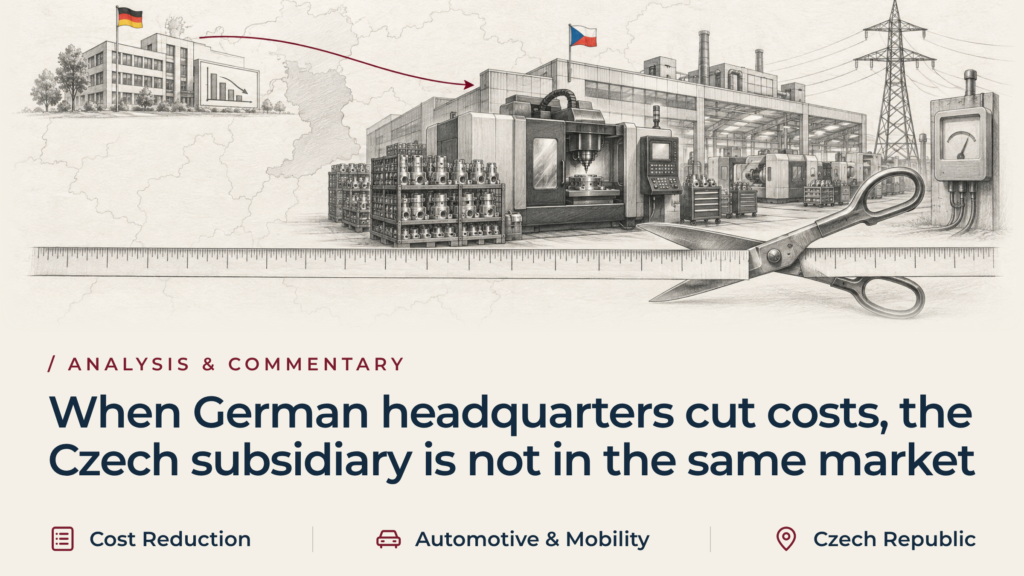
In brief When a German parent group launches a cost reduction programme, corporate finance often sets one savings target. It then applies that target to every foreign entity, including any Czech subsidiary. That is usually where the mandate fails. Czech industrial sentiment currently sits at a five-year high. German sentiment stays weak, and the two economies are pulling apart. The Czech subsidiary’s real constraint is usually energy and skilled labour, not the wage bill German headquarters wants to control. Testing which parts of a German cost mandate actually fit Czech conditions is a board-level judgement. It is not an administrative rollout. Getting it wrong can turn a savings target into a supply chain crisis within weeks. The trigger: How a German cost target reaches the Czech subsidiary The pattern usually starts in Germany. Margins come under pressure. Overheads rise. The executive committee approves a group wide cost containment mandate. Corporate finance calculates a single savings percentage, often eight to twelve per cent of operating expenditure. It then applies that figure uniformly across every foreign entity. The Czech subsidiary receives its allocated figure inside the monthly reporting pack. The number arrives detached from the plant’s actual operating conditions in Bohemia or Moravia. Nobody at headquarters has recently walked the shop floor. Nobody has reviewed the energy contract or checked the order book against current capacity. This is not carelessness. A parent under pressure at home reasonably wants every part of the group to contribute. The problem starts when that instinct reaches the Czech subsidiary unchecked. Nobody has first tested whether its cost base and market position resemble Germany’s at all. German parent defensive planning meets Czech manufacturing reality Executive committees rarely see this gap in a single report. The two economies are now moving on different paths. In Germany, industrial confidence remains subdued. The DIHK Economic Survey gathers data across roughly 26,000 enterprises. It found that domestic labour costs are the top risk factor for a record 59 per cent of German companies. Research by Strategy& and PwC puts German industrial labour costs at roughly 30 per cent above the European Union average. The DIHK spring survey adds a second data point. Only 23 per cent of German industrial companies plan to raise capital investment in 2026. Corporate leadership in Germany is acting defensively, and a frozen capital budget is one visible result. None of this describes the Czech subsidiary’s own market. Applying German defensive logic to Czech operations risks a basic error. It treats a symptom of the German economy as if it were a Czech one. Why a uniform cost reduction target misreads the Czech subsidiary Czech manufacturing sentiment tells a different story. The AHK Czechia economic survey covers 125 member and other German enterprises. It found that business sentiment on the Czech economy has reached its highest level in five years, with nearly every indicator rising. The managing director of AHK Czechia summarised the shift directly: it no longer holds true that the Czech economy catches pneumonia when Germany catches a cold. DTIHK findings confirm the same signal from a different angle. An eight-year downward investment trend has halted. Renewed industrial modernisation has replaced it. Germany Trade and Invest’s own assessment states plainly that Czechia is decoupling from the German economic cycle. Crucially, Czech plant directors worry about a different risk entirely. In the DTIHK findings, industrial leaders in Czechia rated energy prices and supply as their single biggest risk to competitiveness. Labour costs came second. Volatile power tariffs, the capital cost of automation and a shortage of technical staff constrain the Czech subsidiary. Wages matter far less. A cost programme built around German labour arithmetic targets the wrong constraint. How executive boards recognise cost target mismatches in foreign entities Executive committees rarely spot this divergence through a standard monthly pack. By the time it shows up in the numbers, it has usually already cost the business something. A handful of concrete signs tend to appear first. German updates describe headcount containment and capacity reduction. Reports from the Czech subsidiary ask for extra shifts, machinery overhauls and recruitment instead, to protect existing customer commitments. Margins erode through unscheduled expedites. The plant appears to respect its monthly ceiling on paper. Underneath that, unplanned downtime and premium freight quietly multiply under different budget lines to meet delivery deadlines. Local management stops raising operational constraints with corporate controlling. It concludes headquarters will not adjust the target regardless of what it hears. Skilled technicians, shift supervisors and production engineers start leaving for competitors paying market rates. Customers eventually bypass the local entity altogether. They raise delivery or quality complaints directly with group executives instead. Any one of these signs deserves attention. Two or more appearing together usually means the target and the Czech subsidiary’s real operating conditions have already separated. What a credible cost programme response requires in Czechia Resolving the mismatch starts with an honest fact base, not a renegotiated percentage. The board faces key choices and steps to resolve the mismatch: Where the relationship between parent and local management remains strong, this can stay an internal conversation. Both sides need to trust the data first. Group executives can then visit the plant and examine supplier contracts. They can audit the shop floor and recalibrate the target together with local leadership. Internal resolution becomes harder to sustain under three specific conditions. At that point, an independent executive on site is usually the fastest route back to one shared set of facts. The cross-border corridor bridge: German headquarters, Czech subsidiary, and accountable interim leadership An interim COO or interim managing director gives the Czech subsidiary operational and statutory authority in one place. That executive reports to the same board that set the original target. The interim leader carries no stake in past investment decisions or corporate politics. That independence allows a clear audit of machine availability and a clear view of the true production bottleneck. Supplier terms then get renegotiated against current conditions, not the assumptions behind the original mandate. This
Electrolux Jászberény Plant Closure Operational Execution During an Eight-Month Wind-Down
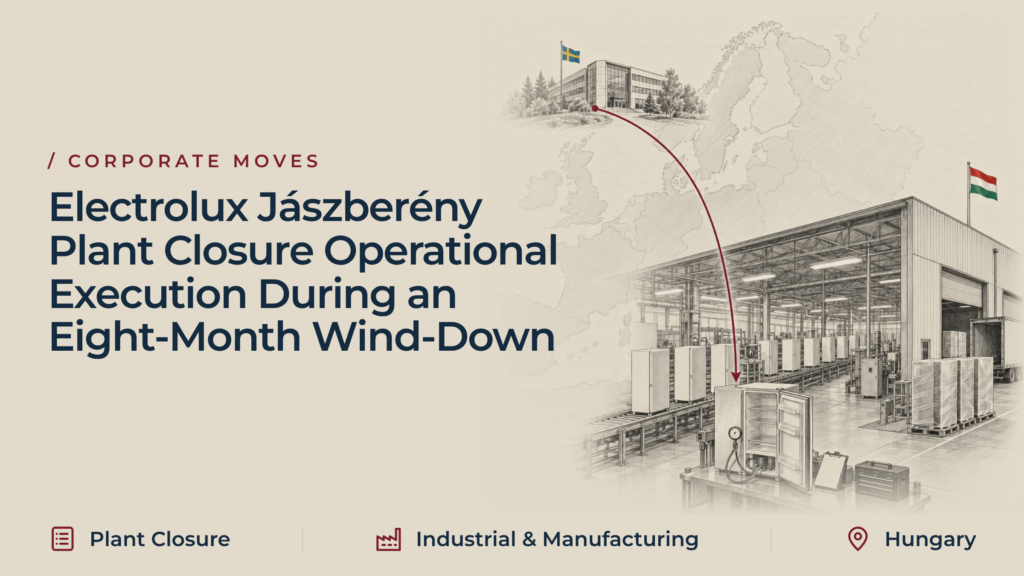
What the Electrolux Jászberény plant closure demands from plant leadership before the final shift ends.
 EN
EN  DE
DE  FR
FR  IT
IT  PL
PL  RO
RO  CS
CS  SK
SK  HU
HU  ES
ES  RU
RU  AR
AR  SL
SL