When a Swiss group loses visibility of its Romanian operation: restoring financial control under pressure

In brief A Swiss group Romanian subsidiary under strain follows a familiar pattern. Margins look healthy on paper. Cash requests keep arriving that those margins should not explain. The Swiss Code of Obligations places a non-delegable duty on the board. It must supervise corporate finance, wherever that finance actually sits. Restoring control starts with an interim CFO taking direct, on-site authority over banking, procurement and reporting. The next step is rebuilding one fact base that the board and local management both trust. How a Swiss group Romanian subsidiary reaches this point For a Swiss industrial group, or a family-owned precision manufacturer, financial visibility rarely fails all at once. It erodes through a pattern that looks manageable one month at a time. The subsidiary’s monthly management pack shows steady gross margins. Production runs to schedule. In the same period, local management asks Zurich or Zug for an unbudgeted treasury advance. The advance covers payroll or value-added tax. Either fact alone looks normal. Together, across several closing cycles, they describe a business the board can no longer see clearly. Swiss boards usually give this the benefit of the doubt, and that instinct is reasonable. Extended supplier credit terms, a slow customer payment, a tax-timing issue: each explanation sounds plausible on its own. Swiss governance culture also favours delegation over remote intervention. The board waits for a clearer picture before it acts. Article 716a keeps ultimate direction and supervision of management with the board. The board cannot delegate this duty. In practice, boards usually meet it through trust in local leadership, not daily involvement in a subsidiary’s finances. Extending that trust for one more quarter is a fair response to a pattern nobody has proven serious yet. The real risk sits in what happens while the board waits. Without functioning financial guardrails on site, a plant can drift. Informal supplier deals appear, and maintenance spending gets deferred. Inventory values can quietly absorb production scrap instead of reporting it. None of this needs bad intent behind it. This is what happens when a subsidiary manages its own financial discipline for too long. Its systems and authority cannot keep up. Navigating two governance systems: Swiss Code of Obligations vs. Romanian statutory reporting A Swiss parent and its Romanian subsidiary sit inside two different governance frameworks. The visibility gap usually starts there. This is a large part of why a Swiss group Romanian subsidiary becomes hard to manage from a distance. Article 716a of the Swiss Code of Obligations does not let the board delegate its duties. Ultimate direction of the company, and supervision of management, stay with the board. This holds true whatever reporting structure sits underneath it. The Romanian subsidiary operates inside a separate, demanding statutory regime. Law 31/1990 and the accounting rules in OMFP 1802/2014 set a mandatory chart of accounts. They also set strict invoice archiving requirements. Local finance teams spend much of their time keeping the entity compliant with the National Agency for Fiscal Administration. Statutory compliance and managerial controlling are related skills. They are not the same skill, though. A team that handles the first will not automatically deliver the second. Key drivers of reporting gaps: ERP systems, currency volatility, and informal authority Technology adds a further layer. Swiss headquarters usually consolidates through a platform such as SAP S/4HANA. The Romanian plant often keeps its statutory books on local software. It bridges the two systems through manually maintained spreadsheets. Currency adds another distortion. Transactions move across Romanian leu, euro and Swiss francs. When the finance team does not consistently maintain hedging and intercompany recharges, a margin can look accurate in the local ledger. It can still mislead the board in the currency it actually manages. Authority gaps tend to close themselves informally, and that is understandable. Someone has to keep the plant running day to day. Without an explicit sign-off structure, local leadership builds its own. Often a plant manager takes personal control of procurement decisions. The result is rarely concealment. A local team is usually solving its own problems with the tools and authority it actually has. Headquarters, meanwhile, keeps managing it through a reporting format built for a level of real-time visibility it no longer has. Warning signs that a foreign manufacturing plant has lost financial visibility Several recurring patterns tell a Swiss owner that the gap has moved from friction to a governance problem. It now needs direct intervention. The clearest signal is a subsidiary that reports acceptable EBITDA. At the same time, operating cash flow stays persistently negative. It repeatedly needs unplanned funding from the parent. A second signal is intercompany reconciliation that will not close cleanly across several periods. Balances build up in suspense accounts instead of resolving. A third signal is local finance answering specific questions with narrative explanations instead of reconciled general ledger data. That usually means the data itself does not yet exist in a trusted form. Finished goods or raw material inventory that looks disproportionate to actual throughput can hide obsolescence or unrecorded scrap. The single clearest test of financial control is simple: can the subsidiary produce a reliable thirteen-week rolling cash forecast? It should reflect real contractual commitments. If it cannot, headquarters is managing the business on trust, not on facts, whatever the monthly pack says. Financial control recovery: Deploying an interim CFO to restore operational oversight A three-day inspection by corporate internal audit produces only a historic snapshot. It does not establish who controls today’s bank transfers. Nor does it stay on site long enough to change how the subsidiary operates. Restoring control needs an executive with authority to act, not a team with authority to report. An interim CFO with cross-border European manufacturing experience takes direct command of local finance, treasury and procurement. The board defines this mandate before the assignment starts. The sequence below matters more than any single action. It is the sequence that restores control in a Swiss group Romanian subsidiary time and again, and each stage depends on the one before it holding.
One version of the truth: restoring visibility between a Romanian plant and Swiss headquarters

In brief When a Swiss parent and its Romanian plant work from different numbers, the issue is rarely dishonesty. Headquarters reads aggregated monthly ERP (enterprise resource planning) output. The plant runs the day on local schedules, informal rework decisions and unrecorded work in progress. Until both work from one verified fact base, the Board cannot price its own risk. Restoring control means establishing the physical facts on site and defining who may decide what. It means appointing an executive with both financial and operational authority. The trigger: operational reporting and cash flow position stop agreeing The situation reaches the Board in a recognisable form. The Romanian subsidiary reports stable output, acceptable delivery and controlled cost. The consolidated cash position says something else. Working capital rises and the plant requests funding again. Nobody at group level can explain the difference from the pack. The instinct is to ask for more reporting, and it is reasonable. More detail is the lever headquarters can pull. But reporting drawn from the same data does not make that data more reliable. Boards move slowly for a second reason. Establishing the real position has consequences, from writing down inventory to restating a signed-off margin. A Group CEO or family owner weighing that step is carrying a real cost, not avoiding an uncomfortable conversation. The calendar sets the timetable, not the discomfort: the year-end count and audit, the next covenant test, the next funding tranche. If due diligence or the year-end auditor discovers the position first, someone else prices it. Both the count and the write-down are easier when the owner picks the date. Why cross-border reporting gaps widen between plants and headquarters Four conditions widen it, each with a legitimate origin. Where group ERP routings do not reflect real setup times, local planners build spreadsheets to run the day. Two records exist, but they rely on only one to decide. When write-off approval sits at group level, the plant sets rejected parts aside for rework that never happens. They stay on the books as work in progress: a process design gap, not local evasion. When the plant measures on-time delivery against its own revised date, both sides measure honestly, yet they measure different things. The International Journal of Quality & Service Sciences identifies this as a recurring pattern in unverified front-line reporting. Distance removes the informal correction a domestic controller applies by walking the floor. Across a border, a video call explains variances, often correctly, but nobody tests them against a bin. This is not a subsidiary concealing its position from an owner. It is two organisations, each behaving reasonably and holding different halves of the same picture. Nothing connects machine-level output to financial performance. Multiple research reports treat that connection as the precondition for managing operational and financial performance. Specific financial reporting challenges in Swiss-Romanian manufacturing Three features make this version harder to close. The Romanian entity keeps statutory accounts under local fiscal rules, alongside the group pack. Two legitimate sets of books exist. Local attention sits with the one a tax authority backs. A Swiss group applies a materiality threshold, but the local finance team may never have heard about it. Balances the plant treats as housekeeping are exactly those that matter at consolidation. Swiss franc (CHF) and Romanian leu (RON) translation absorbs part of the drift in conversion cost before it reaches the consolidated margin. That is one reason unit cost and cash movement can both look defensible. The group can test two of these from Switzerland. One is reconciling statutory inventory valuation against the group pack by category. The other is restating unit conversion cost in RON at constant rates. Materiality needs a conversation with the local controller, not a file. How the Board identifies disconnects in plant performance reporting Headquarters can observe these conditions without an investigation. Where any three of these five persist across two monthly closes, headquarters is responding to a period that has already closed. Steps to establishing one verified fact base across manufacturing sites Starting with the reporting system is the wrong first move. A system built on unverified balances reproduces the same error, faster. The sequence starts with a physical count of raw material, work in progress, finished goods and uncounted rework racks. The team reconciles the count to the general ledger and brings a write-off proposal to the Board within three to four weeks. Restate the last six months of deliveries against customers’ original requested dates. The balance sheet is only half of what the Board is pricing. Presume variance is a design fault until evidence says otherwise. Variance traceable to an unrecorded process is structural. Variance that changes as the team examines it, or that someone amends after a count date, signals irregularity instead. The response then changes: preserve evidence and access, involve advisers, and then speakto the plant. The mandate sponsor, typically the Group CEO or the accountable Board member, makes that switch on evidence, not the executive alone. While the count runs, the plant keeps shipping. The team runs a controlled count by area, not a full stop. It moves funding onto a rolling forecast instead of releasing it against requests. Once the team establishes the position, two definitions matter more than any ERP project. The workstation logs scrap the moment it occurs, not the system at month end. On-time delivery counts against the customer’s original date. Decision rights follow the same logic. The plant records scrap disposal below an agreed value locally the same day. It refers anything above that to the group within a defined response time. Headquarters commits to brief local staff on materiality and respond to escalations within a set time. ERP harmonisation and the permanent finance appointment can wait until this holds. The two non-delegable Board decisions for operational control The trade-off is narrower than it appears. It is not accuracy versus speed. The real choice is whether to accept a visible write-down now, building a fact base every later decision can rely on. The alternative
High-Risk Merchant Account Providers: A CFO’s Checklist

A high-risk merchant account is a liquidity position, not a procurement line item. Reserves, settlement terms and termination rights decide how much cash your business can actually access. Here is how six specialist providers compare, and what boards and CFOs should establish before signing anything.
CBAM Compliance for Manufacturers Is Now a Cash Flow Problem

CBAM compliance manufacturers face a 2026 cost exposure that reaches pricing, provisions and liquidity before certificate purchases begin.
The Private Equity Value Creation Plan Has an Operator Gap

The board pack shows pricing actions, procurement savings, headcount measures, working capital targets and a revised plant footprint. The private equity value creation plan assigns a financial benefit to each initiative, but teams still miss production schedules, inventory continues to rise and customers continue to delay decisions. The problem is not a shortage of analysis. The portfolio company lacks enough operating authority to convert the plan into changed behaviour, changed output and cash. Bain & Company reported in June 2026 that private equity firms held approximately 33,000 unsold portfolio companies, alongside an implied capital cycle and holding period of about seven years. The same report recorded four consecutive years of record-low distributions as a percentage of net asset value through the first half of 2026. A longer hold extends the period during which unfinished operational work consumes cash and management attention. The private equity value creation plan fails when ownership is separated from authority Capital pressure increases the operator gap in PE value creation Invest Europe reported that European private equity and venture capital firms raised €147 billion in 2025 and invested €135 billion. European divestments totalled €45 billion at historical investment cost in 2025, compared with €47 billion in 2024. Fundraising and investment recovered more strongly than realised disposals, leaving sponsors with more assets that must be improved, held or prepared for sale. The operator gap appears in three places Governance volume is a poor proxy for control. More steering meetings can improve visibility while leaving the underlying decision rights unchanged. The operating partner can challenge assumptions and impose milestones, but the company still needs an executive who can direct people, commit expenditure, stop work and accept the operational consequences. The portfolio-company CEO must sequence first 100 days value creation First 100 days value creation begins with subtraction A portfolio-company CEO usually receives more objectives than the organisation can execute at once. Pricing, footprint, procurement, management replacement and working capital reduction often compete for the same finance, engineering and plant resources. First 100 days value creation depends on deciding which constraint must move first and which initiatives must wait. Physical dependencies determine the order A plant cannot reduce labour, install equipment, qualify a new supplier and increase output simultaneously without creating delivery or quality risk. A commercial team cannot change price architecture while account managers remain measured only on volume. The CEO must choose the primary constraint and make the trade-off explicit. CE Interim has examined how post-acquisition CFO gaps destabilise reporting cadence, cash visibility and management alignment during the first 100 days. That finance gap is rarely isolated. It slows decisions across the entire programme. The CFO must prove that EBITDA margin improvement becomes cash EBITDA margin improvement reaches the report before it reaches cash Management can report EBITDA margin improvement before the company receives any cash benefit. Management may recognise procurement savings while old inventory remains on the balance sheet. Overtime, severance or lower output may offset labour reductions. Price increases may improve the income statement while receivables age and customer volumes fall. The CFO must separate the completed financial state from the cash that implementation consumes. Four financial tests support portfolio company operational improvement Measure the recurring profit effect after the company completes implementation. Record the one-time cash cost required to reach that state. Track the working capital effect during the transition. Set the date when the benefit appears in cash and financing headroom. Weekly evidence must connect finance to operations Institutional Limited Partners Association reporting standards shape how fund performance is communicated to investors, but company-level control still depends on weekly operating evidence. The CFO needs a bridge from the investment case to price, volume, mix, labour, material, overhead, inventory and receivables. Monthly EBITDA alone cannot show which physical driver is failing. The COO must convert portfolio company operational improvement into plant decisions Margin targets do not identify the physical constraint A manufacturing plan may assign one value to lower conversion cost, although the underlying causes can include unstable equipment, poor line balance, excessive product complexity, low yield, weak maintenance or an unsuitable footprint. Portfolio company operational improvement starts by identifying which condition limits throughput or absorbs cash. A general productivity programme cannot compensate for the wrong diagnosis. The sequence changes the financial result Reducing headcount before stabilising machine availability can increase overtime and missed deliveries. Renegotiating suppliers before simplifying specifications can preserve avoidable complexity. Closing capacity before transferring process knowledge can move disruption from one site to another. Regulatory work competes for the same management capacity European Commission moved the Carbon Border Adjustment Mechanism into its definitive regime on 1 January 2026, with authorisation, emissions reporting and certificate obligations for importers in covered sectors. The NIS2 Directive, Corporate Sustainability Reporting Directive and Corporate Sustainability Due Diligence Directive create further demands on data, controls and management capacity, even where scope and implementation differ by company. The CHRO must close the PE talent gap before execution capacity fails Experience and capacity are separate tests The PE talent gap is not limited to an unfilled role. It exists when competent leaders have never managed a restructuring, plant closure, integration or cash crisis under a compressed ownership timetable. It also exists when they have relevant experience but no capacity to execute change while keeping the base business stable. External appointments are common, but authority still decides the result Altrata BoardEx reported that external appointments accounted for approximately 70% of current US portfolio-company leadership-team members. Its dataset covered almost 12,000 companies and 55,000 individuals across the United States, Canada, the United Kingdom, Germany and France. It also found that 70% of portfolio-company CEOs had previously served as CEO elsewhere and 93% of CFOs had prior CFO experience. The CHRO must test whether the executive controls the teams and decisions that determine the result. A senior appointment placed inside the old reporting structure can preserve the same delay under a different name. The same test applies below the executive committee, where plant management, controlling, procurement and commercial leadership may
Automotive Supplier Insolvency Starts When the OEM Cancels

Automotive supplier insolvency often begins when an OEM withdraws the programme carrying a plant’s fixed costs. This article explains how lost volume turns into a liquidity crisis, when legal filing duties arise, and how boards must decide whether to restructure, sell or close.
Restructuring & Turnaround in Belgium: Expert Insights

Restructuring in Belgium: silent bankruptcy, CRO-led turnarounds, and how early action preserves value in financial distress.
Restructuring & Turnaround in South Korea: Expert Insights
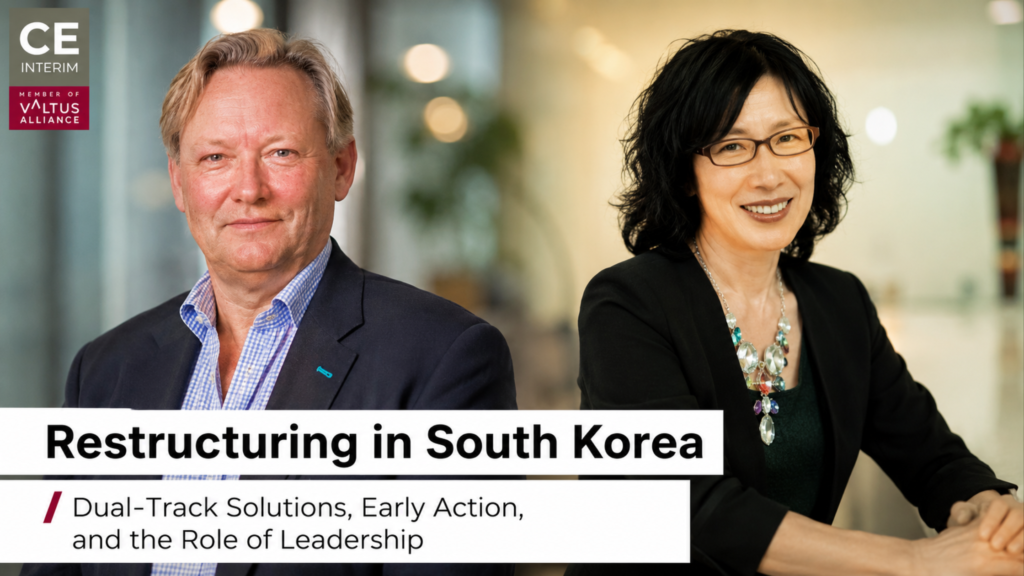
Restructuring in South Korea: workouts, court rehabilitation, and how early action preserves value in corporate crises.v
Interim CFO Leadership During International Expansion

Learn how Interim CFOs support international expansion through financial visibility, governance control, and operational coordination.
Interim CFO Support During ERP and Reporting Recovery

Learn how Interim CFOs stabilize ERP and reporting recovery through governance control, reporting visibility, and operational leadership.