In an environment shaped by global economic pressure, industrial transition, and changing capital markets, South Korea’s restructuring framework has become increasingly important for both domestic and international companies.
At Valtus Alliance, we rely on an international network of restructuring experts, recognising that each country operates within its own legal framework and restructuring culture.
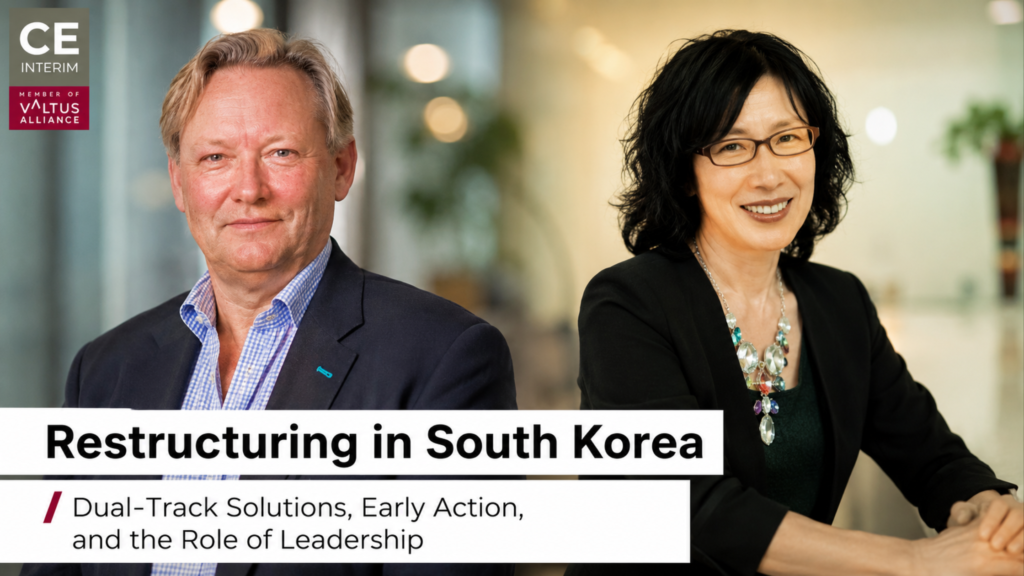
In this interview, KJ Lee (Partner, You & Partners, South Korea) speaks with Wim De Mulder (Partner, VALPEO, Netherlands) about how restructuring works in South Korea — from court-supervised rehabilitation and creditor-led workouts to the growing role of pre-emptive restructuring and interim leadership.
A Dual-Track Restructuring System
Wim
What makes the restructuring framework in South Korea unique?
KJ
South Korea operates with a dual-track restructuring system that combines court-supervised and out-of-court solutions.
The primary formal route is the Court-Supervised Rehabilitation process under the Debtor Rehabilitation and Bankruptcy Act (DRBA). This is often compared to Chapter 11 in the United States and is designed for companies that are financially distressed but still fundamentally viable.
Once proceedings begin, the court can appoint a receiver, often from existing management, and issue stay orders that freeze creditor actions. This creates a protected environment where the company can prepare a rehabilitation plan covering debt restructuring, asset sales, operational restructuring, and workforce measures.
If rehabilitation is not viable, the same framework also governs liquidation and bankruptcy proceedings.
Alongside this formal route, South Korea also relies heavily on creditor-led workout programs under the Corporate Restructuring Promotion Act (CRPA). These out-of-court restructurings are commonly used for large corporations because they are generally faster and less disruptive than formal court proceedings.
For smaller and mid-sized businesses, more informal creditor agreements remain a practical and widely used tool.
Director Responsibility Without a Mandatory Filing Trigger
Wim
Are directors required to file immediately in a liquidity crisis?
KJ
Interestingly, South Korea does not impose a strict mandatory insolvency filing obligation in the way some jurisdictions do.
There is no formal statutory trigger that automatically forces directors to file the moment insolvency appears. However, this does not remove responsibility from management.
Directors still have fiduciary duties to monitor the financial condition of the company and act in its best interest. That means restructuring or insolvency proceedings should be initiated when they become the appropriate course of action.
The environment is therefore more flexible, but also more nuanced. Timing decisions are generally protected under the business judgment rule, provided they are made in good faith and based on proper information.
The Most Common Mistake: Waiting Too Long
Wim
What is the most common mistake companies make early in a crisis?
KJ
The most damaging mistake is delay driven by optimism.
Many companies convince themselves that the problem is temporary when it is actually structural. They treat solvency issues as short-term liquidity challenges and rely on optimistic forecasts or temporary fixes.
This often leads to actions such as delaying supplier payments, selling assets too cheaply, or continuing operations without addressing the underlying business model.
Another common issue is the attempt to protect shareholder equity at all costs. In Korea, where ownership structures are often concentrated, founders and controlling shareholders may resist measures that dilute their position, even when restructuring is necessary to preserve enterprise value.
At the same time, many businesses continue operating as normal instead of immediately focusing on cash preservation and operational stabilisation.
That delay destroys optionality very quickly.
Protective Measures Without a Formal Shield Procedure
Wim
Do protective shield proceedings exist in South Korea?
KJ
Not in the same way they exist in some European systems.
Instead, South Korea relies on the protective mechanisms built into Rehabilitation proceedings under the DRBA. Once a company files, the court can issue preservation and stay orders that effectively function as a protective shield by stopping creditor enforcement actions.
More recently, the Seoul Bankruptcy Court has introduced systems such as pre-autonomous restructuring support (pre-ARS) and hybrid restructuring models. These allow for court-supported negotiations before a formal filing takes place and help reduce the stigma associated with insolvency proceedings.
Employee Protection and Wage Security
Wim
How are employees treated in insolvency situations?
KJ
Employee wages are strongly protected under Korean law.
Claims for wages, retirement allowances, and certain benefits receive high priority under both the Debtor Rehabilitation and Bankruptcy Act and the Labor Standards Act.
A particularly important feature is the government-backed Wage Claim Guarantee System. Through this system, employees can recover a significant portion of unpaid wages and retirement benefits, subject to certain limits.
This creates an important social safety net and helps maintain stability during restructuring situations.
The Homeplus Case: A Modern Korean Restructuring
Wim
Can you describe a significant recent restructuring case?
KJ
One major example is Homeplus, one of South Korea’s largest supermarket chains.
The company faced severe pressure from declining offline retail sales, aggressive e-commerce competition, and a heavy debt burden following a leveraged buyout by MBK Partners.
By early 2025, liquidity pressure became critical and the company entered court-supervised rehabilitation.
What makes the case particularly important is that the restructuring strategy combined financial restructuring with a structured M&A process. Existing equity was effectively wiped out, while the rehabilitation process focused on preserving operational continuity and finding a new investor through a sale process.
The case demonstrates how Korea’s rehabilitation system can be used not only to stabilise a company, but also to facilitate ownership transition under court supervision.
What Foreign Corporations Should Do
Wim
What is the best course of action for a foreign corporation with a Korean subsidiary in crisis?
KJ
The most important principle is simple: act early.
The Korean system works much better before the situation deteriorates into full insolvency. Once suppliers stop shipments, employees go unpaid, and banks downgrade exposure, available options shrink rapidly.
The first step is defining the strategic objective.
Is the subsidiary core to the group’s future strategy and worth defending through restructuring and additional liquidity? Or is it a non-core asset where the objective should be a controlled exit?
In many situations, a creditor-led workout is the best initial path because it is faster and carries less stigma than court proceedings.
If that is not sufficient, court-supervised rehabilitation provides stronger protection and broader restructuring powers.
Even in situations where closure becomes unavoidable, a controlled court-led process is far preferable to a disorderly collapse.
Building a Restructuring Ecosystem
Wim
How does your restructuring network operate locally?
KJ
Pre-emptive restructuring is becoming increasingly important in Korea.
Companies are focusing more on operational restructuring, cost optimisation, and strategic repositioning before a formal crisis emerges.
To support this, we work closely with international advisory firms such as Alvarez & Marsal and AlixPartners, while also leveraging our Valtus Alliance network.
This allows us to deploy experienced interim restructuring leaders — including CROs, turnaround CEOs, and workout-experienced CFOs — at an early stage, where they can have the greatest impact.
Final Perspective
South Korea combines formal restructuring tools with a highly relationship-driven restructuring culture.
Legal frameworks matter, but outcomes are ultimately shaped by timing, stakeholder alignment, and leadership execution under pressure.
Companies that act early retain flexibility.
Those that delay quickly lose control of the process.










 EN
EN  DE
DE  FR
FR  IT
IT  PL
PL  RO
RO  CS
CS  SK
SK  HU
HU  ES
ES  RU
RU  AR
AR  SL
SL