
What UAE investment means for German industrial operations

A German industrial business that has accepted Gulf capital notices the change in its month end close. UAE investment in German industry has moved from announcement into execution. The Federal Government press office confirmed the announcement on 10 September 2026. Both leaders welcomed a UAE investment package of EUR 40 billion in Germany. The figure tells a board nothing about the delivery agenda it has inherited. Three forms of UAE investment in German industry, three delivery agendas The sum is a declaration of intent, not an itemised commitment. The joint declaration reported by WAM records 29 business to business agreements worth more than EUR 9.356 billion, which sit alongside the package rather than inside it. Minister Sultan Ahmed Al Jaber called the sum additional to roughly EUR 34 billion already invested, Handelsblatt reported on 10 September 2026. What matters operationally is the form UAE investment in German industry takes. An acquisition makes controlling integration the first constraint Covestro is the clearest case, and it predates the September package. XRG, the international arm of ADNOC, completed its takeover of Covestro AG on 10 December 2025, with a EUR 1.17 billion capital increase at closing. Emirates Global Aluminium shows a different pattern, expanding a German recycling asset it already owns. In both cases the owner sets the reporting standard, and the German finance function runs two closes. Control also brings a regulatory sequence. A non EU acquirer falls under screening by the Außenwirtschaftsgesetz and Außenwirtschaftsverordnung, administered by the Bundesministerium für Wirtschaft und Energie. Regulation (EU) 2019/452 runs alongside. Merger control sits with the Bundeskartellamt or, under the EU Merger Regulation, the European Commission. The EU Foreign Subsidies Regulation, Regulation (EU) 2022/2560, can attach commitments shaping how the owner runs the asset. Boards read these as closing conditions. They set the operating terms for two years. A minority position moves the question from control to information Minority capital adds a reporting obligation to a company that never carried one. Partners Group announced on 14 July 2025 that a consortium had agreed to acquire Techem of Eschborn, with Mubadala Investment Company joining as a minority investor. Parity co-determination under the Mitbestimmungsgesetz of 1976 applies above 2,000 employees, the Drittelbeteiligungsgesetz between 500 and 1,999. A minority shareholder gains visibility into a supervisory board it cannot reshape, and the load falls on controlling rather than the plant. Project funding makes milestone reporting the operating discipline Project capital is the most demanding of the three, because it carries dates. RWE announced on 6 February 2026 a memorandum with Masdar. Masdar would explore investing by 2030 in existing RWE owned battery storage assets of up to 1 GW in Germany, with a further 1 GW by 2035. That establishes intent, not completion. The pattern holds where the investor is not the counterparty. GlobalFoundries, the US headquartered group in which Mubadala Investment Company holds a large stake, announced on 28 October 2025 a EUR 1.1 billion expansion of its Dresden site, taking it beyond one million wafers a year by the end of 2028, with expected support from the federal government and the Free State of Saxony under the European Chips Act. That is corporate capital, not part of the September package. Public co-funding adds audit and milestone evidence, so the reporting calendar becomes a production constraint, not a finance task. The headquarters to site interface decides German industrial operations after foreign investment Decision rights before reporting formats Distance changes the mechanics, not only the atmosphere. A shareholder committee in the Gulf works a different week, so a Thursday capital question waits for the next one. An investment council used to monthly operating detail meets a controlling function built for a supervisory board that meets quarterly. Neither expectation is unreasonable, and the two pull against each other. That is the trade-off a board is actually managing. Meeting the owner’s information needs quickly tends to slow local decisions, and protecting decision speed leaves the owner uncertain for longer. The board decides how much decision latency it accepts, and for how long. Sequence matters here. Decision rights come first, because formats agreed before authority produce fast figures nobody on site can act on. The capital authorisation path comes second, because a stalled project is the first cost a customer notices. Controlling harmonisation comes last. In German industrial operations after foreign investment that order is often reversed. Past the second quarter it shows in delivery before it shows in the accounts, a pattern CE Interim sets out in its work on post merger integration. Works council timelines set the clock Under section 106 of the Betriebsverfassungsgesetz, a company above 100 employees must inform its economic committee, the Wirtschaftsausschuss, of material commercial change. Any change qualifying as a Betriebsänderung triggers the reconciliation of interests and social plan process under sections 111 to 113. The works council calendar sets the achievable pace of change, not the investment committee paper. An execution readiness check for the first 180 days A board can measure most of this before the first owner close. Three questions establish where a site stands, and each carries a threshold. The decision now in front of the board UAE investment in German industry is not by itself an operational risk. The risk sits in the gap between new governance load and existing management capacity, while the plant holds its delivery commitments. The EUR 10 billion indicated for the Free State of Bavaria has no named recipient, so boards should plan against structures rather than headlines. The choice is narrower than the announcement suggests. A board can carry the new load with its existing team, rebuild finance and operations leadership to hold it permanently, or accept that the site cannot meet the commitments made on its behalf and reopen the question of scope, ownership or closure. Where the gap is specific and time limited, an interim chief financial officer or chief operating officer can hold it, under a written mandate. It sets out who holds the reporting line to the new owner,
Interim CFO in the UAE for Family Offices and Boards

UAE family offices and boards are scaling faster than their finance structures can support. Here is where Interim CFO leadership creates real value.
Defence Localisation and Manufacturing Scale-Up Across the Gulf
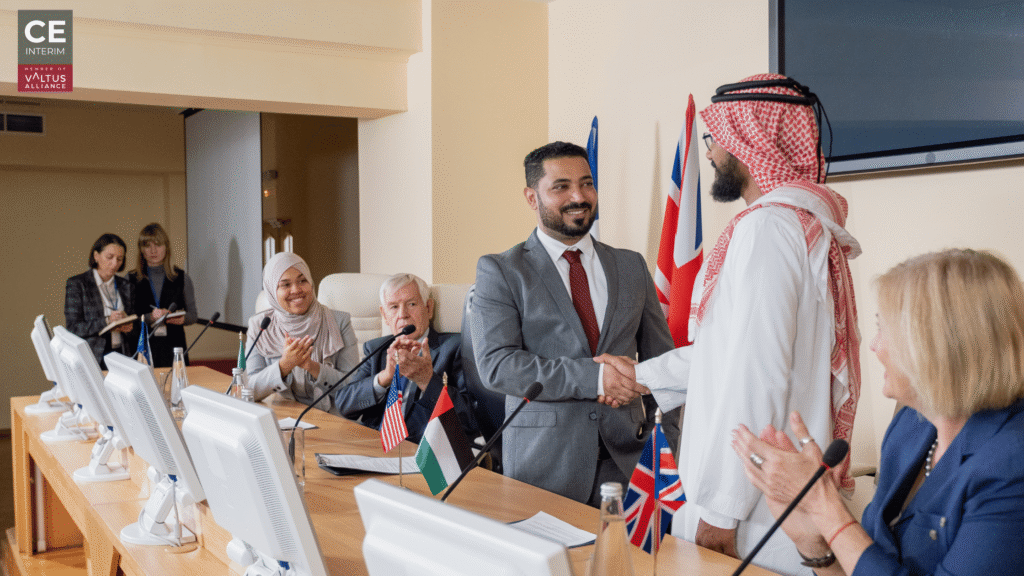
Defence localisation across the Gulf is accelerating. Can Saudi and UAE factories scale suppliers, workforce, and execution fast enough?
Crisis restructuring: Interim Finance Director stabilizes cost control in United Arab Emirates within 90 days
Interim Finance Director Case Study, Cost Control Stabilized in 90 Days
Finance governance: Interim CFO stabilizes statutory closing in 60 days in Dubai
Interim CFO Case Study, Statutory Closing Stabilized in 60 Days
How to Get a Manufacturing License in UAE | Ultimate Guide

Get your Manufacturing License in UAE with fewer delays—real steps, approvals, and site setup tips to reach production fast.
Top Advisory Services for Startups in Dubai | CE Interim

These Advisory Services for Startups in Dubai aren’t your typical playbook—CE Interim offers game-changing strategies built for real results.
Interim vs. Permanent Hiring in Dubai: What’s Better for Growth?

Interim vs. Permanent Hiring—which one fuels business growth in Dubai? Here’s the answer CEOs wish they had sooner.
How to Network in Dubai and Build Lasting Business Relationships

Network in Dubai like a pro—know where to go, what to say, and how to build business relationships that actually last.
How to Find Business Partners & Local Sponsors in Dubai

Finding Local Sponsors in Dubai is easier—if you know where to look. Here’s how to connect with the right partners.
 EN
EN  DE
DE  FR
FR  IT
IT  PL
PL  RO
RO  CS
CS  SK
SK  HU
HU  ES
ES  RU
RU  AR
AR  SL
SL