Turnaround, restructuring or closure: choosing the right future for a Czech site

In brief When a Czech manufacturing subsidiary consistently misses its financial targets, a Swiss owner faces one of three paths: operational turnaround, structural restructuring, or orderly closure. The right choice depends on product competitiveness, unit economics and cash runway, weighed against the statutory obligations of the Czech Labour Code and Insolvency Act. Each path requires a different executive mandate and a different kind of authority on the ground. The risk is not choosing wrongly. It is not choosing at all, and losing the cash and the time needed to choose well. Why Swiss boards delay Czech plant turnaround decisions In boardrooms across Zurich, Basel and Winterthur, an underperforming Czech plant rarely gets discussed with detachment. A Swiss industrial group or private equity owner that invested in acquiring, modernising or expanding a facility in Plzeň, Brno or Liberec has good reason to believe in the original investment case. Reversing that view, in public, in front of colleagues and investors, is genuinely difficult. The instinct to give the site more time is reasonable. One more capital injection, a change in sales leadership, or another quarter for European industrial demand to recover can each look like the responsible, patient choice. Industrial sector analysis from PwC Switzerland on manufacturing restructuring points to a pattern behind that instinct: export weakness and persistent cost inflation can turn a small monthly cash shortfall into a balance-sheet problem before management has fully registered the shift. The difficulty is that delay is not a neutral position. Every month a board postpones a decision between recovery, resizing or closure, the subsidiary consumes liquidity that could otherwise fund severance, customer re-tooling or a controlled wind-down. Left long enough, the choice makes itself: cash reserves run out, and control passes from the Swiss parent to Czech banks, creditors and the insolvency courts. The task for the board is to make the decision while it still has options, not after the options have narrowed to one. Key challenges in Swiss-owned plant turnaround strategies across the corridor Czech manufacturing operations are often technically strong and deeply embedded in European supply chains, which makes the decision more consequential, not simpler. Four structural factors make it harder to call correctly from Zurich. Diagnostic criteria: Operational turnaround, capacity restructuring, or plant closure The diagnostic is not about how bad the numbers look. It is about what is causing them. Four questions, assessed together, point to a different pathway. Diagnostic criterion Operational turnaround Capacity restructuring Orderly closure Market demand and order book Core product demand is strong; backlog exists but is unfulfilled because of plant bottlenecks. Demand has permanently shifted; specific legacy lines are structurally unprofitable. Demand has collapsed or moved to lower-cost geographies; no viable long-term market remains. Operational health Machine breakdowns, weak daily cadence, high scrap, inconsistent shopfloor supervision. Overcapacity; fixed overheads exceed current and forecast volumes by more than 40 per cent. Production technology is obsolete; the capital required to modernise cannot clear the corporate hurdle rate. Unit contribution margins Positive gross margin per unit; losses driven by scrap, overtime and premium freight. Variable margins positive on core lines, negative on secondary lines; overhead absorption is failing. Negative gross margin even at full theoretical capacity; rising input costs cannot be passed to customers. Cash runway Adequate working capital; cash burn can be stopped within 60 to 90 days of shopfloor stabilisation. Three to six months of liquidity to fund severance, lease termination and line consolidation. Liquidity is severely constrained; continuation risks director liability and insolvency under Czech law. When gross margins hold and the order book is intact, the site needs an operational turnaround. When specific lines are obsolete or the footprint no longer matches demand, it needs restructuring. When unit economics are negative and the technology is beyond economic repair, the board is looking at an orderly closure, whether or not it has said so yet. Matching executive authority to the Czech site restructuring mandate The three pathways are not different intensities of the same job. Each requires a distinct mandate, a distinct scope of authority and a different tolerance for risk, and the diagnostic above is what should determine which one the board commissions. Assign authority before the diagnostic is complete and the mandate will be built around an assumption rather than the facts of the site. As McKinsey’s research on turnaround leadership sets out, execution speed and decision authority have to match the stakes of the specific mandate, not a generic interim brief. Assigning the wrong authority to the wrong mandate is one of the more common ways a board loses time it cannot get back: a turnaround specialist without statutory authority cannot execute a closure, and a closure-oriented executive will read every operational problem as terminal, even where recovery is genuinely available. How interim management bridges Zurich headquarters and Czech operations None of the three pathways can be executed from Zurich alone, and none should be left entirely to the local team to interpret on its own. Headquarters needs a reliable, granular fact base: unit costs, scrap data, cash runway, customer risk, expressed in terms the board can act on rather than a monthly summary that arrives too aggregated to be useful. The local operation needs one accountable executive with clearly defined authority, so that plant leadership is not managing a recovery, a restructuring or a wind-down under contradictory instructions from multiple stakeholders at once. CE Interim’s role is to establish that shared fact base and that single line of accountability, then place the executive whose authority matches the mandate the diagnostic actually points to. That means confirming, before mobilisation, which decisions stay with the Swiss board, which move to the interim executive, and what would trigger escalation back to Zurich: for example, unit economics deteriorating past the thresholds set in the mandate brief, or a customer signalling it will invoke a line-stoppage clause. Those triggers are agreed before the executive starts, not improvised once the mandate is under way. Once the mandate is defined, a proven, mandate-matched executive can
Ransomware Attack Manufacturing: Six Weeks to Insolvency

A ransomware attack manufacturing crisis can stop production, drain cash, and force a board to restructure, sell, or close within weeks.
Automotive Supplier Insolvency Starts When the OEM Cancels

Automotive supplier insolvency often begins when an OEM withdraws the programme carrying a plant’s fixed costs. This article explains how lost volume turns into a liquidity crisis, when legal filing duties arise, and how boards must decide whether to restructure, sell or close.
The First 72 Hours After a Hungarian Plant Enters Customer Escalation

The first 72 hours after a customer escalation determine whether the issue stays operational or becomes an enterprise risk. Here is what boards must do first.
Interim Plant Manager, COO, or CEO: Who Should Lead a Hungarian Recovery

A plant recovery fails when authority is smaller than the problem. Learn when a Hungarian operation needs an Interim Plant Manager, COO or CEO.
Restructuring & Turnaround in Belgium: Expert Insights

Restructuring in Belgium: silent bankruptcy, CRO-led turnarounds, and how early action preserves value in financial distress.
Restructuring & Turnaround in South Korea: Expert Insights
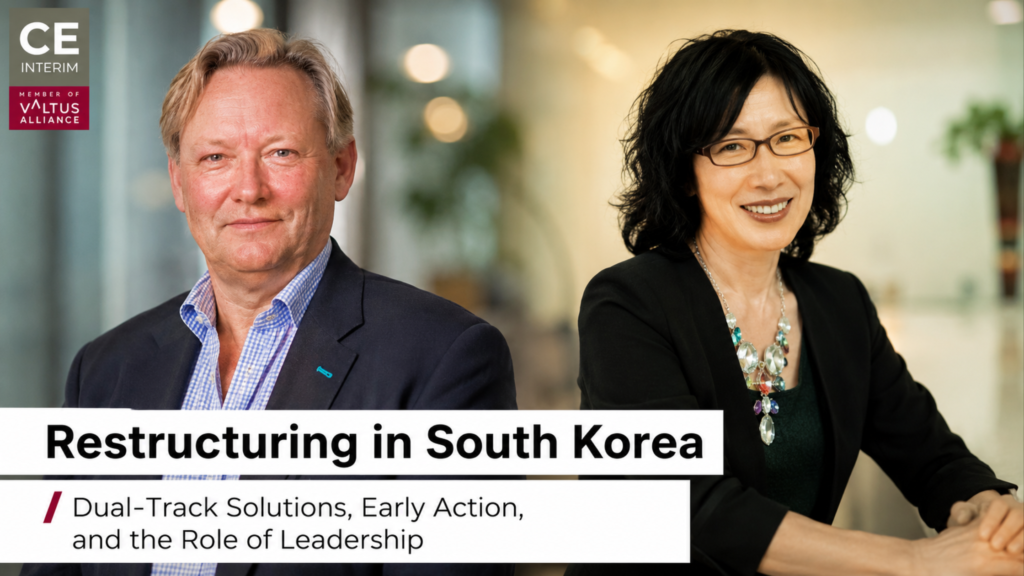
Restructuring in South Korea: workouts, court rehabilitation, and how early action preserves value in corporate crises.v
Interim CFO Support During ERP and Reporting Recovery

Learn how Interim CFOs stabilize ERP and reporting recovery through governance control, reporting visibility, and operational leadership.
Interim CFO Leadership During Corporate Restructuring

Corporate restructuring fails when visibility and cadence collapse before plans are executed. Here is what Interim CFOs actually stabilise and how.
Interim CFO Strategies for Working Capital Stabilization

Working capital pressure starts with operational drift, not a liquidity crisis. Here is how Interim CFOs identify and fix the three specific levers that matter.
 EN
EN  DE
DE  FR
FR  IT
IT  PL
PL  RO
RO  CS
CS  SK
SK  HU
HU  ES
ES  RU
RU  AR
AR  SL
SL