Plant Security During Operational Turnarounds
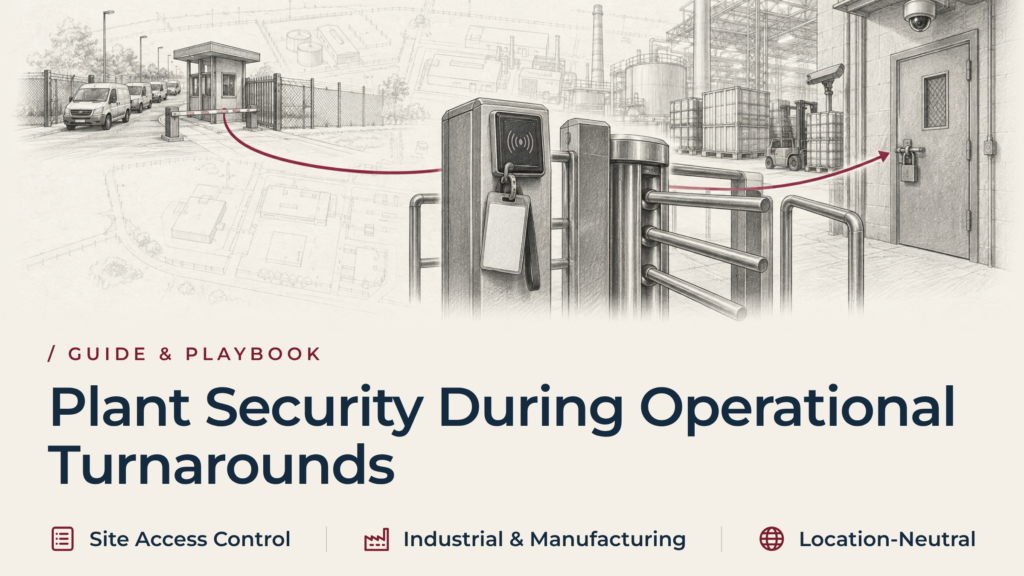
Learn how plant leaders can strengthen security during operational turnarounds by controlling contractor access, restricted areas, credentials and site risks.
When headquarters must intervene: a board checklist for Czech manufacturing operations

In brief When a Czech manufacturing subsidiary keeps missing operational targets, the board’s natural response is to ask for more reporting. It usually means a revised turnaround plan, a weekly cash tracker, another review call. That instinct is understandable. It rarely closes the gap, because more detail from the same reporting line does not change what is happening on the shopfloor. Direct executive intervention becomes the right decision once specific, observable conditions are present, not once patience runs out. This sets out what those conditions are and which executive authority each pattern actually requires. It also covers how quickly that authority can be in place. The operational trigger: why increased reporting fails to resolve plant target misses The pattern arrives at a German board in a familiar form. A plant in Plzeň, Mladá Boleslav or Liberec has been reporting broadly acceptable output for several quarters. Yield keeps drifting and margin keeps contracting. Each quarter brings a revised turnaround plan from local management that has not closed the gap. Asking for more reporting is a reasonable first response. A board can pull several levers without stepping into the plant itself. A weekly cash tracker, a fresh recovery plan, another review call: all cost little to request. Under pressure, that instinct is sound. The difficulty is that reporting drawn from the same operation, at the same level of authority, rarely produces different facts. It produces the same picture in more detail. Timing matters more than it appears to at this stage. Operational turnaround research by McKinsey & Company on decisive executive intervention points to why timing matters. Turnaround situations respond to rapid, decisive executive action within the first thirty days. Every additional month spent reviewing plans while shopfloor scrap continues to rise uses up cash and customer confidence. It also narrows the range of options still open to the board. Cross-border management challenges: oversight limits between German HQ and Czech sites Four conditions make this specific corridor harder to manage than the geography suggests, and each has a reasonable origin. Compliant reporting can still hide operational drift. Czech plant teams typically maintain strong administrative discipline. The monthly pack reaching Stuttgart or Munich is usually complete and correctly formatted. That formal compliance is real, and it is not the same thing as operational visibility. Machines running below rated speed, unlogged micro-stoppages and rework cycles rarely appear in a top-level OEE or scrap figure. Nothing in the reporting template asks for them directly. Proximity does not substitute for shift-level knowledge. A facility in Ústí nad Labem or Plzeň sits only a few hours from Bavaria or Saxony. German executives reasonably read that distance as manageable oversight. A half-day site visit produces a clean tour and a useful conversation with the plant manager. It does not surface what changes between shifts, which is usually where the real variance sits. Legal and information barriers: Czech managing director liability and local knowledge risks Czech corporate law places personal liability on the local managing director. The jednatel carries statutory fiduciary responsibility for the entity, separate from the German parent’s own governance. Headquarters sometimes sets aggressive production targets without releasing the working capital or capital expenditure those targets assume. When that happens, the jednatel’s own legal exposure gives them a direct reason to protect their position. They have less reason to volunteer the full picture upward. That is a predictable response to how authority and liability are split across the border. It is not a sign of bad faith. Long-tenured local teams hold knowledge headquarters cannot easily audit. Supplier pricing history, maintenance records and shift scheduling logic often live in personal relationships built over years. Rarely does that knowledge sit in a shared system. When headquarters requests data, what comes back is a summary filtered through that same local knowledge. No other version of it currently exists to send. Board diagnostic checklist: key warning signs of operational breakdown in foreign subsidiaries These conditions are observable from headquarters, without commissioning a further review: Where two or more of these are present at once, passive governance has reached its limit. Multiple governance research studies on subsidiary oversight and operational systems point to the same conclusion. The decision in front of the board is which executive authority to put on site. It is not whether to request one more report. Executive intervention framework: matching operational patterns to interim leadership roles Intervention does not mean sending a corporate team from Germany for a further review. It means matching the pattern already visible in the conditions above to the specific executive authority it requires. That authority then needs to be on site quickly enough to still change the outcome. Pattern on the ground Executive role required Authority carried Typical duration Shopfloor execution has broken down: scrap above 5%, on-time delivery below 85%, downtime unmanaged Interim Plant Manager Direct authority over shift scheduling, shopfloor discipline, maintenance and quality gates 3 to 6 months Procurement, engineering and production are working against each other Interim COO Cross-departmental authority to realign supply chain, production flow and local engineering 6 to 9 months Cash burn has become a structural risk: negative EBITDA, creditor pressure Interim CRO Statutory managing director (jednatel) authority to restructure the balance sheet, renegotiate terms and resize the footprint 6 to 12 months Board trust in local leadership has been lost and compliance has broken down systemically Interim CEO or Managing Director Full enterprise leadership, direct interface with the group board, works councils, key customers and banks 6 to 12 months Implementation sequencing: deploying statutory authority for rapid plant turnaround Matching the pattern to the role is only the first decision. The second is sequencing. A Plant Manager mandate that later needs CRO-level authority to renegotiate supplier terms costs weeks in escalation and remobilisation. That is why the diagnostic above should be run honestly rather than optimistically. Run it honestly at the point the board decides what to commission. McKinsey & Company research on transformation in distributed operations makes a related point. Interventions that work
Defence Supply Chain Bottlenecks Start Below Tier One

Defence supply chain bottlenecks now sit below primes, where capacity, qualification, localisation and working capital restrict output.
CBAM Compliance for Manufacturers Is Now a Cash Flow Problem

CBAM compliance manufacturers face a 2026 cost exposure that reaches pricing, provisions and liquidity before certificate purchases begin.
Ransomware Attack Manufacturing: Six Weeks to Insolvency

A ransomware attack manufacturing crisis can stop production, drain cash, and force a board to restructure, sell, or close within weeks.
Europe Manufacturing Outlook 2026: Restocking, Not Demand

European manufacturing outlook 2026 suggests factories are seeing industrial restocking before genuine demand recovery. Learn what that means for capacity planning.
The First 72 Hours After a Hungarian Plant Enters Customer Escalation

The first 72 hours after a customer escalation determine whether the issue stays operational or becomes an enterprise risk. Here is what boards must do first.
Interim Plant Manager, COO, or CEO: Who Should Lead a Hungarian Recovery

A plant recovery fails when authority is smaller than the problem. Learn when a Hungarian operation needs an Interim Plant Manager, COO or CEO.
Operational Underperformance Or Structural Crisis? A Board-Level Diagnostic for Hungarian Manufacturing

Not every operational problem is a structural crisis. Learn the board-level diagnostic that helps distinguish temporary underperformance from governance failure.
Why recovery plans fail in German-owned Hungarian plants

When recovery plans keep being rewritten instead of delivered, the problem is rarely the plan itself. Discover why mandate-driven execution changes the outcome.
 EN
EN  DE
DE  FR
FR  IT
IT  PL
PL  RO
RO  CS
CS  SK
SK  HU
HU  ES
ES  RU
RU  AR
AR  SL
SL