
In brief
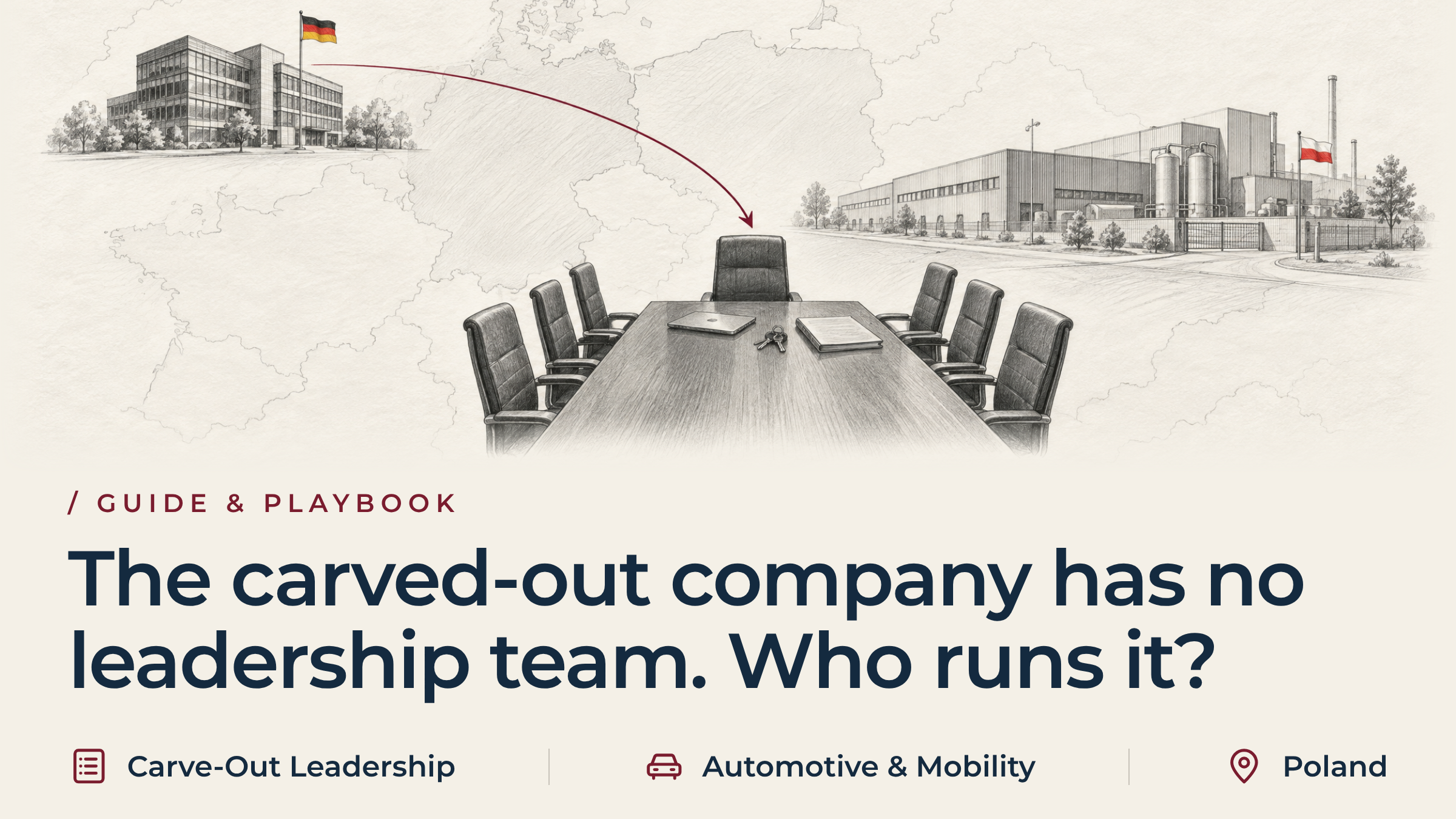
A carve-out leadership gap appears the moment a divested business completes. The new entity often lacks the finance and technology leadership it needs to run alone. The parties have signed the share purchase agreement. The entity has legally separated. But nobody on site has built a standalone treasury before, negotiated independent software licences, or signed off a statutory audit. The buyer faces one decision. Place a proven executive into the carve-out leadership gap now. Or wait months for a permanent hire, while the transition services agreement clock keeps running.
Why Completion Triggers an Immediate Carve-Out Leadership Gap
The deal completed last month. Ownership has transferred. Closing funds have settled. The transition services agreement has taken effect, and the new entity is trading.
Inside the business, the picture looks different. The company manufactures and ships orders every day. But it has no executive architecture of its own, and no formal decision rights. For years, the division relied on the parent’s treasury, statutory accounting, tax compliance, enterprise IT and supplier contracts. When the sale closed, those capabilities stayed with the seller.
This is the carve-out leadership gap. Committed plant managers and sales leads remain in place. Nobody has built a standalone finance function before. Nobody has carried statutory authority before. Standalone entity leadership needs both, and neither arrives automatically with a signed share purchase agreement.
Boards often hesitate to name the carve-out leadership gap directly. It can feel unfair to challenge divisional leaders who performed well through due diligence. Sponsors hope the division head will grow naturally into a chief executive role. They hope seller-provided services will bridge the distance until a permanent search concludes. Meanwhile, the transition agreement clock keeps running, whether anyone owns the carve-out leadership gap or not.
Key Operational Signs of an Unresolved Carve-Out Leadership Gap
The carve-out leadership gap rarely announces itself in a board pack. It shows up first in daily operations, usually inside sixty days of completion, through several key operational signs:
- Lack of month-end ownership: Local controllers know how to feed numbers into the former parent’s consolidation software, but nobody owns standalone balance sheet integrity or statutory reconciliation.
- Routine decision escalation: Credit terms, minor IT purchases, and small capital requests reach the board because nobody ever agreed a local approval matrix.
- TSA drift into permanence: Teams start treating transition services agreements as ongoing outsourcing rather than a costly, time-limited bridge with scheduled extension premiums.
- Banking stalls: The former parent’s guarantees still entangle local bank mandates, preventing teams from opening accounts or clearing payment runs independently.
Once two or three of these signs appear together, the business is already inside the risk window. The carve-out leadership gap has already taken hold.
Financial and Operational Costs of Unfilled Standalone Entity Leadership
Every week without an owner for the carve-out leadership gap has a measurable impact across multiple areas of the business:
- Uncontrolled cash burn: Cash burn continues without a reliable forecast, forcing the board to approve spending on instinct rather than verified numbers.
- Erosion of supplier trust: Suppliers that cannot verify or confirm purchase order sign-offs demand cash in advance, stripping working capital from the business.
- Deteriorating customer confidence: Delivery delays caused by stalled banking mandates or unresolved IT migrations quickly impact key customer accounts.
- Compromised board credibility: As the leadership gap remains open, the case for the deal’s original investment thesis progressively weakens.
Cross-Border Challenges in Managing Carve-Out Leadership Gaps
The carve-out leadership gap becomes sharper once the operation sits across a border from its new owner. Sponsor deal teams and operating partners typically sit in London, Frankfurt, Munich or Paris. The plant sits in Poland, Czechia, Hungary or Romania.
An operating partner in Frankfurt cannot run daily cash reconciliation from a distance. Local tax filing needs continuous presence. Local compliance needs familiarity with national reporting rules and regular contact with works councils.
Inherited managers are used to executing group instructions, not setting policy for a standalone company. Under the old ownership, a problem in Ostrava escalated to headquarters in Stuttgart. Today it lands directly on the sponsor’s desk.
An operating partner covering six portfolio companies cannot also sit inside a Polish plant. Closing the carve-out leadership gap in finance or IT needs someone in the building, not on a call. Without a dedicated executive on the ground, the business drifts rather than stabilises.
Strategic Interventions and Interim Carve-Out Director Roles
Closing a carve-out leadership gap needs targeted placement, not a wholesale change of management. Effective carve-out management separates two jobs. Stabilise the business now. Appoint permanent leadership for the long term.
First, place a proven executive directly into the function that is missing, often as an interim carve-out director or interim chief financial officer. Most often, that function is finance or technology. This closes the carve-out leadership gap where it actually sits, and restores cash visibility and clear decision rights. It does this without disturbing production or customer delivery.
Second, run permanent search in parallel with the interim appointment, never after it. An interim executive buys the board time. The board can then run an unhurried search. It can find a chief executive or chief financial officer who fits the business over five years. It avoids a compromised hire made under expiring transition-service deadlines.
The mandate needs clear boundaries. The board delegates authority to renegotiate vendor terms, recruit local controllers and manage the transition agreement exit. Statutory authority and major capital approvals stay with the board throughout.
Aligning TSA Deadlines with Executive Search Timelines
The case for immediate placement rests on two timelines that do not fit together. Transition services agreements in European divestitures typically run six to twelve months before steep extension penalties apply. Executive search for a permanent finance director or technology lead takes around four months from decision to desk. Add typical European notice periods of three to six months, and the timeline stretches towards nine months.
Waiting for a permanent hire means running most of the transition window with nobody accountable for the carve-out leadership gap. Bain & Company’s Global Private Equity Report 2025 links early, decisive leadership intervention to the gap between top-quartile and underperforming carve-outs. Buyout multiples on invested capital have fallen to roughly 1.5x from a historical 3.0x in recent vintages. That shift raises the cost of a slow start.
Roland Berger surveyed nearly 400 transaction specialists across DACH, France, the UK and the US. More than a third of carve-outs missed cost, schedule or quality targets. Inexperienced separation leadership and unrealistic planning drove most of that shortfall. Boston Consulting Group puts one-time separation costs at 1 to 5 per cent of divested revenue. That figure rises to 13 per cent once complex, multi-country deals delay disentanglement. McKinsey & Company identifies operational execution as the factor that most affects a carve-out’s outcome. Dedicated leadership on site drives talent retention and supply chain readiness.
Case Study: Resolving a Cross-Border Carve-Out Leadership Gap in 9 Months
The mandate: a carve-out without standalone finance leadership
A mid-market private equity fund acquired a commercial vehicle lighting and sensor division from a German industrial parent. The carved-out entity generated EUR 65 million in annual revenue. It ran two sites. A manufacturing plant in Lower Silesia, Poland, employed 460 production workers. An engineering centre in Brno, Czechia, employed 85 technical specialists.
The deal carried a strict nine-month transition services agreement. It covered group accounting, treasury, IT hosting and procurement. The sponsor’s deal team assumed the Polish plant general manager and local controller could hold the business together. They expected a search firm to find a permanent standalone chief financial officer in time. That assumption is exactly where the carve-out leadership gap took hold. The same assumption opens a carve-out leadership gap in most cross-border deals of this size.
Where the operating model broke down
By day forty-five, the leadership gap was visible across several critical functional areas:
- Absence of standalone reporting: The local finance team had only submitted trial balances previously and lacked experience preparing independent balance sheets or local statutory tax filings.
- Delayed close and cash blindness: The first month-end close ran twenty-three days late, leaving the board without visibility over weekly cash burn.
- Frozen banking and supplier friction: Entangled bank mandates caused local banks to freeze payments, prompting component suppliers to issue breach notices and demand letters of credit.
- Stalled executive recruitment: The search for a permanent CFO stalled after candidates withdrew due to lengthy notice periods while the TSA clock ticked down.
Deploying an interim carve-out CFO within 72 hours
The operating partner engaged CE Interim once the business showed clear signs of drifting into paralysis. Within 72 hours of the completed mandate brief, a mandate-matched interim chief financial officer arrived on site in Lower Silesia. The executive carried full authority over financial and administrative separation.
The executive took four actions. First, the executive agreed independent credit facilities with two Polish regional banks, backed by audited working capital data. Disbursement resumed within twelve days. Second, a bilingual senior accountant took over ledger closing. That freed the plant controller to focus on product costing and manufacturing variance. Third, the executive audited corporate IT services and carved local reporting into an independent cloud ERP environment within four months. Fourth, the interim CFO worked with the search committee to define the standalone capability the permanent hire would need. The executive also ran technical interviews for the role.
Early exit and a structured handover
Within ninety days, the business produced its first on-time standalone monthly report. The team had fully established independent banking, treasury and statutory accounting by month four.
By month seven, two months ahead of the contractual deadline, the transition services agreement ended completely. The early exit saved EUR 450,000 in scheduled extension premiums. It avoided disputes with the former parent. When the permanent CFO arrived in month eight, they inherited an audited, functioning finance organisation with an established reporting rhythm. They did not inherit the carve-out leadership gap the sponsor had once assumed would close itself.
Frequently Asked Questions About Carve-Out Leadership
How quickly can an interim carve-out executive start on site?
A proven, mandate-matched executive can start on site within 72 hours of a completed mandate brief. Rapid deployment halts operational drift. It also keeps transition services agreement milestones on schedule.
Should a buyer appoint an interim executive or wait for a permanent search?
Run both tracks together. An interim appointment closes the carve-out leadership gap immediately, stabilising cash, governance and technology separation. It also gives the board time to run an unhurried permanent search rather than a rushed one.
Who does the interim carve-out executive report to?
The interim executive reports directly to the board or the private equity deal partner. That line bypasses the former parent’s hierarchy. It keeps accountability focused squarely on standalone separation.
What happens when the permanent executive arrives?
The interim executive runs a structured handover. Banking, reporting and accounting are already in place by then. The permanent appointee inherits a working business, not an unresolved carve-out leadership gap.
What if the inherited divisional managers are capable?
Capable managers should stay in the roles they know well. Running a division inside a parent and building a standalone company are different jobs. That difference is exactly what creates the carve-out leadership gap in the first place. An interim executive absorbs the separation workload, so local managers can concentrate on production and customer relationships.
Where does the operating partner’s own capacity fit into this decision?
Some sponsors already have an operating partner with genuine standalone-build experience. Where that partner can sit inside one business full time, rather than monitor a portfolio, that route works well. It stops being enough in three cases. The partner covers several companies. The gap is functional rather than general. Or the entity sits in a country the deal team does not operate in.
Related knowledge and next step
The decision at completion is simple to state and hard to leave unmade. Appoint now, or run the carve-out leadership gap and hope it closes on its own. Where a sponsor’s own operating partner can sit inside the business full time, that internal route is often right. It stops working in the same three cases. The partner covers several portfolio companies. The missing capability runs deep. Or the entity sits in a market the deal team does not know well.
Related Reading
CE Interim provides cross-border executive leadership for critical business transformations. Where a carve-out leadership gap threatens separation velocity, CE Interim provides a proven, mandate-matched executive ready to start within 72 hours of the completed mandate brief. To discuss an active carve-out situation in confidence, speak with a CE Interim Partner.

 EN
 DE
 FR
 IT
 PL
 RO
 CS
 SK
 HU
 ES
 RU
 AR
 SL