WHY CE INTERIM
Built by operators.
Trusted by boards.
We don't fill roles. We lead missions.
25+
Countries via Valtus Alliance
WHERE WE OPERATE
Interim Executive deployment
across 5 continents.
From Europe to the Gulf to the Americas — senior leaders, deployed locally.
5
Continents & Growing
FOR INTERIM EXECUTIVES
Your next mandate
starts here.
CE Interim connects senior interim executives with high-impact mandates across Europe, Americas & Middle East.
60,000+
Interim Executives in our global network
KNOWLEDGE HUB
Insights from the operators,
not the observers.
Editorial, research and intelligence from executives who've been in the room.
25k+
Monthly readers

When production moves into a CEE plant, the receiving site becomes the real risk

Production transfer CEE plant ramp-up

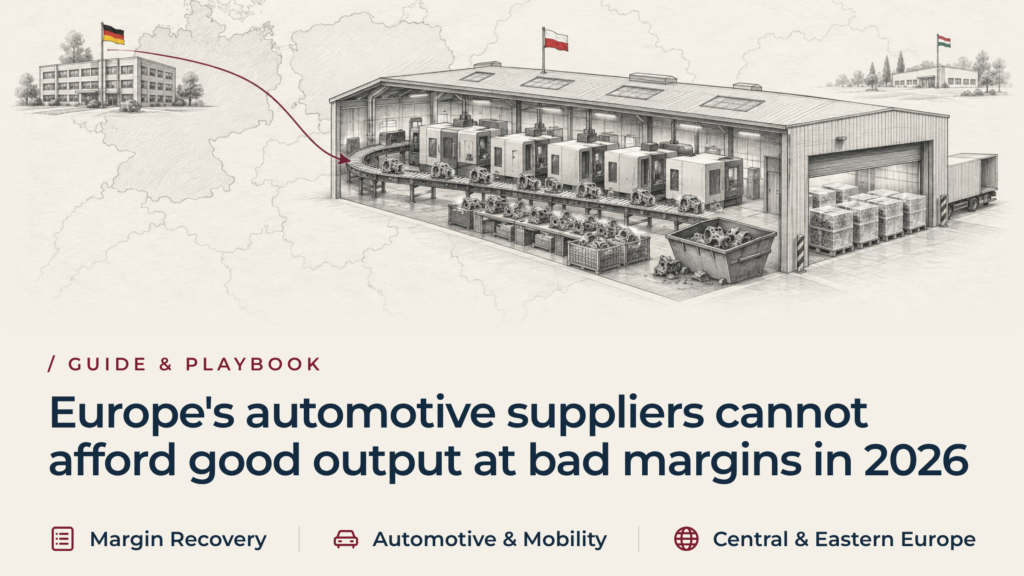
In brief A production transfer CEE plant ramp-up succeeds or fails at the receiving site, not at the plant that is closing. Relocating manufacturing into Central and Eastern Europe shifts real risk. It moves from the departing facility to the plant that receives the lines. The receiving subsidiary absorbs unfamiliar machinery, recruits scarce technical specialists, and protects existing customer deliveries at the same time. Most receiving plants already run near capacity, and local managers rarely challenge an unrealistic schedule set by headquarters. A safe transfer needs dedicated executive authority on site. That authority separates transfer milestones from daily production. It also audits machine capability honestly and protects stability before customer commitments become irreversible. Inherited transfer deadlines and silent CEE receiving plants Inherited transfer deadlines and silent CEE receiving plants create significant operational risks through several key factors: Nearshoring production to Central Europe: High interest, missing operational roadmaps Nearshoring production to Central Europe highlights a clear gap between strategic intent and execution readiness: Why receiving transferred production in CEE plants carries higher operational risk Executing a cross-border production transfer demands far more than moving machinery across a border, as structural differences between sending and receiving sites drive operational risk: Early warning signs of a failing CEE plant production transfer ramp-up Executive committees rarely receive early warning of transfer distress through standard monthly reporting. Subsidiary dashboards tend to stay green until customer deliveries fail. Leadership can look instead for shop-floor signals that a production transfer CEE plant ramp-up is already in trouble. Any one of these signs justifies treating the production transfer CEE plant ramp-up as already in trouble, not still on track. Executing a successful plant ramp-up leadership intervention Recovering a compromised ramp-up needs clear operational boundaries and dedicated leadership. When a plant absorbs a major transferred programme inside its existing structure, delivery pressure collides with commissioning discipline. Every production transfer CEE plant ramp-up needs this separation from day one. Separating daily plant operations from production transfer governance The primary governance requirement is separation. Incumbent plant leadership should stay focused on current customer orders, safety and baseline productivity. An independent programme authority should own the transfer corridor and provide plant ramp-up leadership on site. This calls for an experienced interim plant manager or a seasoned ramp-up director. That person reports directly to the group operations director or the board. The role carries explicit decision rights over milestones, expenditure and technical acceptance. This is the single most important governance choice in any production transfer CEE plant ramp-up. Four critical operational controls for CEE plant ramp-up leadership A programme authority enforces four controls in any production transfer CEE plant ramp-up. Case study: Stabilising a EUR 45 million production transfer to a CEE plant The following mandate shows what a production transfer CEE plant ramp-up looks like in practice, involving a German Tier 1 powertrain supplier and its receiving plant in Poland. The mandate: Managing an inherited sixteen-week production transfer schedule The group faced escalating manufacturing costs at its domestic facility in Lower Saxony. Its board approved transferring two automated transmission component machining lines and an automated robotic sub-assembly cell. The destination was its subsidiary near Wroclaw, Poland. The programme represented EUR 45 million in annualised customer revenue, supplying critical transmission housings to three German vehicle assembly plants. That scale is what turns an ordinary equipment move into a full production transfer CEE plant ramp-up. Domestic plant closure timelines and social plan deadlines in Germany drove the schedule. Corporate project management set a sixteen-week timeline from German decommissioning to start of production in Poland. On paper the case looked straightforward: modern CNC machinery was moving to an existing facility with lower overheads. In reality, the receiving site in Lower Silesia was already running at 91 per cent capacity utilisation. It carried 7.8 per cent worker absenteeism. It also faced severe regional recruitment constraints, with local unemployment for qualified CNC operators below one per cent. Incumbent Polish plant leadership accepted the sixteen-week deadline without objection, because challenging group leadership carried a career cost. These conditions meant the production transfer CEE plant ramp-up was already at risk before a single truck arrived. Shop-floor realities: Unlabelled tooling, calibration failure, and delivery risk When the transfer began, physical reality overwhelmed the plant. Thirty-two unlabelled flatbed trucks arrived carrying dismantled robotic cells, uncatalogued tooling dies and incomplete PLC wiring documentation. The German lines had relied heavily on undocumented operator adjustments and manual overrides that nobody had recorded in engineering manuals. Once the plant reassembled the lines on the Polish shop floor, they failed basic calibration. This is the moment a production transfer CEE plant ramp-up stops being a plan and becomes a live operational problem. To meet the milestone, local management pulled seven senior maintenance technicians and process engineers off running production lines. Their job was to troubleshoot the incoming equipment. The consequences showed immediately. Preventative maintenance on existing customer lines collapsed. Unscheduled downtime on mature programmes jumped from three per cent to fourteen per cent. Scrap rates on existing customer lines rose to 8.2 per cent. On-time in-full delivery fell to 76 per cent. To keep German OEM assembly lines running, the Polish plant began booking dedicated express road transit. That transit cost EUR 180,000 a month in premium freight. A primary vehicle manufacturer issued a formal red-flag supplier escalation notice. It assessed EUR 45,000 a day in delivery disruption penalties and threatened to cancel the contract entirely. The intervention: Four operational moves to secure plant ramp-up leadership The supervisory board engaged CE Interim. Within 72 hours of completing the mandate brief, an experienced interim Manufacturing Programme Director arrived on site in Lower Silesia. The director assumed full executive authority over the relocation corridor. First, operational ring-fencing. The interim director established absolute governance separation immediately. Daily production lines returned exclusively to the incumbent Polish plant manager. That team focused entirely on existing customer orders, which eliminated scrap and restored basic shop-floor discipline. Second, securing critical sending-plant expertise. The interim executive negotiated financial retention packages in Germany. The

CE INTERIM

Executive Interim Management Platform

I am a..

Client / Company

Hiring interim leadership

Interim Manager

Seeking mandates