

In brief
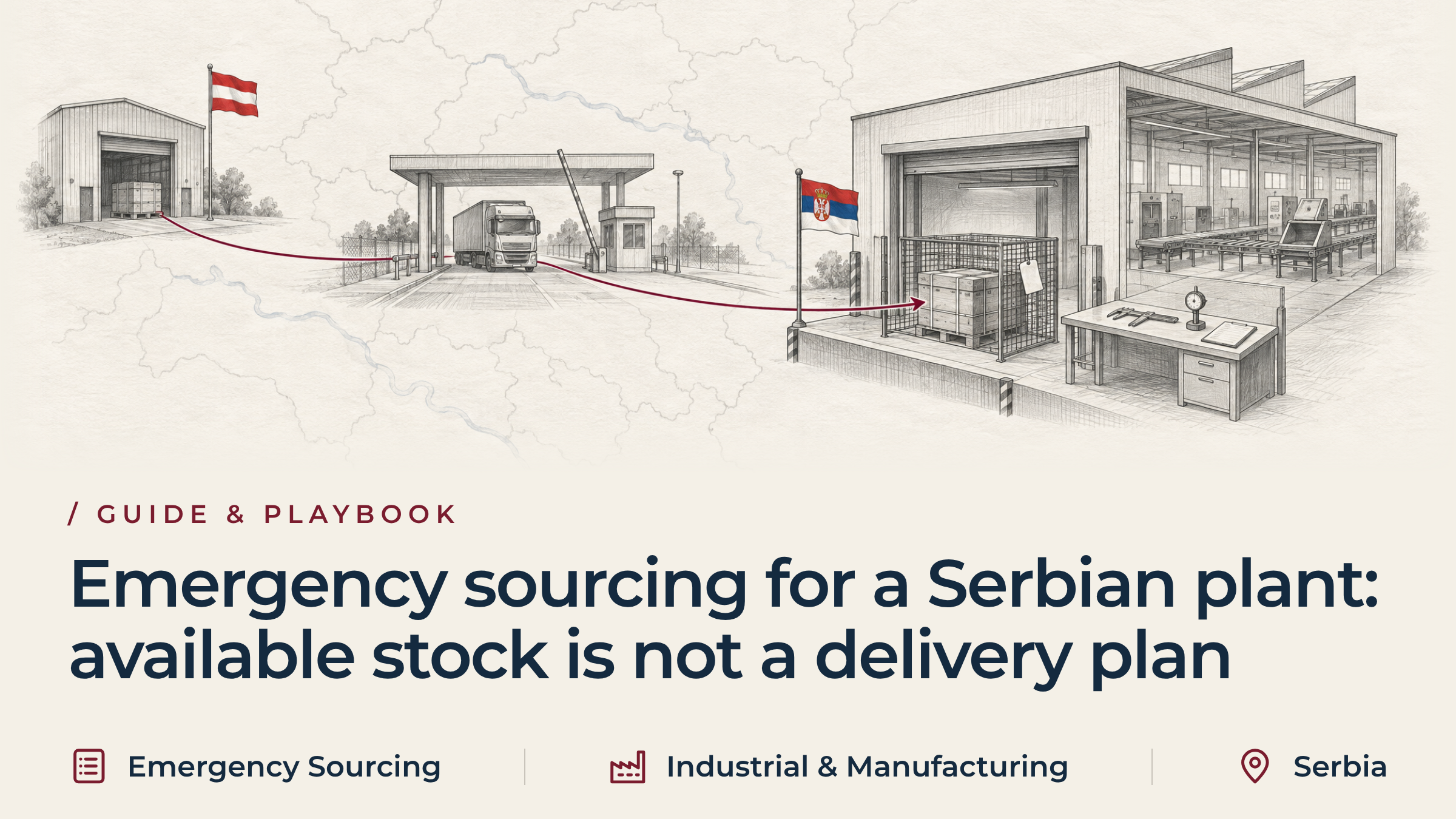
A critical supplier has stopped delivering, and an alternative source outside Serbia confirms it holds stock. In emergency sourcing Serbia situations, that confirms availability and nothing more. Between available stock and a usable part sit release, dispatch, export formalities, transit, clearance and technical release, each with a different owner. The first decision is who owns the route, not which supplier ships.
Signing a purchase order does not create a route
A supplier fails, group procurement finds replacement material in Austria or Germany, and the new supplier confirms stock. Sales then asks the manufacturing operation in Serbia for a revised date. The plant answers from the dispatch estimate, and the commitment now rests on a route nobody has described.
The alternative supplier’s own position deserves attention first. The IWH Halle Institute for Economic Research recorded 4,880 insolvencies of German partnerships and corporations in the third quarter of 2026. That is the second-highest quarterly level since 2005, on a count that excludes the micro-enterprises in the official statistics. In Austria, KSV1870 recorded 5,139 corporate insolvencies in the first three quarters of 2026 and expects around 6,800 for the full year. Thin margins across European automotive suppliers compound the same picture.
What emergency sourcing Serbia requires before the group confirms a date
Before a date leaves the building, the buyer needs the route described milestone by milestone, a named owner for each, and a written list of unconfirmed dependencies. A purchase order and a dispatch estimate cover the first two steps of seven in any emergency sourcing Serbia plan. The other five sit with carriers, customs representatives, the Serbian authorities, and the plant’s own goods-in and quality functions.
Establishing dispatch readiness before cross-border manufacturing supply moves
Who can release the stock
Stock can be physically present and still unavailable. Another customer may hold the allocation, unpaid invoices may block release, or the sales contact may lack authority. Incoterms 2020 then decide who books transport and who carries the formalities: EXW and FCA leave both largely with the buyer, while DAP and DDP move more to the seller. Establish which terms this order carries rather than assuming those used with the failed supplier.
What movement itself requires
Goods leaving the European Union for Serbia need an export declaration through the Automated Export System. They also need pre-departure information under Article 263 of the Union Customs Code, Regulation (EU) No 952/2013, carried there or in an Exit Summary Declaration. Movement under customs supervision then needs a transit declaration in the New Computerised Transit System. That system has moved through its Phase 5 and Phase 6 releases. Someone must act as holder of the transit procedure, and someone must provide the guarantee covering the duties at risk.
Setting the route with specialists, not assumptions
What common transit does and does not establish
Serbia takes part in the common transit procedure established by the Convention of 20 May 1987. It has been a contracting party since 1 February 2016, as the European Commission records. Common transit moves goods under customs supervision from an office of departure to an office of destination, with duties secured rather than paid. It does not clear the goods, grant permission to use them, or set a clearance time for any consignment.
Duty, origin and the Serbian formalities
Trade between the European Union and Serbia runs under the Stabilisation and Association Agreement, signed on 29 April 2008 and in force since 1 September 2013. Preferential treatment depends on the goods meeting the origin rules. The supplier must also produce a EUR.1 movement certificate or an origin declaration under the revised pan-Euro-Mediterranean Convention, in force since 1 January 2025. An emergency supplier outside the normal chain may not hold it, and duty then becomes payable from someone’s budget.
Uprava carina Republike Srbije applies the Carinski zakon and is modernising through the eCarina programme. The Transport Community has extended Green Lanes with CEFTA 2006 and the Regional Cooperation Council, using electronic exchange of pre-arrival data through the CEFTA SEED system. The crossing used, Horgoš to Röszke, Kelebija to Tompa, Batrovci to Bajakovo or Šid to Tovarnik, is a routing decision the plant will feel. None of this gives a consignment priority, and none of it replaces a customs representative confirming the requirements for this product and route. Five points deserve written confirmation before the group revises any customer promise:
- the customs representative in Serbia, and whether Authorised Economic Operator status (AEO-C or AEO-S) applies
- the office of destination, the place of unloading and who presents the goods
- the documentary and product requirements for this commodity and route
- the origin evidence the supplier will issue, and the duty position without it
- who settles import duty and taxes, and from which budget
Replacement supply Serbia becomes usable at goods receipt and technical release
Arrival at the gate is not availability in the plant. Replacement supply Serbia needs a receiving slot, a consignee able to accept the load, a goods receipt booked in the ERP system and stock that planning can see. A consignment arriving outside receiving hours, or against an order line that does not exist, waits in the yard.
Technical release is the harder gate. Material from a source the plant has not used before needs incoming inspection and a documented decision that it may enter production. In automotive environments, approval of a supplier change for production use is a separate process with its own owners. The arrival plan therefore ends at authorised for use, not at received.
Communicating confidence honestly before customer promises change
Most of the damage comes from reporting a single date instead of a position. A better discipline is to place the consignment against a short sequence of states, and to say which rest on evidence rather than expectation. The sequence below is a planning tool rather than a customs procedure, carrying no timing values.
- Available: the stock exists and the supplier has identified it
- Released: authorised to leave, commercially and physically
- Dispatched: collected against a confirmed booking and declaration
- In transit: moving under the agreed procedure
- Cleared where applicable: destination formalities complete
- Received: booked in and visible to planning
- Authorised for use: released by quality for production
Reported this way, headquarters sees which milestones have evidence behind them and which rest on an estimate. The plant never has to defend a date it did not own. Customer commitments then change against confirmed states, not the first optimistic entry in the sourcing plan. The report names anything provisional or blocked, alongside the person who can resolve it.
One arrival plan, one named owner
An internal supply-chain and logistics team can own this work when it has the resources and the support. The test is not capability, but whether anyone holds the route end to end while running the day job. Where purchasing owns the order, the forwarder owns the truck, an adviser owns the declaration and the plant owns the consequences, the route has no owner. That gap is executive rather than administrative.
Where nobody can carry that ownership alongside existing responsibilities, an Interim Supply Chain Director can hold the sequence and the escalation. Each specialist keeps their own responsibility. A customs representative still lodges the declarations, the authorities still decide regulatory acceptance, and quality still decides what enters production. CE Interim, part of Valtus Alliance, works at both ends of a corridor like this one under Partner-led governance. No mandate guarantees passage, and nobody should describe one that way.
The emergency sourcing Serbia decision is narrower than it appears. The group has usually settled whether to buy the replacement material. What remains is whether to confirm a delivery date now, to confirm a narrower commitment covering only the evidenced milestones, or to hold the date until the route has an owner. Two of those are defensible in front of a customer, and a date given on a dispatch estimate is not.
Frequently asked questions
Is available stock the same as a confirmed arrival?
No. Availability means the material exists and the supplier has identified it. A confirmed arrival requires release, a booked movement, export and transit formalities, destination formalities and a goods receipt. In emergency sourcing Serbia work, the distance between those two states is where most missed dates begin.
What does common transit establish, and what does it not?
Common transit moves goods under customs supervision between offices of departure and destination, with a guarantee covering the duties at risk. Serbia has been a contracting party to the 1987 Convention since February 2016. It does not clear the goods on arrival, confirm that the plant may use them, or set a clearance time.
Who should connect dispatch and plant readiness in emergency procurement Serbia?
One named executive on the buyer’s side, with authority to commit the group and standing to hear the truth from every party. That means one owner coordinating supplier, carrier, customs representative, goods-in and quality, reporting a single position to headquarters. Emergency procurement Serbia decisions involve three or four organisations and two countries, so coordination is the job, not an addition to it.
Which assumptions must the team resolve before customer promises change?
The terms governing release, the holder of the transit procedure and the guarantee, the origin evidence and the duty position, the destination formalities for this route, and the plant’s receiving and technical release capacity. Each belongs on the record as confirmed, provisional or blocked, with an owner against it. Cross-border manufacturing supply becomes predictable when that list stops producing surprises.
 EN
 DE
 FR
 IT
 PL
 RO
 CS
 SK
 HU
 ES
 RU
 AR
 SL