

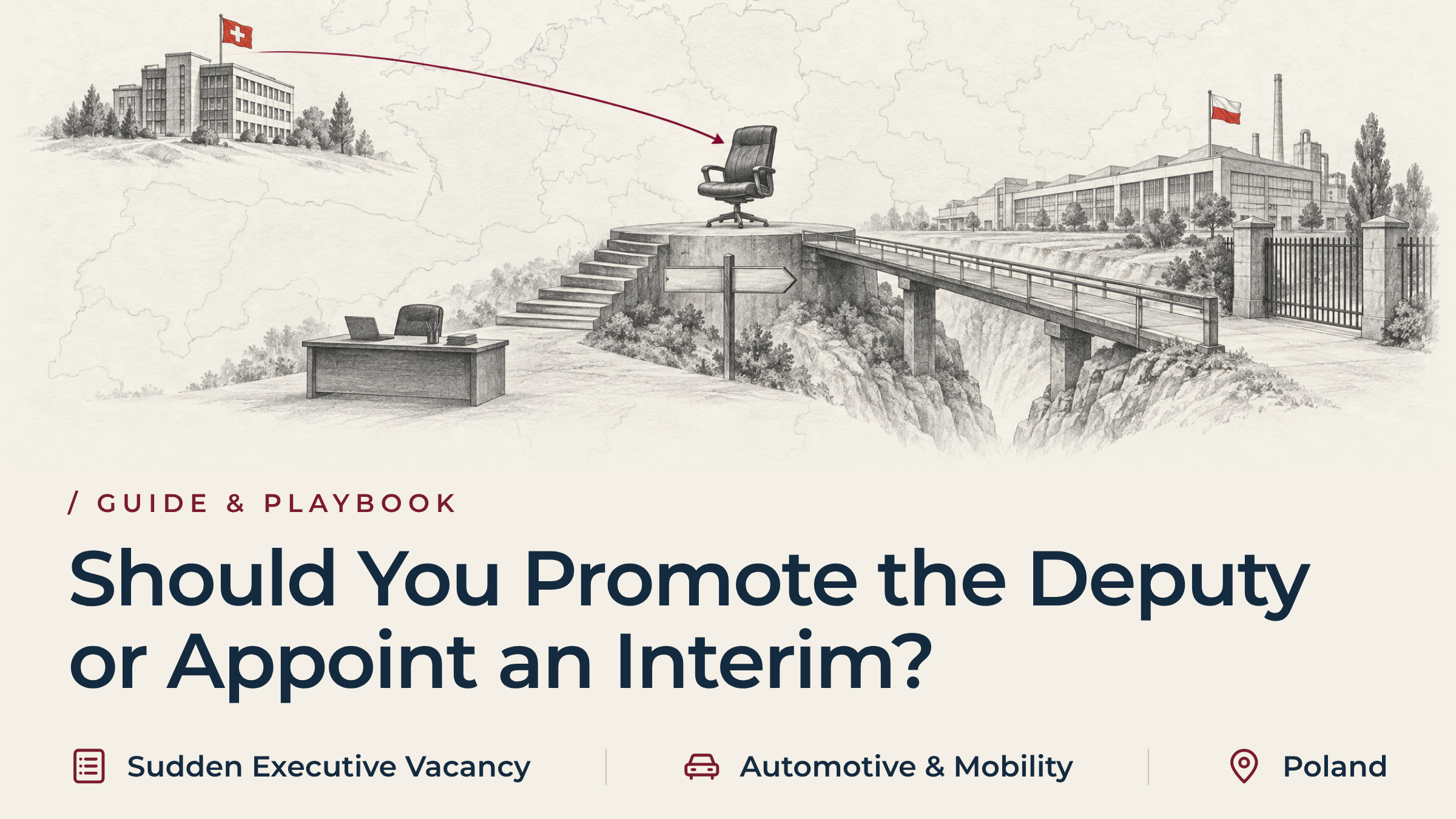
Should you promote the deputy or appoint an interim?
In brief
An internal successor covers most sudden vacancies, and most of the time that is right. Internal promotion protects institutional knowledge. It keeps customers and the workforce steady. It avoids the cost and confidentiality exposure of an external search. The decision breaks down in four situations. The vacancy follows an operational failure the internal successor helped cause. Statutory eligibility abroad rules the candidate out. Two rivals turn succession into politics. Or the board leaves the internal successor in an open acting role for months. Where any of these apply, an independent interim executive gives the board a neutral bridge while it resolves permanent leadership.
The Boardroom Trigger: What Happens on Tuesday Morning
On a Monday afternoon, a managing director resigns, falls ill, or the board removes them. By Tuesday morning, the board needs someone to chair the executive committee.
In most boardrooms, the immediate move is to ask the deputy to step up. The chief operating officer, plant director or finance director becomes acting head. This solves the calendar problem without committing to an external search.
The reflex is even stronger in a cross-border group. A Polish, Czech, Hungarian or Slovak deputy often knows the parent's expectations as well as the plant itself. That makes the calendar problem feel solved before anyone tests whether the deputy is actually ready.
This is often the correct decision. The business is trading soundly and the strategy is clear. The board has already prepared the internal successor for wider responsibility. Promoting from within is then sound governance.
The difficulty starts when the board reaches for internal cover for the wrong reason. Nobody has checked whether the internal successor is ready. Somebody simply has to run Tuesday's meeting. Covering the calendar and leading the business are different problems. An open acting title, with no clarity on authority, term or candidacy, creates a limbo. That limbo slows every decision underneath it.
The Evidence: Internal Succession Is the Corporate Default
Internal promotion is the dominant path in modern corporate governance. The data support the instinct to look inside first.
Korn Ferry's review covered nearly 1,000 companies across EMEA. In eight of ten countries studied, half or more of the 2024 chief executives came from inside the business. The internal successor is now the default choice, not the exception.
The Harvard Law School Forum on Corporate Governance published The Conference Board's 2024 survey of United States listed companies. It found that 59 per cent of new Russell 3000 chief executives were internal promotions. So were 77 per cent of new S&P 500 chief executives. The lesson for a board is not that internal promotion is safe by default. It is that internal promotion is safe once the four conditions below actually hold.
Russell Reynolds Associates' analysis found that departures cluster among external hires. Just 13.1 per cent of all new S&P 500 chief executives left within three years. That figure rises to 17.2 per cent when the appointment came from outside.
The same Conference Board survey warns against treating an interim title as an extended audition. An internal successor asked to prove themselves in an open acting position rarely converts to the permanent role. The caution around them can itself slow the business.
Where the Succession Pipeline Runs Dry
Beneath these figures sits a preparedness gap. Boards often discover it too late.
Stanford Graduate School of Business and Heidrick & Struggles surveyed more than 140 CEOs and directors. 54 per cent of boards were actively grooming a successor. Yet 39 per cent had zero internal candidates ready for an emergency.
Headquarters cannot appoint an internal successor from a pipeline it assumed existed but never tested. Boards that discover the gap the Tuesday after a resignation face a hard choice. They can promote an unready internal successor, or start an external search from zero. Neither option is comfortable. That is exactly why the decision deserves a deliberate framework, not a reflex.
When the Internal Successor Is the Right Choice
Four conditions, taken together, show when promoting the internal successor is the stronger decision. A board should look for all four before confirming the appointment as permanent.
-
The mandate is continuity. The business is profitable, customer relationships are solid, and the strategy calls for steady execution rather than restructuring.
-
The internal successor has carried profit and loss responsibility. The candidate has managed a full revenue and cost structure, not just a single function.
-
The workforce and customers already accept their authority. The internal successor commands respect across the shopfloor, the executive team and the primary customers.
-
The board already planned this succession. It evaluated this person through formal governance before the vacancy occurred.
When these four conditions hold, an external interim executive adds cost and delay without adding value. The internal successor already carries trust an outsider would need months to build. These four conditions apply as much to a Hungarian or Slovak subsidiary as to the parent company.
When the Internal Successor Is the Wrong Choice
Four conditions point the other way. Any one of them can justify bringing in an outside executive instead.
-
The vacancy follows a systemic failure. The previous leader left after unresolved quality defects or missed targets. The internal successor worked inside that same operating environment. Promoting them signals that nothing will change.
-
Two internal candidates are competing for the seat. Promoting one over the other divides the executive team into camps. It also risks losing the candidate the board does not choose.
-
The role requires cross-border statutory registration the candidate cannot meet. In Poland, Czechia, Hungary, Romania or Slovakia, a plant director may lack the right qualification. They may also lack the local identifier needed to register as a director.
-
Nobody can replace the internal successor in their current role. Promoting a strong operations director into the top seat leaves that function without leadership. It trades one vacancy for two half-covered ones.
Where any of these apply, the board needs an executive with no loyalty to the decision that created the vacancy. That executive should not compete for the internal successor's former job either.
Why Cross-Border Ownership Complicates the Choice
In cross-border groups, the internal-successor decision often collides with an untested legal reality.
A board in Munich or Zurich may want the local production director to run a Polish or Czech subsidiary. Operationally, this candidate knows the plant and the workforce well.
Corporate law across Central and Eastern Europe requires a managing director to carry personal legal liability. It also requires them to register personally in the commercial register. Local plant directors often decline the formal appointment once counsel explains the risk. A registered director carries personal liability for late insolvency filing, tax arrears and environmental compliance.
If the internal successor accepts the title without registering, the subsidiary has nobody who can legally bind it. The related guide on what happens when a subsidiary's only director resigns explains the risk in full. Banks and commercial registers reject instructions from anyone missing from the official register extract.
The choice between an internal successor and an interim executive is therefore not only a talent question. In a foreign subsidiary, it is a governance question too. The board needs to resolve it before confirming the acting role. Otherwise a contract or a payment run will expose the gap later.
This is precisely the gap an interim mandate closes. One accountable local leader, properly registered, reports a single verified fact base back to the owner.
How to Structure the Acting Role, if the Board Promotes Internally
If the board promotes the internal successor, three steps stop the arrangement drifting into limbo.
-
Grant full statutory and decision authority. Pass a board resolution and complete the commercial register filing. This gives the internal successor real authority over capital spending, pricing and personnel, not just the title.
-
Set a fixed evaluation window. Give the arrangement three months. Agree the operational measures that will decide whether it becomes permanent in advance.
-
State the candidacy plainly. Tell the internal successor whether the board is considering them for the permanent role. If not, say so, define the mandate as transition leadership, and protect their original position.
Yale School of Management examined work by Ballinger and Marcel. Temporary leaders with ambiguous decision rights become cautious and slow to act. An internal successor left in an open acting role for months meets that same constraint, however capable they are.
When to Bring in an Independent Interim Executive Instead
The board should look outside in three situations. The business needs restructuring. Internal rivalry threatens execution. Or the internal successor cannot meet statutory eligibility.
The need is sharpest in a foreign subsidiary. There, the board has the least informal visibility into whether the candidate is ready.
An independent interim executive does not compete for the permanent seat. In practice, this is usually an Interim CEO or Interim Managing Director, brought in for exactly this situation. Because they are not a candidate, they can make difficult cost decisions freely. They can renegotiate supplier terms and manage a customer escalation without weighing the effect on their own career.
A permanent executive search typically takes three to eight months. An interim executive protects the business for that period. It also gives the board time to run a proper search, rather than rush the decision it was avoiding.
Case Study: The Silesian Automotive Components Plant Recovers
The mandate: a Swiss-owned automotive plant near Gliwice, Poland
A Swiss industrial group owns a Silesian automotive component plant near Gliwice, Poland. The plant employs 350 people and generates 60 million euros in annual revenue.
What broke down: a quality escalation forces the board's hand
A severe breakdown in quality metrics triggered a formal escalation from an OEM customer. The Swiss board then removed the Polish managing director. It faced the internal-successor question directly: promote the long-standing Polish plant operations director, or bring in an outside executive.
The operations director earned respect across the shopfloor, but he had run manufacturing during the quality breakdown. Promoting him risked telling the German OEM customer that the leadership responsible for the defects remained in charge. It would also have left the shopfloor engineering role vacant, at the height of the customer's containment audits.
The interim managing director takes formal statutory office
The Swiss board engaged CE Interim, which deployed an experienced automotive turnaround executive within 72 hours of the completed mandate brief.
The interim managing director took formal statutory office immediately. He travelled to Munich within the first days to agree a 24-hour quality containment protocol with the OEM. This covered full inspection and sort of finished stock, and controlled shipping of verified parts only. It also included a daily call with the customer's quality team until the containment measures held.
On the shopfloor, the interim executive restructured the production flow. He added an in-process check ahead of final packing. He separated suspect batches from verified output. This let the plant keep shipping while the team traced and corrected the defect. He kept the internal operations director in his core technical role throughout. He used weekly reviews to coach him on the customer's quality framework, rather than sideline him.
The outcome: scrap rates fall and the plant stabilises
Over a five-month mandate, scrap rates fell by 42 per cent. The OEM lifted the customer's escalation status. The interim executive then prepared the ground for the permanent managing director. He preserved the operations director as a vital technical leader instead. That recognised his shopfloor experience, not the top job the quality breakdown had ruled out for him.
Frequently Asked Questions About Internal Succession and Interim Leadership
Should the Internal Successor Be Told Whether They Are a Candidate for the Permanent Role?
Yes. If the internal successor is an active candidate, define the evaluation criteria and timeline clearly, and confirm both in writing. If the board is not considering them, say so and frame the mandate as transition leadership, not a trial. Ambiguity here turns a capable deputy into a resentful one, and it is entirely avoidable with one honest conversation.
How Long Can an Executive Serve in an Acting Managing Director Capacity?
An acting managing director arrangement should not run longer than the ninety-day evaluation window described above without a decision. Leaving an internal successor in an open acting role beyond three months creates strategic drift. It exhausts the person carrying it. And it signals indecision to customers and employees at the exact moment they need confidence. Set the limit before the arrangement begins, not once it already feels indefinite.
What if Two Internal Candidates Are Competing for the Vacant Role?
Do not appoint one as acting head over the other. Doing so turns a leadership gap into a contest. It risks losing the candidate the board does not choose. It can also divide the wider executive team into camps. Neither candidate can lead fairly while competing for the job, and the business pays for the distraction. An independent interim executive removes the politics and keeps both internal candidates productive while the board decides.
Does Bringing in an Interim Executive Damage the Internal Successor's Morale?
Not necessarily, but only when the board frames it correctly. An interim executive can join as a defined operational bridge, without competing for the permanent role. That shields the internal successor from a public test they are not ready for. Handled well, it lets them keep performing strongly in their existing role. It spares them from failing in a role that never suited them yet.
What Should the Board Do if the Internal Successor Declines the Acting Role?
Respect the decision. Forcing a reluctant functional manager into enterprise leadership rarely produces good results. That holds true however capable they are in their existing job. If the internal successor declines, treat that as useful information. Move directly to an interim executive with the statutory and crisis credentials the situation requires, rather than pressing the point.
Related knowledge and next step
An internal successor left too long in an undefined acting role creates strategic drift, and confirming one who was part of the failure that created the vacancy risks signalling to customers and employees that nothing has changed. In a foreign subsidiary, an internal successor who accepts the title without registering as director leaves nobody who can legally bind the company.
These governance questions sit either side of this decision: what to do in the first week after a CEO resigns, how long it really takes to replace an executive once an outside search is needed, and what happens when a subsidiary's only director resigns.
Related reading:
CE Interim provides cross-border executive leadership for critical business transformations, and a proven, mandate-matched executive is ready to start within 72 hours of the completed mandate brief. Where a contested succession or an unregistered acting role has left the board exposed, the next step is straightforward. A conversation with a CE Interim Partner is a reasonable place to start.

 EN
EN  DE
DE  FR
FR  IT
IT  PL
PL  RO
RO  CS
CS  SK
SK  HU
HU  ES
ES  RU
RU  AR
AR  SL
SL