

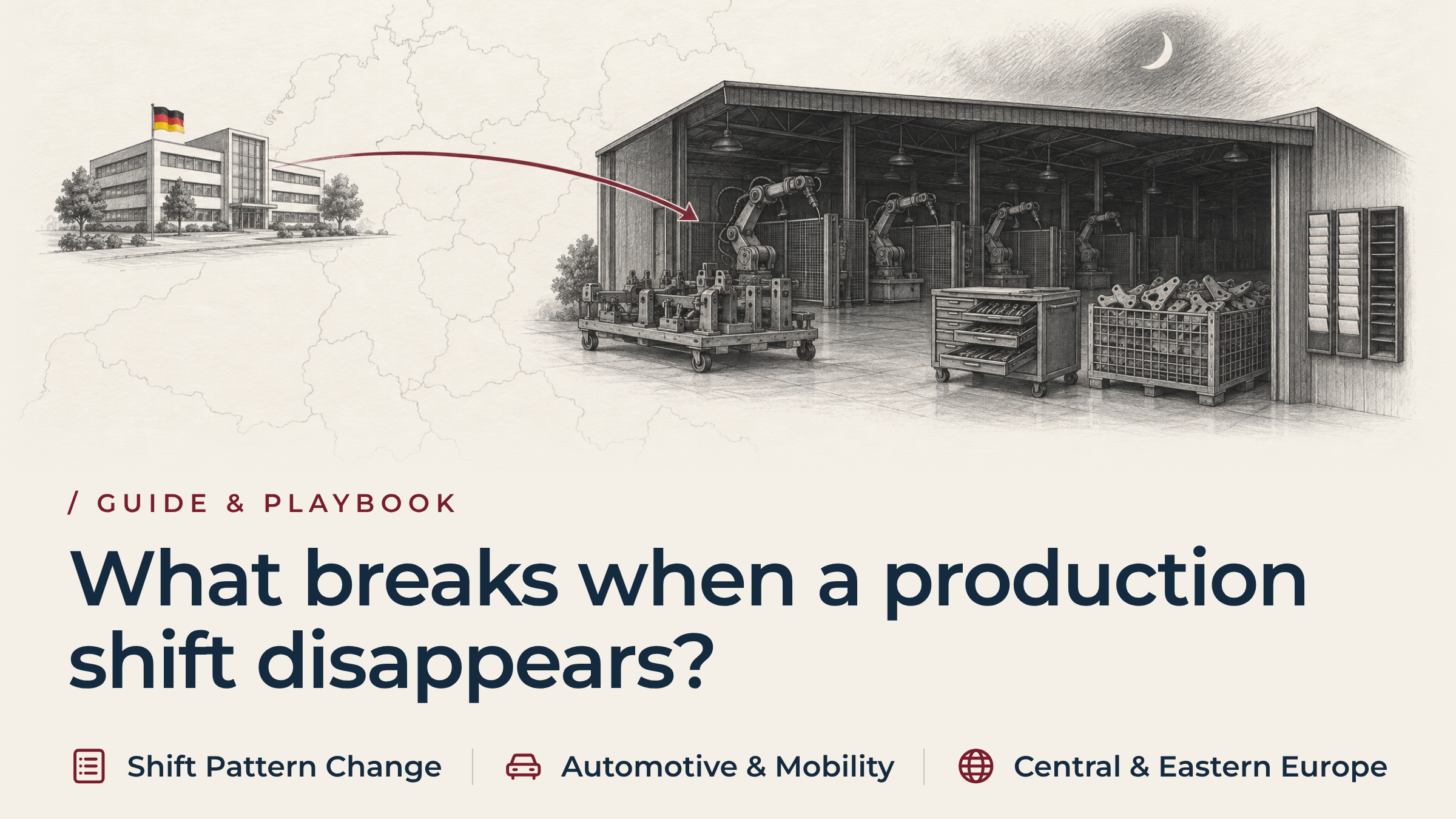
What breaks when a production shift disappears?
In brief
Removing a production shift is one of the fastest ways to cut plant operating expenditure on paper. Shift premiums disappear, direct labour hours drop, and utility consumption falls with them. A shift carries far more than finished output, though. It absorbs preventative maintenance windows, complex tooling changeovers, supervisory cover, offline quality containment and warehouse staging.
When a plant removes that shift without reassigning this hidden workload, the remaining shifts inherit it unannounced. Breakdowns increase, changeovers eat into production hours, and delivery reliability fails. Before fixing an execution date, plant leadership needs a complete inventory of everything the shift was carrying.
The decision trigger: why plant shift pattern changes fail
Corporate leadership usually approves a shift removal before anyone reviews what it carries. The business faces OEM volume contraction, a rising regional electricity tariff, or a parent-company margin target. It instructs the plant to move from three shifts to two, or from four continuous crews to three.
Finance has already modelled the payroll saving from the eliminated shift premium and headcount. The plant has announced the execution date to the workforce, and HR has started the statutory notification process.
Operational concern sits beneath that corporate timetable. The plant manager knows the site's third shift rarely ran standard output alone. It was the window when toolmakers rebuilt worn dies without stopping the line. Technicians serviced CNC spindles in it, and logistics staff replenished parts racks for the morning rush. None of that work appears in a capacity-utilisation spreadsheet. The plan accounts for none of it when the shift disappears.
Capacity vs. reality: why shift elimination models omit maintenance workload
Group leadership keeps the plan simple for an understandable reason. Acknowledging the shift's hidden workload is uncomfortable. It would mean admitting that the remaining shifts now carry lower effective capacity than their rated output suggests. That complicates a saving the business has already approved. None of this is bad faith; it is an understandable instinct under a margin target.
The practical effect is the same regardless of the motive. The operational plan states a volume target and stays silent on everything the shift was covering. It assumes general efficiency gains will somehow absorb the missing hours. They rarely do, and the gap only becomes visible once the remaining shifts have been carrying it for a while.
Cross-border challenges in eliminating third shift manufacturing operations
Removing a production shift is harder to execute well across borders. Group manufacturing executives in Munich, Zurich or Paris see the question through capacity-utilisation arithmetic. A hundred and twenty hours across three shifts can apparently fit into eighty hours across two.
That is a reasonable starting assumption, but it does not describe what the extra shift was absorbing at site level in Central and Eastern Europe. Three assumptions usually need correcting before the numbers hold.
- Machine availability. The group model assumes 85 per cent availability continues across the two remaining shifts. Preventative maintenance used to run during the cold night shift. It now competes directly with live production, which pulls availability down. The International Journal of Productivity and Performance Management ranks availability loss among the largest drivers of Overall Equipment Effectiveness loss.
- Changeover duration. Corporate planners assume a changeover still takes forty minutes on a crowded morning shift, the same as it took overnight. Running lines now claim the shared cranes, forklift routes and setter technicians full time, so changeovers rarely finish that fast.
- Supervisory span. Headquarters assumes supervision scales in a straight line. Night shift supervisors quietly handled second-tier quality approvals, scrap quarantine and raw material intake paperwork. Day shift supervisors have no spare capacity to absorb that work.
Key symptoms that shift removal will reduce delivery and output reliability
Four consistent symptoms appear wherever removing a production shift happens without reassigning its hidden workload. They are worth checking for before the date arrives.
- Changeovers eat into prime daytime hours. Die changes, colour flushes and fixture reconfigurations that used to happen overnight move into the morning shift. That idles line operators and costs volume.
- Breakdown frequency climbs. Maintenance technicians spend daylight hours responding to emergency stops instead of running planned lubrication, calibration and wear-plate replacement. That accelerates equipment wear.
- Supervisors cover missing operators. With less staffing flexibility across two shifts, any unplanned absence pulls a supervisor onto the line. That takes them away from quality checks and escalation.
- Weekend overtime quietly replaces the shift. To recover the output lost to daytime stoppages and longer changeovers, the plant schedules emergency weekend cover. That erodes the labour saving the board approved.
Reallocating workload: where off-shift tasks must land
Removing a production shift always means relocating five categories of hidden work, not just output. Each one needs a landing place before management sets the date.
- Asset maintenance: deep preventative maintenance, lubrication, spindle calibration, filter and fluid changes.
- Tooling changeovers: major die swaps, mould pre-heating, fixture alignment, first-off quality approval.
- Quality containment: offline sorting, scrap analysis, gauge checks, quarantine logging.
- Internal logistics: warehouse slotting, dunnage staging, raw material replenishment, finished goods wrap.
- Technical trials: new product trial runs, cycle time studies, software updates, customer engineering audits.
Maintenance needs a dedicated window. Moving from three shifts to two technically opens an overnight window. That window only has value if a maintenance crew actually works it. Shutting the whole site down to save on heating and lighting pushes maintenance into weekend overtime instead. That raises premium pay and reliance on outside contractors.
Changeovers need a home that is not the morning shift. A major changeover needing several setters and crane access cannot run safely alongside a fully staffed assembly cell. Management has to decide whether changeovers can move offline, and whether SMED-style methods can shorten them.
The International Journal of Industrial Engineering and Management reports a 30 per cent reduction in changeover time at a hygiene-products plant in Eastern Slovakia using this approach. Re-batching the schedule can also cut how often changeovers happen.
Managing quality containment and internal logistics after shift reductions
Quality containment needs a root cause, not a shift to absorb it. Many plants use the night shift as an informal buffer for parts needing manual deburring or visual inspection. Once that shift goes, containment needs a different home. The plant either engineers it out at the source or builds it into standard cycle time on the other lines.
Logistics needs a protocol, not improvisation. Moving stampings and packaging to the line during live production creates congested aisles and forklift delays. When indirect logistics headcount shrinks alongside the shift, a visual replenishment protocol has to keep the lines fed.
Aligning governance and works councils in international shift changes
A shift pattern change rarely keeps its works council, statutory notice period and group finance deadline in the same country. The site manages the local consultation and the physical transition. The group holds the saving target and the reporting date. Both roles are legitimate. The inventory above needs to close that gap. Both sides should agree and sign it off before either commits to a date.
The pressure behind that date is real. CLEPA, the European Association of Automotive Suppliers, reports that a quarter of European automotive suppliers now expect negative profitability in 2026. That kind of margin pressure is exactly what pushes a parent company toward a shift-pattern decision like this one.
Case study: recovering plant output after an unplanned shift elimination
The mandate below shows what happens when removing a production shift proceeds without that inventory. A tier 1 automotive metal forming and robotic welding plant in Central Eastern Europe operated a continuous three-shift pattern with 450 employees.
Its German parent company instructed the plant to cut operating expenses by €1.8 million. Local leadership announced the elimination of the third (night) shift across all robotic welding lines.
Within five weeks of the move to two shifts, line availability fell from 86 per cent to 58 per cent. Daily scrap rose by 40 per cent, and two German vehicle assembly plants issued formal warnings over missed JIT delivery windows. Facing severe customer penalty claims, the Group Chief Operating Officer engaged CE Interim.
CE Interim deployed an already vetted, mandate-matched, NDA-bound executive, ready to start after the completed mandate brief, as Interim Plant Manager. Partner-led transformation governance backed the mandate throughout.
The interim executive's on-site operational audit found the root problem within forty-eight hours. The factory had removed the third shift without an operational plan for the tasks it absorbed. That shift had carried three vital functions.
- Four major welding fixture changeovers, each taking two hours.
- Weld tip dressing, robot torch realignment and preventative maintenance across twenty-four automated weld cells.
- Sorting and reworking stampings affected by dimensional drift from an upstream sub-tier supplier.
Operational solutions to restore capacity and reduce delivery impact
Once the shift disappeared, changeovers moved into the morning shift and consumed four hours of peak production time. Preventative maintenance stopped altogether, which caused frequent weld faults and burn-through defects. Operators on the morning and afternoon shifts had to sort their own incoming stampings. That slowed cycle times by 25 per cent.
The interim executive put three decisive operational changes in place.
- A dedicated transition window. A four-hour crew between the afternoon and morning shifts handled tooling changeovers and preventative weld torch calibration exclusively. Machines then started each shift at 100 per cent capability.
- Standardised changeover protocols. Pre-staged welding jigs, pneumatic clamping connections and pre-calibrated robot weld programmes cut average changeover time from 120 minutes to 35.
- Containment moved to the source. Third-party quality sorting at the Tier 2 supplier's facility, before delivery, removed manual sorting from the factory floor. It returned full cycle speed to primary operators.
Over a ten-week period, the plant stabilised its two-shift rhythm. Line availability rebounded to 88.5 per cent, and scrap fell below 1.4 per cent. OEM delivery compliance returned to 100 per cent without air freight. The revised operating model delivered the targeted €1.8 million in permanent annual cost reduction. That confirms the point. Removing a shift works when the plant reassigns the work it carried. It fails when the remaining shifts absorb that work without a plan.
Internal leadership vs. external executive support during shift reductions
A plant with an experienced engineering group, strong process capability and real equipment headroom usually has what it needs. If the management team has run a shift pattern change before, removing a production shift is well within its reach.
Independent executive authority earns its place when the existing leadership has to run live, high-pressure delivery. At the same time, that leadership also has to dismantle and rebuild the shift structure. A local operations manager under daily pressure on customer delivery cannot easily step back to audit informal dependencies.
The same manager cannot renegotiate maintenance coverage with a works council and enforce supplier containment at the same time. An interim executive brings the focused authority to redesign the operating rhythm and set clear boundaries. That protects throughput while the cost base resets.
Frequently asked questions about removing a production shift
What should be planned before eliminating a third shift?
Plant leadership needs a complete inventory of the maintenance, changeover, quality, logistics and trial work the shift was carrying. Each item needs an agreed landing place before the execution date goes on the calendar.
What tasks does a shift carry beyond manufacturing volume?
A shift usually absorbs equipment maintenance windows, tooling changeovers and supervisory escalation cover. It also carries offline scrap containment, product trial runs and raw material line replenishment.
What operational failures typically result from shift reductions?
Tooling changeovers and maintenance routines collide directly with running production hours. That pushes machine availability down and forces unplanned line stoppages during the busiest daytime hours.
Can remaining shifts absorb the missing shift pattern workload?
Not reliably. Unless the plant compresses machine changeovers and reschedules preventative maintenance into planned downtime windows, the remaining shifts become the bottleneck. Output losses follow quickly.
When do delivery impacts and line failures appear after shift removal?
That depends on how much slack existed in maintenance and inventory before the shift disappeared. No single timescale applies to every plant. What matters is setting a deliberate review point. Otherwise, a breakdown or a missed delivery ends up announcing the gap on its own.
What checklists are required before setting the shift pattern change date?
Management needs an inventory of every non-volume task the shift carried, plus reallocated maintenance and changeover windows for each one. It also needs process cycle times validated under live trials before the date goes on the calendar.
Related knowledge and next step
A production shift carries more than output. When a plant removes one without a plan for the work it was carrying, breakdowns, failed changeovers and missed deliveries follow within weeks.
Related reading:
- Does Your Swiss Company Need a Resident Director?
- Who Runs the Business After a Dismissal for Cause?
- How long does it really take to replace an executive?
CE Interim provides cross-border executive leadership: an already vetted, mandate-matched, NDA-bound executive, ready to start after the completed mandate brief. Discuss your plant's shift structure with a CE Interim Partner before the execution date is set.

 EN
 DE
 FR
 IT
 PL
 RO
 CS
 SK
 HU
 ES
 RU
 AR
 SL