
Changing an automotive supplier when production cannot wait
In brief
A replacement automotive supplier can quote a price and ship sample parts within days of a disruption. None of that is supplier change approval. Commercial availability, technical acceptance, the applicable customer's own sign-off and verified production-rate capability are four separate checks. Each has its own owner and its own evidence. An executive managing the switch coordinates these checks. Nobody can waive one of these checks to protect a delivery date. Only the party with the relevant authority, inside the customer's own quality organisation, can close it.
The Trigger: Why a Quotation Is Not Automotive Supplier Change Approval
The pattern is familiar to any purchasing or quality team that has managed a supplier disruption. An incumbent supplier stops delivering, or signals that it soon will. Purchasing moves fast and finds a replacement. It offers a competitive quotation, confirmed machine capacity and sample parts that look acceptable on the bench. Inside the business, the problem can start to look solved.
It is not. A quotation confirms commercial interest, nothing more. A sample confirms that a careful team can make one part by hand while everyone watches closely. Neither confirms that the replacement source can hold the volumes, tolerances and traceability the actual customer requires. Neither confirms that the customer whose vehicles the part enters has agreed to accept it at all.
The first executive task is to define the change precisely. The approval route is not uniform across a supply base. One product might sit on the customer's own approved-source list, with its own documented change procedure. Another might carry safety or regulatory characteristics that trigger a full engineering change notice instead.
Assuming one route covers every affected part is how a sourcing team loses weeks it did not have. That first decision matters more than the paperwork that follows. It sets whether supplier change approval is even possible on the timetable purchasing has already promised.
What PPAP and Production Part Approval Actually Establish in Automotive Sourcing
Replacement supplier qualification in automotive manufacturing runs through a mechanism known as production part approval, or PPAP. The Automotive Industry Action Group developed and publishes it. PPAP exists to confirm one thing: a supplier's process can produce conforming parts consistently during an actual production run. It must do so at the rate the business needs, not only on a careful bench sample.
That distinction carries most of the weight. A part made slowly, by hand, on development tooling can look identical to one made at volume on serial tooling. The two can still behave differently once dimensional drift, tool wear and handling variation enter the picture. Production part approval exists to catch that gap before it reaches a vehicle. It does not exist to slow a business down for its own sake.
It does not establish a single, universal timeline, approval level or permitted exception. Each customer sets its own requirements for a given part, product line and risk category. Those requirements differ between customers and between components.
An executive managing a supplier change should rely on the customer's current documentation, not a general industry assumption. That documentation decides what evidence a specific approval needs.
The Five Readiness Gates Between Replacement Supplier Qualification and Usable Supply
One way to make this coordination visible to a non-specialist executive is to separate readiness into five distinct gates. Each gate has its own owner and its own evidence. The sequence below is a general pattern for a PPAP supplier change. The applicable customer and product set the actual evidence, approval level and duration at each one, not a fixed formula.
- Commercial option: Purchasing confirms terms, tooling ownership and the supplier's basic quality credentials. No production commitment follows from this gate alone.
- Technical evidence: Quality and engineering check dimensional and material conformance against the real drawing and specification. They use the supplier's actual production tooling, not a bench sample.
- Customer decision, where applicable: The receiving customer decides whether the change needs full approval, an interim arrangement or a documented exception. It also sets the terms. The buying company alone cannot make this call.
- Repeatable production: A trial run at the required rate, on the production tooling itself, shows the process is stable. One batch passing inspection does not show that.
- Usable arrival: The receiving plant checks the part in its own systems, inspects it on arrival, and releases it to the line. That is a distinct step from clearing the earlier gates.
A business can clear the early gates quickly and still sit weeks from gate five. Treating gate one as though it were gate five is where emergency sourcing decisions go wrong.
Mitigating Automotive Supply Chain Disruption: Keeping Delivery Promises Honest
The sourcing plan's earliest realistic date and the date planning teams should promise customers are not the same thing. A confirmed quotation, a clean sample and an eager supplier all create pressure to quote the optimistic date. The evidence at each gate does not yet support that date.
An executive coordinating the response should let planning and customer-facing commitments move at the pace of the gates. They cannot move faster than the gates that have genuinely closed. Quality might confirm technical evidence while the applicable customer has not yet decided on the approval route.
That gate stays open regardless of what the supplier's own schedule suggests. Promising a date ahead of supplier change approval is risky. It turns an internal planning assumption into an external promise the business may not keep. Protecting the customer relationship depends on that discipline more than it depends on speed.
Governance and Leadership: Who Should Coordinate the Supplier Change Approval Process
Not every supplier change needs a dedicated executive brought in from outside. An internal programme leader or quality director may already have the time and authority for this. They may also have the cross-functional standing to coordinate purchasing, engineering and the customer relationship. That person should lead the response. Adding further leadership on top adds a layer, not capability.
Temporary executive leadership earns its place in a different situation. Purchasing, quality and planning each manage their own piece of the decision. No one holds a shared view of which gates remain open. Or the customer relationship itself needs a senior, credible point of contact to keep the qualification honest under schedule pressure.
What temporary leadership coordinates is the sequence and the accountability. It does not acquire the authority to accept or release a part on the customer's behalf. That authority stays exactly where the customer's own quality organisation places it.
Replacement sourcing, qualification evidence and delivery commitments sometimes start moving on separate tracks with no single owner. That is the point to raise supplier change approval with a CE Interim Partner. The conversation can extend to the wider mandate it sits inside.
Automotive Case Study: Fast-Track Supplier Change Approval and Interim PPAP Qualification
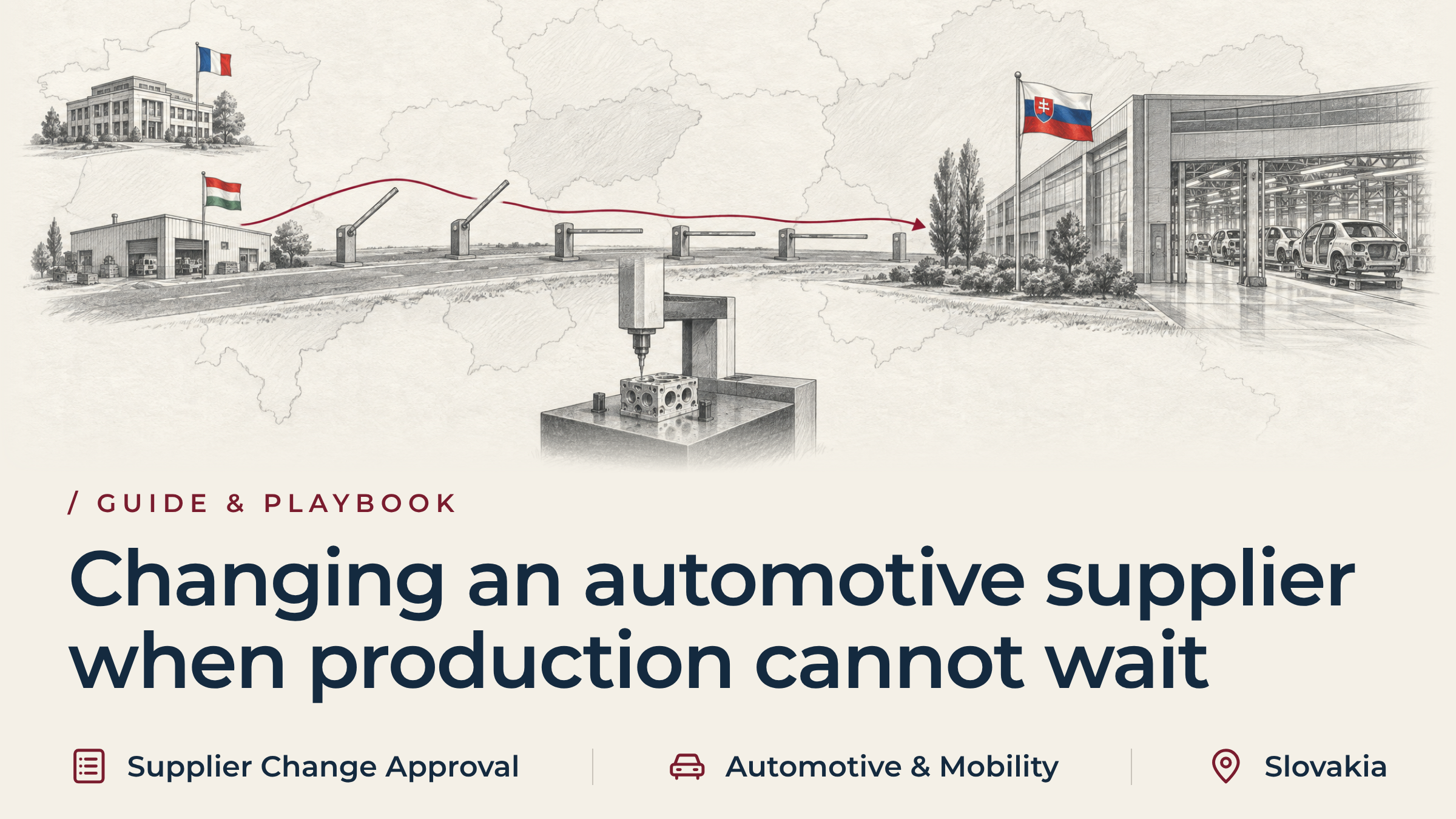
A major French Tier 1 automotive braking systems manufacturer operated a 700-person assembly plant in western Slovakia. The plant supplied electronic stability control (ESC) hydraulic valve blocks directly to primary vehicle assembly plants in Germany and France.
The plant's incumbent Italian supplier of precision micro-machined aluminium spool valves suffered a catastrophic hydraulic fire. The fire destroyed its specialised multi-spindle CNC machining line. The supplier declared force majeure, confirming that replacement machinery would require a minimum of five months to commission.
The Slovakian assembly facility held only six days of buffer inventory. A shutdown of the ESC assembly lines would halt three major OEM vehicle assembly plants within seven days. That shutdown would trigger contractual downtime penalties of €55,000 per hour.
Procurement located an alternative precision machining supplier in northern Hungary with compatible Swiss-type lathe capacity. The supplier offered to begin cutting parts immediately using prototype fixtures.
However, the customer's OEM quality director in Wolfsburg issued a strict warning. Specifically, shipping ESC units containing components from an unapproved vendor without full PPAP Level 3 compliance would result in an immediate vehicle hold, customer containment audits, and rejection of all shipments.
Engaging Executive Leadership for Emergency Automotive Supplier Qualification
Confronted with an imminent multi-million-euro line stoppage and an intense deadlock between purchasing speed and customer quality compliance, the Group Chief Operating Officer engaged CE Interim.
CE Interim deployed an already vetted, mandate-matched, NDA-bound executive as Interim Supply Chain Director on site. The executive was ready to start after the completed mandate brief. Institutional Partner-led transformation governance supported the mandate throughout, coordinating directly between executive leadership in Paris and plant operations in Slovakia.
Supply Chain Diagnostic: Bridging Prototype Samples and Serial PPAP Capability
Arriving at the Slovakian facility within forty-eight hours, the interim executive conducted an immediate engineering and supply chain audit:
- Supplier capability gap: The Hungarian replacement supplier was technically proficient. However, its initial sample parts had been produced on an offline development machine with manual deburring. The supplier lacked production clamping jigs. Also, its automated optical inspection system had not been programmed for the critical valve geometry.
- Customer escalation risk: Sourcing had requested a complete customer waiver. The OEM had flatly rejected this request. It viewed the request as an attempt to bypass safety-critical engineering checks on a primary braking component.
- True delivery buffer: Net usable stock on the Slovakian floor was sufficient for exactly 4.2 production days.
Operational Interventions for Accelerated Automotive Supplier Change Approval
The interim executive executed three decisive operational interventions over an eight-week crisis mandate:
- Restructured customer engagement and negotiated interim PPAP: The interim director travelled to Wolfsburg to meet directly with the OEM's Vice President of Supplier Quality. Presenting a transparent, defensible qualification roadmap, the executive negotiated a formal sixty-day Interim PPAP Level 3 deviation permit. The agreement permitted production shipments under the condition of a mandatory safe-launch containment protocol. That protocol required one hundred per cent third-party offline sorting and CMM dimensional verification before component release.
- Supervised on-site tooling industrialisation and run-at-rate: The interim executive embedded an experienced automotive quality engineer at the Hungarian machining facility. Over twelve continuous days, the team commissioned dedicated multi-cavity production fixtures and programmed automated vision inspection systems. The team also executed a formal 300-piece run-at-rate trial at customer takt time. That trial demonstrated process capability indices of Cpk 1.78 on all safety dimensions.
- Synchronised cross-border safe launch logistics: The executive established a dedicated express transport corridor connecting the Hungarian supplier, an independent metrology inspection lab in Gyoer, and the Slovakian assembly plant. Daily CMM data sheets were uploaded directly to a shared portal accessible by OEM quality auditors, establishing complete traceability before parts entered the assembly cells.
Results: Preventing OEM Line Stoppages and Achieving Full PPAP Serial Validation
Within eight weeks, the accelerated supplier change approval delivered complete operational stability:
- Zero OEM customer line stoppages: Maintained unbroken delivery continuity for all customer vehicle assembly plants, avoiding more than €3.2 million in potential line-stoppage claims.
- Flawless quality performance: Delivered over 45,000 precision micro-valves during the interim deviation window with zero customer parts-per-million (PPM) defects or assembly line faults.
- Full permanent PPAP sign-off: Completed all metallurgical endurance trials, process capability documentation, and formal Level 3 PPAP sign-off within seven weeks, two weeks ahead of the OEM deadline.
- Long-term dual-sourcing security: Transformed an emergency crisis response into a permanent, cost-competitive secondary supply source that reduced unit component costs by six per cent.
Frequently Asked Questions About Automotive Supplier Change Approval and PPAP
Is an initial supplier quotation evidence of automotive production readiness?
No. A quotation confirms commercial interest, indicative pricing and theoretical capacity. Production readiness depends on three separate things. The supplier's actual production equipment must show verified tooling capability. Confirmed dimensional and material conformance must follow. The applicable customer must also decide what approval route the change requires.
What does PPAP validate during an automotive replacement supplier change?
Production part approval exists to confirm one thing. A supplier's manufacturing process must produce conforming parts consistently during an actual production run, at the rate the business needs. A single sample is not enough. The exact evidence for supplier change approval depends on the specific customer and product, not on a fixed industry template.
Can production urgency bypass OEM supplier change approval requirements?
Urgency changes the sequence, not the requirement. Where production cannot wait for the full approval process, the applicable customer may agree to an interim or provisional arrangement. Additional containment inspection backs that arrangement. The decision still belongs to the customer, on its own documented terms.
Who should coordinate supplier change approval and delivery commitments?
A single accountable owner should hold the readiness sequence and the customer-facing delivery commitment together. That owner might be an internal programme leader or a temporary executive brought in for the mandate. Either way, one person coordinates the full supplier change approval process. Split ownership between purchasing, quality and planning risks an optimistic delivery promise built on an unapproved component.
Related knowledge and next step
A workable replacement is not the same as an approved one. The four gates above decide whether that gap costs a missed date or a vehicle hold at the customer's line. A supplier change approved too casually can still end in a vehicle hold, a containment audit, or a broken promise.
Related reading:
- When several CEE plants are resizing at once, who sequences the changes?
- Production is moving to Slovakia. Who owns the receiving site's capacity plan?
- Europe's automotive suppliers cannot afford good output at bad margins in 2026
CE Interim provides cross-border executive leadership. An already vetted, mandate-matched, NDA-bound executive is ready to start after the completed mandate brief, under Partner-led governance throughout. A CE Interim Partner can help establish which gates remain open and who should close them.
 EN
 DE
 FR
 IT
 PL
 RO
 CS
 SK
 HU
 ES
 RU
 AR
 SL