

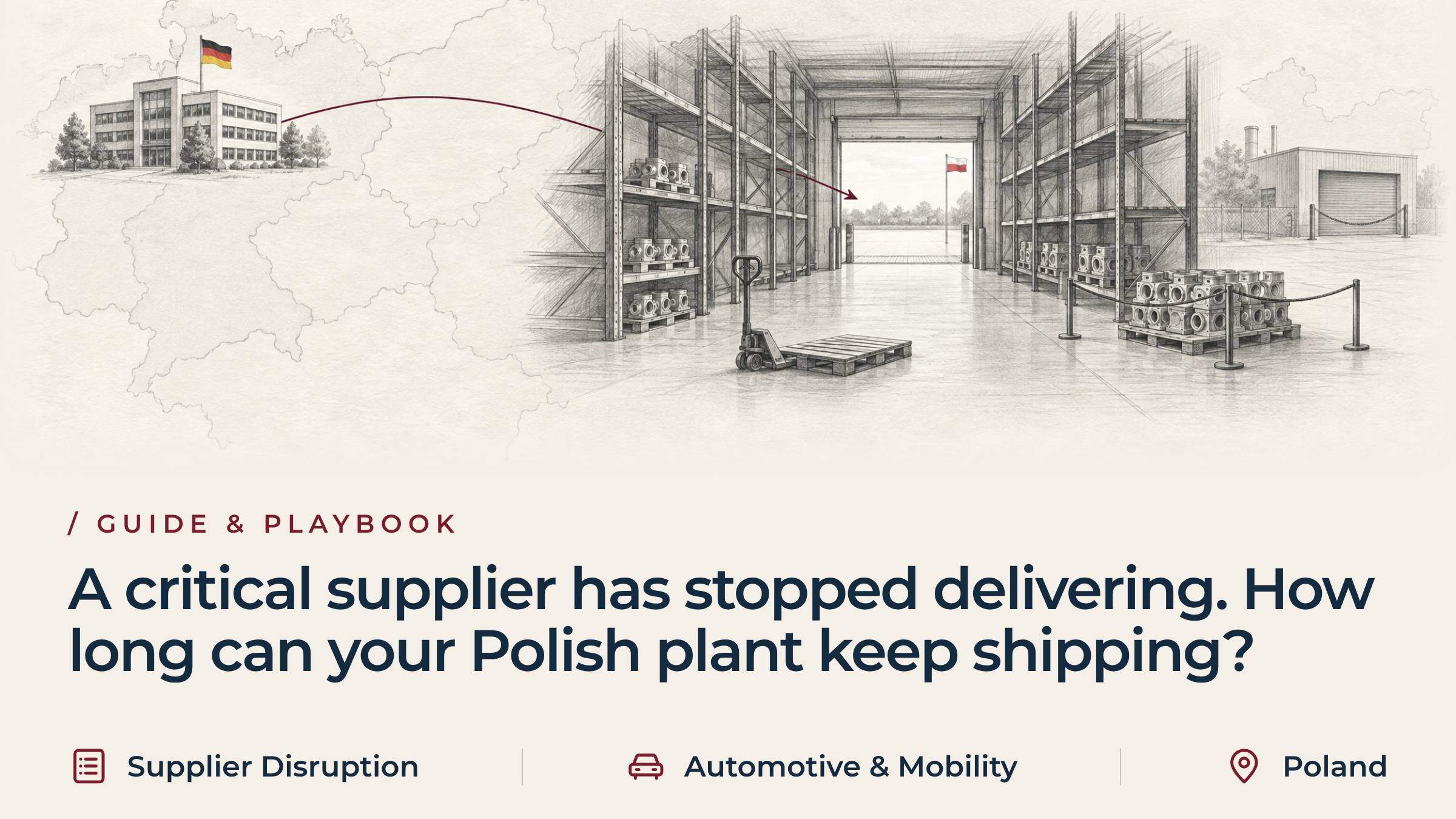
A critical supplier has stopped delivering. How long can your Polish plant keep shipping?
In brief
A critical supplier has stopped delivering, yet the order book is still full. A supplier failure contingency plan does not start with a general risk review. It starts with one question. Which confirmed customer orders can the plant still fulfil from stock that is genuinely usable, not merely recorded as present? Quarantined batches, unapproved revisions and material already committed elsewhere are not free stock. Within the first day, a named owner should separate verified facts from assumptions. The owner should also set the point at which usable supply runs out.
The Disruption Trigger: Assessing Critical Supplier Disruption Risks
The commercial picture at group headquarters often looks reassuring. The order book is healthy. The Polish plant reports full staffing. The machines are running. Then purchasing flags a missed delivery from a critical component supplier, somewhere in Silesia or across the border.
A common first reaction is hesitation. Local ERP records still show weeks of stock on hand, so a formal crisis feels premature. Managers hope the missed delivery is transport friction, not something worse. Sales teams keep confirming dispatch dates to customers in Stuttgart, Munich, Lyon or Zurich.
This hesitation is understandable. A healthy order book is a genuine signal. Nobody wants to declare a crisis over a single delay. The real risk sits elsewhere. Production keeps consuming safety buffers on secondary work, while stock for the highest-penalty customer programmes quietly drains away. The cause often becomes clear only later: a serious equipment failure, a formal insolvency filing, or a sub-tier payment dispute. By then, the buffer has often gone.
Core Principles of an Effective Supplier Failure Contingency Plan
A supplier failure contingency plan earns its name in the first hours. It answers three questions before anyone makes a new commitment. Which customer orders face real exposure? How much stock is genuinely usable against them? Who owns that answer while it keeps changing?
Each question follows a separate discipline. Affected orders come from the customer order book, not from the supplier's missed shipment alone. Usable stock comes from a physical check, not an ERP balance. Ownership means one named individual, not a function, holds the current position and updates it.
The plan's job in the first hours stays narrow on purpose. It does not diagnose why the supplier failed. It does not promise an outcome. It separates what the business knows from what it still needs to confirm. Planning, purchasing and customer teams then work from the same facts, not three different guesses.
Building a Precise Deliverable-Order Position and Exposure View
A reliable exposure view connects five things in a single chain. Assuming any one of those links, rather than verifying it, breaks the chain.
- The critical component itself, identified precisely rather than described generally.
- The customer product or programme that component feeds.
- Usable stock: physically present, conforming, and not already committed to another order.
- Confirmed inbound supply, checked on the dock rather than taken on trust from a shipping notice.
- The customer promise the chain exists to protect, ranked by contractual and commercial consequence.
Quarantined batches do not belong in the usable column. Nor do parts awaiting an engineering concession. Stock already staged against lower-priority work does not count either, however it appears on a warehouse report. A gross inventory balance from an aggregated system query routinely overstates what is actually free. It cannot see a quality hold, an obsolete revision or a line-side buffer that a supervisor has quietly set aside.
Managing Supply Chain Uncertainty with Operational Rigour
Every exposure view assembled during a live disruption rests on assumptions. When might the supplier resume shipping? How long will emergency freight take? Does an alternative source have real capacity? Treating an assumption as a fact is how a seemingly comfortable stock position turns into a surprise.
The useful discipline is not guessing better. It is keeping an explicit, dated register that separates two things. One is what the team has physically verified, such as parts inspected on the dock. The other is what remains a promise, such as a supplier's assurance of a Monday delivery. Each assumption needs an owner who can obtain confirmation, and a date by which the whole position gets reviewed again.
No standard number of safe production days applies across suppliers, components or sites. A contingency plan should not invent one. The honest answer changes as the team confirms more facts. That is precisely why it needs continuous ownership, not a single calculation made on day one.
Bridging the Gap Between Enterprise ERP and Shop-Floor Reality
Managing a supplier failure contingency plan across a German, French or Swiss headquarters and a Polish plant introduces a specific distortion. Neither side is usually acting unreasonably.
Headquarters needs reliable, aggregated reporting to protect capital and respond to the Board. An ERP query run from Frankfurt or Basel is a legitimate way to ask the question. The problem is what the query cannot see. An aggregated balance cannot distinguish conforming stock from a quality hold, or a confirmed delivery from a shipping promise. It can look more reassuring than the shop floor actually is.
The plant floor usually works to different incentives. A site director measured on overall equipment effectiveness and cost has one aim: keep machinery running on secondary orders. That can consume the last of a scarce component. Without an explicit cross-border decision owner, both sides can be doing something locally defensible. The business as a whole can still drift toward an avoidable line stop.
Early Warning Indicators of Critical Supplier Failure
Certain operational symptoms usually appear before a full production halt. Recognising them early is what keeps a supplier failure contingency plan a planning exercise rather than a scramble.
- Phantom availability: recorded stock balances look stable. Materials handlers report missing parts or repeated manual corrections on the shop floor.
- Informal rationing: supervisors start holding private buffers of fasteners, brackets or sensors at individual workstations instead of through central stores.
- Double-claimed buffers: more than one scheduler believes they own the same remaining stock against separate customer deadlines.
- Conflicting shipment messages: sales confirms on-time delivery to a customer while logistics quietly arranges split shipments or emergency freight.
- Supplier financial signals: a sudden request for prepayment, or a refusal to release goods without full payment. A sudden change in banking details is another warning sign.
None of these signals proves that a supplier has failed. Each one is a reason to verify the exposure view sooner rather than later.
Executing an Actionable Production Continuity Response
A supplier failure contingency plan only works if planning, purchasing and customer-facing teams share one position, not three separate ones. Without that, a planner may schedule against stock that purchasing has already promised elsewhere. A sales director may confirm a delivery date that logistics already knows is unrealistic.
A single, dated position should state what is confirmed, what remains assumed, and what customers can reliably be told. It does not need to resolve every question. Supporting a struggling supplier through its difficulty, or accelerating a qualified replacement, is a separate and higher-stakes decision. It carries its own trade-offs between continuity and financial exposure. It deserves its own analysis, not a verdict inside a first-response plan.
Deliverable-Order Position Register for Cross-Functional Teams
This register is the working core of a supplier failure contingency plan: a template, not a worked example. It belongs jointly to planning, purchasing and customer-facing teams. It stays useful only if someone owns the task of keeping it current.
- Component: the specific input at risk, named precisely rather than described by category.
- Affected customer orders: which confirmed orders depend on it, ranked by contractual and commercial consequence.
- Usable stock: the verified, conforming, uncommitted quantity on hand today, not the system balance.
- Confirmed inbound supply: what has actually been inspected or cleared, not merely promised by a shipping notice.
- Unresolved assumption: what still needs confirming, and the date by which it will be.
- Owner: the named individual accountable for keeping the register honest.
A blank register, consistently maintained, is more useful to a Board than a one-off estimate. Nobody updates that estimate once the immediate pressure eases.
Evaluating Industry Evidence and Supplier Insolvency Realities
Practitioner guidance from the German Association of Materials Management, Purchasing and Logistics (BME) covers early-warning indicators for supplier distress and probability-of-default rating. It also sets out a defined procedure for switching suppliers once a risk has materialised.
That context matters: a structured supplier failure contingency plan counts as a recognised discipline, not an unusual precaution. It is not evidence of a standard recovery timeline, and no credible source currently supports one.
Formal distress does not automatically mean a stop in deliveries. German packaging manufacturer ZIRBS filed for insolvency in October 2026. Administrator PLUTA stated that the business continued operating in full, with existing customer orders intended to continue as normal, while an investor process ran alongside.
The filing itself said nothing about the eventual outcome. It is a reminder to verify a supplier's actual operating status directly, rather than treating an insolvency filing as a confirmed stop. A legal filing, or a rumour, is not the same thing as a stopped production line.
Case Study: Protecting Deliveries After Critical Supplier Failure at a Polish Plant
A major German Tier 1 automotive chassis and steering systems manufacturer operated a 650-person assembly facility in Lower Silesia, Poland. The plant supplied just-in-time steering modules directly to primary BMW and Volkswagen vehicle assembly plants in Bavaria and Saxony.
Without advance warning, the plant's sole-source supplier of precision machined aluminium housings, located in Upper Silesia, halted dispatches. The supplier had experienced severe cash flow insolvency following a dispute with its raw material creditor. This produced a supplier-side shopfloor walkout and an unannounced transport embargo.
Local Polish enterprise resource planning (ERP) records indicated that the plant held fourteen calendar days of component safety stock. Relying on this figure, plant leadership assured the Munich headquarters that deliveries were protected. However, within forty-eight hours, assembly lines began starving for parts. A physical audit revealed that over sixty per cent of the recorded warehouse stock consisted of non-conforming batches awaiting rework. This also included obsolete drawing revisions, or parts already consumed on lower-priority export builds. The plant was facing a complete production halt within seventy-two hours. This exposed the group to OEM line-stoppage penalties exceeding €45,000 per hour.
Deploying Interim Leadership for Rapid Supply Chain Crisis Resolution
Recognising that the Polish facility was heading toward an imminent customer line stop and that internal procurement teams were overwhelmed by conflicting priorities, the Group Chief Operating Officer engaged CE Interim.
CE Interim deployed an already vetted, mandate-matched, NDA-bound executive as Interim Supply Chain Director on site. The executive was ready to start after the completed mandate brief. Institutional Partner-led transformation governance supported the mandate throughout, maintaining an open escalation channel directly to the Group Executive Board.
Operational Diagnostic: Uncovering Phantom Inventory and Supply Cliff Edges
The interim executive arrived at the Lower Silesian plant and ran an intensive forty-eight-hour on-site operational diagnostic. He started on the warehouse floor itself, physically counting every pallet and checking its quality status. He matched each one, or not, to a specific customer order. He trusted nothing from the system balance that had reassured Munich days earlier. The audit uncovered critical vulnerabilities that aggregate corporate reporting had masked:
- Gross inventory distortion: Of the 8,400 housings recorded in the system, only 1,420 were physically conforming and uncommitted. They were available for immediate assembly. The true operational cliff edge was not two weeks, but exactly 2.8 production days.
- Informal line-side hoarding: Assembly supervisors had established private buffers of critical fasteners and seal kits at individual workstations. This prevented central materials schedulers from assessing real stock availability.
- Creditor impoundment: A consignment of 3,200 finished housings was sitting completed inside the distressed supplier's facility. Local hauliers and raw material creditors had placed a physical lien on the warehouse docks pending invoice settlements.
Targeted Interventions to Restore Manufacturing Continuity and Supply
The interim executive executed three decisive operational interventions over an eight-week crisis mandate. Each one addressed a different point of failure the diagnostic had exposed:
- Enforced inventory ring-fencing and customer allocation: The executive froze all automated material allocations. The executive then ring-fenced every conforming housing exclusively for high-penalty OEM lines. Secondary aftermarket lines were temporarily paused, extending the plant's deliverable-order horizon from 2.8 days to 6.5 days.
- Negotiated commercial and legal stock release: The interim director worked with the supplier's provisional insolvency administrator and local legal counsel. This established a secure third-party escrow mechanism. The buyer guaranteed payment for direct labour and energy on a cost-plus basis. This secured the immediate release of the 3,200 impounded finished housings and re-established supervised production runs.
- Accelerated emergency dual-sourcing qualification: In parallel with secured short-term deliveries, the interim executive mobilised a rapid-response industrialisation cell. They transferred duplicate stamping dies to an audited machining supplier in the Czech Republic. This coordinated accelerated PPAP sample approval and coordinate-measuring machine (CMM) dimensional checks within twenty-one days.
Turnaround Results: Safeguarding OEM Delivery and Enhancing Supply Base Resilience
Within eight weeks, the Polish plant completely eliminated the threat of assembly line disruption, achieving concrete operational results. The escrow release, the ring-fencing discipline and the Czech qualification programme ran in parallel rather than in sequence.
- Zero OEM customer line stoppages: The plant maintained 100 per cent on-time delivery compliance for primary German vehicle assembly plants. This held throughout the eight-week disruption window.
- Secured critical component volume: The team recovered 3,200 finished parts from the distressed supplier. They then supervised an additional four weeks of controlled production before transitioning volume.
- Qualified alternative production: Fully validated the Czech replacement supplier at volume, securing a stable dual-sourcing footprint that reduced single-source vulnerability.
- Restored governance and customer trust: The OEM customer formally closed its emergency escalation audit without issuing commercial penalties. The plant also established an audited deliverable-order reporting model that headquarters adopted across all European facilities.
Internal Execution vs. External Support for Supply Chain Resilience
Many manufacturing organisations can and should run this response internally. The plant and group supply chain team may already have the authority and the physical access to verify stock. They may also have the capacity to hold the role alongside their existing work. If so, that is usually the right answer. No supplier disruption, on its own, changes that.
Outside leadership becomes relevant specifically when dedicated ownership is missing. It is not simply because the situation is urgent, or because the supplier sits in another country. A plant director and group procurement lead are usually already carrying a full workload. A legal negotiation with an insolvency administrator, a physical audit and a customer communications plan rarely fit alongside it. Something gets dropped. Capacity and dedicated authority are the gap, not competence.
Frequently Asked Questions: Supplier Disruption & Contingency Planning
What information matters first when responding to a critical supplier disruption?
First, establish the physically verified volume of conforming, uncommitted stock and map it against active customer orders to determine when production stops. Diagnosing the supplier's failure can wait, as it does not change immediate shipment capability.
Is a standard stock balance sufficient for supplier failure contingency planning?
No. Standard balances often include rejected, obsolete, or committed stock. Only an initial physical count of conforming, uncommitted inventory, regularly updated by a designated owner as conditions shift, provides an accurate view.
How does supplier insolvency impact ongoing manufacturing deliveries?
Not automatically. Under many European frameworks, administrators can continue operations and fulfill orders once payment is secured. Direct contact with the administrator is essential to confirm actual status rather than relying on the filing alone.
Who should own the deliverable-order position during a supply chain crisis?
A single named individual must own the position to prevent conflicting customer commitments. This owner, whether an existing team member or a short-term interim manager, provides one accountable source of truth across purchasing, planning, and sales.
Related knowledge and next step
A supplier failure contingency plan is not a document finished once and filed away. It is a position that a named owner keeps honest. Customer orders, usable stock and supplier promises keep changing underneath it. Organisations that handle disruption well are usually the ones that treat it that way.
Related reading:
- When several CEE plants are resizing at once, who sequences the changes?
- Production is moving to Slovakia. Who owns the receiving site's capacity plan?
- German HQ sees the Czech plant hitting plan. Rework hours say capacity is already gone
Where the existing team has the authority, the access and the time to hold that position, it should. When customer commitments are exposed and nobody inside the business can own the response alongside existing work, that is the point to speak with a CE Interim Partner.
CE Interim provides an already vetted, mandate-matched, NDA-bound executive, such as an Interim Supply Chain Director. That executive is ready to start after a completed mandate brief. The executive works within the authority the business grants, reporting through Partner-led governance throughout the mandate.
To discuss a live supplier disruption in confidence, contact a CE Interim Partner.
 EN
 DE
 FR
 IT
 PL
 RO
 CS
 SK
 HU
 ES
 RU
 AR
 SL