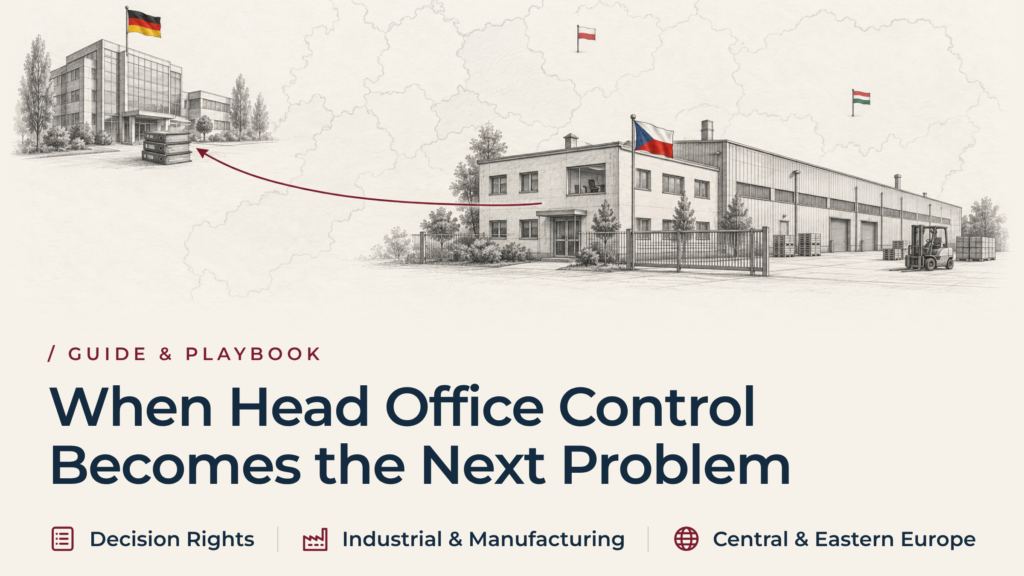
When a Mittelstand carve-out includes a Serbian plant

A German family business sells its automotive division. Serbian manufacturing is inside the perimeter. What the new owner needs to establish,
and how quickly.
Interim managing director for a foreign subsidiary: protecting customer delivery in a Hungarian plant

In brief An interim managing director foreign subsidiary mandate exists for one moment. The managing director of a Hungarian manufacturing plant resigns without warning. The board has no one on site. A permanent replacement typically takes four to six months to recruit, negotiate and release from a competing employer. An interim managing director foreign subsidiary appointment closes that gap. The interim executive takes statutory signatory authority under Hungarian company law. The interim executive holds customer delivery commitments on site and stabilises the local management team. The permanent successor then inherits an intact business, not a recovery project. Managing a sudden managing director resignation and the six-month leadership gap A managing director rarely resigns from a Central European plant at a convenient moment. A competitor sometimes makes a stronger offer. A dispute with headquarters sometimes becomes unworkable. A compliance issue sometimes forces an abrupt exit. Whatever the cause, the board faces an immediate gap across legal, operational and commercial authority. An interim managing director foreign subsidiary appointment is usually the fastest way to close it. The instinctive response is understandable. The plant has experienced department heads and capable shift supervisors. It has modern, largely automated equipment. Headquarters assumes the plant can hold its own for a few months. A search firm, meanwhile, works through a proper process. Hungary’s industrial labour market rarely allows that assumption to hold. Hungarian labor market dynamics accelerating executive vacancy risks Experienced plant leadership is scarce in corridors such as Győr, Debrecen, Tatabánya and Székesfehérvár. Every rival employer and headhunter in the region already knows the names that matter. A managing director’s departure reads locally as a signal, not a rumour. Within weeks, operations managers, toolroom specialists and quality heads start taking calls from competitors. Capital requests sit unsigned. Supplier disputes go unresolved. By around the eighth week without a named executive on site, that drift usually reaches customers. Delayed shipments follow, and difficult calls from procurement follow with them. Why an interim managing director foreign subsidiary mandate is essential for operational continuity Two separate pressures compound each other once a Hungarian plant loses its managing director. One is statutory. One is a labour-market pressure. Statutory representation and legal authority under Hungarian corporate law Under the Hungarian Civil Code (Act V of 2013), the managing director (ügyvezető) holds the company’s registered executive-officer role. That role sits with the Court of Registration (Cégbíróság). Major commercial contracts, tax filings, customs declarations and local bank payments all need the signature of a registered executive officer. A managing director can tender resignation at any time. Where the company’s operation requires it, though, the resignation takes effect only once the company appoints a new executive. Otherwise it takes effect on the sixtieth day after notice. Until the Court of Registration formally registers a qualified executive, or grants full commercial power of attorney (cégvezető), the subsidiary struggles to execute routine contracts. It also struggles to engage local trade unions and deal with authorities. Managing the six-month executive search timeline during leadership transitions A conventional executive search in Hungary is not a quick process. The delay is structural, not a sign that the search firm is underperforming. Mapping bilingual industrial leaders across Hungary, Austria and Slovakia takes time. Running a proper competency and board-approval process typically takes eight to twelve weeks on its own. Negotiating compensation, governance expectations and a formal offer adds two to four weeks. Senior Hungarian industrial executives then usually serve three- to six-month notice periods. Enforceable non-compete agreements often reinforce those notice periods. That adds a further twelve to twenty-four weeks before the successor can start. Add those figures together. The honest range for an interim managing director foreign subsidiary gap is four to six months, sometimes longer. No one at the plant holds full authority for that entire span. That cost rarely appears as one number on a board pack. It accumulates instead, in the departures, delayed shipments and stalled decisions described below. Most of it has already happened by the time it shows up in the numbers. Warning signs of an unmanaged executive vacancy in manufacturing plants A plant without executive leadership rarely fails all at once. Not every signal deserves the same weight. Interdepartmental friction: the primary operational signal for interim leadership The most diagnostic sign is also the earliest: friction between departments that no one has the authority to resolve. Production, maintenance and quality meetings turn into disputes rather than decisions. An experienced executive treats that friction as the moment to act. It is not a pattern to keep watching. Downstream risks of prolonged managing director vacancies in local subsidiaries Everything that follows this first signal is largely confirmation, not new information. Quality engineers, continuous-improvement leads and shift supervisors start handing in notice. They cite uncertainty about the plant’s future leadership. On-time, in-full delivery performance drifts from a typical 98% toward the low 90s or below. Unmanaged bottlenecks and rising expedited-freight costs drive that drift. Supplier invoices needing a managing director’s sign-off pile up unpaid. Local trade union and works council (üzemi tanács) representatives eventually raise grievances directly with regional headquarters, rather than resolving them locally. By the time that last signal appears, the plant has already lacked functioning local authority for some time. Continuity through a leadership change depends on one thing. Someone needs to be visibly and immediately accountable on site, not reassuring the board from a distance. Acting on the first signal usually costs less than waiting for the later ones to confirm it. Core requirements of an interim managing director foreign subsidiary mandate An emergency interim managing director is not a caretaker holding the seat warm. The mandate carries full accountability for the plant’s performance, customer relationships and statutory obligations from day one. It follows a sequence that puts the most time-sensitive decisions first. Before the executive arrives, a CE Interim Partner agrees the reporting cadence directly with the board. The Partner also agrees the escalation threshold, and reviews progress every two weeks throughout the mandate. That cadence means oversight never
Beyond the announcement: UAE companies already operating in Germany

In brief UAE-owned businesses in Germany are not a forecast. They already exist across several sectors. The population includes factories, energy assets, logistics networks and sales offices. Several of them carry German statutory obligations in full. What differs between them is the form of presence. Company ownership brings a German board structure, works council rights and German reporting law. Project ownership brings contractual rights over a single asset. Commercial presence brings neither. Which form applies is the first governance decision, because it sets who answers for what. An aluminium foundry in Hannover and a wind farm off Rügen Emirates Global Aluminium completed the acquisition of Leichtmetall Aluminium Giesserei Hannover GmbH on 3 May 2024. The parties signed a binding sale and purchase agreement on 21 March 2024. The seller was a fund that Quantum Capital Partners of Munich manages. EGA states that the Hannover site now trades as EGA Leichtmetall. It produces up to 30,000 tonnes of aluminium billets a year. Secondary aluminium accounts for around 80 per cent of its input. EGA did not disclose the financial terms. The plant did not change on that date. The reporting line above it did. Iberdrola reports that the 476 MW Baltic Eagle wind farm reached full energisation on 10 July 2025. The site lies roughly 30 km off Rügen in the German Baltic Sea. Masdar holds 49 per cent of the project under a July 2023 agreement, and Iberdrola retains 51 per cent. That is a German asset under partial UAE ownership, not a German operating company. Covestro AG confirms an Investment Agreement with ADNOC dated 1 October 2024. The offer price was EUR 62.00 per share. The National reports that the transaction completed on 10 December 2025. XRG now holds roughly 95.1 per cent. ADNOC International Germany Holding AG accounts for about 83.43 per cent, and XRG P.J.S.C. for about 11.68 per cent. Covestro states that its headquarters remain in Leverkusen, with around 17,500 employees across 46 production sites. Each of these transactions closed before the September 2026 investment announcement in Berlin. None of them forms part of it. Why UAE-owned businesses in Germany fall into three separate categories Company ownership transfers the German statutory structure, not only the shares A UAE owner that buys a German company also acquires its governance bodies. Those include the Aufsichtsrat, the Geschäftsführung or Vorstand, and the co-determination regime around them. Covestro states that the Investment Agreement runs to 31 December 2028. It also states that the company continues as an Aktiengesellschaft, with no domination or profit-and-loss-transfer agreement. ADNOC recognises collective bargaining agreements and the rights of German works councils. Covestro’s 2025 reporting records the company as a dependent company under the Aktiengesetz since completion (Covestro annual report 2025). RAK Ceramics reached the same category on a smaller scale. It became sole shareholder of KLUDI GmbH & Co. KG of Menden in 2022 (TGA Fachplaner). The two had run the Kludi RAK joint venture together since 2006. Contract, not hierarchy, governs project ownership Masdar’s position in Baltic Eagle is an equity stake in an asset. Shareholder agreements and the operating arrangements with Iberdrola govern it. No German plant manager reports to Abu Dhabi as a result. Mubadala Investment Company holds minority positions in German companies on a comparable basis, without operating control. The governance question here is narrower, and also less forgiving. A right that the parties left out of the agreement does not exist afterwards. Commercial and service presence buys market access without a German operating company Emirates has served Germany from Dubai since its first Frankfurt flight in July 1987. It now flies to Frankfurt, Munich, Düsseldorf and Hamburg. Current air services arrangements limit it to four German points. Etihad Airways serves Frankfurt and Munich from Abu Dhabi and keeps an office in Frankfurt. DP World sits between the categories. It runs a German inland logistics network, alongside assets elsewhere in Europe. It also bought the holding company of P&O Ferries and P&O Ferrymasters for GBP 322 million. DP World announced that transaction on 20 February 2019. Governance between owner and German operation takes shape at closing, not afterwards Most UAE-owned businesses in Germany now inherit that governance in outline before they take control. ADNOC and Covestro notified the European Commission under the Foreign Subsidies Regulation on 15 May 2025. The Commission opened a Phase II investigation on 28 July 2025. It granted conditional clearance on 14 November 2025. Cleary Gottlieb notes that this was only the second conditional FSR clearance after a Phase II review. The first involved e& and PPF Telecom. Concerns included an unlimited State guarantee from the UAE. The remedies required ADNOC to revise its articles of association, so that ordinary UAE insolvency law applies. ADNOC also agreed to share certain Covestro sustainability patents on transparent terms. Gulf News reports that Germany’s Federal Ministry for Economic Affairs and Energy approved the transaction separately. That approval sits under the screening regime in the Außenwirtschaftsverordnung. Commitments at that stage define what an owner may and may not decide later. Below the regulatory layer, governance between owner and German operation turns on calendars and thresholds. The German entity closes under HGB, while the owner consolidates under IFRS. A second reporting process therefore needs people, a timetable and a named owner on each side. Capital expenditure authority once sat with a managing director. It may now route to an investment committee several time zones away. The length of that approval cycle decides whether a furnace relining happens in its planned quarter. Changes to headcount, shift patterns or site scope need consultation with the Betriebsrat under German co-determination. No owner instruction shortens that process. What the next wave can take from UAE-owned businesses in Germany The existing population of UAE-owned businesses in Germany is instructive because it varies in form. Three points carry across all of them. The decision in front of a board is narrower than the announcement cycle suggests. It is not whether to invest in Germany. It is which
How German industrial experience can become lasting UAE capability

In brief Knowledge transfer to UAE manufacturing usually fails at the handover, not at the agreement. Capital, feasibility studies and licensing arrangements move quickly. Process knowledge moves slowly, because it sits with individuals rather than in documented routines. It leaves the plant when those individuals do. Four things make the transfer permanent: a baseline, a programme owner with authority, a local successor in place from the start, and adoption on the daily operating metrics. Where knowledge transfer to UAE manufacturing actually fails A plant commissions a new line. The licensor’s engineers stay on site and the ramp-up hits its curve on schedule. Eighteen months later, yield sits below the commissioning benchmark and unplanned downtime has risen. Nobody in the building can reconstruct why the original process parameters carry the values they do. The equipment has not changed, so this is not a hardware problem. The plant lost a technical method that people demonstrated but never wrote down. The Ministry of Industry and Advanced Technology launched Operation 300bn in 2021. It targets raising industrial contribution from AED133 billion to AED300 billion by 2031. That growth arrives as new lines, new processes and new systems inside existing plants. The relationship with Germany runs in both directions, and WAM reported during the September 2026 state visit that the UAE plans to invest EUR 40 billion there, including roughly 1 GW of data-centre capacity. Each of those moves puts method into a building that then has to hold it. Establish the baseline before you appoint the programme owner A baseline beats a training plan as a starting point. Without one, nobody can separate knowledge that transferred from knowledge that someone merely presented. A baseline makes knowledge transfer to UAE manufacturing auditable rather than assumed. Build it from the plant’s own records, not from national aggregates of the kind the Federal Competitiveness and Statistics Centre publishes. What the baseline has to contain Why the programme owner has to sit inside the operation RAK Ceramics announced on 17 February 2026 that it had selected RISE with SAP. The programme covers the company’s 55 entities. No vendor or parent-company project office can hold business-process ownership across 55 entities and still run them locally. Whoever defines the process controls the master data, the reporting logic and the production plan. If that ownership never moves to the operating company, the system runs while the capability stays where it was. Pair the incoming executive with a named local successor The second failure point is the successor, or rather the absence of one. An incoming executive raises performance while present. Whether that improvement survives depends on one person. A named individual works alongside the executive from the first month. That individual needs authority to decide and room to make correctable mistakes while support remains on site. Naming a successor in the final quarter of a mandate comes too late. Emiratisation makes this sequencing commercially concrete. The UAE government requires private-sector firms with 50 or more employees to raise their skilled-Emirati share by two percentage points a year. The target reaches 10 per cent by the end of 2026. The 2025 non-compliance contribution stood at AED108,000 per unfilled post per year, rising to AED120,000 in 2026. Recruitment through Nafis and MoHRE satisfies the count. It does not by itself produce a technically capable successor. That difference separates a compliance cost from an operating asset. The same logic applies under the National In-Country Value programme, where demonstrated local capability carries weight in tender evaluation. Sanad, a Mubadala company, worked with Lufthansa Technik Middle East and Khalifa University on an automated chord measurement system. The system combines an industrial robotic arm with a laser profiler. The partners spent 18 months on it, then demonstrated it at Lufthansa Technik’s Hamburg headquarters in January 2025. Trials in the UAE came first. The technology travelled from the UAE to Germany, not the other way. Knowledge transfer to UAE manufacturing works better as an exchange between two capable organisations than as instruction. Building local operating capability through routines, measurement and handover Routines are what remain when a mandate ends. Adoption therefore needs measurement on the same cadence as output. Nobody should assume it at the close of a training programme. Four disciplines carry most of the weight. Sequencing matters most before the investment decision. WAM reported that TA’ZIZ launched a joint feasibility study with Covestro and XRG on 30 June 2026. The study assesses a world-scale MDI plant at Ruwais Industrial City, with capacity of up to 660,000 tonnes a year. A feasibility study is not a final investment decision. The period before that decision is the cheapest point at which to settle who will run the plant in year five. The same question sits behind an asset upgrade such as the rolling-mill agreement EMSTEEL announced in November 2025. Plant assessments under the Industrial Technology Transformation Index raise it too. Emirates Global Aluminium licenses its own smelter technology internationally. Platforms such as Make it in the Emirates connect that capability to demand. The decision in front of you A plant has three options. It builds the capability to run its own processes. It buys that capability from outside each time a line or a system changes. Or it accepts that performance stays tied to the availability of people it does not employ. The second option holds for a defined period and turns expensive as a permanent condition. It converts a one-off transfer cost into a recurring one. It also leaves valuation exposed at the moment an owner most wants the freedom to restructure, sell or consolidate the asset. Where the internal bench is not yet there, an interim executive with relevant sector and process experience can hold operational responsibility. The successor then grows into the role underneath them. CE Interim, part of the Valtus Alliance, applies that model across its industrial mandates in the GCC and Europe. Building local operating capability on that basis makes the mandate’s end date the measure of the work. The test is
UAE investment in Germany: building the delivery team behind the deal

In brief A joint declaration of 10 September 2026 recorded a planned UAE investment package of EUR 40 billion in Germany. EUR 10 billion of it goes to Bavaria. For UAE investors in Germany, that figure marks the start of a delivery obligation, not the close of a transaction. What follows is a regulatory clock the investor does not set. German officers carry statutory duties running to the company rather than the shareholder, and the operating baseline rarely matches the deal model. What UAE investors in Germany are actually acquiring The form of the investment decides how much control follows the money. The first form gives full control. ADNOC International Germany Holding AG, an XRG subsidiary, completed its takeover of Covestro on 10 December 2025. The capital increase came to EUR 1.17 billion. It has since moved to squeeze out minority holders under §327a AktG, and a Covestro general meeting follows on 19 May 2026. TPG confirmed the second form, a minority position, in a transaction announced on 14 July 2025. A consortium of Partners Group, GIC, TPG Rise Climate and Mubadala agreed to acquire Techem. The enterprise value came to approximately EUR 6.7 billion. Partners Group holds the controlling stake, Mubadala a minority one. Such a holder influences through governance and information rights, not instruction to management. The third form is exploratory intent, which readers most often mistake for commitment. RWE stated on 6 February 2026 that it had exchanged a memorandum of understanding with Masdar. Masdar will explore investing by 2030 in existing RWE battery storage projects in Germany of up to 1 GW. The parties will also assess joint development of a further 1 GW by 2035. Exploration is not a final investment decision, and no delivery obligation arises until the parties take one. The arithmetic that does not add up The declaration records these figures separately. They do not add together. INSIGHT EU MONITORING reports the EUR 40 billion package. WAM, via Dubai Eye 103.8, places EUR 10 billion of it in Bavaria, so that allocation sits inside the package. The Next Web records the declaration’s reference to data centres of approximately 1 GW. INSIGHT EU MONITORING separately records 29 agreements and MoUs exceeding EUR 9.356 billion. Existing stock is separate again. Emirates 24|7 quotes Dr Sultan Al Jaber putting prior UAE investment in Germany above EUR 34 billion, and the joint declaration cites XRG’s roughly EUR 15 billion in Covestro. Both are prior commitments, not new disbursements. From the business plan to German operational milestones An investment thesis passes through statutory gates the investor does not control. Each can attach conditions on later integration or restructuring. Energy and digital infrastructure theses carry a constraint no clearance resolves. Grid connection operates within the Bundesnetzagentur framework. Network capacity sequences it, not the investment timetable. For UAE investors in Germany, the milestone that matters is the date the asset can produce, connect or deliver. This series covered the same point in what UAE investment means for German industrial operations. Executive accountability after investment sits with named German officers A Geschäftsführer runs a German GmbH; a Vorstand runs an AG. Under §43 GmbHG and §93 AktG, their duty of care runs to the company, not the shareholder. In an AG, the Aufsichtsrat appoints, supervises and can dismiss the board. For UAE investors in Germany, the officer weighs an owner instruction against a personal statutory duty. That runs slower than a portfolio operations team expects. Two qualifications follow. A Beherrschungsvertrag grants a parent the right to issue binding instructions. It also transfers loss compensation to the controlling entity, so the parent buys directive power rather than receiving it. Co-determination applies by statute. The Betriebsverfassungsgesetz gives works councils enforceable rights over restructuring, the Drittelbeteiligungsgesetz one-third employee board representation above 500 employees, the Mitbestimmungsgesetz parity co-determination above 2,000. Naming a sponsor contact does not establish executive accountability after investment. The owner sets it before completion, writing down what the officer answers for and what evidence proves it: Where these settle themselves during the first quarter, nothing dramatic happens. Month one variance becomes unreadable, because nobody baselined anything. Later decisions then rest on partial information. Where temporary leadership bridges a defined transition A gap opens between the moment the investor commits capital and the moment local management becomes accountable. Through it the company still has customers, a works council and a reporting calendar. Oversight from abroad adds reporting without adding authority, since authority sits with named officers. A German-based interim executive holding a defined mandate fills that gap. The role coordinates the operating company, the UAE sponsor and specialist advisers. Decision rights and the handover to permanent management belong at the outset. CE Interim, part of the Valtus Alliance, places such executives across DACH, Central and Eastern Europe and the GCC. The same question runs in reverse, in the decisions that shape a UAE plant launch. For UAE investors in Germany reviewing a position now, the decision is narrower than it looks. Either the arrangement produces verified operating evidence against the thesis, in which case leave it alone. Or decision rights and reporting need rebuilding, while that is still inexpensive. Or the capability is not transferring, and the owner should reduce exposure before the next reporting year. Those options narrow in the order listed.
Already in the UAE: the next operational challenge for German companies

A regional managing director in Dubai approves a quotation for an overhaul. He then waits eleven days for a component held in Germany. The customer bought on price and relationship, and now judges the order on the date the equipment runs again. That gap describes where many German companies in the UAE sit today. They are commercially established, operationally shallow, and carrying promises the local entity never took on. The political direction moves faster than most local operating models. CNBC reported on 11 September 2026 that the UAE plans to invest EUR 40 billion in Germany under a joint declaration dated 10 September 2026. Gulf Today reported in April 2025 that UAE officials cited over USD 1.2 billion committed to projects across Germany. These figures are announced intentions of different vintages, not one running total. They still raise what customers assume a German entity can deliver locally. The forms of local presence German companies in the UAE actually operate Presence in the Emirates takes at least five forms. Each carries its own cost base, regulatory footprint and ceiling on growth. Treating them as one subsidiary type is where planning goes wrong. The distance between the first form and the fifth is not a matter of scale. Each step transfers an obligation from Germany to the Gulf. Those obligations are stock, certification, repair liability, headcount and the authority to commit to a date. A subsidiary can grow revenue for years without making that transfer. The constraint then surfaces as a service failure rather than a commercial one. What the dual structures already show Phoenix Contact opened a regional headquarters and distribution hub in Dubai (TECOM) in 2008. The company states it was the first manufacturer in its industry to do so. That free zone entity also carries out value-added repair and assembly. In 2012 the group added Phoenix Contact Electrical Equipment Trading LLC in Abu Dhabi Industrial City (Phoenix Contact Middle East). Two entities in one country is not duplication, because a free zone hub and mainland customer work are different businesses. Where the ladder ends Lufthansa Technik AG owns Lufthansa Technik Middle East outright and opened it in 2017. The Dubai South business repairs airframe related components under GCAA, FAA and EASA approvals. Diehl Aviation opened a 1,100 square metre facility in the Dubai Airport Freezone in February 2025. It holds EASA Part 21G approval for assembly, rework and on-site certification of cabin components with STS Aviation Services (Runway Girl Network). In November 2025 Diehl Group announced support for the Emirates A380 retrofit programme, with local manufacturing and assembly running through the Dubai workshop. Wilo inaugurated its expanded Dubai factory in February 2025 and doubled production capacity in the UAE. From sales office to local operations: what changes first The change begins with the promise. A sales organisation sells a product at a price with a lead time. A service or assembly organisation sells a date on which equipment runs again. That date depends on parts, certified people and the right to decide locally. What breaks first is stock. Service demand is intermittent in a way distribution demand is not. The entity must position inventory against failures that have not happened yet. Working capital moves to the Gulf ahead of the revenue. It settles in slow-moving items that a distribution profit and loss account never had to carry. The first symptom is inventory growth and ageing receivables while the top line looks healthy. What breaks second is authority. The local team must take certification, warranty and rework decisions where the equipment sits. Locally held approvals therefore matter more than floor space. Regional logistics capacity resets what customers expect. On 11 June 2025 DHL Group announced plans to invest more than EUR 500 million in the Middle East. It runs to 2030 and prioritises the UAE and Saudi Arabia. As freight gets faster, the approval chain becomes the longest step in the cycle. Service capacity, stock and customer delivery are one system Most German companies in the UAE run service capacity, stock and delivery as three separate lines. In an owned service entity they form one loop. A missing part idles a certified technician. An idle technician pushes the promised date. A missed date becomes a credit note or a frame agreement that quietly does not renew. Decision latency sits alongside that loop. Every escalation that travels to Germany costs a day the customer counts in hours. Customers then treat the entity as a local operation while headquarters runs it as an export desk. A diagnostic for the next stage of growth Five questions separate an entity ready for the next rung from one that will absorb capital without changing its output. The first two are easy to answer, and the last three settle the matter. If the answers point back to Germany, the entity operates as a sales office. Its licence and headcount do not change that. The model is legitimate and often profitable. It becomes a problem when customers already buy from it as something else. The decision now in front of the board The board has three options and each is defensible. It can fund the upgrade, sequencing stock, certified people, approvals and delegated authority. Capability then arrives ahead of the obligations it creates. It can hold the current model and place service scope with a distributor. It can also withdraw local scope and return to export. The middle position is the one that does not hold. There, an entity carries promises it lacks the stock, authority and certification to keep, and customers notice that gap before headquarters does. The move from sales office to local operations is a defined transition with a start, milestones and an end point. Companies often place an executive for that period. They then hand the operation to permanent local management on completion. CE Interim, part of Valtus Alliance, places interim executives into industrial operations in DACH, Central Europe and the Gulf. A companion article, From German headquarters to a UAE plant,
From German headquarters to a UAE plant: the decisions that shape a successful launch

German expansion into the UAE succeeds or stalls after the decision. What headquarters must settle, what the local team must own, and who runs the launch.
High-Risk Merchant Account Providers: A CFO’s Checklist

A high-risk merchant account is a liquidity position, not a procurement line item. Reserves, settlement terms and termination rights decide how much cash your business can actually access. Here is how six specialist providers compare, and what boards and CFOs should establish before signing anything.
Nearshoring in Central Eastern Europe Has a Leadership Gap

Poland entered 2026 with factories, lines and investment commitments advancing faster than the labour base around them. Polish Investment and Trade Agency (PAIH) reported 64 supported projects in 2025. Declared investment exceeded €4 billion, with more than 6,600 planned jobs. Of those, 42 production projects represented more than €3.6 billion and about 2,900 planned jobs. For boards pursuing nearshoring Central Eastern Europe, that capital-to-employment pattern matters. It shifts the question toward who can make increasingly automated capacity productive on schedule. Statistics Poland / Główny Urząd Statystyczny (GUS) estimated that industrial sold production rose 3.1% in 2025 and labour productivity rose 3.5%. Average employment fell 0.5%, while nominal gross monthly wages increased 8.0%. The European Commission reported that 62.4% of Polish industrial businesses saw labour shortages as a production constraint in Q4 2025. Across the EU, the figure was 17.5%. That is the starting condition for CEE manufacturing 2026: capital intensity is rising while labour and management depth remain tight. Nearshoring Central Eastern Europe becomes an operating problem after site selection The location case ends before the execution risk begins CE Interim has already set out the regional location case in Nearshoring Advantage: CEE as Europe’s Factory Hub. This article starts after the board selects the geography, approves capital and assigns the business case. At that point, nearshoring Central Eastern Europe becomes a dated sequence of commissioning, qualification and ramp-up obligations. The board no longer owns a location thesis alone. It owns an execution calendar. Poland industrial capacity is expanding into a tighter cost base Narodowy Bank Polski (NBP) recorded PLN 56.5 billion of inward direct-investment transactions in Poland in 2024. That was 55.1%, or PLN 69.2 billion, below 2023. NBP also identified rising labour costs and energy prices among factors affecting investment plans. The 2025 PAIH project rebound therefore sits inside a pressured market. Poland industrial capacity must absorb those operating conditions, not just new machines. Construction can hide the nearshoring leadership gap Physical completion does not prove operating readiness Civil works, equipment deliveries and installation milestones are easy to report. Operating readiness is harder to see. A line can reach physical completion while maintenance standards, escalation routines, shift leadership and supplier recovery remain incomplete. The Lower Silesia and Opole industrial corridor illustrates the broader problem. New Poland industrial capacity competes for experienced production, engineering and maintenance leaders who may already carry existing output. Before commissioning, five systems need clear ownership The nearshoring leadership gap becomes expensive when ownership stays fragmented across functions. Before the plant enters commissioning, management needs clear control over a short set of operating systems: Eurostat adds another constraint. Between 1 January 2005 and 1 January 2025, Poland and Romania each lost roughly 2 million residents. Romania’s population fell by about 11%. For a Plant Manager or Plant Director, that changes staffing assumptions. It affects shifts, maintenance depth and supervisor replacement during ramp-up. Automation can reduce direct labour in some processes. It also raises the cost of weak technical decisions around more capital-intensive assets. Commissioning turns separate workstreams into one production system The nearshoring leadership gap becomes measurable during integration Commissioning forces machinery, utilities, ERP and MES interfaces, quality gates, maintenance routines, suppliers and workforce capability to work together. The plant now exposes weak decision rights through missed milestones, unstable cycle times and unresolved defects. The COO, Operations Director or Ramp-up Director must decide which deviations the plant can contain locally. Other deviations threaten qualification or launch timing and need faster escalation. If nobody owns those trade-offs, each function can look busy while the plant remains unstable. CEE manufacturing 2026 places more weight on local decision quality This pressure extends beyond Poland. BMW Group opened its Debrecen, Hungary plant on 29 September 2025. Series production of the Neue Klasse BMW iX3 began in late October 2025. The site integrates high-voltage battery production with highly digitalised manufacturing processes. Across CEE manufacturing 2026, the same operating test applies to highly integrated assets. The relevant industrial footprints include Mercedes-Benz Vans in Jawor, Poland and Nokian Tyres in Oradea, Romania. The management requirement rises with integration. A local engineering issue can affect production, quality and logistics at the same time. More automation does not remove the need for judgement; it concentrates that judgement in fewer roles. That is why the nearshoring leadership gap often becomes visible before a formal vacancy appears. SOP converts unresolved problems into cost, inventory and customer risk Romania manufacturing FDI shows why installed assets are not the same as operating economics The National Bank of Romania (BNR) reported an inward FDI position of €125.035 billion at the end of 2024. Industry accounted for 37.1%, and manufacturing represented 76.1% of the industrial FDI position. Net FDI flows in 2024 were €5.603 billion, down 17.0% from 2023. Romania manufacturing FDI is substantial, but installed capacity still has to perform. The plant must convert technical capability into volume, quality and cash on the dates assumed in the investment case. Working capital sees instability before the board deck does According to the European Commission, Romanian industrial output declined 0.9% in 2025. The same report put real labour-productivity growth per hour at about 4.5% annually in 2015 to 2019. It slowed to around 2% in 2020 to 2025. High energy prices and rapid labour-cost increases weakened manufacturing competitiveness. That is the operating context for Romania manufacturing FDI in places such as Oradea and Bucharest-Ilfov. Once SOP begins, instability moves quickly into the financial statements. Scrap consumes material, premium freight protects customer schedules, overtime fills productivity gaps and inventory rises to buffer uncertainty. Contribution margin arrives later while fixed costs are already running. Nearshoring Central Eastern Europe therefore becomes a cash-control issue when production misses the assumptions in the investment case. The first six months of production test management bandwidth CEE manufacturing 2026 requires a management system, not a project team Early production exposes whether the site has made the transition from project governance to operating discipline. Recurring defects must move from containment to permanent correction. Maintenance has to move from
Transitional Services Agreement Exit: The Clock Nobody Owns

Honeywell Aerospace became an independent public company on 29 June 2026. The company still depends on global real estate, IT, finance administration and HR services under its TSA. Honeywell Aerospace states that those services will generally run for no more than two years following the spin-off. That is the operating reality behind a transitional services agreement exit: the deal closes before the dependency chain disappears. Honeywell completed the Solstice Advanced Materials spin-off on 30 October 2025, with the Solstice Advanced Materials TSA generally limited to 12 months. Aptiv completed the Versigent separation on 1 April 2026 and disclosed transition services, principally IT, for terms of up to 24 months. Different clocks create the same exposure: legal separation happens first, while operating independence arrives dependency by dependency. A transitional services agreement exit starts with the replacement service Contract dates do not create operating capability The buyer can switch off a TSA service only when the replacement process works without seller support. The replacement needs system access, complete data, contracts, controls and a named owner. TSA exit planning must therefore work backward from the operating state, not forward from the contract date. A completion percentage proves very little. Payroll, cash movement and customer invoicing must still work after the seller withdraws. The dependency often reaches far beyond the service label. The Kenvue and Johnson & Johnson TSA dated 3 May 2023 covered a wide operating scope. It included IT, supply chain, HR, medical safety, finance, regulatory activities, sales and marketing, R&D, real estate, legal operations, government affairs, distribution and tax. The same SEC disclosure describes a separate data-transfer agreement for extraction, transfer, traceability, retention and deletion. One shared service can therefore sit underneath several business processes at once. Post-carve-out standalone operations need a full-cycle test The buyer needs evidence that the standalone company can complete whole operating cycles without the seller. This is where post-carve-out standalone operations become measurable. Test the points where functions meet, because incomplete separation usually appears there first. 1. Close the books using standalone data, approvals and reporting access. 2. Run purchase-to-pay from supplier order through receipt, approval and payment. 3. Run order-to-cash from customer order through invoicing, collection and reconciliation. 4. Complete payroll, identity administration and exception handling without parent access. This is also where carve-out execution differs from system implementation. A live application proves only that the application runs. It does not prove that the company can absorb errors, exceptions and month-end pressure after the legacy route disappears. TSA exit planning fails when rights and consents remain with the seller Technical readiness can still hide contractual dependence A configured system can remain unusable if the new company lacks the rights around it. Data may be incomplete, identities may still sit with the seller, and supplier interfaces may still point to legacy infrastructure. Regulation (EU) 2023/2854, the EU Data Act, belongs on the control map where teams reassign data access and use rights. The Aptiv and Versigent TSA makes the contractual dependency explicit. The agreement requires necessary third-party consents and states that the service provider has no obligation to continue a service if the required consent is missing and no alternative arrangement exists. A vendor consent or license can therefore remain on the critical path after the internal build is complete. The buyer should track three forms of control • Operational control: can the business perform the service without seller access? • Contractual control: does the new entity hold every license, consent and vendor right it needs? • Data control: can the company access, retain, transfer and delete the required data under its own authority? These questions keep separation management tied to operating evidence. They also prevent carve-out execution from becoming a collection of technical go-lives with unresolved legal dependencies. Separation management needs one owner for the dependency chain Functional milestones can all be green while the company is still dependent Each function can finish its assigned work and still produce a company that cannot stand alone. Finance, IT, HR, procurement, legal and operations do not become independent at the same moment. Finance may need bank mandates before close. Procurement may need supplier contracts before purchase orders move. HR may need payroll and identity controls before the parent removes access. The risk sits between workstreams, not inside them. Effective separation management needs one integrated exit condition for each service. The Separation Management Office or Separation Director must own the sequence, expose conflicts and reject local completion when a downstream dependency remains open. CE Interim documented a related governance problem in a PE-owned industrial carve-out requiring independent financial visibility and governance after acquisition. The case shows why standalone reporting and decision rights must become real operating capabilities. Spreadsheet milestones are not enough. Local entities can block TSA exit Central platform readiness does not settle local ownership A central ERP cutover does not make every local entity independent. Banking, payroll, tax, customs, cybersecurity controls and statutory reporting still need named ownership. Industrial groups expose this problem sharply because plants may depend on central systems while carrying local legal obligations. EU Member States were required to transpose Directive (EU) 2022/2555, NIS2, by 17 October 2024. The Directive covers, among other sectors, manufacturing of critical products. During separation, the operating question is direct: who owns identities, infrastructure, managed services and security processes after the seller steps out? CBAM now belongs in the 2026 cutover test CE Interim published an earlier CBAM manufacturing overview in September 2025. That article predates the current implementation details, so a 2026 carve-out must supersede its readiness context with the operative regime. The Carbon Border Adjustment Mechanism definitive regime started on 1 January 2026. Under CBAM, importers or indirect customs representatives above the 50-tonne single mass-based threshold must obtain authorised CBAM declarant status. CBAM covers cement, iron and steel, aluminium, fertilisers, electricity and hydrogen. For an affected carve-out, the buyer must prove that the standalone importer and customs process work under the new entity. Data ownership and compliance responsibility must also sit there. Western Digital and