
Pourquoi un autre candidat a-t-il été retenu pour ce projet à titre provisoire ? | 1405
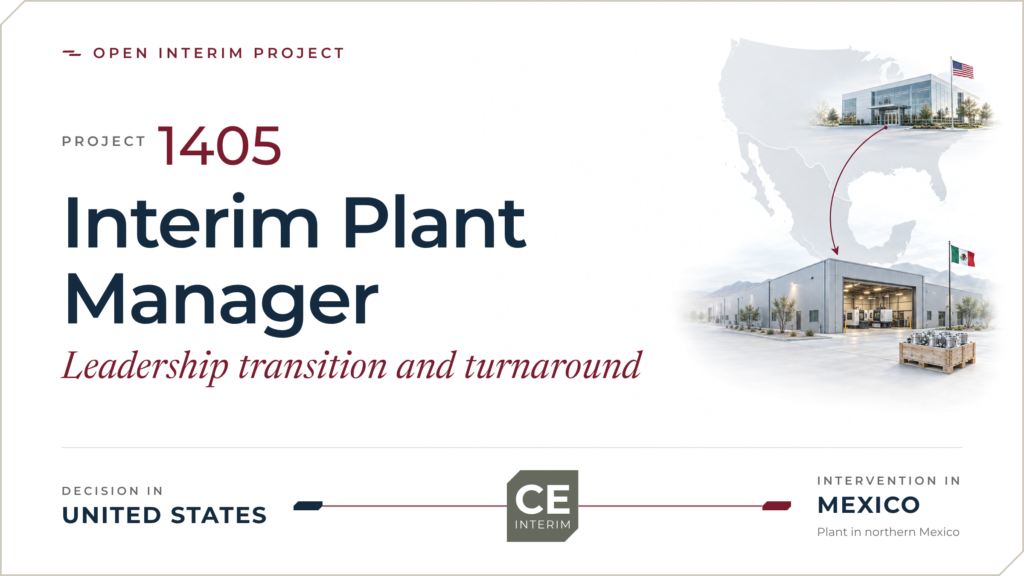
Thank you for the time and thought you invested in this mandate. Being considered at all meant that your experience was credible against a demanding brief. The search drew a large response, and the interim executives who reached the later stages were all experienced plant leaders with real results behind them. Interim decisions are rarely about general quality. They come down to a narrow combination of factors: how closely an executive’s past situations mirror the present one, the type of equipment and scale involved, the stage of the change programme, and how quickly the owners can picture that person taking control on day one. This note explains the profile that matched this particular mandate most closely, so that you can see how the assessment was made and use it for future opportunities. What the client really needed On paper this was a plant manager role. In reality it was a leadership handover in the middle of an operational recovery. A long-serving site leader was leaving on a known date, the plant was part-way through improving its performance, and the owners wanted to protect the progress already made rather than restart it under a new name. The site was small and highly mechanised. Much of the output depended on older, mechanically complex automatic machines, each operator running several of them at once. The skills needed to set up and maintain that equipment had been built up internally over many years and sat largely in the heads of experienced employees. Ownership and the plant also sat in different countries and worked in different languages. The executive would report directly to the top of the group while leading a small local management team every day on the floor. In practice the mandate asked for five things at the same time: The profile that fit this mandate most closely Across the brief and the interviews, a clear picture emerged of the executive this situation called for. None of the points below is unusual on its own. What mattered was finding them together in one person. 1. Repeated experience of taking over a plant mid-change The strongest fit was an executive who had already stepped into several plants during a leadership transition or a recovery, and who could show the numbers before and after. That mattered because the immediate task was continuity under pressure. The owners wanted someone who had lived through this exact moment before, not someone who would be learning it on site. 2. Hands-on depth with the plant’s actual equipment General high-volume or automated manufacturing experience was common across the shortlist. Direct, personal experience of running and setting up older automatic machining equipment, with operators covering several machines each, was much rarer. Where this was present, the executive could talk credibly with the people who run the machines from the first day. Where it was absent, the owners had to accept a learning curve during a period when they had little room for one. 3. Comfort at the scale of a small site Several strong profiles came from leading large, multi-site organisations with deep support functions. This plant had only a handful of managers. The closest fit was an executive who was at ease being the senior engineer, the maintenance escalation point and the customer contact at the same time, without the layers a large operation provides. 4. Maintenance discipline on ageing assets Equipment effectiveness on older machines depends on maintenance routines, set-up times and spare parts as much as on production planning. Profiles that had personally built preventive maintenance systems and developed local technicians aligned closely with the real constraint in the plant. 5. A respectful way of capturing know-how held by people The owners were clear that the workforce was not resistant to change, but needed to understand why it was happening. The best fit was an executive whose first step is to observe and learn before changing anything, and who then turns undocumented experience into standard work without making long-serving employees feel replaced. 6. A natural bridge between owners and plant The role required fluent communication with the shop floor in its own language and clear, concise reporting to group leadership in theirs. The closest fit had done this before, under foreign ownership, and could hold local accountability while keeping headquarters fully informed. 7. A genuine interim track record and immediate availability Finally, the owners needed someone who could start before the outgoing leader left, commit to full-time presence on site and work under an interim mandate with a clear handover at the end. A history of completed interim assignments, rather than permanent roles alone, gave additional confidence that the executive would deliver within a defined period and then step away cleanly. Why strong candidates may still not have been taken forward Most of the executives considered met the majority of the formal requirements. The difference was in how many of the points above were evidenced together, and how directly. In a short, time-critical mandate, the owners were effectively answering a small set of questions: A profile with excellent results in a larger or more modern environment could still score lower on two or three of these questions. That reflects the narrowness of this mandate, not the strength of the executive. What you can learn from this for future interim projects One honest final note At the final stage, owners also weigh how quickly they can picture an executive taking control in their particular plant, with their people and their equipment. That judgement is partly about evidence and partly about confidence. It is legitimate when it is based on the business situation, and it is often decided by small margins. Your experience remains relevant, and we will continue to consider you for mandates where your background matches the situation closely. Why work with us? CE Interim delivers proven, mandate-matched executive interim leaders, ready to start within 72 hours of a completed mandate brief, across borders, cultures, and industries. We specialise in high-impact interim management for private equity firms,
L'Europe procède à une restructuration de sa chaîne d'approvisionnement automobile. Toutes les usines ne suivent pas la même voie.
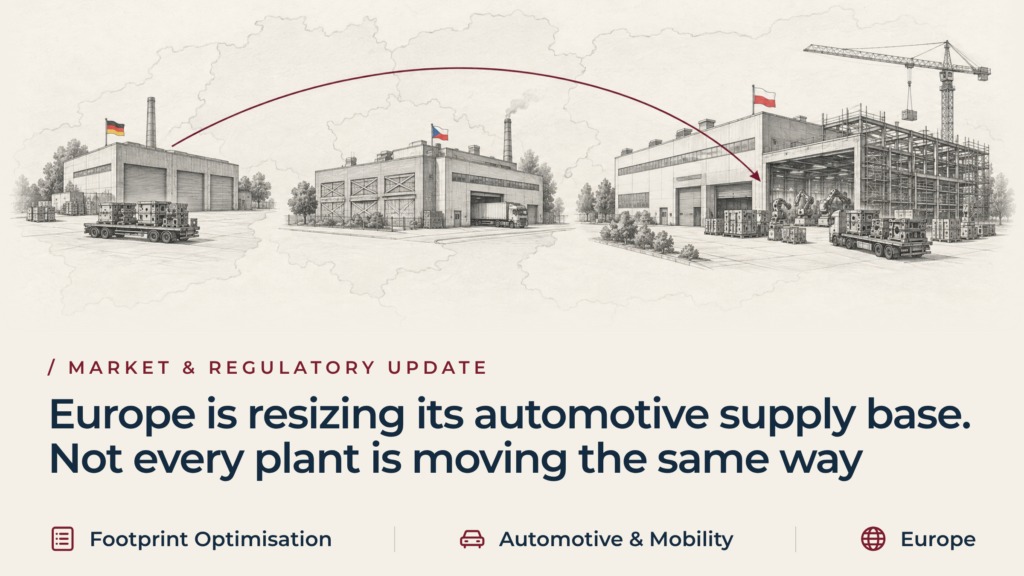
La restructuration des équipementiers automobiles en 2026 ne se résume pas à une seule vague de fermetures. Certaines usines voient leur activité réduite de moitié et sont maintenues en activité, d’autres sont fermées et délocalisées, tandis que d’autres encore se voient confier ces activités.
Quelles sont les conséquences de la suppression d'une équipe de production ?
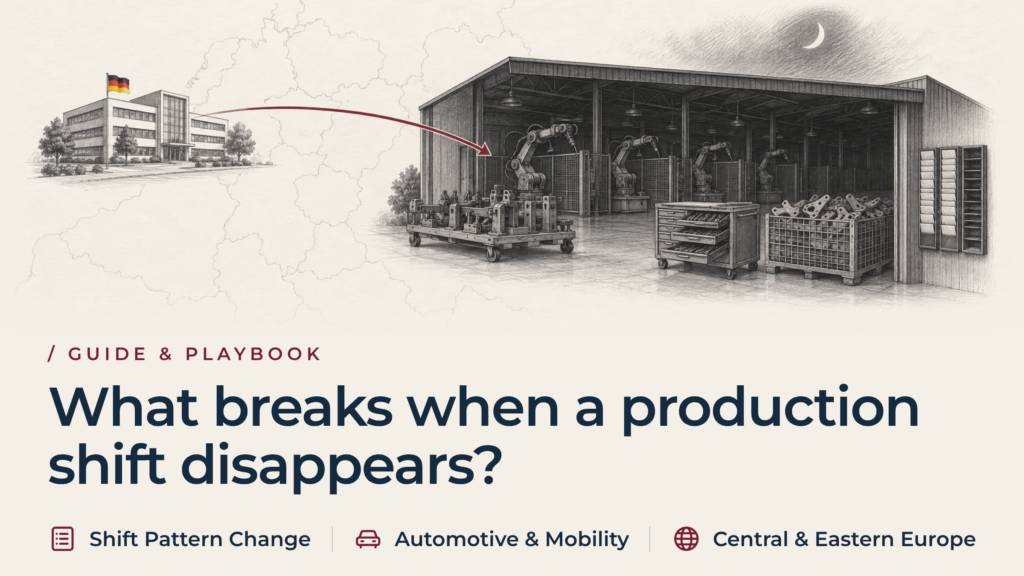
La suppression d'une équipe de production permet de réduire les coûts sur le papier, mais les créneaux de maintenance, les changements de production, la supervision et la gestion des incidents doivent tous être réaffectés ailleurs.
Le siège allemand a approuvé la restructuration d'une usine tchèque. Quel sera le coût de ces économies ?

Un conseil d'administration approuve un objectif d'économies annuel, mais les coûts liés à la restructuration de l'usine nécessaires pour y parvenir sont rarement évalués dans leur intégralité. Les catégories à définir en premier lieu.
Votre usine polonaise a un objectif en termes d'effectifs. Les tâches ont-elles été réorganisées en conséquence ?
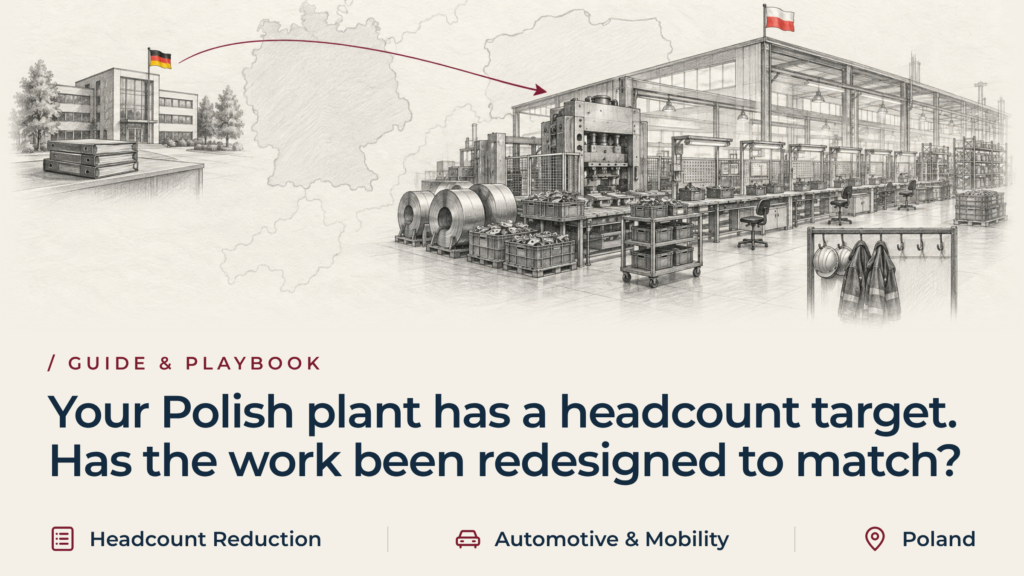
Une réduction des effectifs dans une usine permet de réduire la masse salariale, mais pas la charge de travail. Découvrez ce qu'il faut repenser ou supprimer pour qu'une usine polonaise de taille réduite puisse respecter les mêmes engagements.
Lorsque plusieurs usines de CEE modifient leurs capacités de production simultanément, qui définit l'ordre dans lequel ces changements doivent être mis en œuvre ?

La restructuration d'une usine multi-sites en Europe centrale et orientale se heurte à des difficultés lorsque les réductions d'effectifs, les transferts et les montées en puissance se déroulent en parallèle. Qui a le pouvoir de faire attendre un site ?
La production est délocalisée en Slovaquie. Qui est responsable du plan de capacité du site d'accueil ?
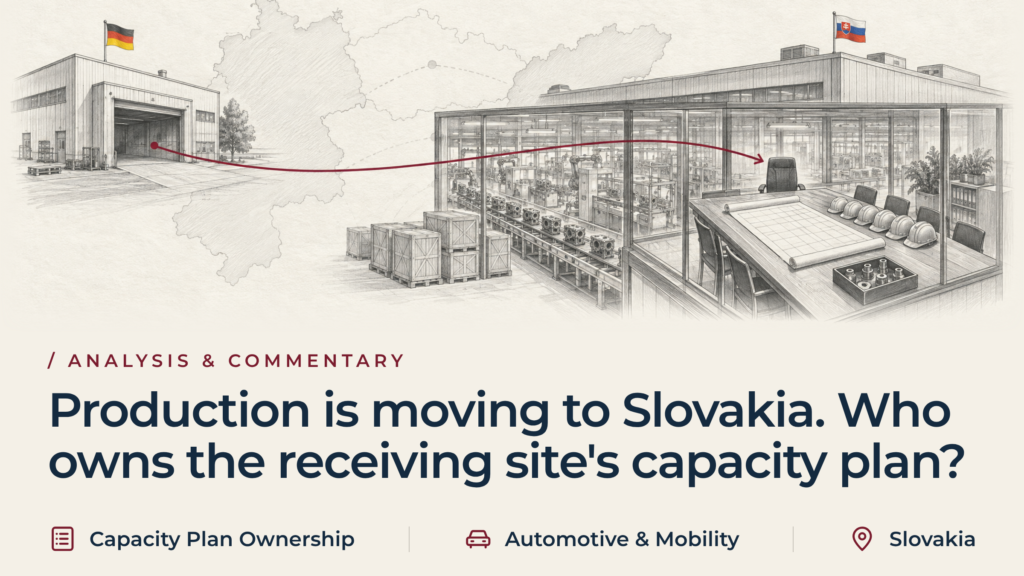
Une usine de réception chargée du transfert de production prend en charge le volume, les risques liés au lancement et la charge de gestion, tandis que ses propres clients continuent d'attendre une production normale. À qui appartient-elle ?
À partir de quand un problème de qualité devient-il un problème nécessitant la remise en état de l'usine ?
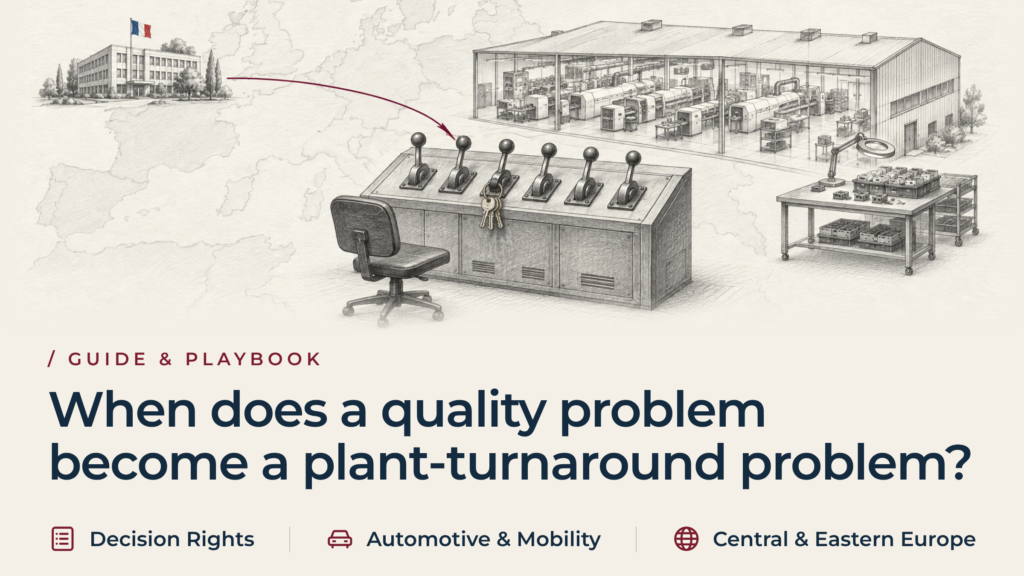
Il existe un seuil de redressement des usines confrontées à des problèmes de qualité : les causes relèvent de six fonctions qu’aucun directeur de la qualité ne peut contrôler. Ce que les conseils d’administration doivent reconnaître en priorité.
Le siège allemand estime que l'usine tchèque respecte ses objectifs. Le nombre d'heures de retouche indique que la capacité est déjà épuisée.
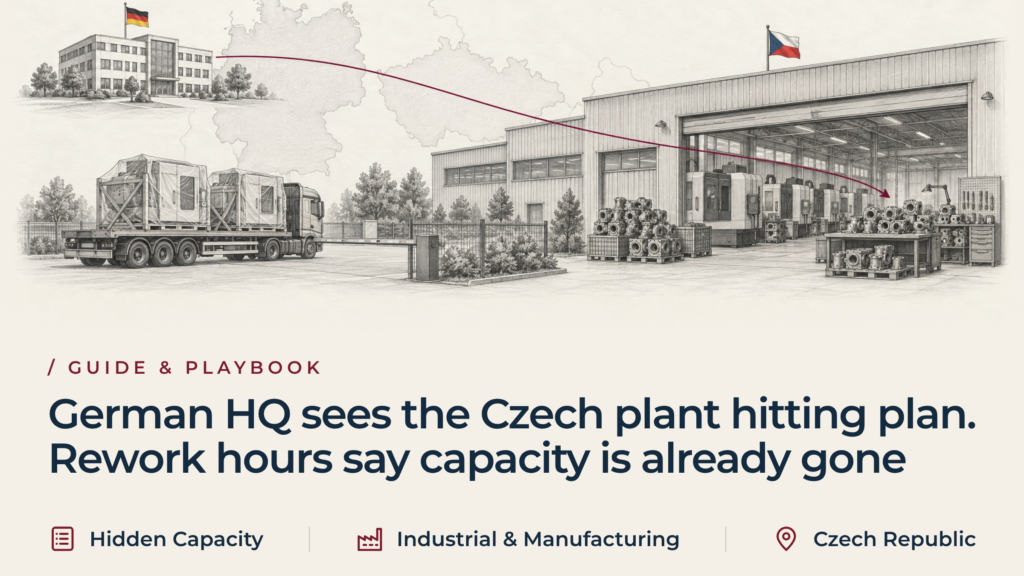
Une usine tchèque demande une augmentation de sa capacité de production. Avant de donner votre accord, évaluez le coût actuel des retouches qui mobilisent la capacité de production, ainsi que le volume de production qu’elles permettent déjà d’assurer.
Avant d'ajouter une équipe supplémentaire en Roumanie, déterminez la part de la production que représentent les retouches.
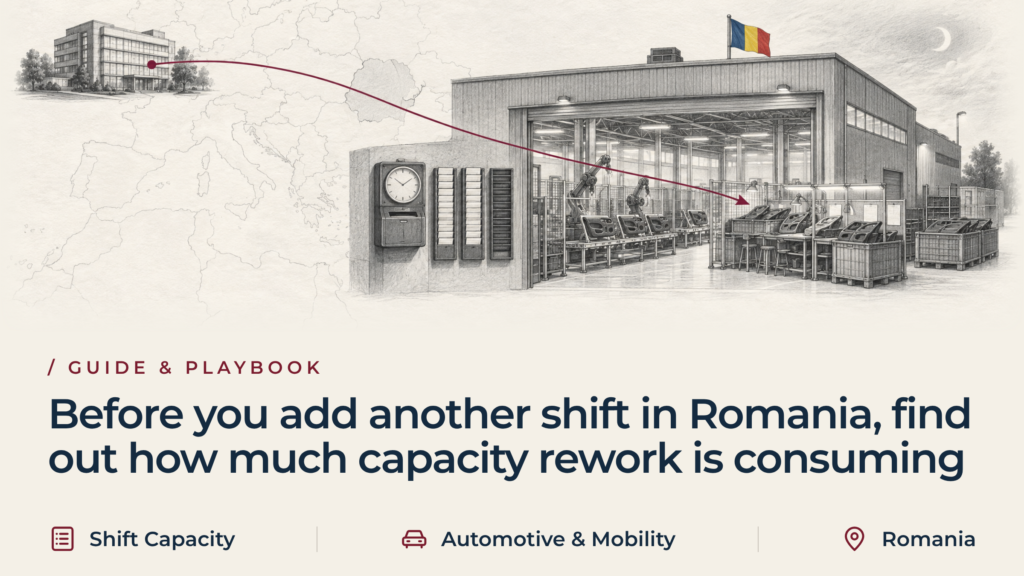
Un site roumain souhaite que davantage d'opérateurs assurent la protection des livraisons. La décision de prolonger les équipes ou de réduire les retouches en production dépend avant tout de la capacité de production de produits conformes dont il dispose déjà et de celle qu'il est en train de perdre.
 EN
 DE
 FR
 IT
 PL
 RO
 CS
 SK
 HU
 ES
 RU
 AR
 SL