

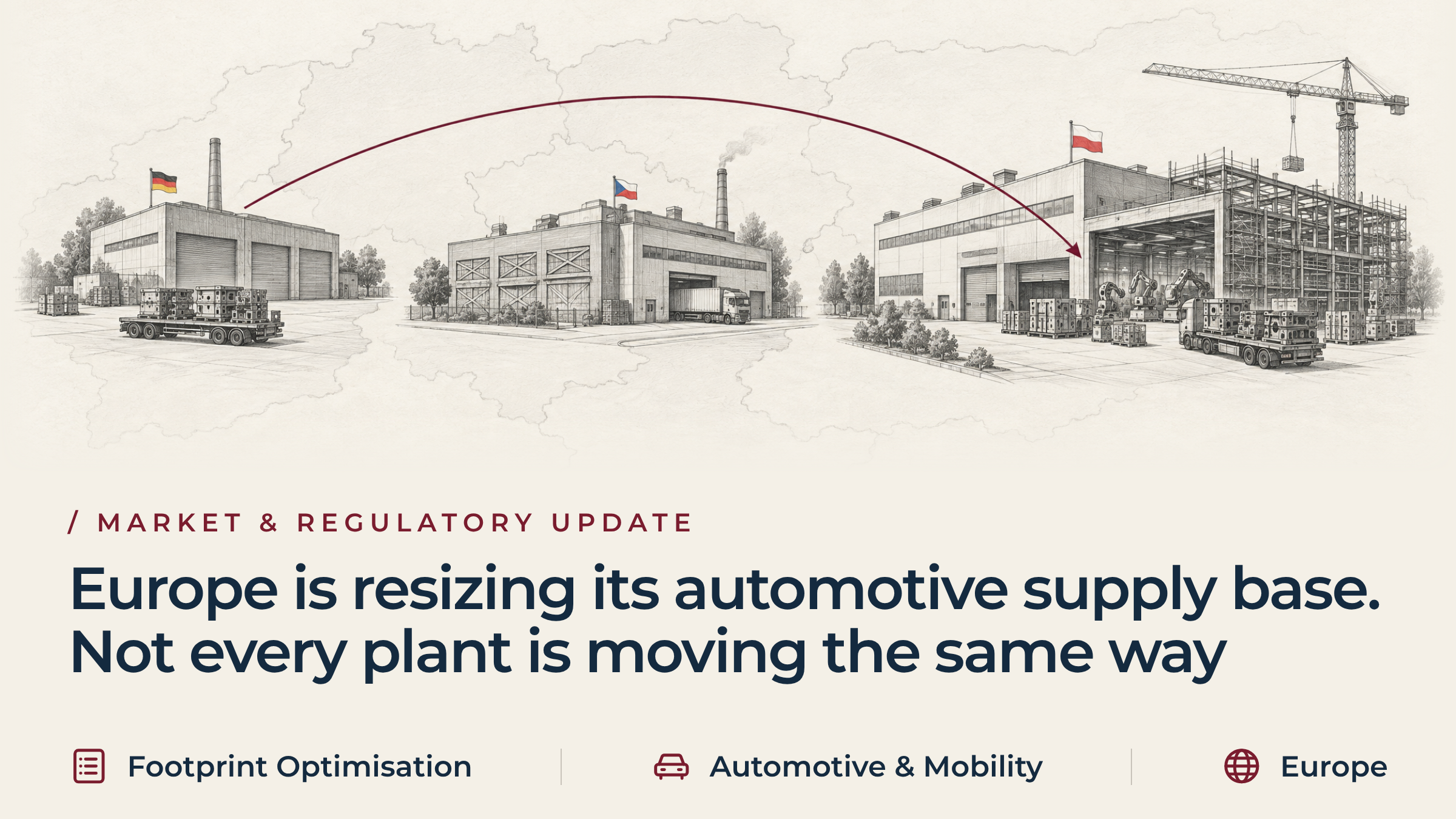
Европа перестраивает свою базу поставщиков для автомобильной промышленности. Не все заводы следуют одному и тому же пути
Вкратце
Executives often read automotive supplier restructuring across Europe as one closure wave. The documented pattern is different. Verified 2026 cases show three things at once. Some plants are halved in size and still running. Others are closed, with production moved elsewhere. Still others are expanding to receive that relocated work.
A group that applies one template to all three makes two mistakes at once. It starves the sites meant to receive new volume. It also claims credit for the sites it has simply closed. That distinction matters more than the headline job-cut figure. It is the first fact a board needs before it decides where its own plants sit.
Strategic triggers: how OEM demand shifts drive supplier capacity reduction
An executive committee sits down to reconfigure its European manufacturing footprint. Vehicle demand forecasts from its OEM customers have softened. Battery electric vehicle demand has not matched the group's own projections. Component pricing pressure has not eased. Leadership concludes that its fixed cost base no longer fits current volumes across Germany, France and Central and Eastern Europe.
The difficulty is not that conclusion. It is the comparison the board makes next. European automotive suppliers announced 18,900 job cuts in the first half of 2026, according to CLEPA's Data Digest 27. The natural instinct is to read that figure as an instruction to cut everywhere, now. CLEPA describes these as announced reductions, not completed ones. The figure says nothing about the plants that stay open. It says nothing about the plants absorbing work that leaves somewhere else.
A board that reads the headline instead of the pattern makes a specific error. It can dismantle a manufacturing competence in one country. At the same time, it can load an unprepared plant elsewhere with volume that plant cannot yet receive. That is what automotive supplier restructuring looks like when a board moves before it maps the pattern underneath the headline.
Cross-border execution: regulatory and labor dynamics in European supplier restructuring
Reading automotive supplier restructuring across borders is harder than reading it from one head office. The trend and the decision sit at different levels. The trend is European: trade imbalances, platform rationalisation, and a gap between projected and actual electric vehicle volumes. The decision is always national.
Every closure, headcount reduction or production transfer happens under one country's own labour law and works council agreement. It also depends on the local supplier base and that site's own physical constraints.
Eurofound's overview of 22 July 2026 makes a point worth holding onto. The reshaping of Europe's automotive supply base is geographically uneven. It does not run in a straight line from west to east. Some western plants are shedding headcount while keeping automation that is expensive to replace.
Some Central European plants are absorbing deep workforce cuts while staying fully operational. Other Central and Eastern European sites are becoming the destination for transferred lines, not the source of the next cut.
None of this tells a board what its own sites are doing. It tells the board what question to ask before it decides.
Three strategic trajectories: resized sites, plant closures, and relocation destinations
This is what automotive supplier restructuring actually looks like on the ground. Executive teams that get this right sort their own plants into one of three documented trajectories, not one closure story. Three verified 2026 cases illustrate each position:
- Reduced and retained. The site shrinks and keeps running. Eurofound's factsheet 300818 covers JTEKT Czech Republic, dated 1 August 2026. It records roughly 300 positions eliminated, close to half the workforce. The plant remained operational throughout.
- Closed and relocated. The site stops and the work moves elsewhere. Eurofound's factsheet on Inteva Products, numbered 300403, records a Czech plant closure with production relocated to Romania.
- Receiving transferred volume. The site stays open and absorbs someone else's closed line. Eurofound's factsheet on Lear's Gründau closure (11 August 2026, factsheet 300875) records the outcome. Capacity transferred from Germany to Slovakia, Serbia and Tunisia.
None of these three cases proves what caused the restructuring, and none forecasts which plant closes next. They record three different outcomes, happening inside the same sector at the same time.
1. Reduced and retained: operational adaptation in resized manufacturing plants
A plant in this position is not closing. The group is asking it to keep delivering the same output, or close to it, with far fewer people. That is an operating model question, not a headcount question.
Shift patterns compress, cycle times rebalance, and the plant still has to hold its existing quality certification. A site cannot simply work fewer hours. It has to re-sequence machine changeovers and material flow to carry the same delivery commitment on a smaller base.
2. Closed and relocated: managing wind-downs and production transfer to Romania and CEE
A plant in this position is winding down. The operational focus moves entirely to the close itself. The team has to handle severance correctly. It has to build a customer safety stock before the lines stop. It then decommissions the equipment and releases the site on environmental terms.
Eurofound's Inteva record shows that closure and production relocation are often the same event, not two separate ones. The work does not disappear. It goes to Romania, or wherever the receiving plant sits.
3. Receiving transferred volume: industrialisation challenges in CEE expansion sites
Groups often treat a plant in this position as a free win, which is exactly why it ends up under-resourced. Absorbing someone else's closed line takes more than space on the floor. It needs new electrical and pneumatic connections and a fresh customer part approval. It also needs extra people and a commissioning programme layered on top of the plant's own schedule.
Lear's multi-country transfer out of Gründau, split across Slovakia, Serbia and Tunisia, shows what this looks like at scale. Three receiving sites became three separate integration projects, running at once.
Operational risks: why uniform cost-cutting templates fail across diverse sites
This is where automotive supplier restructuring most often goes wrong operationally. A uniform percentage target does not fail the same way at all three trajectories. It produces three different, and predictable, operational consequences:
- At a plant the group resizes and keeps open, a blanket cut removes staff it still needs elsewhere. Those are often the engineers a receiving site needs to install transferred tooling.
- At a receiving plant, treating the transfer as a free addition, not a launch, produces severe delivery arrears. Arrears severe enough can put a customer on controlled shipping.
- At a plant the group is closing, fixing the decommissioning date too early exposes the customer to a parts shortage. That happens when the receiving site has not yet achieved certified part approval.
None of the three plants did anything wrong on its own. The error sits one level up, in a target that assumed every site was the same kind of site.
Case study: managing a multi-plant stamping and tooling relocation to Poland and CEE
The clearest way to see this automotive supplier restructuring risk in practice is a mandate CE Interim carried. A group had got the sequencing wrong, and then corrected it.
The challenge: bottlenecks and delivery delays from uniform headcount mandates
A tier-1, German-headquartered supplier of seating mechanisms and structural pressings ran four plants, in Germany, Poland, Czechia and Romania. Facing group-wide margin pressure, the board announced a uniform 15 per cent headcount reduction across all four sites. At the same time, it ordered the closure of an older German stamping plant. The group gave itself six months to transfer that plant's production to Poland and Romania.
Four months in, the plan had stalled. The Polish plant had already removed 45 operators and five manufacturing engineers to hit its own headcount target. That was the same target applied to every other site in the group. Then fourteen heavy stamping dies and four robotic welding cells arrived from Germany, with nowhere ready to receive them. Tooling queued on the shipping dock, because the floor space it needed was still running the plant's existing programme. The plant's remaining engineers had no slack left. They absorbed the tooling installation on top of daily firefighting, not instead of it.
Micro-stoppages spread through lines that had nothing to do with the transfer. Delivery compliance fell from 98.5 per cent to 74 per cent within a few weeks. One OEM customer put the entire group on Controlled Shipping Level 1. It also threatened a New Business On Hold freeze across every future platform the group was bidding for.
The solution: restructuring governance and stabilising CEE operations in 11 weeks
The group's chief executive engaged CE Interim. CE Interim sent its standard profile: an already vetted, mandate-matched, NDA-bound executive ready to start after the completed mandate brief. On site in Poland, that executive took over as Interim Operations Director, carrying network-wide authority over the relocation programme.
A CE Interim Partner stayed engaged with the group's chief executive throughout the mandate. The Partner reviewed progress and escalation points alongside the interim executive on site.
The diagnosis took days, not weeks. Headquarters had treated the Polish site as a place to cut cost, not as an active receiving plant. Before the German tooling even arrived, that plant was already running at 94 per cent capacity utilisation.
Its engineering team had no spare capacity for tool recommissioning or press foundation work. It also had none left for the customer approvals the transferred lines still needed.
The interim executive ran three changes at once.
- Ring-fenced the Polish site from the group-wide headcount freeze. A temporary industrialisation team then handled foundations, crane access and machine commissioning, without touching the running lines.
- Re-sequenced the transfer and negotiated an eight-week extension to the German customer safety stock. German lines stayed live until the Polish and Romanian tooling reached certified process capability above 1.67 Cpk.
- Built one cross-border governance board, covering engineering, quality and supply chain across the departing and receiving sites. Daily tracking covered tool recertification and OEM approvals.
Within eleven weeks the transfer stabilised. The relocated lines achieved full production part approval. Delivery compliance recovered to 99.6 per cent, and the OEM lifted Controlled Shipping. The group kept its €6.2 million in permanent annual conversion savings from the German closure. Both CEE operations stayed stable throughout the transfer.
Interim leadership in cross-border automotive supplier restructuring
A seasoned industrialisation function can sometimes deliver a restructuring on its own. It needs to lead on-site commissioning and negotiate a customer safety stock extension. It also needs to keep local plant managers focused on running their own operation, not someone else's transfer. A cost target on its own is not a reason to bring in outside leadership.
Independent executive authority matters once automotive supplier restructuring needs trade-offs across more than one border and more than one site. Nobody reasonably expects a plant manager facing closure in Germany to prioritise a Polish plant's launch.
A site director in Czechia or Romania cannot credibly resist a group target built for every site alike. An interim executive with network-wide authority can hold both sides to one sequence and one set of facts. That authority also protects delivery to the OEM while the transfer runs.
Frequently asked questions about European automotive plant closures and relocation
Is the 2026 wave of European automotive plant closures a single uniform trend?
No. The documented 2026 cases show three different outcomes at once. Some plants are halved in size and kept open. Some are closed, with production relocated elsewhere. Others are expanding to receive that relocated work. Reading the pattern as a single closure wave misses the sites that are actually growing.
Which regions in Central and Eastern Europe are receiving relocated production lines?
Documented 2026 transfers move toward Central and Eastern Europe, including Poland, Romania, Slovakia and Serbia. Some volume also moves outside the region, to sites such as Tunisia. Production relocation across Europe in 2026 rarely stays inside a single corridor. One closure can split volume across several receiving countries at once, as Lear's Gründau transfer shows.
Are Central and Eastern European plants experiencing headcount reductions alongside expansions?
No. Several CEE sites are absorbing significant headcount reductions of their own. At the same time, groups are designating other CEE sites to receive transferred work. Supplier capacity reduction and supplier capacity expansion are both happening across CEE, often in neighbouring countries.
What does "geographically uneven" restructuring mean for group footprint planning?
It means groups are not adding or removing capacity on one simple regional rule. Eurofound's own overview describes the pattern as uneven by design. The outcome for any one plant depends on its component technology, its customer exposure and its own unit economics. It does not depend on which side of a border that plant happens to sit.
What operational facts should a board verify before approving multi-site plant closures?
Before signing, a board should know where each of its own plants sits among the three trajectories. It should know whether a receiving site has the engineering bandwidth and floor space to absorb incoming work. It should also confirm that a customer safety stock exists to cover the gap while new lines complete certification. Establishing these facts costs far less than discovering their absence after an OEM has already escalated.
Should automotive suppliers apply uniform headcount cuts across all manufacturing sites?
No. The same restructuring wave includes sites that groups are asking to grow, not shrink. A group that applies one cost target to every site, regardless of trajectory, risks under-resourcing some plants. Those are the plants it needs to absorb work leaving somewhere else.
Связанные знания и дальнейшие действия
Automotive supplier restructuring becomes a plan, not just a pattern, only at the level of one group and one site. One cost target applied to plants in three different positions starves the site meant to receive new work, and risks the delivery failure that puts a customer on controlled shipping.
Рекомендуемые материалы:
- Закрытие заводов Mondi в Бжезно и Шаде: управление переходом клиентов и перемещением активов в рамках реструктуризации упаковочных заводов
- Закрытие завода Electrolux в Ясберени: организация работ в ходе восьмимесячного периода сворачивания деятельности
- Когда европейский концерн закрывает автомобильный завод в США: решения совета директоров, которые нельзя делегировать
CE Interim provides cross-border executive leadership for exactly this kind of transition. It sends an already vetted, mandate-matched, NDA-bound executive, ready to start after the completed mandate brief. When the pattern in your own footprint needs to become a site-level plan, talk to a Временный партнер CE.
 EN
 DE
 FR
 IT
 PL
 RO
 CS
 SK
 HU
 ES
 RU
 AR
 SL