
Вкратце
Post-merger product consolidation looks simple in a synergy model and complicated inside a customer's plant. In industrial equipment with service obligations, a customer's drawings, approvals and maintenance plan may name the product. Before retiring a product, establish how customers use it and whether the replacement fits their equipment. Then confirm what the contracts oblige the group to supply and who owns the migration. Retire the product once qualified owners have signed each step.
Post-Merger Product Consolidation vs. Customer Installation Realities
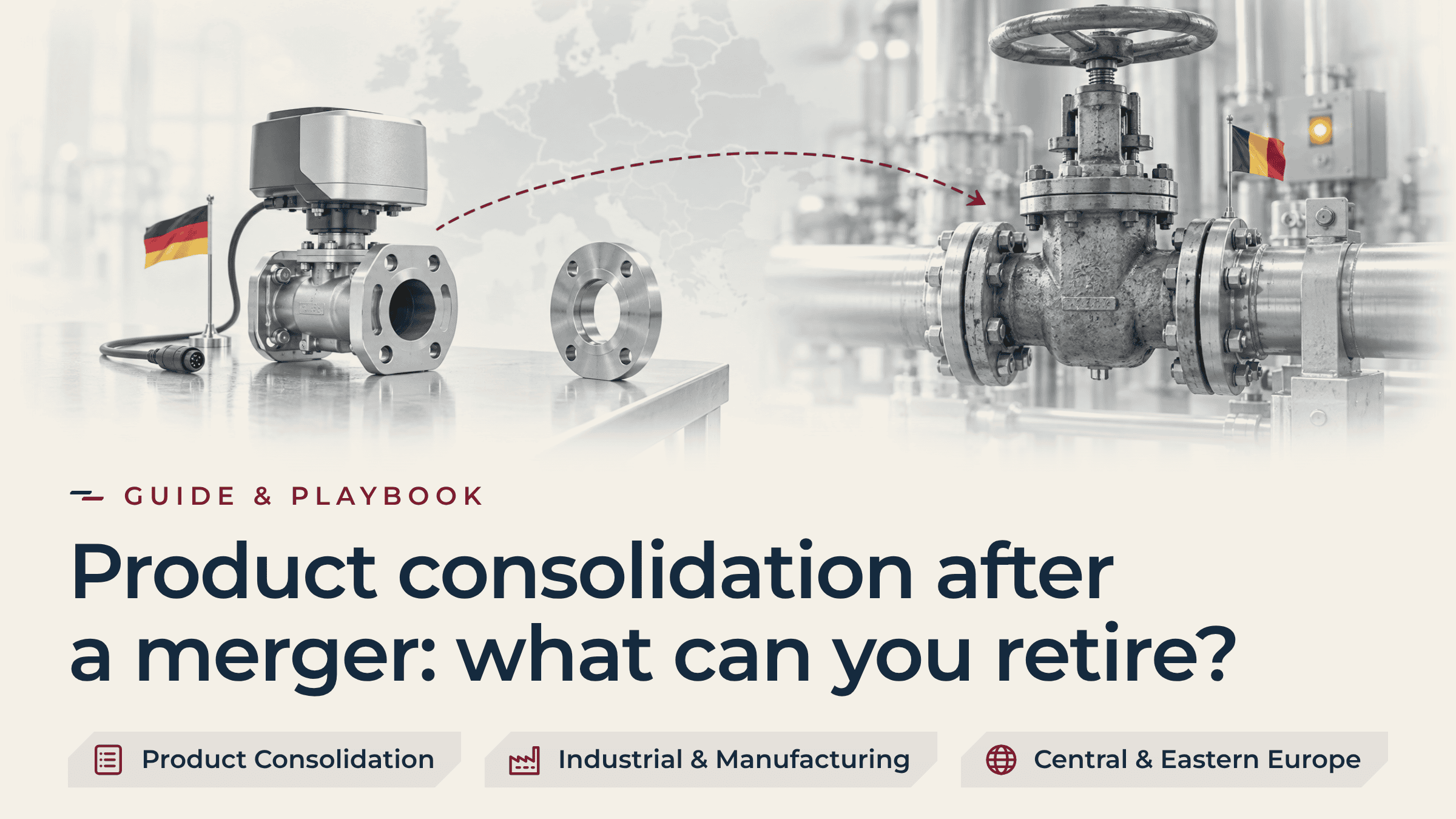
After an industrial acquisition, the deal model flags overlapping product families. Merging the parallel lines promises less duplicate tooling, consolidated buying and fewer changeovers. The synergy case for post-merger product consolidation is reasonable. The group retires the acquired company's legacy pump, valve or hydraulic motor line. The parent's flagship model takes its place.
Within weeks, critical industrial accounts send formal notices. The apparently duplicate component sits inside their equipment by design. Its mounting dimensions, thermal tolerances and certifications do not match the parent's alternative.
The sponsor now faces a real trade-off. Pausing the retirement disrupts the synergy timeline the Board has seen and prolongs two manufacturing footprints. Enforcing it can halt customer production, put equipment warranties in question and move orders to competing component makers.
The deal model does not show what sits inside the customer's installation.
M&A Integration Survey Data: Synergies and Decision Gaps
PwC's 2026 M&A Integration Survey found that only about one in three acquirers fully achieved all prioritised deal objectives. It covers 530 C-suite executives and senior dealmakers at companies with US$1 billion or more in annual revenue. Respondents reported their own results.
PwC attributes the shortfall to a decision gap between the deal thesis and the choices needed to deliver it. A delayed decision, it warns, can cost the buyer customers.
EY-Parthenon's тематическое исследование follows an industrial equipment manufacturer that bought a parts supplier. The target's sales team knew how equipment was configured for different clients. The integration team drew on that knowledge in shaping synergies.
Catalogue Equivalence vs. Customer Product Migration Equivalence
An experienced operations executive starts from the customer's installation, not the catalogue. The customer's drawings, contracts and approvals are the reliable facts. Treat ERP sales history with caution. It shows who bought a part, not which machine uses it or which certificate names it.
Post-merger product consolidation rests on one assumption: that two products with the same function are interchangeable. Test four barriers before scheduling any retirement:
- Mechanical envelope. Mounting patterns, shaft diameters, connection threads and weight distribution must match the customer's assembly.
- Duty-cycle tolerances. Temperature, vibration, pressure and chemical compatibility can differ between older mechanical designs and modern electronic platforms.
- Customer engineering integration. In original equipment manufacturer (OEM) supply, the component sits in the customer's CAD libraries, assembly manuals and bills of materials.
- Approvals and standards. Automotive (IATF 16949), aerospace, medical, railway and energy customers run formal change control. Automotive supply uses the Production Part Approval Process (PPAP).
If the replacement is not a drop-in fit, a notice alone will not retire the product. The change needs a funded customer product migration, led by a named owner.
Manufacturing Footprint Operations: Hungarian and Romanian Facility Case Study
The physical complexities of product consolidation are particularly acute across Central and Eastern European industrial manufacturing hubs. Consider an illustrative, representative operating setting. A French or German industrial engineering group acquires a regional manufacturer of heavy fluid-handling systems. Its primary production plants sit in Győr, Hungary, and Timișoara, Romania.
Product Portfolio Review and Legacy Product Assessment
Following closing, corporate product managers in Frankfurt review the combined product portfolio:
- The German parent manufactures a modern, electronically modulated industrial valve line priced at a premium, engineered to standard DIN/ISO specifications.
- The acquired Romanian manufacturing plant produces a rugged, mechanically actuated legacy valve line. The plant has manufactured the line continuously for twenty years.
Corporate management marks the Romanian valve family for immediate retirement within six months. It notifies customers that the group will fulfil all future orders with the German electronically modulated alternative.
OEM Customer Feedback and Customer Product Migration Constraints
The operational backlash from European OEM customers is immediate:
- Physical fit and geometric constraints: The customer's industrial machinery has a fixed physical envelope. While technically more advanced, the German valve has a different port configuration. It also requires electrical power and control integration that the client's mechanical field installations do not have.
- Regulatory and safety decertification: In chemical processing and energy infrastructure applications, safety regulators certify the customer's equipment. The certification names the Romanian valve by exact part number. Substituting the component invalidates the customer's operational permit, requiring a costly twelve-month recertification process.
- Spares and warranty commitments: The acquired business has contractual obligations to supply exact replacement components and wear kits. These obligations run for ten years following the installation of capital equipment. Ceasing production breaches these long-term service agreements, exposing the group to substantial liquidated damages.
The acquirer finds that an administrative decision has created 8 million euros in contractual liabilities. The decision aimed to save 1.5 million euros in factory changeovers. It also exposes key customer accounts to defection.
Legacy Product Retirement: Evaluation of Strategic Options and Costs
The decision is rarely retire or keep. The sponsor chooses between three paths, and each moves cost and risk to a different place:
- Keep both lines for now. Customers see no change, and the group carries two footprints until the facts are clear.
- Phase one line out through last-time buys. Customers place final orders to cover their service needs.
- Migrate to a funded replacement. The group proves drop-in fit or helps fund the customer's re-engineering. It takes longest but best protects the account.
The synergy date can wait. The customer's stated obligations cannot. Choose once the installed-base facts are reliable.
The Product Migration Framework: 8 Criteria for Product Retirement
In post-merger product consolidation, a product leaves the catalogue once a named signatory has cleared every condition below. The gate is a management aid, not a universal certification process.
- Affected offering. Engineering and the plant operations lead sign off part numbers, drawings, tooling status and volumes.
- Customer installed base. The Commercial Director confirms active customers, equipment models and revenue at risk.
- Contracts, spares and warranty. Legal counsel audits availability and warranty obligations.
- Proposed replacement. The Application Engineering Lead confirms drop-in status or maps the customer's redesign.
- Customer approval. The team maps requalification steps, such as PPAP or field trials, and records written consent.
- Legacy spares and support. The Operations Director approves a spares plan covering the contract period.
- Transition owner. One accountable executive coordinates engineering, plants and sales.
- Release. The Group COO and the plant's Managing Director jointly authorise ending series production.
Applying Migration Gate Criteria to Valve Line Consolidation
The valve line above is an illustration, and its figures are editorial constructs, not a CE Interim mandate. Run before the notice, the gate would have started with a fact base that Frankfurt and both plants trust.
- Specify the line. The plant lead documents part numbers, drawings and tooling status.
- Map the installed base. The Commercial Director lists every OEM customer, its equipment and the revenue at risk.
- Read the contracts. Legal counsel reviews the ten-year spares and wear-kit obligations. The 8 million euros of exposure becomes visible here, before any customer escalates.
- Test the replacement. Application engineering checks port configuration, power supply and control integration. The German valve fails the drop-in test.
- Compare the calendars. Customer recertification takes twelve months and the notice allows six. The retirement date has to follow the customer's calendar.
- Name the owner. One executive owns the migration across engineering, plants and sales.
The 1.5 million euros of changeover saving remains available, at a date customers can support. The group also avoids testing the 8 million euros of exposure on its most important accounts.
Managing Cross-Border Operations and Integration Gaps
Group headquarters takes the catalogue decision. The customer contract, the part-number approval and the spares promise can sit with the local plant and its customer contacts. Neither side holds the whole picture.
Headquarters needs a simple portfolio and reliable margin data. The plants need realistic timelines and protection from conflicting instructions. Both needs are legitimate. The first task is a fact base both sides accept: affected customers, obligations and the replacement's fit.
Governance and Authority for Post-Merger Product Rationalisation
Commercial and financial leaders own the synergy target, so the retirement proposal starts with them. The risk begins when the integration schedule drives questions that belong to engineering.
Three groups hold different parts of the decision:
- Commercial and financial leadership proposes candidates and weighs the trade-offs.
- Engineering and quality hold the technical sign-off. Without a drop-in fit, the product does not retire without an agreed customer redesign programme.
- Plant management confirms that the retirement respects local employment agreements, permits and delivery commitments.
The integration lead coordinates these owners and holds the timetable. Escalate when a customer disputes fit, a contract outlasts the retirement date or a signatory is missing. Overriding engineering clearance to meet a milestone can create product liability and warranty claims.
One decision stays with the Board: whether to proceed when customer exposure outweighs the synergy gain.
Product Rationalisation After Acquisition: Step-by-Step Retirement Execution
Once the gate clears a product, the retirement follows a staged sequence:
- Issue last-time-buy notice that matches the contracts and the customer's planning cycle. In the valve scenario, six months of notice is shorter than a twelve-month recertification.
- Fund customer re-engineering and qualification where migration needs it.
- Separate spares from series manufacturing.
- Retire the catalogue numbers last. Do it once affected customers confirm they have migrated or placed final orders.
Three options keep spares available after series production ends:
- Final-run inventory: build a multi-year spares stock.
- Preserved tooling: place tooling with a qualified contract manufacturer.
- Additive manufacturing: make non-critical parts on demand, with customer approval.
Frequently Asked Questions: Post-Merger Legacy Product Retirement
Are Similar Legacy Products Interchangeable During Customer Migration?
Not necessarily. Mounting dimensions, thermal behaviour, electrical interfaces and certifications can differ, and a catalogue comparison cannot show it. Application engineering must verify interchangeability against the customer's installation. Record a confirmed drop-in in writing. Otherwise treat the change as a migration with the customer's agreement.
Who Authorises Customer Product Migration Schedules?
In practice the customer decides. The acquirer can propose a replacement and supply technical data. The customer's engineering, quality and procurement teams judge whether it meets their specification and regulatory obligations. The acquirer's task is to make that decision easy with clear data, samples and one technical contact.
Can Integration Leaders Approve Technical Product Rationalisation Changes?
Not on its own. An integration executive coordinates the programme. Technical substitution needs sign-off from engineering, quality and responsible plant management, within the customer's change-control rules.
What Spare Parts Requirements Apply After Product Retirement?
Retiring a product from series production does not end after-sales obligations. Spare parts, wear components, repair services and technical documentation must stay available for the period in the customer contracts.
Interim Leadership for Post-Merger Integration and Product Migration
Keep the work with existing leaders when they have the capability, authority and time.
The picture changes when post-merger product consolidation crosses plants, countries and commercial teams and nobody owns it end to end. Daily plant escalations absorb engineering, and commercial managers focus on the quarter.
An Временный операционный директор fits when plant and service delivery sit at the centre. An Interim Integration or Carve-Out Director fits when the product decision depends on the wider integration programme.
The executive works inside the authority the client grants. In the first days, the executive establishes the installed-base facts and runs the gate with the named signatories. One picture goes to headquarters and the plants on an agreed reporting cadence. CE Interim stays involved through Partner support, quality oversight and escalation. The mandate ends with a handover to a permanent owner. See product portfolio management by interim experts.
Связанные знания и дальнейшие действия
Sending a notice before knowing the customer's calendar commits the group to a date customers cannot meet. The cost then arrives as contract claims and lost accounts, not as the synergy the model promised.
Рекомендуемые материалы:
- Этап внедрения ERP отмечен как завершённый. Что именно принимает на себя компания?
- Смена системы ERP кажется незначительным изменением. Кто утверждает её влияние на затраты и сроки запуска?
- Шаблон ERP для группы утвержден. Какие исключения для чешских заводов являются обоснованными?
When post-merger product consolidation depends on unresolved customer and service decisions, someone has to own the migration.
CE Interim provides cross-border executive leadership for critical business transformations. We provide an already vetted, mandate-matched, NDA-bound executive, ready to start after the completed mandate brief.
Поговорите с Временный партнер CE to define a bounded operating or integration mandate.
 EN
 DE
 FR
 IT
 PL
 RO
 CS
 SK
 HU
 ES
 RU
 AR
 SL