Вкратце
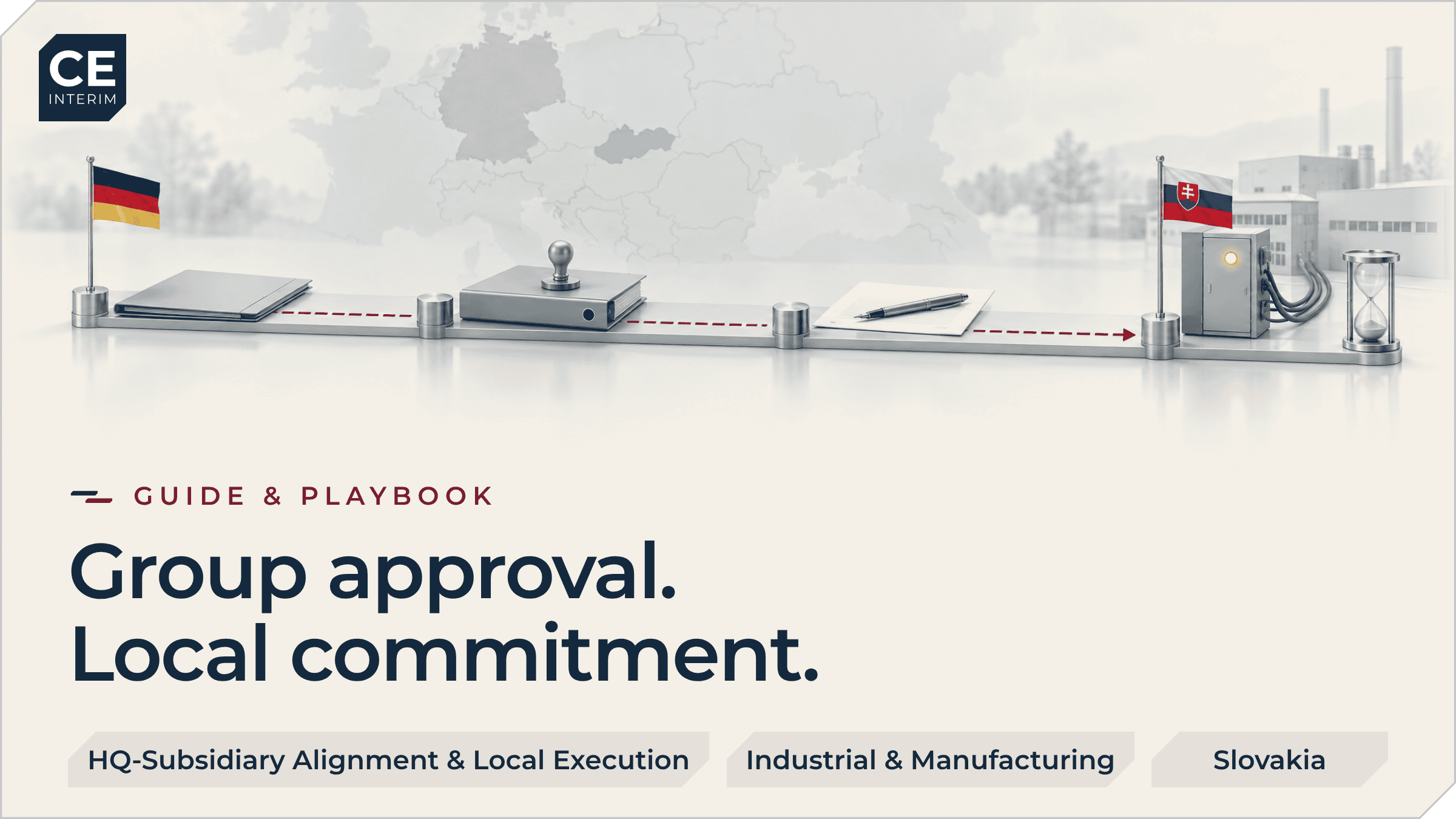
A group energy deal negotiated in Germany does not by itself bind a Slovak operating company. Slovak energy contract approval runs on a separate route. Identify the contracting entity and read the obligations it already holds. Record the internal approval, then take the signature from a person whose authority the Commercial Register confirms. The commercial recommendation, the group approval, the legal signature and the plant implementation are four responsibilities. Merging them leaves a subsidiary double-contracted, outside its switching window, or holding terms the plant cannot operate.
The proposal arrives at a factory, and the contract has to reach a company
The situation below is illustrative. A German parent runs a central tender for electricity across its European operations. Its Slovak plant appears as one delivery location. The contracting party in Slovakia is the Slovak operating company. That company holds its own statutory body, signing arrangements and supply agreement.
A factory site and a legal entity are not interchangeable. The site appears in the supplier's systems as metering points, the odberné miesto the distribution company recognises. Group energy procurement produces a recommendation for that company, not its consent. That gap also runs through German parent and local subsidiary cost pressure.
Read the obligations that already exist before discussing the new price
Slovak energy contract approval begins with the documents the subsidiary already holds, not with the group's proposal. Four of those facts matter most.
- the delivery sites and metering points the current contract covers
- the commercial structure, fixed, indexed or hybrid, and the period it runs
- the consumption assumed in the pricing, and any volume tolerance
- the renewal, notice and termination dates, and who may serve notice
Slovak suppliers include ZSE Energia, SPP, Slovenské elektrárne and VSE, each with its own onboarding documents. Act No. 259/2025 Coll. и Act No. 116/2026 Coll. have since amended the Energy Act, Act No. 251/2012 Coll. Since 1 January 2026 a supplier switch has to complete within three weeks of the request. The technical switch runs within 24 hours. No statutory notice period applies to business customers, so notice runs on the existing contract. A fast switch does not shorten a slow exit.
The consumption figure is the first thing to reconcile
Group energy procurement starts from consumption data. Where that data comes from group reporting rather than metered offtake, the tender price and the invoice diverge. ÚRSO decision 0417/2026/E of 29 September 2026 changed SEPS system-services tariffs mid-year. It set the group 1 tariff at €10.9796/MWh.
Евростат put the EU average non-household electricity price at €0.18/kWh in the first half of 2026. A falling European average is not evidence that this plant's delivered cost is falling.
Four responsibilities inside one group energy procurement decision
A proposal that reaches a subsidiary carries four responsibilities, easy to merge and difficult to separate afterwards. Each has its own owner.
- The commercial recommendation. Group procurement selects the supplier, structure and indicative terms.
- The internal approval. The owner decides, through the general meeting (valné zhromaždenie) or a documented delegation, that the company should contract.
- The legal signature. A person whose authority to bind the company is verifiable commits the entity.
- The operational implementation. The plant applies the accepted terms and reconciles the first invoices.
Slovak energy contract approval fails most often between the second and the third. The same person may hold more than one responsibility, where the documents support that. A konateľ who also sponsors the group tender can recommend and sign, provided the register shows that authority. The sequence that fails treats the recommendation as the approval, and the approval as the signature.
Slovak energy contract approval rests on verified authority, not assumed authority
Subsidiary contract authority: what the Commercial Register settles
Section 133 of the Commercial Code, Act No. 513/1991 Coll., makes one or more konatelia the statutory body of a spoločnosť s ručením obmedzeným. Where a company has several, each may act alone unless the articles provide otherwise. The Commercial Register of the Slovak Republic records that manner of acting. Entries at the Ministry of Justice can require joint signature above a threshold. One live extract, cited only as an example, lets each konateľ act alone below €122,000.
Subsidiary contract authority is harder to restrict than group policy usually assumes. The articles or the general meeting may limit a konateľ, and that limit has no effect against third parties. Section 13(4), effective 17 August 2026, holds even where the company has published the restriction. The Supreme Court of the Slovak Republic held in 8Sžf/89/2013 that acts beyond such a limit still bind the company. The remedy lies against the konateľ.
Сайт Business Register Act, Act No. 29/2026 Coll. works from the other side. Under § 7, nobody may claim ignorance of a published entry.
Where a German parent's authority stops
A German parent acts on the Slovak company as its shareholder, through the general meeting. Holding the office of Geschäftsführer in the parent creates no signing authority in the subsidiary. German law works the same way, and GmbHG § 37(2) denies effect to any restriction on a managing director's authority to represent. Three people can sign: a registered konateľ, a registered prokurista, or the holder of a written power of attorney.
Prokúra runs under § 14 of the Commercial Code, may go only to a natural person, and takes effect only on entry in the register. A power of attorney, plnomocenstvo, runs under §§ 31 to 33 of the Civil Code, Act No. 40/1964 Coll. Section 31 requires the document to state its scope.
Section 135a holds the konateľ to professional care and to the interests of all shareholders. A signature given without a recorded approval leaves that person personally exposed. Verification with Slovak counsel settles the entity-specific position.
The operating handoff and German Slovak operating governance
Slovak energy contract approval does not end at signature. German Slovak operating governance has to name four people before the deadline rather than after it. One supplies the consumption and metering-point data the supplier needs. One communicates the accepted terms to the plant in budget form. One reconciles the first invoices against the tender assumptions. One escalates, with a date, when any step cannot complete in time.
In the weeks before expiry the date matters more than the price. If the existing contract ends before the new supply takes effect, the site does not lose power. It moves to supply of last resort, dodávka poslednej inštancie, on terms nobody negotiated. Regulated components stay open too, since ÚRSO has opened its 2027 price proceedings после deciding 2026 prices.
Сайт ENTSO-E Winter Outlook 2026 to 2027 describes an “overall favourable adequacy situation”. ENTSOG recorded EU storage at 72% on 1 October 2026. Neither says anything about one plant.
Questions that come up before the signing meeting
Can the parent's Geschäftsführer sign the Slovak supply contract?
Only where that person is also a registered konateľ or prokurista of the Slovak company. A written power of attorney from that company also works. The office held in the German parent carries no signing authority, since § 133 leaves the appointment of konatelia to the general meeting.
Does a group framework agreement bind the Slovak subsidiary?
Not on its own. A framework negotiated by the parent records the terms the supplier will offer. The Slovak company becomes bound when an authorised signatory commits it, on an approval the company can evidence. Until then its existing contract runs, with its own notice and renewal dates.
Does Slovak state support for energy costs change the approval route?
It changes the arithmetic, not the route. The European Commission approved the Slovak indirect ETS cost compensation scheme as SA.102712, then amended it as SA.123428 on 30 July 2026. Its reported budget figures remain unverified. The Ministry of Economy of the Slovak Republic calls a CISAF electricity-cost scheme planned. The Commission's CISAF approvals of 16 April 2026 covered Bulgaria, Germany and Slovenia.
Решение, которое предстоит принять группе
The decision is not which supplier wins the group tender. It is whether the Slovak company can reach a signed contract inside the notice window it has. Where the konateľ, the local finance lead and the plant hold the documents, the authority and the time, the internal team completes this. The route becomes difficult when the approval sits with people who cannot sign and the date belongs to nobody.
That is a question of execution capacity rather than energy expertise. Where the internal route cannot complete in time, some groups close the gap with an interim executive on a defined operating remit, one of the conditions in when an interim mandate fits. Either way, Slovak energy contract approval ends in one place: one entity, one approval record, one verified signatory, and one named owner for each date.
 EN
 DE
 FR
 IT
 PL
 RO
 CS
 SK
 HU
 ES
 RU
 AR
 SL