
En bref
Revenue synergies after acquisition do not follow from a combined catalogue. The acquirer gains more products and customer names. It does not automatically gain the right buyers, sellers who understand the new products, or spare plant capacity. Before committing to a group-wide programme, the sponsor should run a 90-day pilot with ten accounts. The pilot tests one customer need, one buyer, one capable seller and one deliverable offer. It produces evidence, not a revenue forecast.
Why Revenue Synergies Require Pilot Validation Before Commercial Rollout
Acquisition models value cross-selling for a good reason. Customers who trust one business may buy a second product from the same group. A merged list of up to 500 accounts, each with another product to offer, looks like a ready revenue line.
After closing, sellers receive the combined catalogue and quotas rise to match the deal model. Each step is reasonable. None tests whether a buyer wants the second product or a plant can build it.
An experienced commercial executive reads the merged list with caution. A shared customer name shows that two businesses sell to one company, not that one buyer wants both products. Six months later, the pipeline is often thin, and each quarter spends customer goodwill that the investment case cannot replace.
PwC's 2026 M&A integration survey covered 530 executives at organisations with revenue of US$1 billion or more. About one in three fully achieved all prioritised deal objectives. PwC describes revenue synergies as often the most visible promise in the deal model. The survey does not isolate cross-selling or Central and Eastern Europe (CEE). A 2021 McKinsey enquête of more than 75 M&A executives found that companies underestimate the complexity of cross-selling.
The sponsor faces a real trade-off. The investment case has a timetable, and a pilot uses 90 days of it. A launch that strains a key customer relationship can cost more.
Cross-Border Cross-Selling Case Study: Industrial Automation in CEE
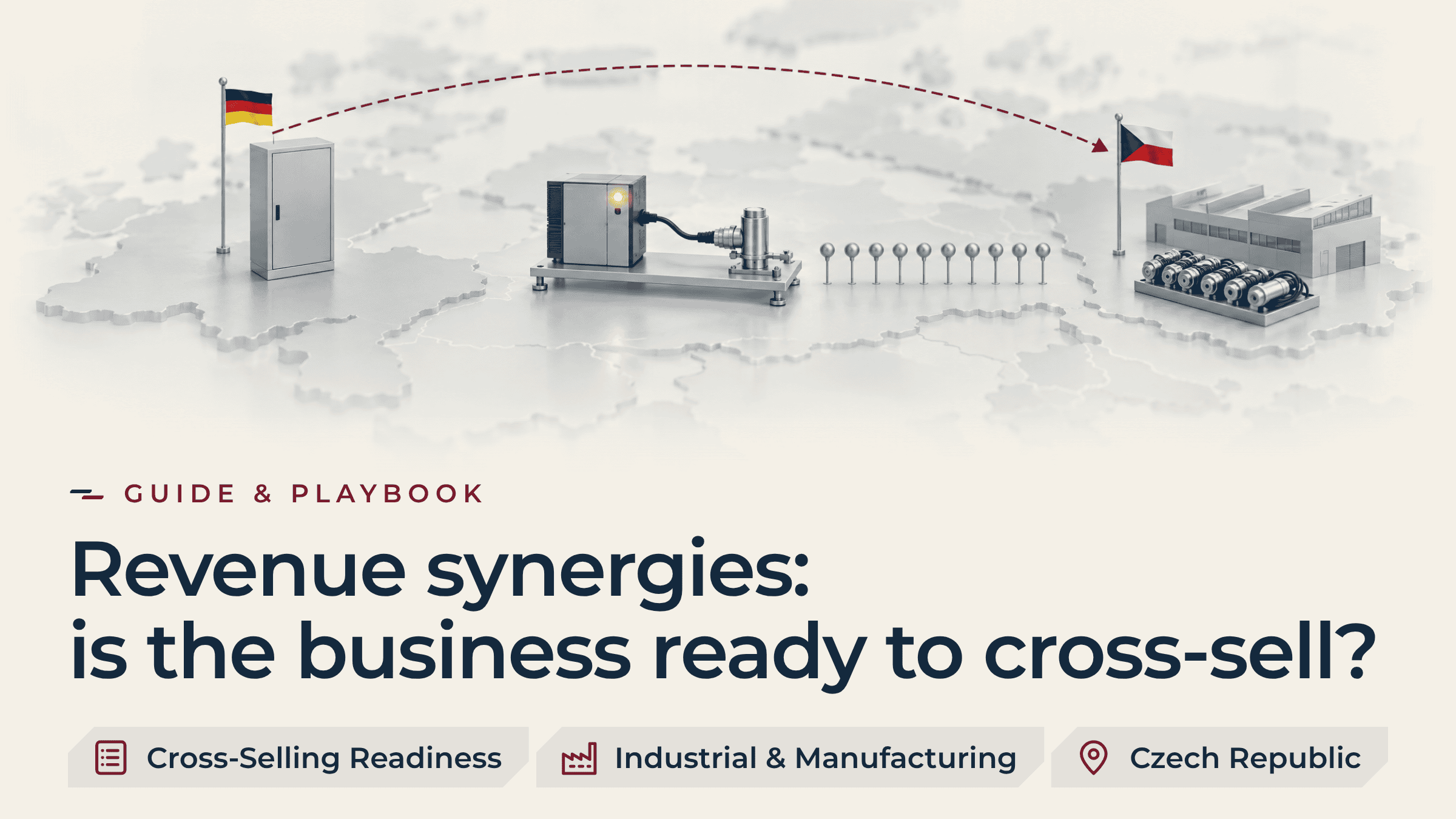
The operational obstacles to cross-selling become acute across cross-border industrial corridors, and this scenario sits in the Western Europe to CEE industrial corridor. Company A is a German industrial automation provider. It acquires Company B, an established precision sensor and cabling manufacturer. Company B's primary operating plants sit in Poland and the Czech Republic. A French acquirer would face the same decision.
The arithmetic appears compelling. If Company A sells advanced robotics controllers to three hundred multinational accounts, and acquired Company B makes precision sensor assemblies for two hundred accounts, merging customer databases should yield multi-million-euro cross-selling revenue. The investment thesis assumes that the German sales force will sell acquired Czech sensor assemblies to its primary automotive clients in Bavaria. The Czech sales force will market the German parent's advanced robotics controllers to industrial machinery clients across Central Europe.
The two businesses remain separate legal entities with separate managing directors. The Czech plant carries its own legacy delivery commitments.
Initial Commercial Integration and Cross-Selling Execution Strategy
Leadership followed the standard pattern: a joint kick-off, the combined catalogue, the merged target list and a higher quota. The plan relied on existing relationships to carry the offer. The deal model treated buyer access, seller readiness and plant capacity as givens, so the group tested none of them.
Operational Obstacles to Revenue Synergies in Cross-Border Manufacturing
Within months, three structural barriers slowed the commercial rollout. Each sat in a different function, so no single leader saw all three at once:
- Divergent buyer personas. The German sales team has established relationships with corporate procurement directors and factory automation managers. However, Czech sensor assemblies are specified by embedded design engineers in R&D departments. The German sales reps lacked access to these technical stakeholders and did not understand the engineering jargon required to sell to them.
- Technical credibility gaps. Client engineers asked about signal attenuation, electrical shielding and thermal drift. The sellers could not answer on the spot, lost credibility in the room and returned to their familiar core automation hardware.
- Operational capacity limits. The Czech plant already ran at 92 per cent of capacity on legacy European orders. On a plant running fifteen shifts a week, the remaining 8 per cent is just over one shift. A bespoke prototype batch, with its changeover and first-article inspection, can use all of it.
In the few instances where customers accepted cross-selling quotes, introducing bespoke prototype batches for German corporate clients created severe factory changeover bottlenecks. The missed delivery dates irritated the parent company's tier-1 customer.
The cross-selling initiative did not merely fail to deliver revenue. It strained factory capacity, reduced seller confidence and exposed the acquiring group's operational seams to valued enterprise clients.
Managing Operational Priorities Between Sales and Plant Leadership
Neither side acted unreasonably. German sales leadership pursued the investment thesis. Czech plant leadership protected existing customers. The German sellers could not commit Czech capacity, and the Czech managing director could not direct German sellers. Nobody held authority to weigh a new commitment against an existing delivery promise.
Restructuring the Cross-Selling Strategy with Pilot Validation
The sponsor paused group-wide quotas and applied the readiness card to one proposition. The plant reserved its remaining 8 per cent headroom for pilot quotations only. Certified sellers paired with Czech application engineers. The pilot began with ten accounts drawn from the 500 on the merged list. The Board and plant leadership received the same evidence.
Common Misconceptions in M&A Revenue Synergy Financial Models
A deal model often rests on three assumptions. Each needs evidence from the operation before it carries revenue:
- Customer access follows ownership. A procurement officer who buys maintenance consumables does not reach the engineering committee that selects capital equipment.
- Any good seller can sell any product. Technical selling needs application knowledge and credibility with engineers.
- Capacity will absorb the volume. Plants rarely take on new demand without investment, headcount or engineering support. An order without verified delivery capacity is a delivery risk, not a synergy.
Commercial Integration Readiness Checklist for Post-Merger Cross-Selling
Before approving a wider rollout, the accountable executive should test commercial integration readiness on eight dimensions. Each item names the check and who signs it off:
- Verified customer need. Name the customer problem the combined offer solves, such as shorter cycle time. Check: Reject propositions that rest on catalogue overlap or a synergy target alone.
- Relevant buying authority. Identify the decision-maker. Check: Confirm that sales coverage has verified access to that person.
- Technical value proposition. State the quantified operating advantage over the incumbent. Check: Head of Application Engineering signs off the claims.
- Seller technical competency. Assess product training. Check: Sellers quote only after formal technical certification.
- Manufacturing and engineering capacity. Audit machine hours, tooling and prototyping resources. Check: Plant Managing Director confirms buffer capacity without backlog.
- After-sales and warranty support. Confirm spare parts, field service and local language support per market. Check: Service Director confirms the network is active.
- Incentive and commission alignment. Set incentives that remove territory disputes and reward collaboration. Check: CFO approves cross-entity commission credits and margin-sharing rules.
- Bounded pilot decision gate. Authorise a 90-day pilot limited to ten qualified accounts. Check: Commercial Director signs off scope, customer safeguards and success criteria.
The card assigns responsibility. It does not replace engineering, quality, legal or competition-law review.
Framework for a 90-Day Cross-Selling Pilot Program
A pilot replaces the company-wide mandate with a four-step test:
- Choose one proposition. Pick a combination with proven technical fit and a clear customer benefit. In the scenario, that is one sensor assembly offered with the controller range to automotive line builders.
- Select ten receptive accounts. Choose clients with verified demand, an established relationship and candid feedback.
- Pair every seller with an application engineer. The relationship owner brings access, and the plant engineer brings technical credibility. Neither enters the meeting alone.
- Track learning, not revenue. Record three milestones. The decision-maker accepts the meeting. The client agrees to an engineering review or sample test. The quotation becomes an order at target margin.
Key Milestones and Timeline for a 90-Day Cross-Selling Pilot
During the first fifteen days, the plant confirms capacity and the sellers complete technical certification. Between days 16 and 45, the pairs hold first meetings and arrange engineering reviews. From day 46 to day 90, quotations go out, the plant confirms delivery dates and the sponsor reviews the evidence.
At day 90, three outcomes are legitimate: extend the proposition, revise it or stop.
Prioritizing Operational Decisions During Post-Merger Commercial Integration
Three decisions cannot wait. The plant must confirm headroom before any quotation leaves. The sponsor must name who may commit plant capacity. The pilot must exclude every account with an open delivery concern.
Other decisions can stay open. A joint catalogue, shared customer systems and group-wide pricing can follow the pilot. The sponsor escalates at once if a quotation would take plant load above the agreed buffer.
Measuring Sales Pipeline Growth vs. Realized Revenue Synergies
An introduction, a quote, an order and a paid invoice are different events. Track four stages:
- Pipeline introduction. A joint meeting takes place. This is activity, not value.
- Technical qualification. The customer sends a formal quotation request with confirmed specifications. The value is potential, pending a capacity check.
- Accepted contract. The customer issues a binding purchase order at or above the target gross margin.
- Realised synergy. The plant delivers on time in full (OTIF), quality assurance accepts the product and the customer pays without concession.
Keep pipeline estimates out of group earnings forecasts, and recognise synergy once the full operating and cash cycle has completed.
Frequently Asked Questions About Post-Acquisition Revenue Synergies
Does existing account access guarantee reaching target buyer personas?
No. Large industrial customers have several independent buying authorities. A maintenance or procurement contact does not reach the R&D engineers who specify production-critical components. The pilot should name the decision-maker and confirm that a seller has a route to that person.
Is a combined product catalog sufficient for cross-selling integration?
No. A merged catalogue gives sellers more to offer, not the ability or the reason to offer it. Without training, aligned incentives, verified capacity and engineering support, sellers return to the products they know. Until those conditions hold for one proposition, a catalogue is a reference document, not a sales programme.
What operational metrics should an initial cross-selling pilot evaluate?
Three facts. Technical buyers must see real value in the combined offer. Sellers must explain it credibly. The plants must deliver without disrupting existing orders. The answers support a decision to extend, revise or stop, not a revenue forecast.
When should an organization appoint a dedicated interim commercial leader?
Internal leaders come first when they have the capability, authority and time. A dedicated interim executive becomes relevant in three situations. Cross-selling may carry a material share of the acquisition case. Sales leaders may have no time beyond protecting current revenue. Territory disputes may reach customers.
Interim Leadership Roles for Post-Merger Commercial Integration
Internal sales leaders hold the customer relationships the pilot needs, but they also carry quarterly targets for legacy products. When they lack time or neutral authority, boards and private equity operating partners appoint an Interim Commercial Director. A wider mandate calls for an Interim Chief Commercial Officer. Where operations dominate, an Integration Director or Interim COO may fit better.
In a cross-border group, the role sits between two owners. Headquarters owns the investment case and needs credible revenue evidence. Plant leadership owns the delivery promise and needs protection from contradictory commitments. Revenue synergies after acquisition need one executive with authority across both.
The mandate runs in sequence. In the first two weeks, the executive pauses new quotas, confirms plant headroom and agrees decision rights with the sponsor. During the pilot, the executive chairs a fortnightly review. At day 90, the executive recommends extending, revising or stopping, and hands the evidence file to permanent commercial leadership.
As a Valtus Alliance member, CE Interim supports delivery across several markets. A CE Interim Partner reviews progress with the sponsor throughout, so headquarters and the plant see the same facts.
Connaissances connexes et prochaine étape
A launch that runs ahead of the evidence shows which assumption failed only after a customer feels the delivery gap. Revenue synergies after acquisition stall when nobody holds authority to weigh a new sales commitment against an existing delivery promise.
À lire également :
- La phase clé du projet ERP est considérée comme achevée. Qu'est-ce que l'entreprise accepte réellement ?
- Une modification du progiciel de gestion intégré (ERP) peut sembler mineure. Qui valide son impact sur les coûts et la mise en service ?
- Le modèle ERP du groupe a été approuvé. Quelles sont les dérogations justifiées pour les usines tchèques ?
CE Interim provides an already vetted, mandate-matched, NDA-bound executive, ready to start after the completed mandate brief. If one executive must hold authority across sales and plant, speak with a Associé par intérim chez CE.

 EN
 DE
 FR
 IT
 PL
 RO
 CS
 SK
 HU
 ES
 RU
 AR
 SL