
Délocalisation d'usines aux États-Unis : Pourquoi la montée en puissance s'interrompt-elle dès le premier mois ?
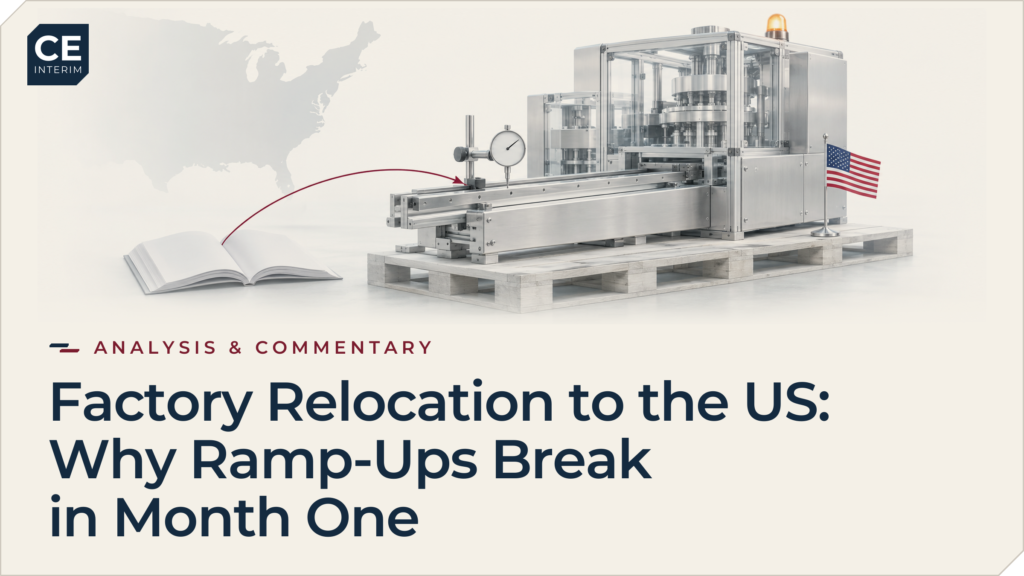
La plupart des délocalisations d'usines vers les États-Unis sont interrompues dès le premier mois. Ce n'est pas à cause des machines. Voici ce qui échoue en premier et pourquoi le leadership est la vraie variable.
L'emploi à discrétion : Ce que les cadres européens regrettent aux États-Unis
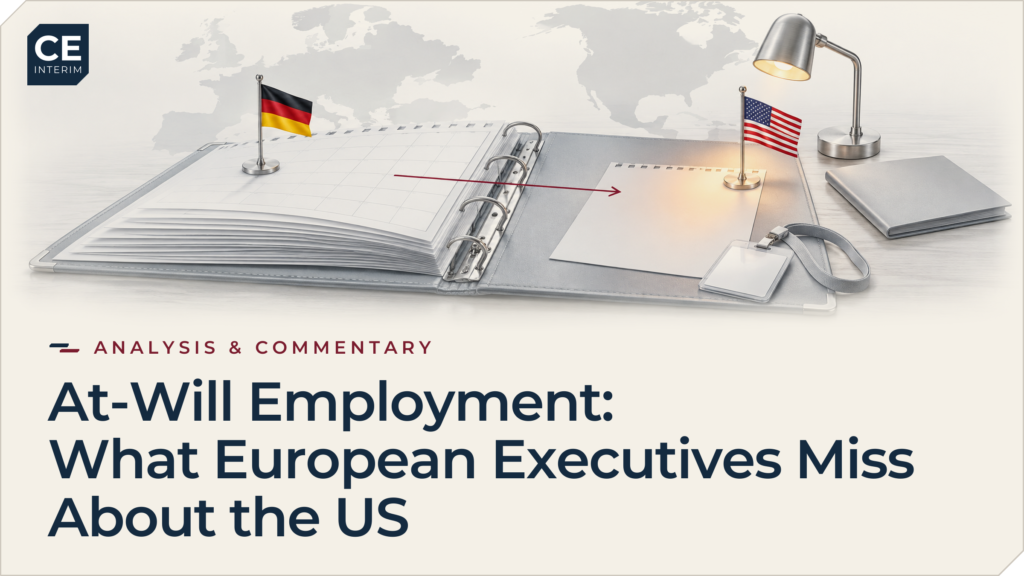
A senior leader at a US manufacturing site gives notice on a Friday. By the following Friday, they are gone. No handover. No transition period. No legal obligation to stay a day longer. For most European executives managing US operations, this is the moment the American employment system stops being an abstraction and becomes a real operational problem. It happens faster than anyone expects. And the response window is shorter than most headquarters teams realise. What At-Will Employment Actually Means In 49 of 50 US states, employment is presumed to be at-will. That means either party can end the employment relationship at any time, for any legal reason, with no required notice period. Two weeks notice is a professional convention. It is not a law. No state or federal legislation requires it when an employee resigns. For European groups accustomed to one to three month notice periods, structured handovers, and overlapping transitions, this is not a cultural difference. It is a different operating system entirely. The practical implication is straightforward and significant: Most European HQ teams mentally budget a transition window that simply does not exist in the US market. The Gap Between European Assumption and American Reality When a European executive hears that a US site leader is leaving, the instinct is to assume a structured wind-down. Documentation, briefings, introductions to key contacts, an overlap with whoever comes next. In the US, that window is often zero. The departing leader notifies HR, works two weeks if they are willing, and leaves. Whatever knowledge, relationships, and institutional memory they carried walks out with them. In one situation, a senior EHS director at a US chemical manufacturing site indicated she wanted to leave at the end of February. By mid-March she was gone. Headquarters knew about it. The local team was covering. But by the time a serious external search was underway, six weeks had already passed and the site was operating without central EHS coordination. The seat had been empty longer than anyone at group level had realised, because the absence looked managed from a distance. The WARN Act: The Shock That Runs in Both Directions Most European owners operating in the US are surprised to discover how fast people can leave voluntarily. Fewer realise that the legal obligations run in both directions. The WARN Act, Worker Adjustment and Retraining Notification Act, requires employers with 100 or more employees to provide 60 days advance notice before a qualifying plant closing or mass layoff. It applies when 50 or more employees at a single site lose their jobs within a 30-day period, or when a plant closes entirely. European groups typically encounter WARN for the first time when they are already deep in a turnaround or restructuring situation. The discovery that they owe 60 days notice, or face back pay and benefits liability for each affected employee, arrives at exactly the wrong moment. The employment system moves fast when individuals leave voluntarily. It requires significant lead time when the company initiates workforce reductions. Understanding both sides of that asymmetry is essential for any European group operating a US manufacturing site. What the Response Window Actually Looks Like From the moment a US site leader gives notice, the operational clock starts immediately. The sequence typically unfolds like this: 1. Day 1 to 3: Notice received. Internal coverage is arranged. Local HR begins exploring options. 2. Day 4 to 10: The departing leader completes their final days. Knowledge transfer is informal and incomplete. 3. Week 2: Seat is empty. Distributed responsibilities are holding, but decisions are already being deferred. 4. Week 3 to 4: Operational drift becomes visible. Customer-facing issues begin to surface. HQ escalates. 5. Week 5 onwards: A senior leader from group steps in to cover. The external search is now running under pressure. The window from notice to operational instability is roughly three to four weeks. Most European groups do not initiate a serious external search until week three. By then the cost is already compounding. What to Have Ready Before It Happens The companies that respond well to a sudden US leadership vacancy are not the ones that react faster. They are the ones that had already thought about this before Thursday afternoon. Three things matter: 1. Know which roles cannot wait. Plant manager, EHS director, site operations lead. These are positions where a vacancy immediately affects compliance, customer confidence, and workforce stability. They are not roles where a six-week internal search is acceptable. 2. Have a provider relationship in place. CE Interim and similar firms can deploy a vetted interim executive within 72 hours. That speed is only useful if the relationship and basic due diligence exist before the call needs to happen urgently. 3. Remove the internal approval bottleneck. European groups that require multiple rounds of budget approval before engaging an interim add two to three weeks to their response time. In a US vacancy situation, those weeks are expensive. None of this requires a formal contingency plan. It requires one conversation at group level, held before the vacancy happens rather than after. The Structural Reality At-will employment is not a risk that appears when someone resigns. It is a structural feature of the US labour market that every European group inherits the moment they open a US plant. The executives who manage it well are the ones who understood the operating system before they needed to use it. The executives who are caught off guard are the ones who assumed the US worked like home. It does not. And the seat will go empty faster than anyone at headquarters expects. The question is whether that is a surprise, or something the organisation was already prepared for.
Le coût caché d'un poste de direction vacant dans l'industrie manufacturière américaine
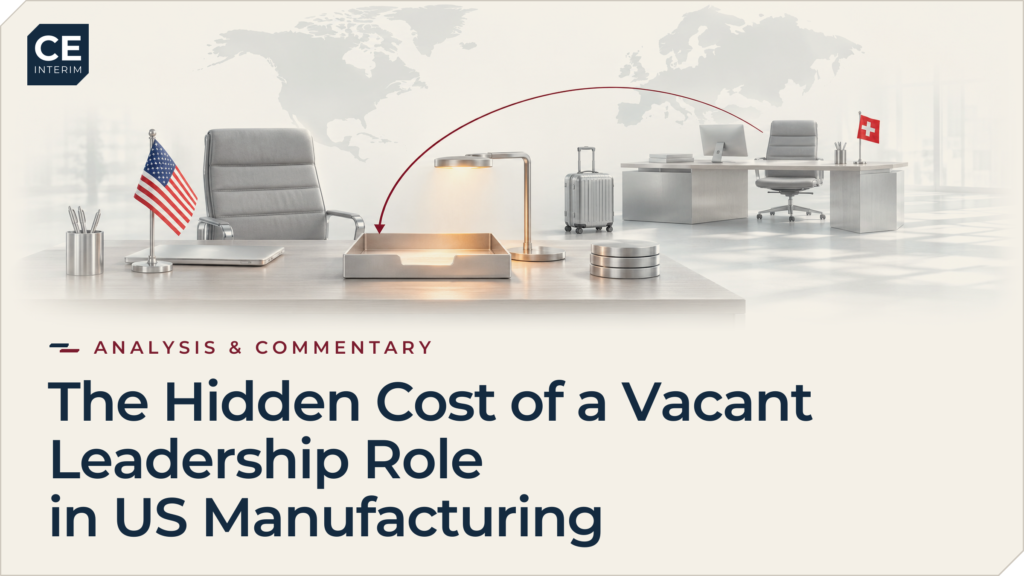
Un poste de direction vacant dans l'industrie manufacturière américaine coûte plus cher que les frais d'embauche. Voici ce qui échappe aux sièges sociaux européens lorsqu'ils calculent le prix réel de l'attente.
Directeur d'usine intérimaire aux États-Unis : Quand le local n'est pas négociable
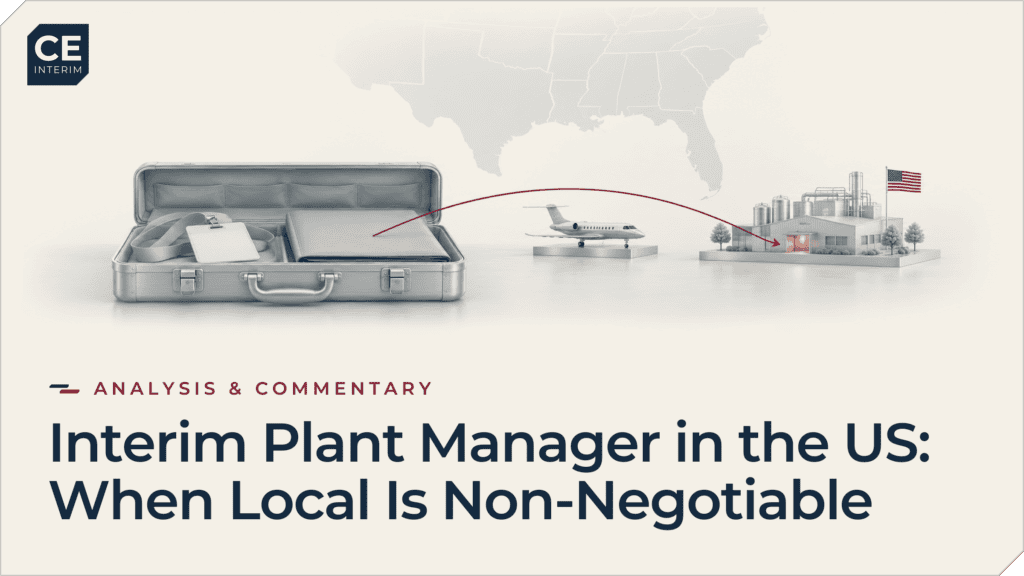
Lorsqu'un poste de directeur d'usine s'ouvre aux États-Unis, les sièges européens se contentent par défaut de “trouver quelqu'un de local”. Voici pourquoi cet instinct coûte des semaines et ce qu'il faut demander en premier lieu.
Pourquoi les chaînes d'approvisionnement du secteur automobile sont-elles les plus exposées à Hormuz ?

Le secteur automobile est confronté à cinq ruptures d'approvisionnement simultanées dans les pays du Golfe : aluminium, produits pétrochimiques, caoutchouc, semi-conducteurs et logistique. Aucun autre secteur n'est exposé simultanément à toutes les catégories de matériaux.
Hormuz, mer Rouge, Suez : quand les trois corridors échouent en même temps
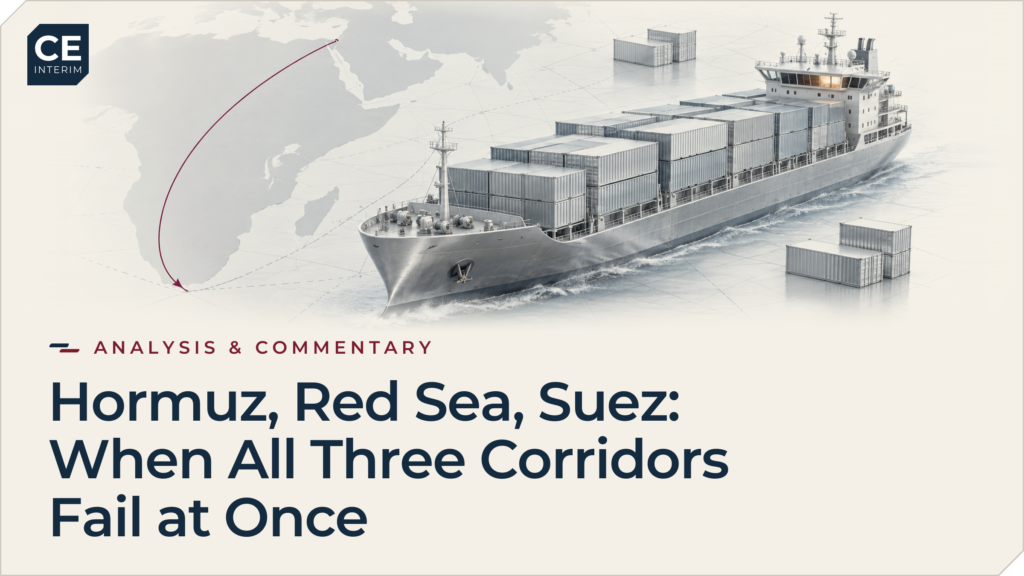
Pour la première fois dans l'histoire commerciale moderne, trois grands couloirs de transport maritime sont tombés en panne simultanément. Voici pourquoi cette situation est catégoriquement différente de toutes les perturbations précédentes.
La crise d'Ormuz déclenche un cas de force majeure. Voici ce qu'il faut faire.
La plupart des entreprises qui reçoivent des avis de force majeure les traitent comme des questions juridiques. Elles devraient les traiter comme des armes de départ opérationnelles. Voici ce que vos contrats ne peuvent pas couvrir.
La crise d'Ormuz prouve que le juste-à-temps a toujours été fragile
Le juste-à-temps a échoué deux fois en cinq ans à grande échelle. Le problème n'est pas le modèle. C'est la structure d'incitation qui le reconstruit après chaque crise.
Comment la crise d'Ormuz détruit discrètement les fonds de roulement
La crise d'Ormuz ne fait pas qu'augmenter les coûts. Elle creuse simultanément cinq écarts dans le cycle de conversion des liquidités. Lorsqu'elle apparaît dans votre bilan trimestriel, des semaines de temps de réponse ont déjà disparu.
Plus que du pétrole : la pénurie d'hélium d'Ormuz affecte les chaînes d'approvisionnement en semi-conducteurs
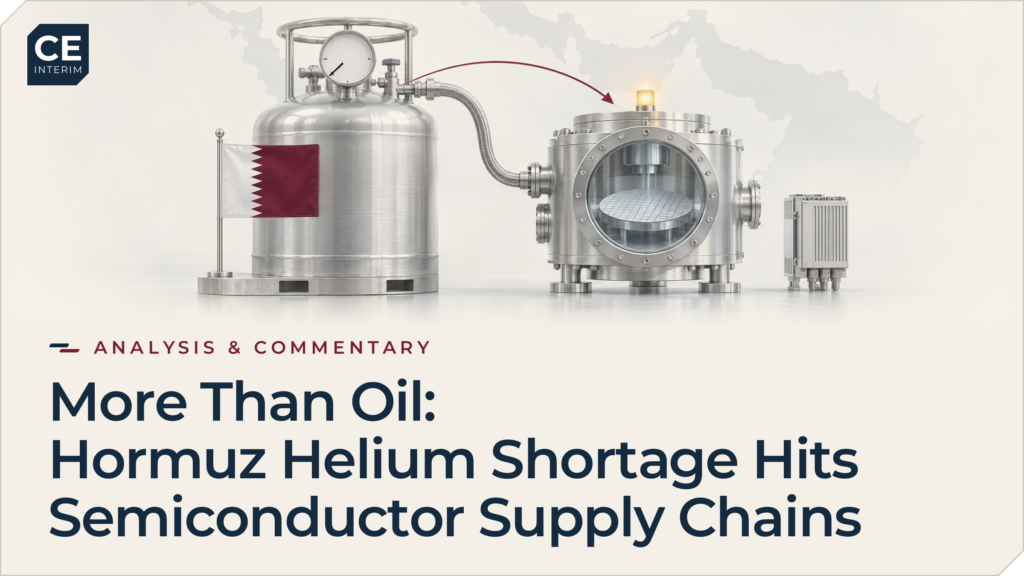
Au-delà du pétrole, la perturbation d'Ormuz entraîne une pénurie d'hélium qui a désormais des répercussions sur les chaînes d'approvisionnement en puces et sur la production mondiale.
 EN
 DE
 FR
 IT
 PL
 RO
 CS
 SK
 HU
 ES
 RU
 AR
 SL