

Pe scurt
Post-merger sales integration starts with one decision: who leads a customer that both businesses already serve. Name one accountable account lead. Keep technical specialists in direct contact with the customer's plants. Leave contracting authority with the legal entity that fills the order. Record these rules in a shared-account charter, then introduce them to the customer jointly.
Managing Overlapping Sales Teams After an Acquisition
After completion, post-merger sales integration decides who sells what, to which buyer, at what price and under whose authority. Both businesses have supplied the same industrial customer for years, so their sales teams now overlap.
The difficulty starts when both teams keep selling to it. Procurement at a tier-1 manufacturer hears from the German key account manager and the Czech commercial director in the same week. Each quotes a different delivery date and can reveal a different margin. Contradictory commitments are the problem, not two contacts.
Naming one lead could alienate the acquired team, and leaving both invites margin erosion. PwC's 2026 M&A Integration Survey asked 530 senior executives about recent deals. Only about one in three acquirers fully achieved their deal objectives. The findings are self-reported and show association, not cause.
Cross-Border Challenges in Post-Merger Sales Integration
An experienced executive looks at the customer first. A consolidated report shows a growing account. It does not show the margin that moved or the engineer who stopped calling.
Borders add three layers. Two legal entities have two sets of directors, each with statutory duties in their own country. The German parent negotiates centrally, while the Czech subsidiary works plant by plant. A query that travels from Pilsen to Munich and back adds days that no group report records.
Both positions are legitimate. Headquarters needs reliable reporting and one price position. The Czech team needs fast decisions and recognition for the engineering that holds the account. Account ownership after acquisition has to serve both.
Post-Merger Sales Integration Case Study: Shared Account Ownership
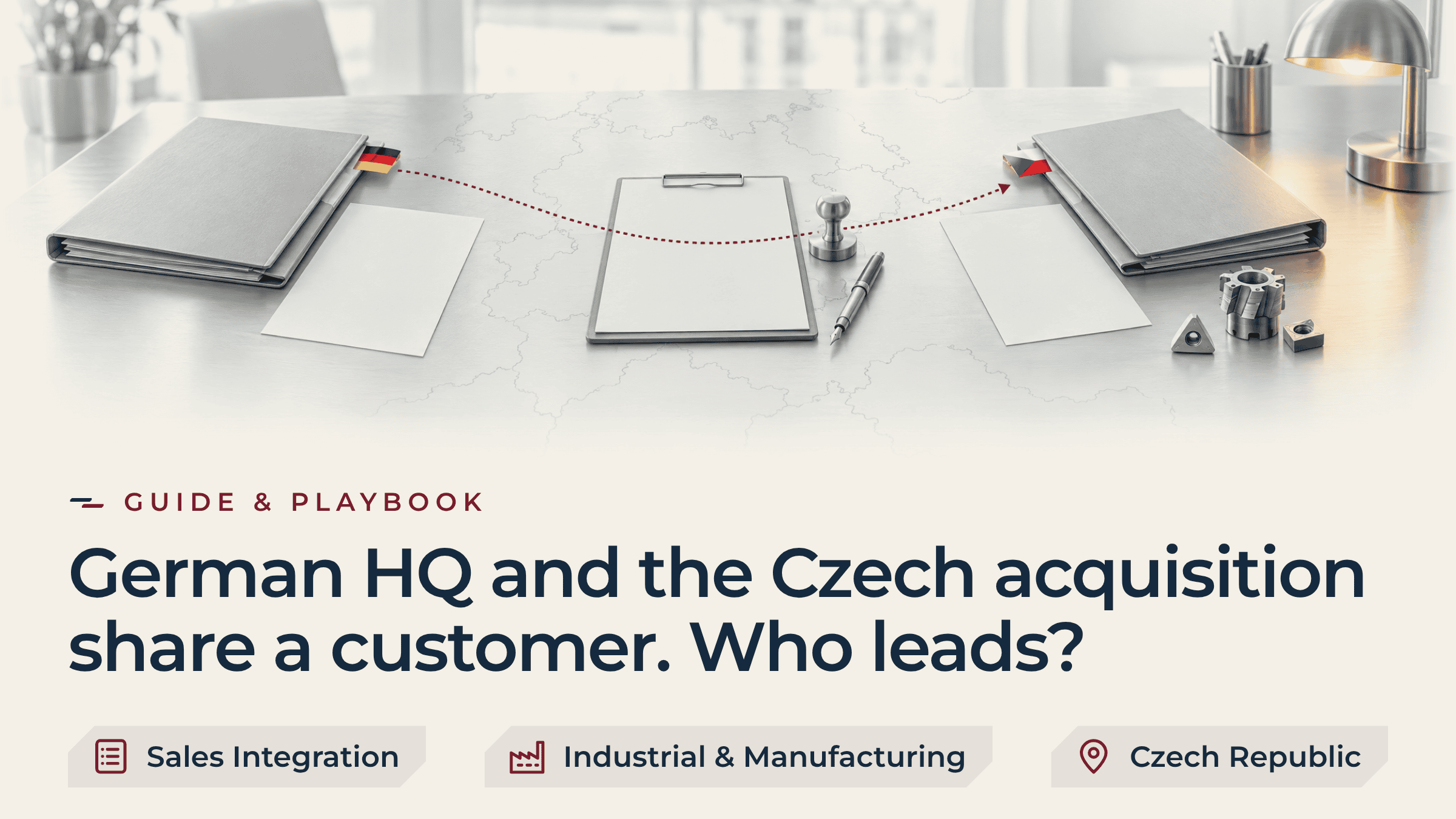
Sales integration becomes particularly sensitive across established European manufacturing corridors. A German engineering group headquartered in Baden-Württemberg acquires a precision machining and tooling business in Central Bohemia, Czechia. Both entities supplied a major European tier-1 automotive systems manufacturer. However, their points of entry into the customer organisation were fundamentally different.
- The German parent held formal relationships with central procurement in Munich. It negotiated annual framework contracts, master pricing matrices and global service level agreements.
- The Czech subsidiary held daily engineering connections with the customer's production plants in Pilsen and Leipzig. Its bilingual application engineers worked on the factory floor, resolving tool-wear issues, adjusting tolerances and delivering rapid prototype runs.
Impact of Centralising Sales Operations at Headquarters
Following legal completion, headquarters declares that all customer communications must flow exclusively through the German key account director. The instruction is understandable, because headquarters wants one voice and one price list. Within weeks, operational friction surfaces in three places.
- Response latency: Plant engineers in Pilsen need immediate tooling modifications. Instead of calling their trusted Czech contact, they must submit queries through Munich central sales. Queries that closed the same day before completion now take about three working days.
- Commercial misalignment: The German team has offered discounted bundled rates on tooling assemblies. This erodes the specialist margins that support Czech factory overheads. The bundle carries an 8 per cent discount on 1.5 million euros of annual tooling. It removes 120,000 euros of margin a year, and margin on those lines falls from 22 per cent to about 15 per cent.
- Internal friction: Sales incentive models remain misaligned. Czech account executives fear their commission credits are being absorbed by headquarters, leading to passive information withholding. Munich's account plan shows two open prototype programmes. The Czech team's own list shows five.
The customer's procurement department sees the division and uses it. It plays the Czech plant's historical component pricing against the German master contract. In week seven, procurement asks the Czech plant to match the Munich bundle across all 4 million euros of tooling. At 8 per cent, that would remove 320,000 euros of margin a year. Enterprise value begins to erode through unaligned commercial governance.
Evaluating Shared Customer Account Value Beyond Invoice Totals
Selecting an account lead purely based on invoice totals or corporate seniority is a mistake. The German parent may invoice 20 million euros in standard assemblies. The Czech subsidiary's 4 million euros in specialised tooling is a fifth of that figure. It may still be the sole technical barrier preventing the client from migrating to an Asian competitor.
Assigning Account Ownership by Legacy Sales Team Contributions
Separate relationship capital from contractual authority first. A tier-1 enterprise contains several buying units, from central procurement to plant managers and development engineers. Ask what each legacy team contributes in four areas.
- Procurement position: Who holds the formal relationship with strategic sourcing?
- Technical relevance: Who can specify solutions and protect engineering margins?
- Operational responsiveness: Who manages daily delivery and urgent quality containment?
- Growth pipeline: Where do active platform bids and prototype programmes sit?
The answers can point to different teams. In the scenario, Munich holds procurement, while the Czech team holds technical relevance and responsiveness.
First 30 Days Sales Integration Priority Plan
An experienced commercial executive protects technical access first, stops conflicting commitments second and designs the structure third. In the scenario, the sponsor names an account lead after procurement's week seven request, with written authority to suspend quotes and convene both entity heads. The first 30 days then run as follows.
- Days 1 to 3. Hold new quotes. Suspend discounted bundles and standalone quotes until the Czech entity head and the Group Commercial Director sign off. Tell the Pilsen and Leipzig engineers they can call their Czech contacts again.
- Days 4 to 10. Map the account, using the Czech team's own opportunity list.
- Days 11 to 20. Draft the charter. Both entity heads and the Group Commercial Director sign it.
- Days 21 to 30. Hold the joint meeting with central procurement and confirm the arrangement in writing.
The group can run on two CRM systems and two price books for a quarter. It cannot run on two quotes. The trade-off is real: more central control protects margin, while more local freedom protects response speed.
Structuring a Shared-Account Charter for Account Lead Governance
The charter anchors post-merger sales integration in one document covering authority, routing and escalation. Seven elements carry the weight.
Defining Account Leadership and Technical Sales Coverage
The first three elements settle who leads and who stays close to the customer:
- Designated account lead. One individual is accountable for account strategy, master negotiations and margin targets.
- Retained technical specialists. Named engineers from both entities keep direct channels to each buying unit at the plants.
- Opportunity routing. Every new request for quotation reaches the account lead within 24 hours. The lead assigns bid ownership by technical fit.
Establishing Contracting Authority, Commercial Approval, and Review
The last four elements settle who commits the business and who checks the result:
- Contracting entity authority. The lead coordinates proposals. Contracting and warranty obligations stay with the entity that produces the order.
- Pricing and margin sign-off. No discount on a subsidiary's products without its head's sign-off.
- Sales credit. The originating lead and the producing specialist both receive credit on cross-business opportunities.
- Quarterly review gate. The Integration Director or Group Commercial Director reviews margin, customer feedback and pipeline.
Separating Account Coordination from Legal Contracting Authority
An account lead coordinates the commercial relationship and holds no unilateral corporate authority. Authority to amend contracts or bind a plant to technical warranties stays with the directors of the producing entity.
Suppose the German account director commits the Czech plant to tighter delivery windows without the Czech managing director's consent. The group then takes on legal and operational liability. Post-merger sales integration works when coordination and authority stay separate.
Three decisions stay with the integration sponsor: the strategic target, any change of supplying entity and any margin-floor exception.
Communicating Post-Merger Sales Integration to Customers
McKinsey's 2009 article on sales force integration names ambiguity, not integration itself, as the fundamental enemy. Leadership therefore presents the charter to the customer jointly and calmly. Four steps follow.
- Hold a joint introductory meeting. The German commercial lead and the Czech commercial director meet central procurement together. The message is plain: ownership has consolidated, while engineering contacts remain intact.
- Explain the dual-layer model. Renewals and group pricing go through the account lead. Engineering stays with familiar plant contacts.
- Confirm continuity in writing. State only what the group has verified.
- Check back at 60 and 90 days. Interview procurement and plant engineering leads.
Measuring Post-Merger Sales Integration Performance at 60 and 90 Days
At 60 days, the scenario review records four changes.
- Plant tooling queries from Pilsen and Leipzig close within one working day again, down from about three.
- 13 of 14 new requests for quotation reach the account lead within 24 hours.
- The 8 per cent bundle is re-priced at 3 per cent with the Czech entity head's sign-off. Annual margin on those lines rises from 210,000 euros to 285,000 euros.
- Procurement asks the Czech plant to match the bundle across 4 million euros. The request closes through the escalation path in three working days. No standalone quote leaves the plant.
At 90 days, interviews with procurement and the Pilsen and Leipzig engineering leads confirm one price position and a one-day response. The account plan lists the Czech team's five prototype programmes. The 4 million euros of tooling revenue holds, and the customer places one new prototype programme with the Czech plant. A review that misses the 24-hour routing test or the margin floor should trigger escalation, not a longer wait.
Frequently Asked Questions About Post-Merger Sales Integration
Does a single account lead limit customer contact points?
No. An industrial account has several buying units, so it needs several contacts. The account lead owns strategy, master agreements and commercial escalations.
How should cross-business unit sales opportunities be managed?
The account lead coordinates the bundled proposal. Each contributing entity's commercial head approves pricing, margin and feasibility for its own products. No bundle reaches the customer without both approvals.
Does account ownership grant authority to modify subsidiary contracts?
No. The lead has coordination authority only. Authorised officers of the fulfilling entity execute amendments and warranty commitments.
How to preserve technical customer relationships after acquisition
Write them into the shared-account charter. Name the specialists, keep direct channels to the customer's engineers and ask the customer at 60 and 90 days whether response times have changed.
Interim Commercial Leadership for Post-Merger Sales Integration
Keep the work with existing leaders when they have the capability, authority and time. One overlapping account does not justify an interim executive. The case changes when several shared accounts compete for the same leaders, or when the charter stalls under defended legacy territories.
At that point the Board or sponsor needs a named owner for the commercial mandate. An Interim Commercial Director can lead pricing and sales coverage inside an agreed mandate. Neither role overrides a contract or a legal entity's authority.
CE Interim sets the mandate with the sponsor and assesses the executive against it. The mandate names decision rights, escalation route and handover to a permanent account lead.
Cunoștințe conexe și următorul pas
A shared customer does not need a winner between Munich and Pilsen. It needs one accountable lead, named specialists and a single route for commitments. The Director comercial interimar fits a sales integration mandate. The Director interimar pentru PMI și separarea activităților covers the wider integrarea post-fuziune programme.
Overlapping offers to one customer move margin out of the group before reporting shows it. Meanwhile, the plant engineers who hold the account stop calling.
Lecturi conexe:
- Etapa ERP a fost marcată ca fiind finalizată. Ce acceptă de fapt compania?
- O modificare a sistemului ERP pare nesemnificativă. Cine aprobă impactul acesteia asupra costurilor și asupra lansării?
- Șablonul ERP la nivel de grup a fost aprobat. Care sunt excepțiile justificate pentru fabricile din Cehia?
CE Interim provides cross-border executive leadership for critical business transformations. It brings an already vetted, mandate-matched, NDA-bound executive, ready to start after the completed mandate brief.
Discutați cu un Partener interimar CE about temporary commercial leadership for post-merger sales integration. This fits when no available owner can bring the teams together.
 EN
 DE
 FR
 IT
 PL
 RO
 CS
 SK
 HU
 ES
 RU
 AR
 SL