

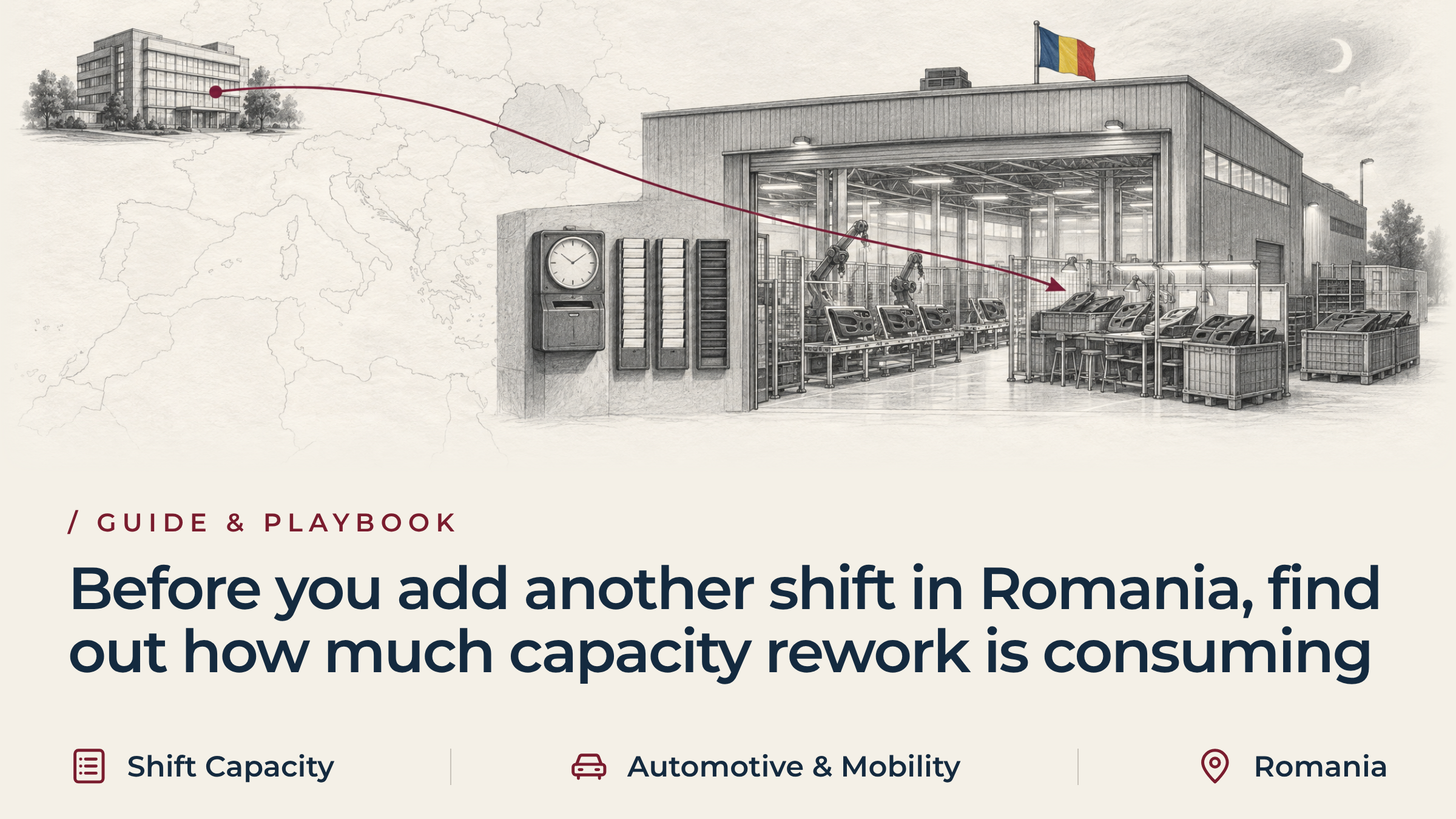
Înainte de a adăuga încă un schimb în România, aflați câtă capacitate consumă refacerea produselor
Pe scurt
A Romanian plant has asked headquarters to approve a new shift or more operators to protect customer delivery. Before anyone signs, the group CFO needs one number first. Underneath the request sits an add shift or reduce rework manufacturing question, not just a staffing request. The answer depends on how much of the plant's paid capacity already reaches the customer as good output. Rework, sorting and repeated processing can quietly consume that capacity long before a genuine shortage exists. The add shift or reduce rework manufacturing decision should rest on a measured number, not on the delivery schedule alone.
The Request on the CFO's Desk
The request usually arrives with a clear justification. A plant in Timisoara, Arad or Brasov is running near its nominal capacity. Customer schedules are expanding. Supervisors are using every overtime allowance they have. The country managing director warns that committed volumes need more hands on the line.
Approving the headcount can look efficient from a group CFO's chair. Romanian hourly rates still compare well with Western European sites. The commercial risk of missing an OEM delivery date can outweigh the payroll cost of one more shift, at least on paper. Headquarters is usually reluctant to challenge local management when a customer line is at stake.
That reluctance is understandable. It is also where the underlying question quietly gets skipped.
Why Hidden Manufacturing Rework Is Hard to Spot Remotely
Group reporting tracks aggregated throughput: units shipped, nominal line efficiency, delivery compliance. These figures confirm that production is happening. They rarely show how many paid hours went into making the same accepted unit twice.
The capacity request reaches headquarters as a single number attached to a delivery risk. The constraint behind that number usually sits on a factory floor nobody at headquarters has walked. A plant under pressure to protect shipments will rarely stop a line for root cause correction. Posting another operator at a sorting bench is faster. It quietly reframes a capacity question as a staffing problem.
From the site, that looks like protecting the customer relationship. From the group, it looks like organic growth. Neither view is wrong, and neither settles the question on its own. That is exactly why the decision needs verification, not assumption.
Key Signals That Rework Is Driving Romania Plant Capacity Requests
A rising headcount request does not, by itself, settle the question. Several practical signs suggest rework, not volume, is driving the request.
- Paid hours rising faster than output. Paid hours across the plant rise faster than the accepted, shipped units they produce. Commercial throughput per hour quietly falls even while the line looks busy.
- Permanent sorting benches on every shift. Manual sorting or rectification benches next to the main line carry staff on every shift. These operators appear as direct production on paper, but they spend their time recovering rejected parts.
- Overtime concentrated on rework, not volume. Weekend and night overtime concentrates on clearing quarantined batches and retesting marginal output, not on genuine extra volume.
- First pass yield below what reaches the customer. First pass yield at the primary cells sits well below what reaches the customer. Manual intervention further down the line closes that gap.
Where several signs appear together, a new shift adds volume to a line that already produces defective material twice. It does not add productive capacity. Each sign answers the same question the same way: more hours, less good output.
Three Steps to Resolve the Add Shift vs. Reduce Rework Decision
Every such request should clear one sequence before it reaches the Board. The sequence starts with a single disciplined question. How much good output does the plant already produce per paid hour, across direct labour, agency staff and overtime?
A credible answer usually follows three steps.
- Establish good output per paid hour. Establish good output per paid hour as the single operating metric. Count only units that pass primary inspection on the first cycle. The metric should never count a reworked part once as output and again as volume.
- Separate shortage from recoverable loss. Separate structural shortage from recoverable process loss. A failure cost framework, such as the one the VDA (the German automotive industry association) maintains, treats rework, sorting and scrap as monetised categories. It does not treat them as an accepted labour variance.
- Choose the proportionate response. Only once the first two steps are complete, choose between three responses. Recover the process on the existing line. Add temporary support while that recovery runs. Or commit to genuine permanent capacity, where the constraint turns out to be real.
Committing to a third shift before this sequence finishes creates a fixed cost that is hard to unwind. Shift premiums, transport allowances and social contributions usually attach to the new contract. In many European jurisdictions, a new shift pattern also triggers works council consultation.
That consultation is slow to reverse once volumes normalise. This is why that decision belongs with the group COO or CFO, advised by whoever runs the diagnostic on site, not with the shift roster alone.
Managing Labour Cost Inflation and Cross-Border Plant Control
The function that requested the capacity rarely produces the figures that would settle the question. Plant leadership supplies throughput and overtime data. Finance supplies the cost comparison. Nobody at headquarters sits close enough to the line to verify that the two describe the same output.
This is not a failure of trust. Headquarters works from aggregated reports because a multi-site structure requires that. Local leadership protects committed shipments because headquarters gave it that job.
That decision needs one verified fact base that both sides can use. Building it is usually the job of an Interim Plant Manager sau Interim COO, mandated jointly by the site and group finance so that neither side is marking its own homework.
Romania's own cost position raises the stakes now rather than later. Manufacturing labour costs there rose 6.3 per cent year on year in March 2026, easing from a 17.7 per cent peak the year before, according to Eurostat's labour cost index. A new shift committed today still costs more over its life than the same decision would have a year ago. That is one more reason the decision cannot wait for the next budget cycle.
Case Study: Eliminating Shift Expansion in a Timisoara Automotive Plant
A Tier 1 automotive interior-trim supplier runs an 850-employee plant in Timisoara. It asks headquarters to approve 55 additional permanent operators and a continuous weekend shift. The change would add an estimated 1.4 million euros a year in payroll and premiums. The goal is to absorb a 15 per cent rise in OEM order releases.
Before approving the contracts, an Interim Plant Manager is mandated to run a diagnostic focused on good output per paid hour. It finds three things.
- Thirty-eight operators on rework benches. Thirty-eight operators per shift work away from the primary line at temporary benches. They perform offline deburring, manual clip re-insertion and re-gluing of components the primary welding cells rejected.
- Welding fixtures producing bonding defects. The primary welding fixtures are losing clamping pressure and drifting out of alignment. They produce bonding defects on an estimated 12.5 per cent of assemblies.
- 4,500 hours a month hidden in rework. The plant spends over 4,500 paid labour hours a month on offline rework and inspection. That cost appears nowhere as its own budget line.
Executing the Operational Recovery Sequence for Higher First Pass Yield
Once the diagnostic separates structural shortage from recoverable loss, the response follows the same three steps. In this illustration, the Interim Plant Manager applies them to the primary line rather than to headcount.
- Stabilise the fixtures first. The Interim Plant Manager stabilises the fixtures first, installing clamping pressure switches and setting a standard maintenance routine for the welding horns.
- Dismantle the rework benches. The Interim Plant Manager then dismantles the temporary rework benches and returns the thirty-eight operators to primary production, rather than moving them to a new shift.
- Install daily management discipline. The Interim Plant Manager establishes daily management discipline across every cell. Hourly production boards and standard work cycles hold the gain, and report jointly to the site and group finance until the pattern is proven.
In this illustration, primary first pass yield rises from 81 to 95 per cent within eight weeks. Good output per paid hour rises by 22 per cent. That is enough for the site to absorb the full OEM volume increase inside its existing two-shift pattern. The proposed third shift, and its 1.4 million euro annual cost, becomes unnecessary. That is what resolving it looks like in practice.
Frequently Asked Questions: Plant Rework & Headcount Capacity
How Is Good Output per Paid Hour Calculated in Manufacturing?
Divide total accepted units that pass primary inspection on the first cycle by total paid hours. Include direct labour, agency staff and overtime. The calculation excludes units rescued through rework, so it never counts a part twice. This keeps the comparison honest when a group weighs one more shift against fixing the line it already has.
Does Rising Overtime Indicate a Genuine Headcount Capacity Shortage?
Not necessarily. Overtime often signals process distress rather than volume growth. Weekend and night shifts frequently sort, repair or retest parts that failed during the standard day. That looks like extra effort, but it adds no accepted output. A plant can look fully utilised and still fall short on good output. That gap is exactly what this question catches.
What Should Corporate Finance Check Before Approving an Additional Shift?
Review daily first pass yield at the primary cells and total hours charged to offline rework and sorting. Check the physical scrap volume against the bill of materials, and the true bottleneck cycle time. These figures, not the delivery schedule alone, answer it properly.
Can Hiring More Operators Resolve Unstable Plant Processes?
Rarely. Adding operators to an unstable process usually increases handling and confusion. That can raise the volume of non-conforming parts rather than reduce it, and it leaves the root cause untouched. Headcount is not a substitute for settling that question properly.
How to Handle Rework When Customer Delivery Is Already at Risk?
Temporary sorting or containment can protect shipments in the short term. Pair it with an immediate, accountable effort to fix the root cause. Otherwise, containment quietly becomes the permanent shift pattern the original decision was meant to test. Treating containment as a permanent fix is exactly the mistake this test is designed to prevent.
Cunoștințe conexe și următorul pas
This decision is one of several where headquarters needs a verified fact base before it can act with confidence, whether the question is a shift roster, a vacant subsidiary role, or a contract that does not automatically follow the business.
Lecturi conexe:
- Când controlul exercitat de sediul central devine următoarea problemă
- Contractele care nu sunt incluse în afacere
- De ce se destramă disciplina la locul de muncă în fabricile românești deținute de companii germane
A mandate-matched Interim Plant Manager or Interim COO can establish that fact base and be in place within 72 hours of a completed mandate brief, before the add shift or reduce rework manufacturing decision is locked in.
The add shift or reduce rework manufacturing decision should never become a cost nobody can reverse, and it is worth raising with a Partener interimar CE before the decision is final.

 EN
EN  DE
DE  FR
FR  IT
IT  PL
PL  RO
RO  CS
CS  SK
SK  HU
HU  ES
ES  RU
RU  AR
AR  SL
SL