
L'espansione dell'industria automobilistica ungherese ha bisogno di leader per l'accelerazione, non di piani

L'espansione dell'industria automobilistica ungherese sta accelerando, ma l'avvio degli impianti deve fare i conti con le carenze di leadership. Perché sarà l'esecuzione, e non la strategia, a decidere i risultati per OEM e fornitori.
Ungheria dopo le elezioni del 2026: Cosa dovrebbero prevedere gli investitori

Le elezioni ungheresi del 2026 spiegate agli investitori. Quali sono i cambiamenti nei finanziamenti dell'UE, nei flussi di IDE e nella crescita industriale, e dove i rischi di esecuzione potrebbero avere un impatto sui rendimenti.
Le aziende tedesche nel settore manifatturiero statunitense: Un punto cieco della leadership

Le aziende tedesche sono produttori di livello mondiale. Ma il modello Mittelstand non si trasferisce automaticamente negli Stati Uniti. Ecco il punto cieco della leadership che molti imparano troppo tardi.
Gestione interinale transfrontaliera: Come funziona e chi ne ha bisogno
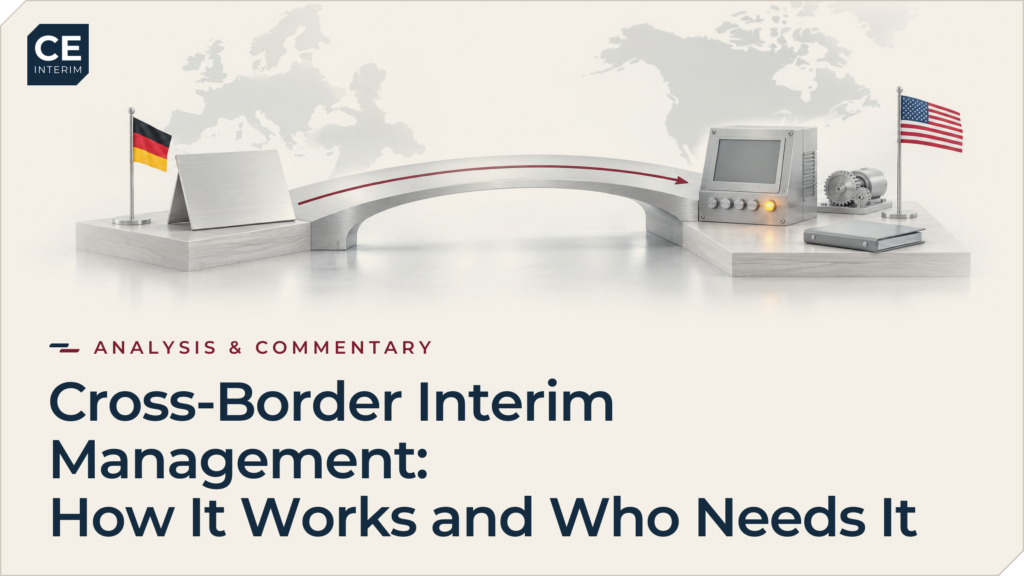
La gestione interinale transfrontaliera: cos'è, come funziona, chi ne ha bisogno e perché le aziende europee con attività negli Stati Uniti sono il pubblico principale.
Trasferimento di fabbrica negli Stati Uniti: Perché le rampe si interrompono al primo mese
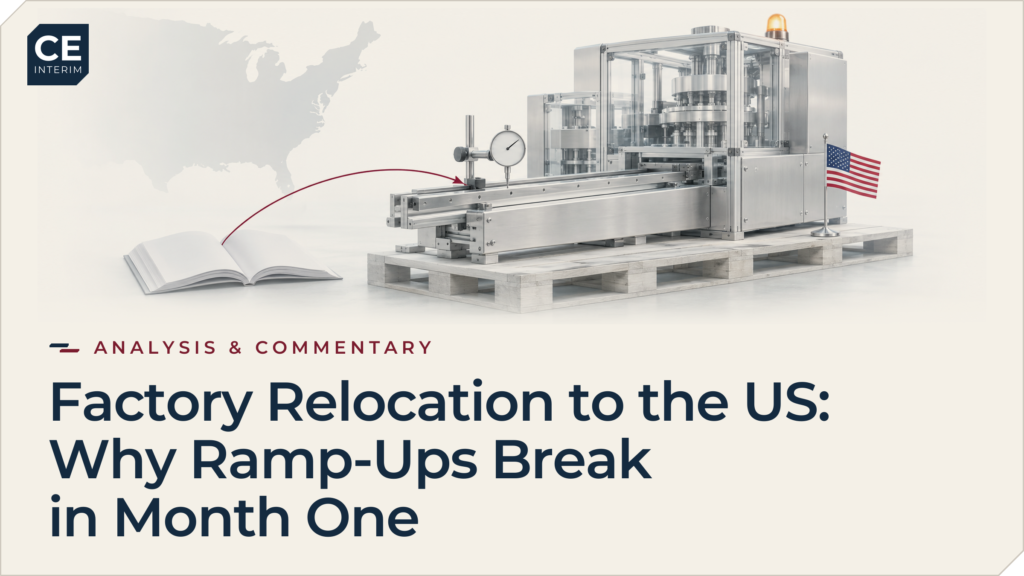
La maggior parte delle delocalizzazioni di fabbriche negli Stati Uniti si interrompe al primo mese. Non a causa delle macchine. Ecco cosa fallisce per primo e perché la leadership è la vera variabile.
Lavoro a tempo indeterminato: Cosa manca ai dirigenti europei rispetto agli Stati Uniti
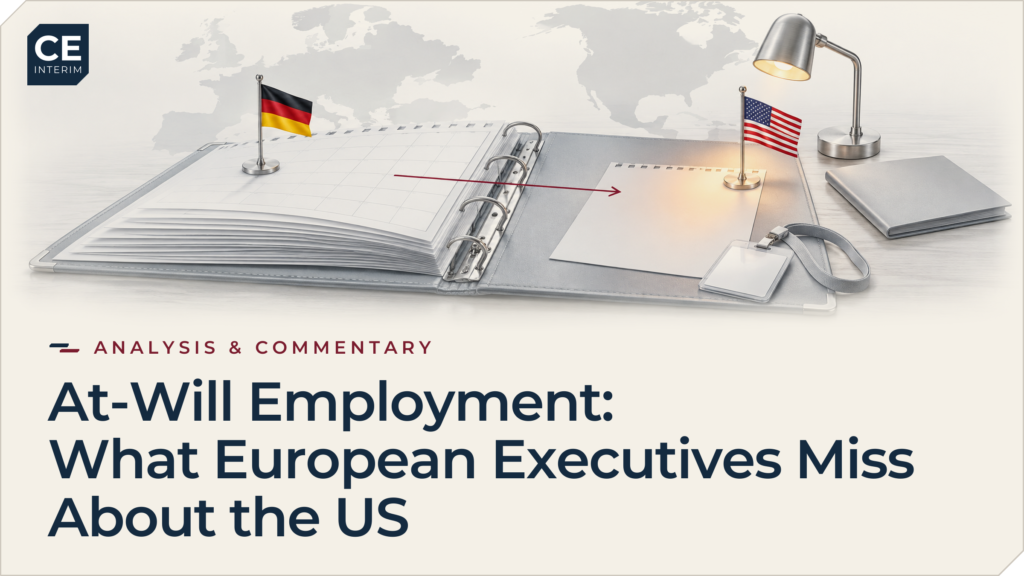
A senior leader at a US manufacturing site gives notice on a Friday. By the following Friday, they are gone. No handover. No transition period. No legal obligation to stay a day longer. For most European executives managing US operations, this is the moment the American employment system stops being an abstraction and becomes a real operational problem. It happens faster than anyone expects. And the response window is shorter than most headquarters teams realise. What At-Will Employment Actually Means In 49 of 50 US states, employment is presumed to be at-will. That means either party can end the employment relationship at any time, for any legal reason, with no required notice period. Two weeks notice is a professional convention. It is not a law. No state or federal legislation requires it when an employee resigns. For European groups accustomed to one to three month notice periods, structured handovers, and overlapping transitions, this is not a cultural difference. It is a different operating system entirely. The practical implication is straightforward and significant: Most European HQ teams mentally budget a transition window that simply does not exist in the US market. The Gap Between European Assumption and American Reality When a European executive hears that a US site leader is leaving, the instinct is to assume a structured wind-down. Documentation, briefings, introductions to key contacts, an overlap with whoever comes next. In the US, that window is often zero. The departing leader notifies HR, works two weeks if they are willing, and leaves. Whatever knowledge, relationships, and institutional memory they carried walks out with them. In one situation, a senior EHS director at a US chemical manufacturing site indicated she wanted to leave at the end of February. By mid-March she was gone. Headquarters knew about it. The local team was covering. But by the time a serious external search was underway, six weeks had already passed and the site was operating without central EHS coordination. The seat had been empty longer than anyone at group level had realised, because the absence looked managed from a distance. The WARN Act: The Shock That Runs in Both Directions Most European owners operating in the US are surprised to discover how fast people can leave voluntarily. Fewer realise that the legal obligations run in both directions. The WARN Act, Worker Adjustment and Retraining Notification Act, requires employers with 100 or more employees to provide 60 days advance notice before a qualifying plant closing or mass layoff. It applies when 50 or more employees at a single site lose their jobs within a 30-day period, or when a plant closes entirely. European groups typically encounter WARN for the first time when they are already deep in a turnaround or restructuring situation. The discovery that they owe 60 days notice, or face back pay and benefits liability for each affected employee, arrives at exactly the wrong moment. The employment system moves fast when individuals leave voluntarily. It requires significant lead time when the company initiates workforce reductions. Understanding both sides of that asymmetry is essential for any European group operating a US manufacturing site. What the Response Window Actually Looks Like From the moment a US site leader gives notice, the operational clock starts immediately. The sequence typically unfolds like this: 1. Day 1 to 3: Notice received. Internal coverage is arranged. Local HR begins exploring options. 2. Day 4 to 10: The departing leader completes their final days. Knowledge transfer is informal and incomplete. 3. Week 2: Seat is empty. Distributed responsibilities are holding, but decisions are already being deferred. 4. Week 3 to 4: Operational drift becomes visible. Customer-facing issues begin to surface. HQ escalates. 5. Week 5 onwards: A senior leader from group steps in to cover. The external search is now running under pressure. The window from notice to operational instability is roughly three to four weeks. Most European groups do not initiate a serious external search until week three. By then the cost is already compounding. What to Have Ready Before It Happens The companies that respond well to a sudden US leadership vacancy are not the ones that react faster. They are the ones that had already thought about this before Thursday afternoon. Three things matter: 1. Know which roles cannot wait. Plant manager, EHS director, site operations lead. These are positions where a vacancy immediately affects compliance, customer confidence, and workforce stability. They are not roles where a six-week internal search is acceptable. 2. Have a provider relationship in place. CE Interim and similar firms can deploy a vetted interim executive within 72 hours. That speed is only useful if the relationship and basic due diligence exist before the call needs to happen urgently. 3. Remove the internal approval bottleneck. European groups that require multiple rounds of budget approval before engaging an interim add two to three weeks to their response time. In a US vacancy situation, those weeks are expensive. None of this requires a formal contingency plan. It requires one conversation at group level, held before the vacancy happens rather than after. The Structural Reality At-will employment is not a risk that appears when someone resigns. It is a structural feature of the US labour market that every European group inherits the moment they open a US plant. The executives who manage it well are the ones who understood the operating system before they needed to use it. The executives who are caught off guard are the ones who assumed the US worked like home. It does not. And the seat will go empty faster than anyone at headquarters expects. The question is whether that is a surprise, or something the organisation was already prepared for.
Il costo nascosto di un ruolo di leadership vacante nell'industria manifatturiera statunitense
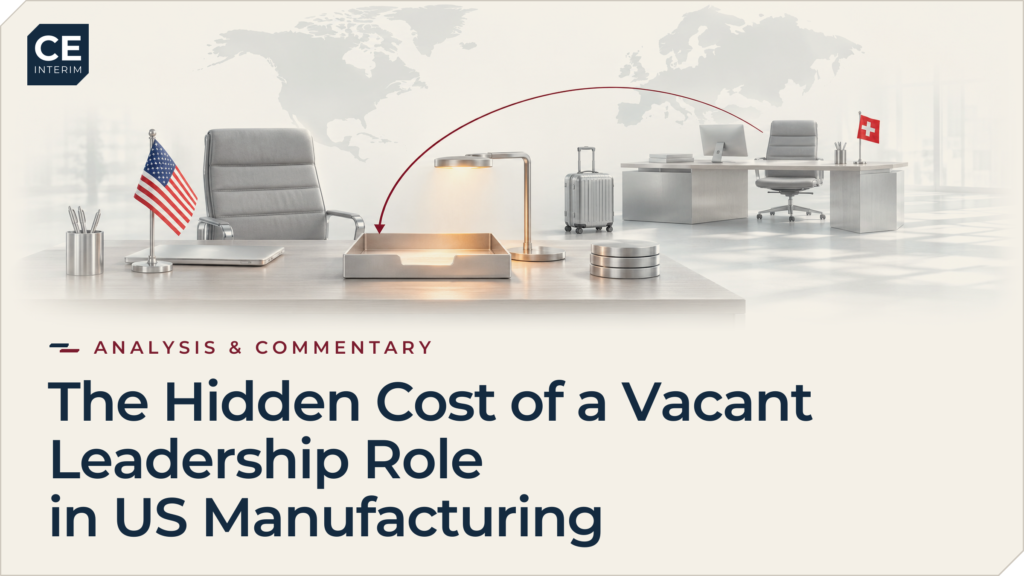
Un ruolo dirigenziale vacante nell'industria manifatturiera statunitense costa più del costo dell'assunzione. Ecco cosa sfugge ai quartieri generali europei quando calcolano il prezzo reale dell'attesa.
Direttore di stabilimento ad interim negli Stati Uniti: Quando il locale non è negoziabile
Quando si apre un ruolo di direttore di stabilimento negli Stati Uniti, i quartieri generali europei pensano subito a “trovare qualcuno del posto”. Ecco perché questo istinto costa settimane e cosa chiedere per prima cosa.
Che cosa devono fare le società di portafoglio PE quando la crisi di Hormuz si aggrava?

La crisi di Hormuz sta comprimendo l'EBITDA dei portafogli di PE in termini di energia, fattori produttivi, trasporto e capitale circolante. Ecco il manuale operativo per i partner operativi.
Perché i leader ad interim sono la risposta giusta a una crisi della catena di approvvigionamento
Quando una crisi della supply chain colpisce, sia le consulenze che le assunzioni a tempo indeterminato falliscono per ragioni specifiche. Ecco perché i leader ad interim esperti sono l'unica risposta in grado di soddisfare il ritmo di una vera e propria disruption.
 EN
 DE
 FR
 IT
 PL
 RO
 CS
 SK
 HU
 ES
 RU
 AR
 SL