
Thank you for the time and thought you invested in this mandate. Being considered at all meant that your experience was credible against a demanding brief. The search drew a large response, and the interim executives who reached the later stages were all experienced plant leaders with real results behind them.
Interim decisions are rarely about general quality. They come down to a narrow combination of factors: how closely an executive’s past situations mirror the present one, the type of equipment and scale involved, the stage of the change programme, and how quickly the owners can picture that person taking control on day one.
This note explains the profile that matched this particular mandate most closely, so that you can see how the assessment was made and use it for future opportunities.
Kaj je stranka resnično potrebovala
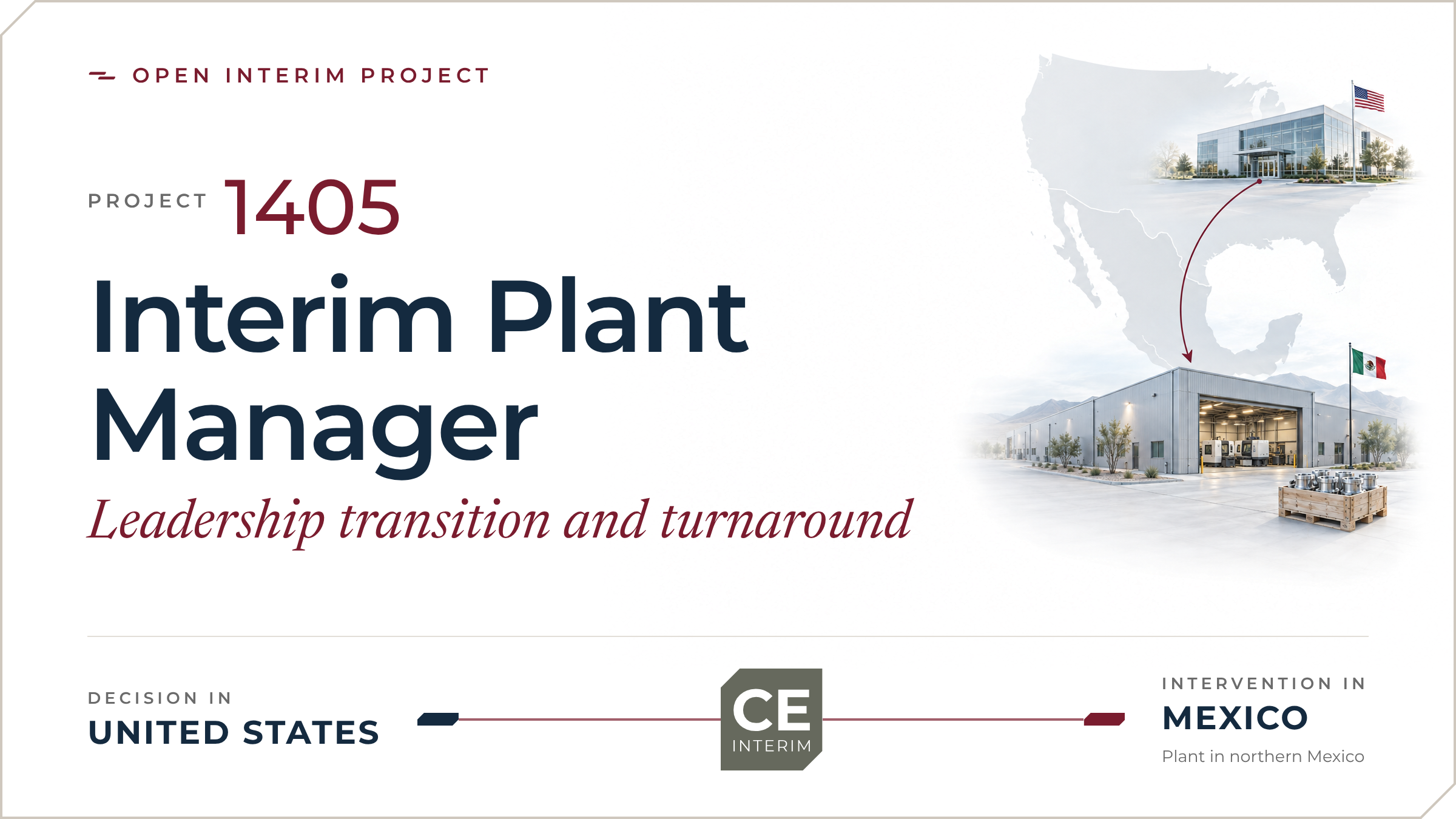
On paper this was a plant manager role. In reality it was a leadership handover in the middle of an operational recovery. A long-serving site leader was leaving on a known date, the plant was part-way through improving its performance, and the owners wanted to protect the progress already made rather than restart it under a new name.
The site was small and highly mechanised. Much of the output depended on older, mechanically complex automatic machines, each operator running several of them at once. The skills needed to set up and maintain that equipment had been built up internally over many years and sat largely in the heads of experienced employees.
Ownership and the plant also sat in different countries and worked in different languages. The executive would report directly to the top of the group while leading a small local management team every day on the floor.
In practice the mandate asked for five things at the same time:
- a controlled handover from the outgoing leader, ideally with a period of overlap
- visible, daily leadership on the shop floor rather than oversight from an office
- measurable improvement in safety, equipment effectiveness and labour efficiency on ageing machines
- direct handling of customer escalations on quality and late deliveries
- change introduced with, not against, a long-service workforce
The profile that fit this mandate most closely
Across the brief and the interviews, a clear picture emerged of the executive this situation called for. None of the points below is unusual on its own. What mattered was finding them together in one person.
1. Repeated experience of taking over a plant mid-change
The strongest fit was an executive who had already stepped into several plants during a leadership transition or a recovery, and who could show the numbers before and after. That mattered because the immediate task was continuity under pressure. The owners wanted someone who had lived through this exact moment before, not someone who would be learning it on site.
2. Hands-on depth with the plant’s actual equipment
General high-volume or automated manufacturing experience was common across the shortlist. Direct, personal experience of running and setting up older automatic machining equipment, with operators covering several machines each, was much rarer. Where this was present, the executive could talk credibly with the people who run the machines from the first day. Where it was absent, the owners had to accept a learning curve during a period when they had little room for one.
3. Comfort at the scale of a small site
Several strong profiles came from leading large, multi-site organisations with deep support functions. This plant had only a handful of managers. The closest fit was an executive who was at ease being the senior engineer, the maintenance escalation point and the customer contact at the same time, without the layers a large operation provides.
4. Maintenance discipline on ageing assets
Equipment effectiveness on older machines depends on maintenance routines, set-up times and spare parts as much as on production planning. Profiles that had personally built preventive maintenance systems and developed local technicians aligned closely with the real constraint in the plant.
5. A respectful way of capturing know-how held by people
The owners were clear that the workforce was not resistant to change, but needed to understand why it was happening. The best fit was an executive whose first step is to observe and learn before changing anything, and who then turns undocumented experience into standard work without making long-serving employees feel replaced.
6. A natural bridge between owners and plant
The role required fluent communication with the shop floor in its own language and clear, concise reporting to group leadership in theirs. The closest fit had done this before, under foreign ownership, and could hold local accountability while keeping headquarters fully informed.
7. A genuine interim track record and immediate availability
Finally, the owners needed someone who could start before the outgoing leader left, commit to full-time presence on site and work under an interim mandate with a clear handover at the end. A history of completed interim assignments, rather than permanent roles alone, gave additional confidence that the executive would deliver within a defined period and then step away cleanly.
Why strong candidates may still not have been taken forward
Most of the executives considered met the majority of the formal requirements. The difference was in how many of the points above were evidenced together, and how directly. In a short, time-critical mandate, the owners were effectively answering a small set of questions:
- Has this person already taken over a plant in exactly this kind of transition?
- Have they personally run equipment like ours, or will they be learning it on the job?
- Are they comfortable leading a small site without large support functions?
- Will long-serving employees trust them in the first weeks?
- Can they start in time to overlap with the outgoing leader?
A profile with excellent results in a larger or more modern environment could still score lower on two or three of these questions. That reflects the narrowness of this mandate, not the strength of the executive.
Kaj se lahko iz tega naučite za prihodnje vmesne projekte
- Lead with comparable situations, not seniority. Describe the plants you took over during a transition, what you found and what changed in the first 90 days.
- Be specific about equipment. Name the machine types and processes you have personally run, set up or maintained. Owners of specialist plants listen for this first.
- Address scale directly. If your recent roles were larger, explain how you have led small sites and what you do yourself when there is no support function behind you.
- Show your entry plan. A concrete, phased approach for the first 30, 60 and 90 days, starting with listening and protecting what already works, builds confidence quickly.
- Make your interim record visible. Separate completed interim assignments from permanent roles in your CV so that clients can see your experience of fixed-term delivery and clean handovers.
- Confirm availability and mobility early. In handover mandates, start date and full-time presence on site can decide the outcome.
Ena poštena zadnja opomba
At the final stage, owners also weigh how quickly they can picture an executive taking control in their particular plant, with their people and their equipment. That judgement is partly about evidence and partly about confidence. It is legitimate when it is based on the business situation, and it is often decided by small margins.
Your experience remains relevant, and we will continue to consider you for mandates where your background matches the situation closely.
Zakaj delati z nami?
CE Interim delivers proven, mandate-matched executive interim leaders, ready to start within 72 hours of a completed mandate brief, across borders, cultures, and industries. We specialise in high-impact interim management for private equity firms, family offices, and global corporations facing moments of transition: digital transformation, market entry, operational turnaround, post-merger integration, or crisis.
What sets us apart is not just the speed or depth of our network, it is how we lead. Every engagement is personally guided by a CE Interim managing partner: former CEOs, CFOs, or COOs who have been on your side of the table, steering organisations through high-stakes decisions.
Z globalnim naborom talentov in operativnim dosegom, ki obsega Evropo, ZDA in Bližnji vzhod, ne zapolnjujemo le delovnih mest, temveč gradimo zaupanje, vodimo prehodne procese in dosegamo rezultate.
As part of the Valtus Alliance, the world’s largest alliance of Executive Interim Management companies, we ensure reliable international execution through a broad international partner network.
 EN
 DE
 FR
 IT
 PL
 RO
 CS
 SK
 HU
 ES
 RU
 AR
 SL