

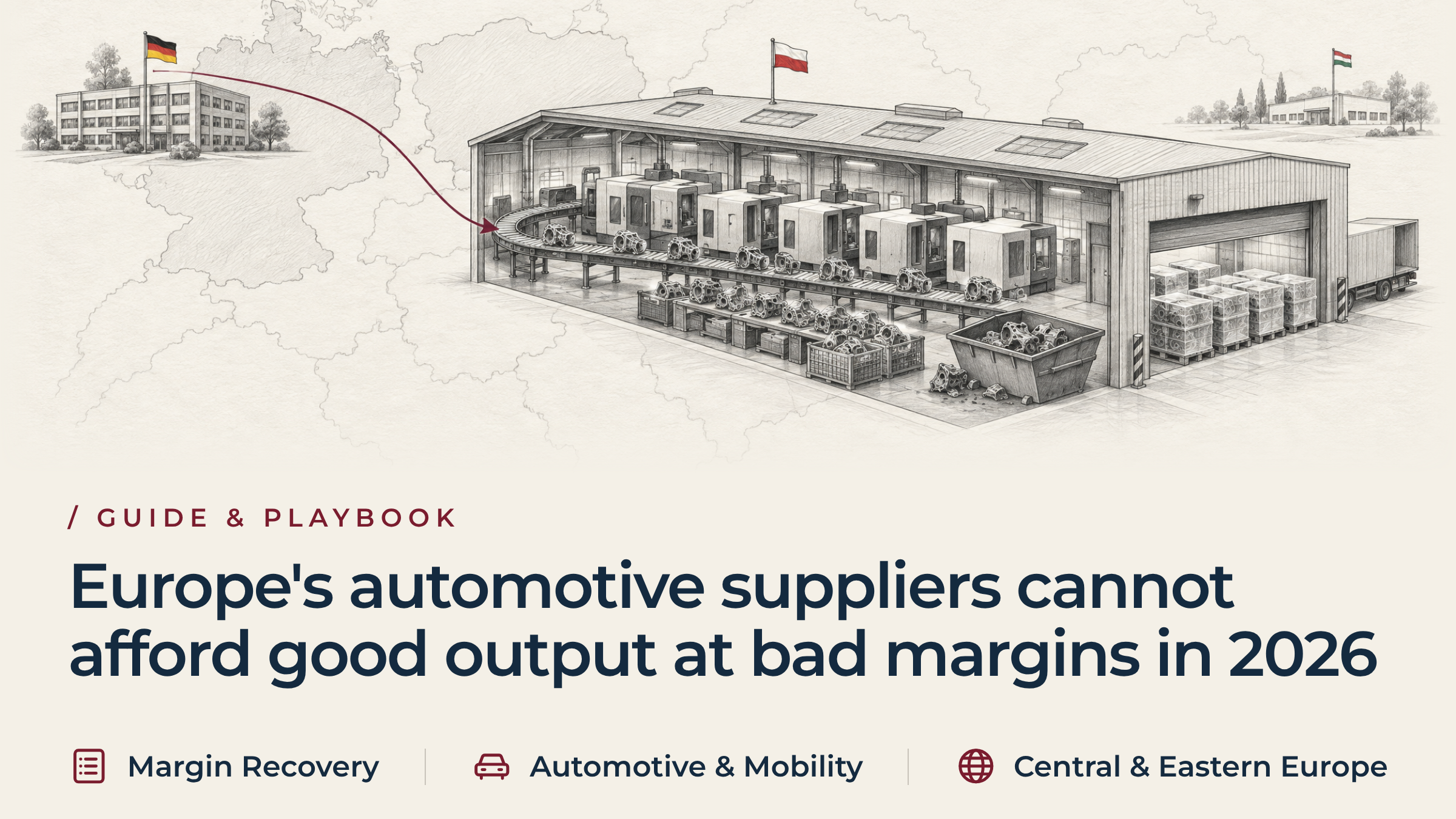
Evropští dodavatelé v automobilovém průmyslu si v roce 2026 nemohou dovolit vysoký objem výroby při nízkých maržích
Stručně řečeno
Automotive supplier margins 2026 sit close to a profitability floor. Three in four European suppliers expect profitability below five per cent this year. Nearly a quarter expect a loss. At that level, a plant cannot treat unpriced loss as routine noise. A site that protects delivery through unbudgeted scrap, rework and weekend overtime is spending margin the business no longer has. Protecting that margin means separating market pressure from controllable factory loss. It means quantifying that loss before the next pricing or restructuring decision.
Understanding Automotive Supplier Margins 2026 and Profitability Benchmarks
CLEPA zveřejněno its Spring 2026 Pulse Check on 23 March 2026. It found that 76 per cent of surveyed suppliers expected profitability below 5 per cent this year. Another 24 per cent expected a loss. Treat both figures as expectations behind that margin pressure, not as realised profitability.
CLEPA’s Data Digest followed on 16 September 2026. It recorded 18,900 announced supplier job losses across Europe in the first half of the year, alongside a weakening automotive trade position. It does not show that scrap or rework caused the fall in supplier profitability. This article makes no such claim.
Together, the two releases confirm one thing. Margin headroom has nearly gone. When headroom stood at eight or ten per cent, a plant could treat conversion waste as routine friction. Near zero, that same waste decides whether the business survives. That is what automotive supplier margins 2026 now rest on, not the price negotiation but the plant floor.
How Conversion Loss in Automotive Plants Quietly Erodes Operating Margins
Group executives watch customer delivery compliance and price negotiations. Plant teams watch the line. Between the two sits a loss neither dashboard shows on its own. That loss is what quietly erodes the plant’s margin.
A plant under fixed OEM pricing cannot negotiate its way out of a bad week. Tooling drifts. A shift loses an experienced operator. The plant protects the one number it controls: the delivery line. It adds a weekend sort. It reruns defective parts through the machine. It books the extra hours to production, not to failure.
None of this is unreasonable. Protecting the customer relationship under pressure is the job, and most plant teams do it well. The problem starts once corporate reporting reads a green delivery line as health. Profitability at that site quietly falls anyway. Nobody has separated the market’s share of that fall from the plant’s own.
The Impact of Conversion Loss Across Cross-Border Automotive Plant Networks
Headquarters Visibility into Plant Conversion Loss and Cost Metrics
A German, Swiss, Austrian or French headquarters usually sees consolidated contribution margin by site, weeks after the month closes. It rarely sees the hours a plant spends recovering a defective part. The plant normally books that time to production, not to a separate failure-cost line. So the dashboard looks stable, and that stability can hide a widening gap in automotive supplier margins 2026.
Plant-Level Workarounds and the Hidden Cost of Poor Quality in Automotive Operations
Local operations managers answer to one immediate consequence. A line stoppage triggers commercial escalation, and it can cost the plant a future platform award. Faced with that risk, a plant will staff manual sorting benches before it accepts a missed shipment. This is a rational response to the incentive in front of it, not a sign of weak management. Corporate leadership should read it that way before deciding what needs to change.
Key Indicators That Conversion Loss Automotive Plant Issues Are Destroying Margins
Executive teams can test a site for conversion loss without waiting for next quarter’s numbers. Look for these four signs together, not one at a time. Together, they separate ordinary friction from a hidden factory quietly consuming cash.
- Delivery versus conversion cost. The plant holds customer compliance above 98 per cent, yet the cost per shipped unit climbs month on month. It hits the plan by spending more than one part’s worth of capacity to ship one good part.
- Informal containment turns permanent. Manual deburring tables and sorting queues become fixed features between production and the shipping dock. They are not a response to one bad batch.
- Overtime rises without matching orders. Payroll shows heavy weekend premiums and temp invoices while customer releases stay flat. The extra hours recover rejected parts rather than build new volume.
- Primary yield and customer acceptance diverge. First pass yield at the primary process falls while the customer acceptance rate holds steady. That gap is the volume the plant rescues by hand.
Together, these four signs mean one thing. A hidden factory is consuming margin that the monthly pack never shows.
Operational Interventions to Recover Supplier Profitability and Mitigate Quality Costs
Recovering automotive supplier margins 2026 does not start with a pricing conversation. It starts with one shared measure of what the plant truly spends to produce an accepted unit. The board needs that measure before any capital or restructuring decision.
Standardizing the Cost of Poor Quality Automotive Accounting via VDA Frameworks
The VDA failure-cost framework keeps quality cost out of general manufacturing overhead. It names the cost type behind each failure: staffing, material, exceptional freight and transport, external services, machinery and equipment. Converting physical defects into one monetary figure gives finance a number it can act on. It also gives the plant a verified floor from which to recover margin.
Distinguishing Gross Output from First-Pass Yield in Plant Profitability Calculations
A part that runs through a process twice has used twice the machine time and twice the energy. It still counts as one salable unit. Counting the rework as productive volume distorts the cost base the board later restructures against. That distortion is exactly where margin goes missing.
Evaluating Plant Capacity and Conversion Waste Before Investing Capital
A site asking for a new shift or a new machine often already holds capacity it has not noticed. Rework loops trap that capacity on equipment the site already owns. Removing the rework releases it faster than a capital request clears approval. Recovering that capacity protects margin without new spend.
Three questions set the sequence. What is the loss actually costing. Is the output number counting a part once or twice. Does the site need new capacity, or does it need back the capacity it already owns. A board that restructures or re-prices before answering risks acting on a baseline that still hides a recoverable loss.
Cross-Border Governance for Automotive Supplier Profitability in CEE Plants
Rebuilding conversion margin across an international plant network is not a desk exercise. A group executive cannot judge shopfloor discipline from a monthly report, however detailed it looks. A distant report is a weak place to defend automotive supplier margins 2026.
A credible diagnostic needs an unannounced site visit. That means checking quarantine stores, maintenance logs and shift handover notes. It also means checking the real ratio of operators adding value to operators sorting. Group management bandwidth often stretches thin across several plants already. An interim executive on site can then establish that fact base faster than a remote review manages from a distance.
This protects the local team too. Plant managers rarely hide a conversion-loss problem in bad faith. They are weighing delivery pressure against unstable equipment, and the workaround is often their most responsible choice at the time. An experienced operations executive gives that team the authority to stop an unstable line and reset the daily routine. It also protects the team from blame for a situation the production system created.
The same discipline protects the board. A footprint decision can rest on financial reports that still hide rework. That risks closing or relocating the wrong site, for the wrong reason, at real cost. A restructuring decision deserves a clean baseline, not a distorted one.
Case Study: Driving Supplier Profitability in CEE Plants Through Conversion Loss Reduction
Systematic failure-cost work, not one-off clean-up projects, recovers conversion margin within months. Operating margins average below five per cent across the automotive supply sector. Two or three recovered points separate an operating profit from a covenant breach. The case below shows exactly how automotive supplier margins 2026 recover inside a live plant network.
Background and Operational Challenges in CEE Tier 1 Facilities
A London-based private equity firm held a controlling stake in a mid-market Tier 1 automotive supplier. The business operated precision transmission and powertrain machining facilities across Poland and Hungary. It faced acute margin compression in early 2026.
The portfolio company operated under rigid, multi-year fixed-price contracts with German automotive OEMs. The plants met customer delivery schedules with 99.2 per cent compliance. Yet the company’s operating margin had compressed to 1.1 per cent. That placed the business in breach of senior debt cash-flow covenants.
The private equity operating partner engaged CE Interim. CE Interim deployed a vetted, mandate-matched Prozatímní provozní ředitel across both facilities, within 72 hours of the completed mandate brief. The mandate: uncover internal conversion losses and restore positive operating cash flow without relying on protracted customer price negotiations.
Diagnostic Findings: Identifying Hidden Conversion Loss and Cost of Poor Quality
Working under partner-led cross-border governance, the CE Interim executive instituted immediate failure-cost accounting aligned with VDA guidelines. The diagnostic uncovered what was hiding inside an output number that still looked acceptable on the plan.
- The hidden failure drain: Both plants were operating unbudgeted weekend third shifts solely to salvage and re-machine transmission housings. The housings displayed bore misalignment and surface porosity. Primary multi-axis CNC cells were losing 22 per cent of available spindle time re-cutting defective components.
- The manual containment burden: Over 30 operators per shift worked offline deburring and manual air-decay leak testing. The cost ran to over 55,000 euros a week in temp agency staffing.
- The false recovery: Scrap metal was sold to regional recyclers and credited to general accounts. This created an appearance of partial recovery while masking the total loss of machine cycle time and energy.
Turnaround Strategy: Restoring Automotive Supplier Margins and Operating Cash Flow
The CE Interim operations director executed an operational turnaround.
- Re-engineered cutting and tooling cycles: Recalibrated high-speed spindles, introduced automated tool-wear sensors, and replaced worn hydraulic clamping fixtures.
- Dismantled offline salvage circuits: Closed down informal rework benches. Parts failing in-process inspection now trigger immediate machine pauses and tooling resets.
- Realigned plant management incentives: Tied local plant manager performance bonuses directly to first-pass yield and conversion cost reduction. This replaced gross shipped tonnage as the target.
Within twelve weeks, primary cell first pass yield increased from 76 per cent to 94 per cent across both facilities. Internal failure costs decreased by 2.6 million euros on an annualised basis, recovering 320 basis points of gross operating margin. The intervention successfully restored EBITDA compliance and protected the sponsor’s enterprise value without disruptive plant closures or hostile commercial disputes.
This is the pattern behind margin recovery across the sector. The loss was already there, inside a plan that still looked on track. Someone recovered it once they measured it on its own terms.
Frequently Asked Questions: Automotive Supplier Margins 2026 & Conversion Losses
What does the 2026 automotive supplier profitability survey actually measure?
The CLEPA Spring 2026 Pulse Check measures forward-looking profitability expectations that surveyed executives reported. It reflects sentiment and commercial forecasts, not realised accounting results. It shows the scale of margin compression across the sector, without pointing to one single cause.
Which conversion losses in automotive plants are genuinely controllable?
Direct labour on manual rework and scrap from worn tooling sit entirely within operational control. So do offline sorting contractors and unscheduled maintenance downtime. That is the cost of poor quality automotive plants already carry, whether or not anyone has measured it. It is the first place to look before any pricing conversation.
Should suppliers address the cost of poor quality or negotiate customer pricing first?
Internal conversion loss first. Asking an OEM for relief while running an unstable, high-scrap process invites a customer audit. That is the real cost behind a weak margin position.
What should executive boards ask plant managers regarding automotive supplier margins 2026?
Four questions cover most of the ground. The trend in first pass yield at the primary process. The hours charged to offline sorting and rework. The scrap volume against the engineering bill of materials. And the exact cost of premium overtime. Together, the answers show the conversion loss automotive plant teams are already absorbing.
Is conversion loss affecting supplier profitability in CEE plants and Western Europe equally?
Broadly, yes. Production volumes shift, and platforms transition faster than headcount plans adjust. The same supplier profitability CEE plant pressure shows up in Western European sites too. Both tend toward the same labour-intensive workarounds, built to protect customer delivery wherever margin is thin.
Související informace a další postup
Running an automotive supply business in 2026 without a clear view of factory conversion cost is no longer sustainable. When the market has already taken most of the margin, a group cannot also carry preventable plant loss.
Další články na toto téma:
- Tlak na ziskové marže ve středoevropském průmyslu: kdy by měla centrála zahájit restrukturalizaci pracovních sil v Rumunsku?
- Jak provozní ředitelé řídí nápravu neúspěšné implementace ERP systému před zastavením výroby
- European manufacturing outlook
A European automotive supplier may be losing yield, carrying unbudgeted rework cost, or facing a governance gap between headquarters and the plant. In each case, CE Interim can place a proven, mandate-matched executive on site, ready to start within 72 hours of the completed mandate brief, to take operational accountability for the recovery. That is how automotive supplier margins 2026 get protected.
Talk to a Prozatímní partner CE when external margin pressure has exposed a plant-level gap. That gap now needs execution, not another analysis cycle.

 EN
EN  DE
DE  FR
FR  IT
IT  PL
PL  RO
RO  CS
CS  SK
SK  HU
HU  ES
ES  RU
RU  AR
AR  SL
SL