

Stručně řečeno
When an integration change disrupts customers, the sponsor has three responses. Correct the change, limit its scope, or pause it under a formal exception. Post-merger customer disruption needs the same two steps whichever applies. Protect the affected commitment at once. Then establish whether the change caused the problem before the authorised sponsor decides. A missed milestone is not automatically worse than a harmful change that stays live. One accountable owner, one named customer contact and written restart evidence keep the decision controlled.
Escalating Integration Service Disruption to Executive Sponsors
A change to order handling, account coverage or service routing goes live on schedule. Within weeks, a material customer problem follows. The programme report records the change as delivered. Customers count confirmed delivery dates and a contact who understands their part.
The sponsor, the executive accountable for the programme, now holds two reasonable views. The programme office protects the schedule the investment case relied on. Customer-facing teams protect the commitments already made. Acknowledging the problem does not mean the integration has failed. It means this change needs evidence.
A Swiss or French owner needs reporting it can rely on and control over capital. The Polish plant needs authority to confirm a date to a waiting customer. PwC's 2026 survey of 530 senior dealmakers reports that about one in three fully achieved their prioritised deal objectives.
Operational Complexity in Cross-Border Post-Merger Integrations
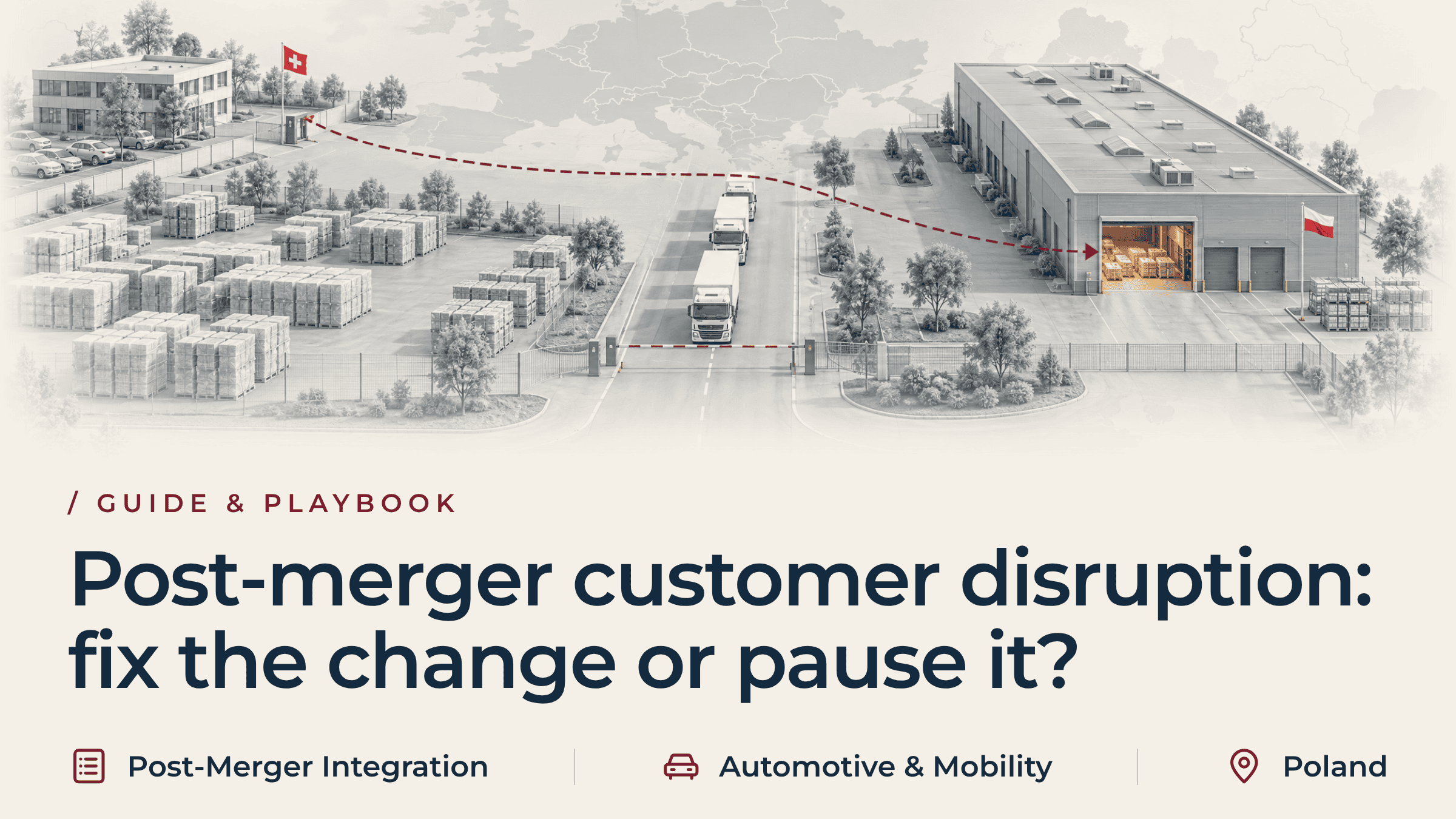
A Swiss/French precision industrial acquirer buys a specialised component plant in Lower Silesia, Poland. The plant employs 410 people and earns €64 million a year. It serves 46 active customers. The 20 largest, mostly German and Scandinavian automotive clients, buy engineered-to-order engine components. They account for 82 per cent of revenue.
Before closing, six bilingual account engineers in Poland covered the 46 accounts and understood each customer's tolerances and buffer-stock agreements. On-time-in-full delivery averaged 96.4 per cent over the six months before closing.
After closing, the transformation team routes all customer correspondence and scheduling through a shared service centre in Western Europe. Its agents work in English and German and have no training on the plant's tolerances. All 46 accounts move over one weekend. The decision was reasonable. The investment case assumed one customer view and shared-centre savings.
Early Operational Impacts of Post-Acquisition Service Disruption
Within three weeks of the cutover, delivery reliability deteriorates in three ways:
- Communication disconnects. Technical queries enter generic ticketing queues that strip context. The centre opens 1,130 tickets. About 38 per cent reach no one with technical authority. The median wait for a technical answer rises from 3 hours to 2.5 working days.
- Scheduling mismatches. The system quotes 15 working days. Heat-treated parts need 21, because specialty steel arrives in weekly batches. By week three, 68 open orders carry dates the plant cannot meet.
- Escalation without authority. Plant planners cannot call the buyers. Service agents cannot move a production slot.
Impact of Integration Service Disruption on Customer Retention
On-time-in-full delivery to the 20 largest accounts falls from 96.4 per cent to 81 per cent. One customer's buffer on a critical part drops from 10 working days to 3. Five accounts send formal escalations. One German customer notifies a late-delivery charge of 0.5 per cent of order value per day.
The business faces operational deadlock. Plant leadership calls the new system unworkable, and central leadership says the plant is resisting standardisation. Each position is reasonable from where it sits. Meanwhile, two accounts, together 14 per cent of plant revenue, ask their sourcing teams to qualify a second supplier.
Identifying the Root Causes of Post-Merger Service Issues
A delivery problem after closing does not prove that integration caused it. Integration service disruption can also come from older weaknesses. The sponsor needs three categories separated before choosing a response:
- Historic baseline deficits. Shortages or scrap that informal expediting masked before the deal.
- Process implementation errors. Wrong settings, corrupted master data or thin training.
- Structural design flaws. Central rules that remove technical discretion from the plant.
Trace individual orders rather than relying on one complaint. Build the baseline from plant records and group system extracts for the six months before closing. Reconcile the two before choosing any option, because each side acts only on figures it trusts.
In the scenario, a review traces the 68 late or at-risk orders. Fifty trace to dates set without a capacity check, eleven to master data errors and seven to a shortage that predates closing. Data errors need correction, design flaws a limit or pause, and the shortage its own owner.
Decision Framework: Correcting, Limiting, or Pausing Integration Changes
Once the cause is clear, the sponsor chooses between three responses. A correction fixes the change and leaves it live. A limit redraws its scope, so part of the portfolio stays on the new route. A pause suspends it for the affected accounts until restart evidence exists. A decision can combine all three. The change-response record below puts the cause, option, owner and restart criteria on one page.
Standard catalogue accounts and group reporting can stay imperfect while the sponsor decides. Three things cannot wait: the affected customer commitments, a named owner and a decision date.
Correcting Process Implementation Errors During Integration
Choose correction when the design is sound but its configuration is not, as with master data mapping. It usually costs the least. It is a safe first response only where the customer's buffer outlasts the time needed to verify the fix.
Limiting Integration Scope for Key Customer Accounts
Choose limitation when the model works for standard catalogue orders but not for engineered-to-order components. Strategic tier-1 accounts return to direct plant coordination. It costs the volume that no longer migrates and a second route to run.
Pausing Changes Under Formal Integration Operating Exceptions
Choose a pause when the change threatens active customer production lines, or when a buffer will run out before a correction can be verified. Routing reverts to the proven workflow, so confirm first that the plant desk still has the people and system access to run it. A pause costs programme time and the credibility of the cutover date. It also defers the shared-centre savings, a deferral the Board owns.
Authority splits across the border. Headquarters keeps pricing, contract and capital decisions. It receives same-day escalation triggers and one weekly report built on the plant's figures. The plant desk regains dispatch authority for the affected accounts. The Board keeps what changes the investment case: the deferred savings and any change to the timetable.
The exception needs a written scope, an accountable owner, a review date and a long-stop. If restart evidence is incomplete at the second review, the sponsor takes the deferral to the Board.
Protecting Customer Retention After Acquisition During Recovery
The sponsor can protect customer retention after acquisition with four measures that need no operating exception. McKinsey's 2009 article on sales force integration describes one face to the customer as a goal.
- Name one contact. Replace ticket numbers with a named, bilingual technical manager who has authority over plant scheduling.
- Publish a verified schedule. Give a conservative 14-day dispatch schedule that the plant confirms by hand.
- Agree who pays for expediting. Emergency freight can cost less than losing the account. The sponsor sets a ceiling in advance, so the plant does not wait for approval.
- Report the governance response. Tell the customer's executive counterpart that leadership has stepped in and who owns the schedule.
Criteria for Restarting Paused Integration Changes
A paused change restarts on evidence, not on a date. The customer decides whether post-acquisition service recovery has happened. Customer-confirmed dates against the agreed weekly service measures are therefore the final test. First, the shared route must show plant capacity at order entry. Data checks run in parallel, and specialist sign-off closes the sequence. Restart in stages, beginning with the accounts least affected.
Managing Integration Service Recovery
This is the record for the scenario:
- Affected commitment and change. Tier-1 OEM engine shipments, moved from the local plant desk to a shared-service ticketing queue.
- Verified root cause. The queue strips engineering specifications, and dates ignore plant capacity. Review confirms a design flaw for 50 of the 68 orders, not plant execution failure.
- Evaluation of options. Option 1: patch the 11 data errors. Option 2: restricted rollout for the 26 standard accounts. Option 3: operating pause for the 20 largest. Weigh the 82 per cent of revenue at risk against the schedule delay.
- Customer consequence. Imminent production line stoppages, with one buffer down to 3 working days.
- Authorised action. An operating pause for the 20 largest accounts, with dispatch authority returned to the plant desk.
- Accountable owner. A designated Prozatímní ředitel pro integraci nebo Prozatímní provozní ředitel, with single executive ownership across HQ and plant.
- Restart criteria. Validated ERP interface, master data audit and customer-confirmed dates against the agreed weekly service measures.
Two-Week Service Recovery Implementation Timeline
The response clock runs in this order.
- Den 1. The Group COO, as sponsor, tests the internal options. Nobody can carry the correction alongside daily delivery, so the sponsor completes a mandate brief.
- Day 2. An interim integration director starts under that brief, with delegated authority. The director names a technical manager for each of the five escalated accounts, calls the German customer and traces the 68 orders.
- Day 4. The review confirms a design flaw, not plant execution failure.
- Day 5. The sponsor approves a written exception and informs the Board chair the same day. The team corrects the 11 data errors, the 26 standard accounts stay on the shared route and the 20 largest return to the plant desk.
- Day 6. Each of the 20 accounts receives a named technical manager and a hand-verified 14-day dispatch schedule.
- Days 7 to 14. The director chairs a 20-minute daily review of every top-20 order whose date moves. Any move beyond one working day, or any buffer below 5 working days, reaches the Group COO the same day. Expedited freight costs €38,000 in the fortnight.
Performance Metrics and Results Following the Operating Pause
By the end of week three under the exception, on-time-in-full delivery to the 20 largest accounts reaches 94.8 per cent, against 96.4 per cent before closing. Fourteen of the 20 accounts confirm in writing that they will keep current volumes. Six have not yet confirmed. The German customer agrees to review its late-delivery charge once dates hold. These figures are illustrative and promise no recovery period.
Interim Leadership Options During Post-Acquisition Recovery
Existing leaders should lead the correction where they have the capability, authority and time. A single routine issue does not justify an interim executive. The question changes when several accounts, the plant and the shared centre need one decision-maker.
. Integration Director fits the scenario, because the fault sits in the programme's route design. An Prozatímní provozní ředitel fits where operating recovery is the core assignment. An interim Commercial Director fits where account coverage and pricing sit at the centre.
Establishing Interim Executive Mandates and Decision Rights
A review can trace the 68 orders and recommend. Only an executive with delegated authority can move a dispatch date. A permanent appointment is unlikely to finish inside a 3-day buffer. CE Interim starts with a confidential briefing and a defined mandate: scope, decision rights, reporting line and escalation route. The sponsor selects from a small number of executives assessed against it.
In the scenario, the sponsor delegates dispatch dates, expediting freight inside the ceiling and the instruction to the shared service lead to hold the old route. Contracts, pricing and technical sign-offs stay with their owners. A CE Interim Partner joins the day 7 review and escalates to the sponsor when evidence and customer results diverge.
Frequently Asked Questions: Post-Merger Customer Disruption
Should You Pause Integration Changes Based on Customer Issues?
No. A pause fits when disruption breaches contractual delivery commitments, threatens customer production lines or recurs across high-value accounts.
Who Has Authority to Approve Temporary Operating Exceptions?
The acquisition sponsor, Group COO or private equity operating partner, under the group's delegation of authority, on the Integration Director's recommendation. Contractual and technical owners confirm what it cannot change.
How to Distinguish Integration Issues From Pre-Existing Service Deficits
Audit lead-time variance, scrap and order-error rates for the six months before closing. If they held steady and diverged after a specific cutover, the change is a likely cause. Order-level tracing confirms it, as the seven shortage orders showed.
What Criteria Support Restarting a Paused Integration Change?
Documented proof that the cause has gone: corrected interfaces and master data, completed training and customer-confirmed service results.
Související informace a další postup
Post-merger customer disruption sits across the programme, the plant and the customer. CE Interim's guidance on integrace po fúzi covers the wider situation.
The sponsor decides whether the change continues, narrows or pauses. The Board owns the deferral that follows and who leads the correction. The longer an unverified change stays live, the fewer options the Board keeps.
Další články na toto téma:
- Milník v rámci projektu ERP je označen jako splněný. Co vlastně firma přijímá?
- Změna v systému ERP se zdá být drobná. Kdo schvaluje její dopad na náklady a termín zavedení?
- Váš polský závod má stanovený termín spuštění systému ERP. Co by bylo důvodem pro uvedení systému do provozu?
By day 14 in the scenario, the Board holds one verified fact base, one accountable executive and one review date. CE Interim can provide an already vetted, mandate-matched, NDA-bound executive, ready to start after the completed mandate brief.
Promluvte si s Prozatímní partner CE to define the integration or operating mandate the situation requires.

 EN
 DE
 FR
 IT
 PL
 RO
 CS
 SK
 HU
 ES
 RU
 AR
 SL