
Selitev tovarne v ZDA: Zakaj se pospeševanje prekine v prvem mesecu
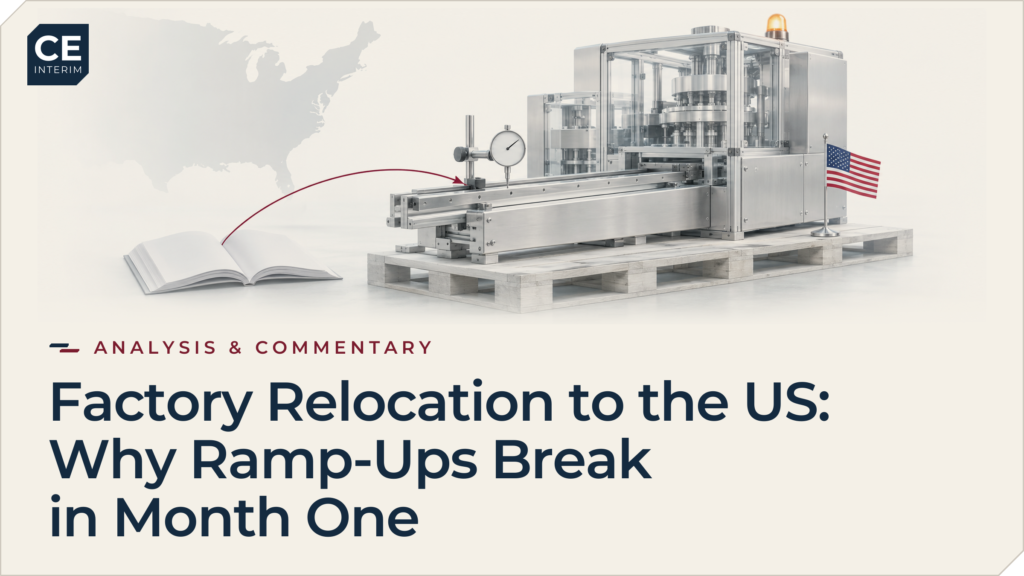
Večina preselitev tovarn v ZDA se prekine v prvem mesecu. Ne zaradi strojev. Tukaj je opisano, kaj dejansko odpove najprej in zakaj je vodstvo prava spremenljivka.
Zaposlitev po volji: Kaj evropski vodstveni delavci pogrešajo v ZDA
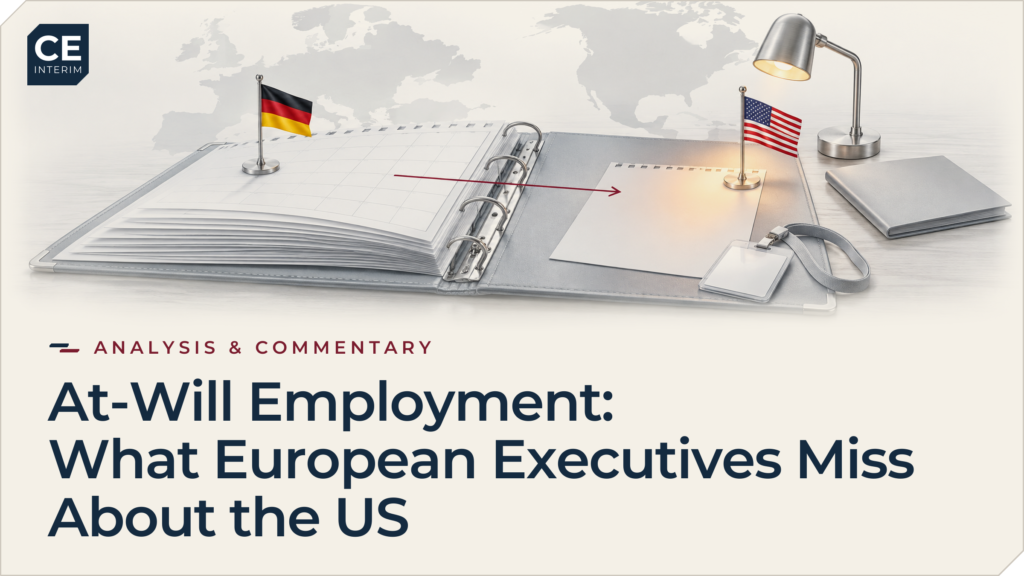
A senior leader at a US manufacturing site gives notice on a Friday. By the following Friday, they are gone. No handover. No transition period. No legal obligation to stay a day longer. For most European executives managing US operations, this is the moment the American employment system stops being an abstraction and becomes a real operational problem. It happens faster than anyone expects. And the response window is shorter than most headquarters teams realise. What At-Will Employment Actually Means In 49 of 50 US states, employment is presumed to be at-will. That means either party can end the employment relationship at any time, for any legal reason, with no required notice period. Two weeks notice is a professional convention. It is not a law. No state or federal legislation requires it when an employee resigns. For European groups accustomed to one to three month notice periods, structured handovers, and overlapping transitions, this is not a cultural difference. It is a different operating system entirely. The practical implication is straightforward and significant: Most European HQ teams mentally budget a transition window that simply does not exist in the US market. The Gap Between European Assumption and American Reality When a European executive hears that a US site leader is leaving, the instinct is to assume a structured wind-down. Documentation, briefings, introductions to key contacts, an overlap with whoever comes next. In the US, that window is often zero. The departing leader notifies HR, works two weeks if they are willing, and leaves. Whatever knowledge, relationships, and institutional memory they carried walks out with them. In one situation, a senior EHS director at a US chemical manufacturing site indicated she wanted to leave at the end of February. By mid-March she was gone. Headquarters knew about it. The local team was covering. But by the time a serious external search was underway, six weeks had already passed and the site was operating without central EHS coordination. The seat had been empty longer than anyone at group level had realised, because the absence looked managed from a distance. The WARN Act: The Shock That Runs in Both Directions Most European owners operating in the US are surprised to discover how fast people can leave voluntarily. Fewer realise that the legal obligations run in both directions. The WARN Act, Worker Adjustment and Retraining Notification Act, requires employers with 100 or more employees to provide 60 days advance notice before a qualifying plant closing or mass layoff. It applies when 50 or more employees at a single site lose their jobs within a 30-day period, or when a plant closes entirely. European groups typically encounter WARN for the first time when they are already deep in a turnaround or restructuring situation. The discovery that they owe 60 days notice, or face back pay and benefits liability for each affected employee, arrives at exactly the wrong moment. The employment system moves fast when individuals leave voluntarily. It requires significant lead time when the company initiates workforce reductions. Understanding both sides of that asymmetry is essential for any European group operating a US manufacturing site. What the Response Window Actually Looks Like From the moment a US site leader gives notice, the operational clock starts immediately. The sequence typically unfolds like this: 1. Day 1 to 3: Notice received. Internal coverage is arranged. Local HR begins exploring options. 2. Day 4 to 10: The departing leader completes their final days. Knowledge transfer is informal and incomplete. 3. Week 2: Seat is empty. Distributed responsibilities are holding, but decisions are already being deferred. 4. Week 3 to 4: Operational drift becomes visible. Customer-facing issues begin to surface. HQ escalates. 5. Week 5 onwards: A senior leader from group steps in to cover. The external search is now running under pressure. The window from notice to operational instability is roughly three to four weeks. Most European groups do not initiate a serious external search until week three. By then the cost is already compounding. What to Have Ready Before It Happens The companies that respond well to a sudden US leadership vacancy are not the ones that react faster. They are the ones that had already thought about this before Thursday afternoon. Three things matter: 1. Know which roles cannot wait. Plant manager, EHS director, site operations lead. These are positions where a vacancy immediately affects compliance, customer confidence, and workforce stability. They are not roles where a six-week internal search is acceptable. 2. Have a provider relationship in place. CE Interim and similar firms can deploy a vetted interim executive within 72 hours. That speed is only useful if the relationship and basic due diligence exist before the call needs to happen urgently. 3. Remove the internal approval bottleneck. European groups that require multiple rounds of budget approval before engaging an interim add two to three weeks to their response time. In a US vacancy situation, those weeks are expensive. None of this requires a formal contingency plan. It requires one conversation at group level, held before the vacancy happens rather than after. The Structural Reality At-will employment is not a risk that appears when someone resigns. It is a structural feature of the US labour market that every European group inherits the moment they open a US plant. The executives who manage it well are the ones who understood the operating system before they needed to use it. The executives who are caught off guard are the ones who assumed the US worked like home. It does not. And the seat will go empty faster than anyone at headquarters expects. The question is whether that is a surprise, or something the organisation was already prepared for.
Skriti stroški nezasedene vodilne vloge v ameriški proizvodnji

Prosto vodstveno delovno mesto v ameriški proizvodnji stane več kot strošek zaposlitve. Tukaj je tisto, kar evropski sedeži zamudijo, ko izračunavajo realno ceno čakanja.
Začasni vodja obrata v ZDA: Ko se o lokalnem ni mogoče pogajati

Ko se odpre mesto vodje ameriškega obrata, evropski sedeži privzamejo odločitev “poiščite nekoga lokalnega”. Tukaj je razlaga, zakaj ta instinkt stane več tednov in kaj je treba najprej vprašati.
Zakaj so avtomobilske dobavne verige najbolj izpostavljene Hormuzu

Avtomobilska industrija se sočasno sooča s petimi motnjami oskrbe v Zalivu: aluminij, petrokemični izdelki, guma, polprevodniki in logistika. Noben drug sektor ni izpostavljen vsem kategorijam materialov hkrati.
Hormuz, Rdeče morje, Sueza: ko vsi trije koridorji odpovedo hkrati

Prvič v sodobni trgovinski zgodovini so hkrati propadli trije glavni ladijski koridorji. Tukaj je razlog, zakaj se to kategorično razlikuje od vseh prejšnjih motenj.
Kriza v Hormuzu povzroča višjo silo. Tukaj je odgovor na vprašanje, kaj storiti.
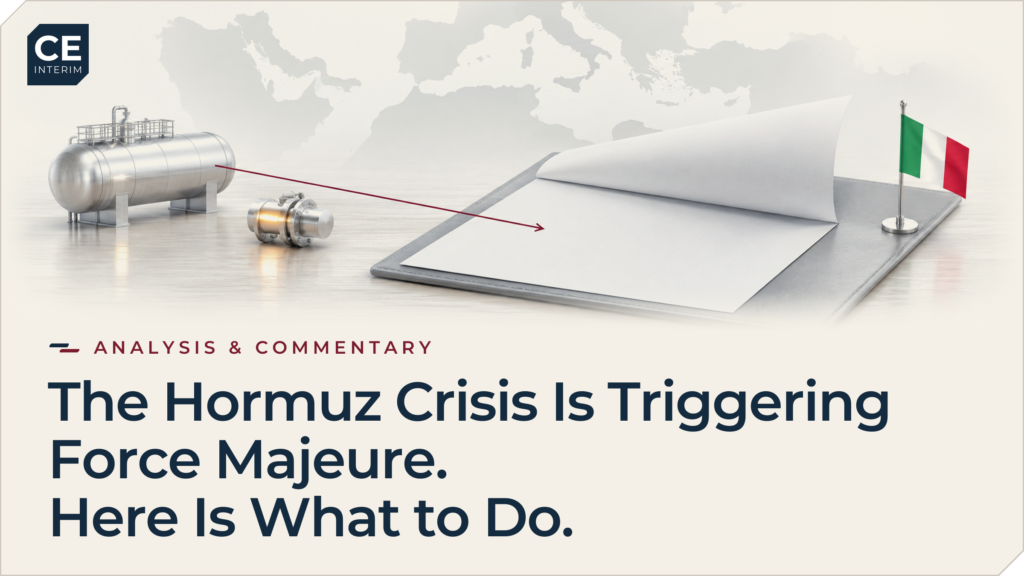
Večina podjetij, ki prejme obvestila o višji sili, jih obravnava kot pravne zadeve. Morala bi jih obravnavati kot operativne izhodiščne sile. Tukaj je opisano, česa vaše pogodbe ne morejo pokrivati.
Kriza v Hormuzu dokazuje, da je bil pravočasni sistem vedno krhek
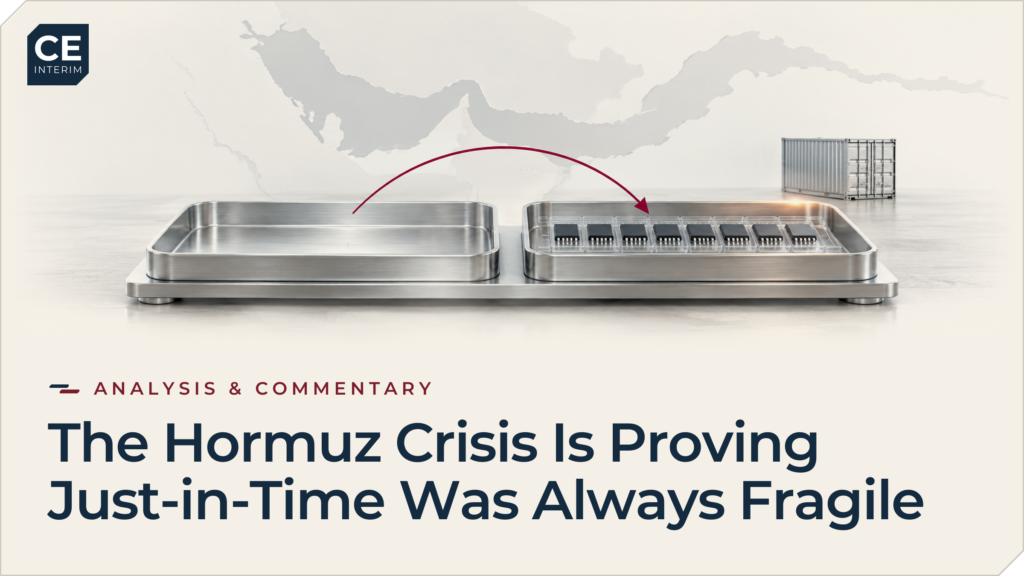
V petih letih je sistem Just-in-time v velikem obsegu dvakrat propadel. Težava ni v modelu. Gre za strukturo spodbud, ki ga po vsaki krizi vedno znova vzpostavi.
Kako kriza v Hormuzu tiho uničuje delovni kapital

Kriza v Hormuzu ne povečuje le stroškov. Povečuje pet vrzeli v ciklu pretvorbe denarja naenkrat. Ko se to pokaže v vašem četrtletnem pregledu, so tedni odzivnega časa že mimo.
Več kot nafta: pomanjkanje helija v Hormuzu prizadene dobavne verige polprevodnikov

Poleg nafte je motnja v Hormuzu povzročila tudi pomanjkanje helija, ki zdaj vpliva na dobavne verige čipov in globalno proizvodnjo.
 EN
 DE
 FR
 IT
 PL
 RO
 CS
 SK
 HU
 ES
 RU
 AR
 SL