

Stručně řečeno
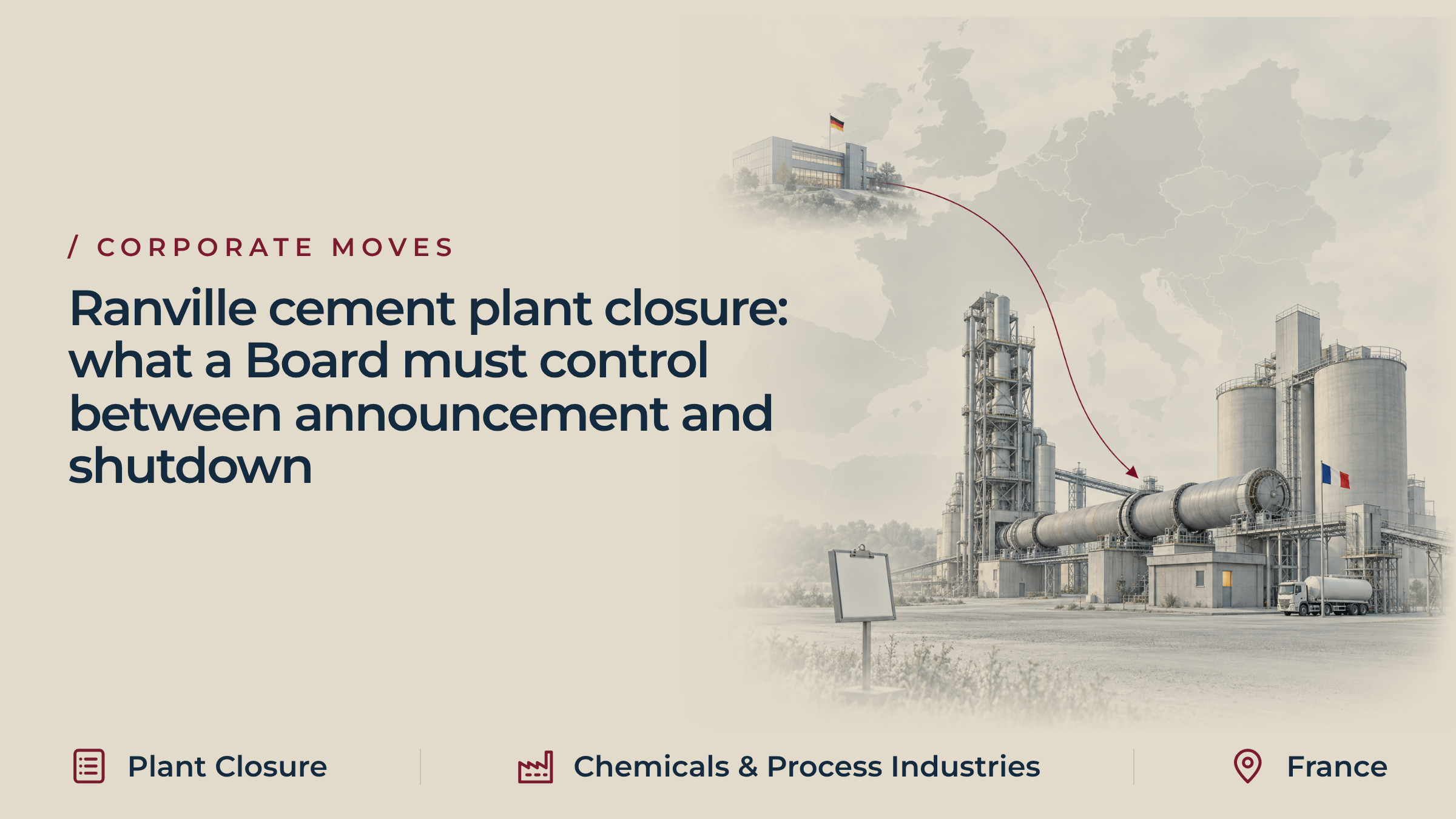
On 16 September 2026, Heidelberg Materials France announced a plan to close its Ranville cement plant in Calvados, Normandy. The decision affects 87 employees at a site that has produced cement since 1964. Heidelberg has not set a closure date. A Ranville cement plant closure runs four workstreams at once: kiln safety, customers, people and site liabilities. Each runs to a different timetable. One accountable executive, working from one fact base shared with headquarters, makes a controlled exit more likely.
Key Details of the Heidelberg Materials France Announcement
The plan concerns 87 of the 91 employees counted in March 2024. Employee representatives are being consulted. The plant took over from the Colombelles works in 1964. S&P Global reports annual capacity of about 450,000 tonnes of cement and 340,000 tonnes of clinker.
The company cites a significant fall in French cement volumes. Regional press puts the group's own drop at 30.7 per cent since 2023. The group says it has invested 650 million euros in Airvault, Beaucaire, Bussac-Forêt and Couvrot. It promises every affected employee at least one offer within the group in France.
Local reporting says employees stopped work on 22 September and negotiations were due from 24 September. Representatives have two months to give their opinion, which runs to mid-November. They reportedly expect closure around March 2028.
In April 2024, Heidelberg announced the closure of Beffes and Villiers-au-Bouin from October 2025. Global Cement reported 170 employees affected. The CGT union calls Ranville the fifth kiln stopped in six years.
Strategic Implications for Industrial Leadership and Governance
Two facts are missing: the closure date and the future role of the site. Without a date, the Board cannot sequence cool-down, supply transfer and the social plan. Without a role, it cannot tell whether Ranville keeps a terminal, a grinding line or nothing.
Here "the Board" means the group-level body that holds the closure budget, date and site role. The French entity's management is the legal employer and operator. Day zero comes first. Without one accountable owner for the consultation record and fact base, the first decision is to appoint one. The March 2028 horizon is an expectation from employee representatives, not a decision.
Delay has a cost. Open points narrow the Board's options while the consultation window runs, and customer cover can be hard to win back. The three-month notice to the prefect sets the earliest shutdown date.
Operational Workstreams in a Cement Plant Decommissioning
Closing a cement plant starts four workstreams at once. The order of attention is kiln safety, customer supply, the social plan, then site liabilities.
1. Kiln Safety, Decommissioning, and Hazardous Material Containment
A rotary kiln runs at about 1,400 degrees Celsius, so operators cool it in a controlled way. A hot shell left still can bow under its own weight, so the kiln keeps turning in slow cycles. Entry follows temperature and gas clearance, not a calendar date.
Older chromium-based linings can contain hexavalent chromium, a carcinogen formed in operation. Stripping them needs containment and certified waste routes. The trade-off is timing. A later last-clinker date protects supply but lengthens the period when maintenance discipline is under most strain.
2. Customer Supply Chain Continuity Across Regional Markets
Ready-mix plants and precast makers depend on daily bulk deliveries. The announcement does not say whether Ranville keeps a grinding or terminal role.
The Board must confirm which plants cover Normandy volumes, from what date and at what delivery cost.
3. Workforce Management and the French Social Plan (PSE) Process
The group-wide offer for every employee is a strong start. Its value depends on whether the posts exist at the right grade, in a reachable region, on acceptable terms.
A collective dismissal of this size needs a French Plan de Sauvegarde de l'Emploi (PSE), a social safeguard plan. The Social and Economic Committee (CSE) gives its opinion. The labour authority (DREETS) validates or homologates the plan, and the employer cannot terminate contracts until it decides.
4. ICPE Environmental Compliance and Site Rehabilitation Requirements
A cement works falls under the French regime for classified environmental installations (ICPE), inspected by the regional environment authority (DREAL). After shutdown, the operator must secure and rehabilitate the site. Baseline sampling of soil and groundwater should start while the operating team and its records remain on site. That gives the Board a trusted liability figure before it fixes the dismantling budget.
Early Indicators of Industrial Decommissioning Drift
These six signals appear first in plant-level reporting. They describe risks that closures create, not events at Ranville.
The escalation rules are Partner judgement, not a regulatory standard. Signals one to three go to the French entity's management and the headquarters sponsor within 24 hours. Emissions breaches and bypassed interlocks risk inspection findings, enforcement action and injury. Signal four goes to management the same day. Signals five and six are reported weekly and escalate if they persist.
- Baghouse filter alarms stay open, and broken sleeves go unreplaced. Dust plumes then draw inspectors to the stack.
- Temperature probes, gas analysers and vibration monitors fail. Shift teams bypass interlocks rather than wait for spares.
- Shell hot spots show on infrared scans, yet teams defer refractory repairs before the last clinker runs.
- Union action reaches the gate, and delivery lorries wait during PSE negotiations.
- Absence rises among shift supervisors and laboratory technicians, and quality release testing slips.
- Free lime in the clinker drifts above specification, which points to unstable flame control or raw mix feed.
Short quality drift within specification can stay imperfect for a few days.
The Role of Dedicated Interim Leadership in Plant Closures
Plant directors with twenty or thirty years on one site are the right people to run production safely. A closure asks them to dismantle what they built, negotiate with colleagues they hired and answer the local mayor. In CE Interim's judgement, an independent interim executive can carry it.
For a single site of this size, a closure-experienced Interim Plant Manager under a headquarters sponsor is the likely fit. An Interim COO fits where production transfer across several plants runs alongside the closure. A separate mandate changes four things.
- The executive answers to the French entity's management and reports to headquarters on a fixed cadence.
- The focus narrows to safety, environmental law and the labour authority.
- Social dialogue has a counterpart who is not tied to the site's internal relationships.
- The resident team keeps production and customer supply running without carrying the exit as well.
The real trade-off is trust. An outside executive gains independence but starts without the resident team's history, so visible support from the resident director matters.
Structuring an Effective Plant Closure Executive Mandate
In a closure of this kind, a CE Interim mandate writes decision rights down before the executive starts. Assessment tests closure experience, French labour-law context and fit with both sides.
Board and Headquarters Decision Responsibilities
Headquarters keeps the decisions that shape the plan. They are the closure budget, closure date, future site role, rehabilitation capital and redeployment terms at other group sites.
Three dates need separate owners. The executive recommends the last-clinker date, which is an operating decision. The Board fixes the closure date after consultation, once receiving plants are confirmed to cover Normandy volumes. The shutdown date follows. The French entity, as operator, notifies it to the prefect at least three months ahead. The last-clinker date is revisited if signals one to three stay open beyond 24 hours.
Delegated Operational Authority for On-Site Management
Inside the delegated authority, the executive decides the daily sequence of the closure, including the following.
- The safety stand-down sequence, with an independent specialist checking the cool-down schedule daily.
- Delivery scheduling, with commercial and decommissioning zones separated by perimeter security and independent metering.
- Maintenance priorities and contractor access.
- A proposed order of PSE meetings, put to the entity's management with labour counsel and verified redeployment offers.
- The environmental baseline, mapped with the inspectors from the first weeks.
Routing these through headquarters can slow the cool-down and blur ownership on site.
Reporting Cadence, Governance Escalation, and Site Handover
A Partner reviews progress weekly with the executive and headquarters. The Partner checks reporting quality and escalates to the Board directly if a signal stays open beyond the rule. Handover comes after validation of the PSE and a cold kiln. The executive gives the decommissioning owner a written file of open liabilities. Demolition design and final land use can stay open for months.
Navigating Cross-Border Governance: German Ownership and French Statutory Process
Heidelberg Materials has its headquarters in Germany. Its French subsidiary owns the plant and employs the 87 people.
Headquarters can set the closure budget, capital for its four invested sites and the reporting it requires. Only Heidelberg Materials France, as employer and operator, can consult the CSE, file the PSE and notify the prefect. An instruction from Germany does not shorten a French statutory timetable.
Sequence matters. Headquarters frames the options and a capital envelope while the French entity runs the consultation. Headquarters then fixes the closure date and budget once the consultation record exists, so the consultation stays genuine.
Headquarters also needs a weekly fact base: cost to date, risks, customer volumes and consultation status. The executive provides facts and options, not decisions. One reporting line protects the French entity from conflicting instructions between group functions.
Ranville has about 2,000 residents, and officials fear a large loss of tax revenue. The entity's management and the executive give the mayor and the prefect one account.
Market Context: Restructuring and Decarbonization in the European Cement Industry
Contes and Hanover are closures of production where the site kept a role. Lumbres and Obourg are investments that show where capital goes.
Case Study: Lafarge France (Contes Plant Conversion)
On 3 February 2021, Lafarge France presented a plan to stop cement production at Contes, near Nice, from early 2022. The LafargeHolcim subsidiary put 65 direct jobs and about 300 indirect jobs at stake, according to reports. The site becomes a terminal, and six workers stay on. Volumes move to the Bouc-Bel-Air plant, which needs more maintenance and logistics. The company promised to avoid forced redundancies through offers at other Lafarge France sites and retraining help.
Announcing the site's future role with the closure gave customers an answer from day one.
Case Study: Heidelberg Materials (Hanover Clinker Production Shutdown)
On 26 January 2024, Heidelberg Materials said Hanover would stop clinker production in the second half of 2024. About 120 people work there, and part of them stay on at the grinding facility. Westphalian plants supply the clinker and gain capacity utilisation. Solutions with the works council include transfers and early retirement where the age structure allows.
Grinding needs clinker on time and to specification, so supply planning became the real task.
Case Study: Eqiom (Lumbres Capacity Expansion Investment)
Eqiom, part of CRH, plans to expand Lumbres by 57 per cent by 2026. Capacity rises from 0.7 to 1.1 million tonnes a year, for a 300 million euro investment. The new kiln targets 20 per cent less CO2 and 40 per cent less NOx. It also targets 80 per cent less SO2 and about 35 per cent less fuel. The site emits about 600,000 tonnes of CO2 a year, roughly 6 per cent of French cement emissions. Its first decarbonisation phase avoids 245,000 tonnes a year.
If a closing group's receiving plants look like Lumbres, ramp-up pace is the Board test. Planned capacity is not delivered volume.
Case Study: Holcim (Obourg GO4ZERO Decarbonization Project)
Holcim broke ground on GO4ZERO at Obourg, Belgium, on 16 May 2024, with over 500 million euros planned. The first phase replaces the current kiln with an air-oxyfuel switchable kiln. It cuts CO2 by nearly 30 per cent per tonne of clinker. The second phase captures 1.1 million tonnes of CO2 a year for storage under the North Sea. Planned output is about 2 million tonnes of near-zero cement a year, supported by the EU Innovation Fund.
A closure date should follow proven take-up of volume, not the project announcement.
Partner interpretation: capital is moving to fewer, larger, lower-carbon lines. The test for a closing site's Board is simple. Can receiving plants cover customer volumes before it fixes the closure date?
Frequently Asked Questions (FAQ) About Cement Plant Closures
How long does it take to cool a cement kiln safely during shutdown?
Industry maintenance checklists give roughly three to five days before safe entry. During this period, the rotary kiln must continue to turn in slow controlled cycles to prevent the shell from warping under extreme thermal stress. Maintenance teams monitor internal temperatures and gas clearance continuously before authorization for refractory inspection is granted.
What are the ICPE notification timelines for plant closures in France?
The operator must tell the prefect the shutdown date at least three months before it, under article R. 512-39-1 for authorised sites. Quarries and waste storage need six months. This formal notification triggers the oversight procedure by DREAL to verify site security and environmental rehabilitation obligations.
When is a Plan de Sauvegarde de l'Emploi (PSE) required under French labor law?
A company with 50 or more employees needs a PSE when it plans ten or more dismissals within 30 days. For fewer than 100 dismissals, the CSE has two months from its first meeting. The labour authority then decides within 15 days on an agreement. A unilateral plan takes 21 days. Individual termination letters cannot be sent until official approval or homologation by DREETS is finalized.
When should executive management appoint a plant closure lead?
Ideally before the first consultation meeting, so the executive holds the fact base from the start. Early appointment ensures a clear separation between daily plant operations and the governance of the shutdown process. This structured oversight helps maintain operational stability, safety discipline, and constructive employee dialogue throughout the transition.
Související informace a další postup
A closure stays under control when each of the four workstreams has a named owner and a date. In the Ranville cement plant closure, the consultation is open. Naming one accountable owner is the first question to settle.
Další články na toto téma:
- Jeden ERP systém je již v provozu. Co je třeba změnit, než se spustí provoz v další zemi?
- Český závod potřebuje nového dodavatele. O tom rozhoduje německá centrála.
- Problémy dodavatelů v Evropě: co je třeba ověřit, dokud ještě dorazují dodávky
CE Interim provides cross-border executive leadership for critical business transformations. A Partner can help a Board define the mandate first: what stays with headquarters, what the executive decides and when. A proven or vetted, mandate-matched executive ready to start within 72 hours after the completed mandate brief can then take charge on site.
Promluvte si s Prozatímní partner CE when a closing plant needs one accountable executive between headquarters and the site.
Redakční prohlášení
This article is an independent operational analysis of the planned closure of the Ranville cement plant by Heidelberg Materials France. It draws on publicly available corporate announcements, financial disclosures and industry research. It does not state or imply a commercial, advisory or client relationship between CE Interim and Heidelberg Materials France or any other company named in it.
 EN
 DE
 FR
 IT
 PL
 RO
 CS
 SK
 HU
 ES
 RU
 AR
 SL