

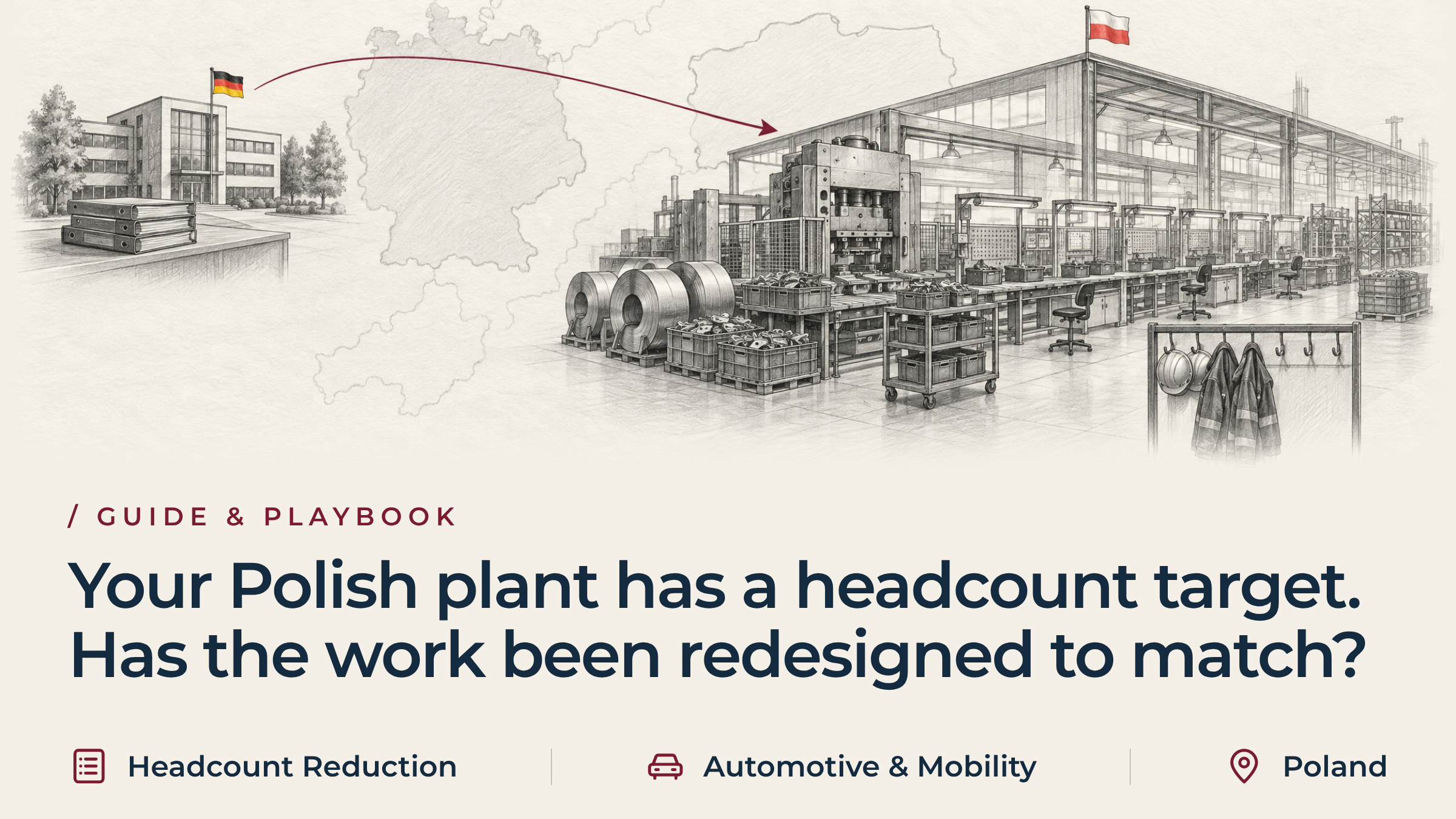
Váš poľský závod má stanovený cieľový počet zamestnancov. Bola práca prispôsobená tak, aby tento cieľ spĺňala?
V skratke
A plant headcount reduction removes payroll cost, not the work people were doing. A corporate board in Munich, Zurich or Paris approves a 15 to 25 per cent cut for a Polish site. It fixes the completion date, and the plan usually stops there. Customer volumes, delivery commitments and quality standards do not shrink to match the smaller team. The site absorbs the gap through unplanned overtime, skipped maintenance and informal workarounds that quietly erode margin. A credible reduction decides, before the people leave, what work stops, what transfers and what continues with fewer hands.
The primary trigger: Top-down plant headcount reduction targets set without operational visibility
A corporate board approves a plant headcount reduction target for the Polish manufacturing subsidiary. An earnings call or investor review flagged margin deterioration across the European footprint. Group finance sets a non-negotiable target. Shopfloor and indirect headcount must fall by fifteen to twenty-five per cent by the end of the second quarter.
The timeline is fixed and headquarters allocates the severance budget. Human resources opens discussions with the local enterprise committee. Group finance tracks the projected labour saving on a spreadsheet in Germany or Switzerland, hundreds of kilometres from the shopfloor.
Customer volumes have not fallen alongside the labour budget. OEM schedules for next month show steady demand. Penalty clauses for missed delivery windows remain severe and supplier quality tolerances allow zero deviation.
Corporate leadership rarely asks how the site will produce the same volume with fewer people. Probing that question risks open concern on the shopfloor, or local management disclaiming responsibility for a number it did not design. In the short term, it is easier to assume the operating routines will adapt on their own.
Why cross-border manufacturing cost reduction in Poland faces governance hurdles
Executing a plant headcount reduction across borders adds governance distance that a domestic factory does not face. The executives who set the target sit hundreds of kilometres from the shopfloor in Silesia, Wielkopolska or Lower Silesia. They see monthly reporting packs, standard labour variances and aggregate output figures. They do not see the informal routines that keep the site compliant day to day.
Hidden shopfloor workarounds: Unmapped roles exposed during plant headcount reduction
Many Polish Tier 1 plants owned by German, Swiss or French parents have built workarounds over the years. The workarounds compensate for legacy engineering flaws or erratic component deliveries. When a part arrives with dimensional drift, an operator manually deburrs it before the automated welding cell accepts it. When an automated packaging station faults, a material handler manually palletises finished goods to keep the line moving.
None of this appears on a job description. None of it generates a distinct routing code in the enterprise resource planning system. Headquarters reads these roles as surplus indirect labour that the business can remove without operational risk.
Misaligned corporate directives: Balancing manufacturing cost restructuring, HR, and supply chain
Language, geography and reporting distance widen the gap further. Group Controlling sets the cost target. Group HR manages the local statutory severance process. Group Supply Chain demands unbroken delivery. Each function issues its own instruction, and none of the three owns the operating design that has to reconcile them.
Local plant managers sit between these conflicting directives. Challenging the cost target risks their standing within the group. Admitting the plant cannot hold output without those roles exposes a weakness in previous management.
The weakness is not only the present team's. Many managers choose a third path. They report the programme as on track, and hope remaining teams absorb the load through goodwill and shortened breaks. That hope is understandable under pressure. It is not a plan.
Warning signs your plant headcount reduction lacks an effective operational redesign
A clean headcount reporting deck can sit on top of a shopfloor that tells a different story. Four concrete symptoms show that the operating model has not been redesigned to match the plant headcount reduction:
- Overtime rises as permanent headcount falls. Total payroll stays flat, or climbs, because remaining operators cover baseline changeovers and material transport on extended weekend shifts.
- Preventative maintenance slips into reactive breakdowns. Technicians reassigned to daily machine operation fall behind on autonomous routines, and equipment trips start appearing without warning.
- Material staging chokes line-side flow. Removing indirect logistics handlers sends operators off station to fetch components, creating frequent short stops that depress hourly output.
- Supervisory bandwidth disappears into firefighting. Shift supervisors spend the shift covering open stations instead of auditing quality compliance or training cross-skilled operators.
Core requirements for manufacturing operational redesign before reducing headcount
A credible plant headcount reduction sorts every activity into three categories before the people leave, not after:
- Work that stops permanently, with written sign-off from headquarters so nobody keeps doing it informally.
- Work the team restructures to take fewer hours, through re-balanced stations, better material flow or faster changeovers.
- Work that remains with fewer people, carrying decision rights and escalation rules the plan states plainly instead of leaving them to guesswork.
1. Eliminating non-essential tasks to support a smaller operating model plant
Management identifies, in writing, every activity the plant will no longer perform. The list typically includes redundant documentation layers, manual double-checking of automated inspection data, and secondary finishing steps no customer ever specified. Without that written instruction from headquarters, local teams keep doing the work informally, pulling labour away from the line.
2. Restructuring and transferring work content for plant headcount delivery
The team re-engineers tasks that cannot stop, so they take fewer hours. This means re-balancing stations against customer takt time. It also means adding gravity feeds or kitting carts to cut material handling, and writing standard work combination sheets.
Where a changeover takes forty-five minutes because operators fetch their own tooling, single-minute exchange of die methods compresses that downtime. The fix has to land before the hours disappear from the roster.
3. Redefining operational decision rights for remaining shopfloor teams
For activity that cannot shrink, decision rights and escalation rules need redefining. Operating teams must identify who can stop a line for a deviation and which tasks pass to machine operators.
They also need to know how quality containment works once an offline inspection table disappears. The plan dual-runs outgoing staff against the new flow under live production, rather than discovering the gaps after they leave.
Industry trends: European manufacturing cost reduction Poland and rightsizing patterns
European automotive suppliers are resizing at scale, and a plant headcount reduction is not the same event as a closure. The Eurofound factsheet on JTEKT Czech Republic records roughly 300 positions eliminated, close to half the workforce, as of 1 August 2026. The plant remained operational throughout. The factsheet documents what happened. It says nothing about how the site redesigned its work. Readers should draw no conclusion beyond the fact that the plant resized and kept running.
Case study: Turnaround and plant headcount reduction at a Polish automotive facility
A major German Tier 1 automotive supplier operated a large stamping and interior sub-assembly facility in Silesia, Poland. The site employed 620 permanent staff.
Facing margin erosion from rising local utility expenses and OEM price deflation, the executive board mandated a 22 per cent plant headcount reduction. The cut affected 136 roles within five months, targeting annual conversion cost savings of €3.8 million.
Three months into the reduction programme, the site had removed 90 temporary and permanent workers. However, scrap rates doubled and weekend overtime surged by 34 per cent. An OEM customer then issued a formal containment warning after uninspected parts arrived at its German assembly plant.
Engaging interim leadership for manufacturing cost restructuring
Recognising that the plant was heading toward a customer line stop, the Group COO engaged CE Interim. CE Interim deployed an already vetted, mandate-matched, NDA-bound executive as Interim Plant Manager on site, ready to start after the completed mandate brief. Institutional Partner-led transformation governance supported the mandate throughout.
Operational diagnostic: Uncovering hidden drivers of scrap and overtime
The on-site operational diagnostic revealed the root cause within the first four days. The factory had removed 35 indirect material handlers and 25 quality sorters without altering the internal logistics flow or machine maintenance intervals.
Machine operators were spending up to 90 minutes per shift walking through warehouse aisles to locate raw stamping coils and plastic clips, leaving primary stamping presses unattended. Offline sorting tables had been dismantled, but primary press tooling had worn cutting dies that produced excess burrs. As a result, defective stampings flowed directly into customer shipping containers undetected.
Targeted operational interventions for plant headcount delivery
The interim executive executed three decisive operational interventions over a ten-week turnaround mandate:
- Restructured shopfloor logistics and kitted delivery. The team implemented a visual point-of-use replenishment system with standardised material routes. This eliminated operator movement and returned 14 per cent productive capacity to primary assembly lines.
- Re-engineered press tooling maintenance and inline poka-yoke. The team overhauled die maintenance cycles and restored toolroom preventative routines. It also installed optical part-presence sensors within the automated welding fixtures, eliminating the need for offline sorting tables.
- Re-balanced work combinations and supervisory spans. The team re-sequenced assembly tasks across two balanced shifts and re-assigned supervisors from station filling to direct line auditing. It also instituted clear operational decision rights for shift leaders.
Results achieved: Achieving sustainable manufacturing cost reduction in Poland
Within ten weeks, the factory stabilised its operating rhythm under the reduced staffing target of 484 employees. First pass yield recovered from 88.4 per cent to 98.6 per cent, and weekend overtime fell by 82 per cent. The OEM customer officially lifted the quality escalation notice.
The revised operating model delivered €4.1 million in net annualised conversion cost reductions. It proves that labour savings only materialise when the team re-engineers the work itself.
Evaluating internal management vs. external executive support for plant headcount reduction
Not every plant headcount reduction needs outside executive help. A plant with a stable, experienced manufacturing engineering function and real capacity headroom often qualifies. That works provided local managers can give thirty hours a week to process mapping without neglecting daily dispatch. Headquarters should then give that team the mandate and the time.
Independent executive authority becomes commercially necessary when daily operations and the redesign compete for the same hours. A plant manager running three production shifts cannot also manage complex statutory consultations and redraw the physical line layout. Asking one person to carry all three forces a compromise on the redesign itself.
An experienced interim executive brings independent authority to question legacy routines. The executive aligns engineering, maintenance and production around one plan, and completes the redesign before the cuts affect delivery.
Frequently asked questions about plant headcount reduction and operational redesign
What key decisions must precede a plant headcount reduction?
Management defines, in writing, which activities, reports and routines stop permanently, and which ones a smaller team still carries. It rebalances the remaining stations against customer takt time. It also confirms which changeovers need faster tooling methods, and tests the revised flow under live production. Only after this redesign exists does fixing an employee's exit date make sense. Setting the date first and designing the work afterwards reverses the correct order. That reversed sequence leaves scrap, overtime and customer escalations to absorb the difference.
Who should take ownership of operational redesign during plant cost restructuring?
The redesign needs one executive with authority across production, maintenance, quality and engineering, not a committee representing each function separately. Delegating it solely to human resources or finance leaves nobody accountable for how the work actually changes once people leave. The owner needs standing to question legacy routines and reassign supervisory responsibility. The owner also confirms, station by station, that the remaining team can hold the line without informal workarounds.
What are the risks of performing operational redesign after headcount reduction?
The plant moves into firefighting rather than restructuring. The remaining workforce absorbs the unmanaged workload through overtime nobody budgeted. Preventative maintenance falls behind schedule, and quality containment weakens as offline checks disappear with the departed roles. Customer escalations typically follow within weeks, not months. The business often ends up paying a staffing agency to cover the capacity the reduction should have removed. The saving on paper survives. The saving in practice does not.
Does plant automation eliminate the need for operational redesign?
No. Introducing automation changes material staging, maintenance requirements and changeover protocols rather than eliminating the need to redesign them. Without redefining technician responsibilities and spare-part logistics around the new equipment, automated lines still suffer prolonged micro-stoppages. The labour saving the business expected from automation does not materialise on its own. The redesign discipline is the same whether the plant is removing people or adding machines. Decide what changes before the headcount or the capital moves.
How long does an operational redesign take during manufacturing restructuring?
A focused redesign usually takes six to ten weeks. That gives enough time to map the value stream station by station and trial rebalanced work content on live production shifts. It also confirms that revised preventative maintenance cycles hold before the headcount actually falls. Compressing the timeline shifts risk onto the first weeks after people leave. That is the most expensive place for the gap to surface: in scrap, overtime and a customer-facing quality incident.
Súvisiace poznatky a ďalší krok
A plant headcount reduction is only one of several situations where headquarters loses sight of the operating reality until a decision is already underway. The following articles cover adjacent moments where that same gap between a corporate instruction and local execution opens up.
- Koľko času skutočne trvá nahradiť člena vedenia?
- Čo robiť v prvom týždni po odstúpení generálneho riaditeľa
- Keď sa kontrolou zo strany ústredia stane ďalší problém
When headquarters has approved a plant headcount reduction and local leadership lacks the bandwidth to redesign the operating model while protecting customer delivery, talk to a Dočasný partner spoločnosti CE about the mandate the situation now requires.
 EN
 DE
 FR
 IT
 PL
 RO
 CS
 SK
 HU
 ES
 RU
 AR
 SL