PROČ CE INTERIM
Vytvořeno provozovateli.
Důvěryhodný pro správní rady.
Neobsazujeme role. Vedeme mise.
25+
Země prostřednictvím Valtus Alliance
KDE PŮSOBÍME
Dočasné výkonné nasazení
na 5 kontinentech.
Od Evropy přes Perský záliv až po Ameriku - vedoucí pracovníci nasazení na místě.
5
Kontinenty a růst
Potřebujete dočasné vedení na určitém trhu?Obraťte se na regionálního partnera
PRO DOČASNÉ VEDOUCÍ PRACOVNÍKY
Váš další mandát
začíná zde.
CE Interim spojuje vedoucí pracovníky na dobu určitou s mandáty s velkým dopadem v Evropě, Americe a na Blízkém východě.
60,000+
Dočasní vedoucí pracovníci v naší globální síti
KNOWLEDGE HUB
Poznatky od provozovatelů,
ne pozorovatelé.
Redakční články, výzkumy a informace od vedoucích pracovníků, kteří byli v této místnosti.
25k+
Měsíční čtenáři

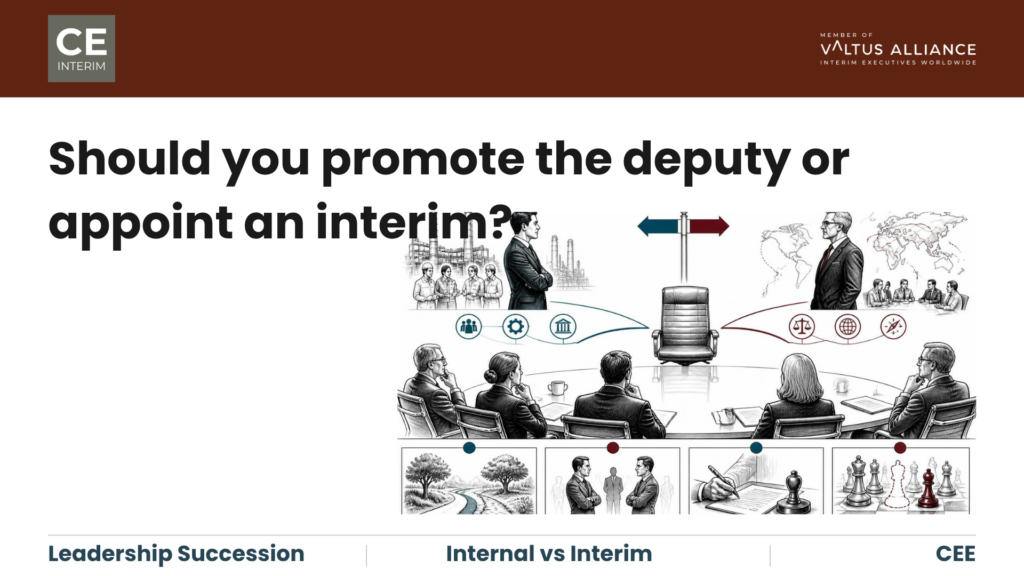
Jak lze do 72 hodin zajistit nasazení dočasného manažera v zahraničí?

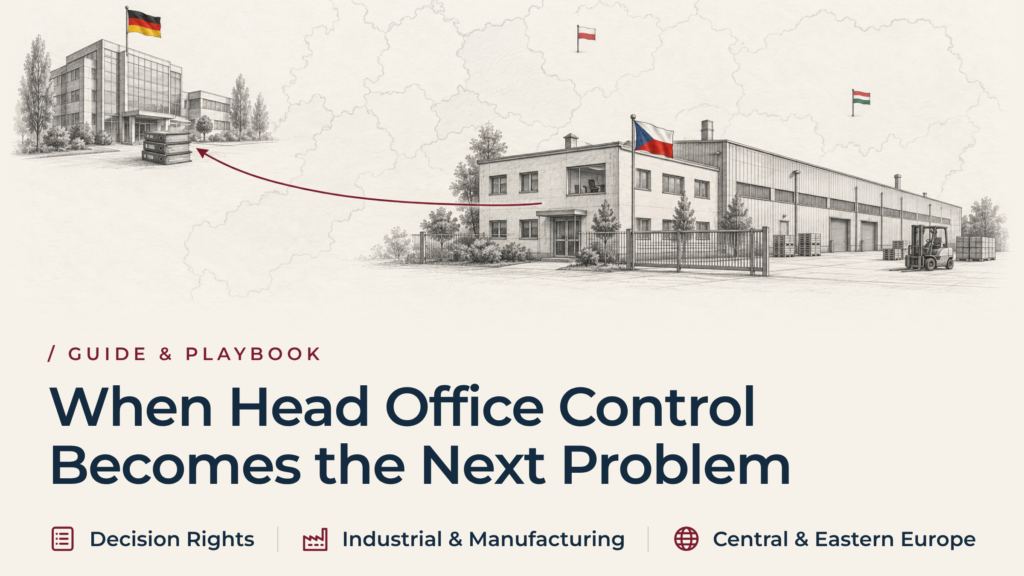
A senior interim executive transitioning from a Group-level briefing directly into a foreign manufacturing site.

In brief Mobilising an interim executive across a border in 72 hours is not a recruitment sprint. It is a disciplined institutional sequence that starts only once a mandate brief is finalised: defining the transformation problem, matching it against a pre-vetted network of proven leaders, and confirming decision rights before departure. A vetted, mandate-matched executive ready to start within 72 hours after the completed mandate brief restores operational control before enterprise value erodes further. The speed is the output of the process, not a shortcut around it. The Financial and Operational Cost of Delayed Board Decisions During Executive Transitions No board wakes up one morning and decides to lose a plant. What actually happens is smaller and more human than that. A site director resigns. The COO tells the board it is “under control.” Everyone agrees to watch the next set of numbers before doing anything drastic. Replacing a leader mid-crisis feels like an admission that things are worse than reported. Admitting that in front of shareholders, lenders, or a parent company feels riskier, in the moment, than waiting one more reporting cycle to see if local management self-corrects. That calculation is not stupidity. It is loss aversion, and every board makes it. The trouble is that the operation does not wait for the board to feel ready. Traditional executive search runs three to six months from brief to start date, and every week inside that window, the business runs itself, unsupervised, in the direction it was already heading. A supplier quietly moves from 60-day terms to cash on delivery. A customer’s procurement team opens a parallel qualification process with a competitor, not because they want to switch, but because their own governance requires a contingency plan on file the moment a key supplier looks unstable. Neither decision gets reversed by a good quarter three months later. Suppliers and customers read behaviour, not intentions, and by the time the board notices, the behaviour has already changed. The cost of that gap is not abstract. Failed leadership transitions have been shown to cost a company more than twice the departing executive’s annual compensation once lost productivity, team attrition, and missed commercial opportunity are counted in. By the time a board formally approves headcount for a permanent search, the damage a rapid interim mandate would have prevented has usually already happened. It just has not shown up on the management accounts yet. Navigating Cross-Border Legal and Operational Complexity in Interim Leadership Deploying executive authority into another country is a different problem from replacing a domestic manager, and treating it the same way is how mandates fail before the executive arrives. CV delivery is not mandate matching. A search firm sending group HR a stack of profiles consumes days without answering the only question that matters: does any of these people have the sector fluency, the appetite for a business under pressure, and the cross-border credibility this mandate requires, right now, in this plant, with these customers watching. Legal mobility is a precondition, not a formality. In Germany, a managing director must conduct the company’s affairs with the due care of a prudent businessperson, and is personally liable to the company for loss arising from a breach of that duty, under section 43 of the Limited Liability Companies Act (Hamburg Chamber of Commerce). The equivalent standard for stock corporations sits in section 93 of the Stock Corporation Act, which requires the due care of a prudent manager and makes board members jointly and severally liable for breaches (Federal Ministry of Justice). That duty attaches on appointment. German case law goes further and recognises the de facto managing director: a person who in practice performs the management role without being registered can attract liability under section 43 in the same way (Kunz Rechtsanwälte). This is exactly why an executive cannot informally help out on site while contracts and registrations are still being settled behind them. Acting without appointment does not avoid the exposure. It creates exposure without the standing that comes with the office. Mobilisation confirms legal readiness before travel, never after. Confidentiality determines whether the plant survives the transition intact. Think of it the way a family thinks about a serious diagnosis: the people closest to the situation need to hear it directly, calmly, and in order, or they fill the silence with their own worst guess. A foreign subsidiary under pressure that leaks news of an incoming interim leader before the mandate is confirmed risks losing exactly the people the new executive will need on day one. Local finance and operations staff who sense instability update their CVs before the board updates its minutes. Decision rights have to be settled before the executive arrives, and this is not a procedural nicety. A survey questioned executives at 350 global companies and found that only 15% believed their organisation made decisions well enough to outperform competitors. What separated the rest was the quality, speed and execution of decision making, and the four places they found decisions getting stuck map directly onto a cross-border mandate: global versus local, centre versus business unit, function versus function, and inside versus outside partners. The second of those is the one that concerns a group and its foreign plant. The study noted that it tends to afflict parent companies and their subsidiaries, because the business unit is close to the customer while the centre sets the goals, and neither position settles who decides. Their conclusion is unambiguous: ambiguity is the enemy, and where accountability is unclear, gridlock and delay are the likely outcomes. Their remedy is a written allocation made before the decision arrives rather than during it. One person holds the decision. A small number hold veto rights. Everyone else provides input or executes. In a cross-border mandate, that allocation is agreed between the group and the incoming executive in the first week, put in writing, and circulated to both sides. An executive who arrives without a written boundary on unilateral authority does not lose credibility gradually.

Proč přeshraniční transformace začíná na jedné ověřené faktické základně

Vysoký manažer, který si prohlíží dva protichůdné přehledy

In brief Transformation cannot be governed when headquarters and the local operation are working from different definitions, assumptions and figures. Before targets are set or initiatives launched, the first leadership task is to establish one verified view of the business: what cash is really available, what the order book actually commits to, what quality and capacity genuinely allow. Everything downstream, including the credibility of the plan itself, rests on that agreement. Where the fact base is contested, decisions stall or get taken twice. Why Subsidiaries and Headquarters Diverge: Operational vs. Financial Reporting No one sets out to run two versions of a business. It happens because a group needs comparability and a plant needs to run. Group finance defines revenue on a consolidated basis, recognises it under group policy, and reports monthly on a calendar the whole portfolio shares. The local operation measures what it can see and act on: what shipped, what the customer accepted, what is sitting in the yard waiting for a part. Both are accurate within their own frame. Neither is complete. Given eighteen months, the two frames drift far enough apart that a single word stops being reliable. “Backlog” means confirmed orders in one place and everything in the pipeline in another. “On-time delivery” is measured against the original promise at group and against the last revised promise locally. The gap is not concealment. It is the definition. Addressing Reporting Discrepancies: Why Boards Hesitate to Challenge Numbers This is where boards hesitate, and the hesitation is worth naming. Challenging the numbers feels like challenging the people. A group CEO who reopens the fact base is making an implicit statement about the managing director they appointed, the finance director who signs the pack, and their own judgement in accepting both for the last six quarters. There is also the quieter problem: if the definitions were wrong, then the decisions built on them were taken on the wrong basis, and some of those decisions were the board’s. So the fact base stays unexamined for longer than it should, while the operational explanation gets rehearsed instead. It was a timing difference. It was one bad month. The customer moved the schedule. Meanwhile the local team is usually working under constraints it has not been asked about directly. Group expectations set at portfolio level may not reflect what the site can produce with the tooling, headcount and supplier terms it has. Escalating that costs something politically. Absorbing it quietly costs less, until it cannot be absorbed. Two people keeping the household accounts in separate notebooks will both be honest and will never agree, and the argument when it comes will be about the money rather than the notebooks. The Complexity of Governing Cross-Border Industrial Operations Distance changes the mechanics, not just the mood. Information reaches headquarters aggregated and late, having passed through a local ledger, a statutory framework and a consolidation layer, each of which is legitimate and each of which removes detail. A group CFO in Munich reading a Hungarian subsidiary’s pack is reading an interpretation of an interpretation, and the operational facts that would explain the variance sit two translations away. The exposure is not marginal. Across the EU, foreign-controlled enterprises make up around 1% of market producer businesses but generate roughly a quarter of total value added, and in several Central European economies the concentration is far higher. Foreign-controlled enterprises accounted for 50% of value added in Slovakia, and 28% of jobs in both Slovakia and Czechia in 2023. A great deal of European industrial output is governed from a country other than the one it is produced in. Add statutory reporting that differs from group policy, ERP instances that were localised at implementation and never reconciled, and a management layer translating between two accounting logics every month, and the divergence becomes structural. It is not a language problem or a cultural one. It is a question of which numbers carry authority, who is permitted to change a definition, and how long it takes for an operational fact to reach the person accountable for it. Identifying the Signs of a Compromised Fact Base in Governance Not approaching this situation. Already in it. The last one is the reliable signal. Once decisions start waiting for agreement about the facts, the fact base has become the constraint on the business. Six Critical Metrics for Verifying a Single Business Truth Six areas carry almost all of the risk. Each needs a single agreed definition, an owner, and a documented source system. This exercise is unglamorous and it is where the value is decided. McKinsey’s research across 15 years of transformations found that completing a comprehensive, fact-based assessment of the business is one of three actions most predictive of a transformation capturing its full value, and that nearly a quarter of all value loss occurs during target setting, before implementation begins. Targets set on a contested fact base are compromised on the day they are agreed. The scale of ordinary error is easy to underestimate. In a Harvard Business Review study in which 75 executives assessed 100 of their own department’s records, 47% of newly created records contained at least one critical error, and only 3% of the resulting data quality scores were acceptable even on the loosest standard. The sample is small and self-assessed, and the study is now some years old, but the direction is consistent with what turns up whenever a group looks properly. Implementing a Fact-Based Decision-Making Framework Verification is not an audit. An audit establishes what happened. This establishes what is true now, so that a decision can be taken this week. The sequence that works is short. Agree the definitions in writing. Name one owner per figure. Fix the source system for each, so the same number cannot be produced two ways. Restate the last two quarters on the new basis, which is uncomfortable and necessary, because a new baseline without history gives the board nothing to judge movement against. Then set targets.

Ukončení smlouvy o přechodných službách: Hodiny, které nikomu nepatří

výrobní ERP operační terminál

Honeywell Aerospace became an independent public company on 29 June 2026. The company still depends on global real estate, IT, finance administration and HR services under its TSA. Honeywell Aerospace states that those services will generally run for no more than two years following the spin-off. That is the operating reality behind a transitional services agreement exit: the deal closes before the dependency chain disappears. Honeywell completed the Solstice Advanced Materials spin-off on 30 October 2025, with the Solstice Advanced Materials TSA generally limited to 12 months. Aptiv completed the Versigent separation on 1 April 2026 and disclosed transition services, principally IT, for terms of up to 24 months. Different clocks create the same exposure: legal separation happens first, while operating independence arrives dependency by dependency. A transitional services agreement exit starts with the replacement service Contract dates do not create operating capability The buyer can switch off a TSA service only when the replacement process works without seller support. The replacement needs system access, complete data, contracts, controls and a named owner. TSA exit planning must therefore work backward from the operating state, not forward from the contract date. A completion percentage proves very little. Payroll, cash movement and customer invoicing must still work after the seller withdraws. The dependency often reaches far beyond the service label. The Kenvue and Johnson & Johnson TSA dated 3 May 2023 covered a wide operating scope. It included IT, supply chain, HR, medical safety, finance, regulatory activities, sales and marketing, R&D, real estate, legal operations, government affairs, distribution and tax. The same SEC disclosure describes a separate data-transfer agreement for extraction, transfer, traceability, retention and deletion. One shared service can therefore sit underneath several business processes at once. Post-carve-out standalone operations need a full-cycle test The buyer needs evidence that the standalone company can complete whole operating cycles without the seller. This is where post-carve-out standalone operations become measurable. Test the points where functions meet, because incomplete separation usually appears there first. 1. Close the books using standalone data, approvals and reporting access. 2. Run purchase-to-pay from supplier order through receipt, approval and payment. 3. Run order-to-cash from customer order through invoicing, collection and reconciliation. 4. Complete payroll, identity administration and exception handling without parent access. This is also where carve-out execution differs from system implementation. A live application proves only that the application runs. It does not prove that the company can absorb errors, exceptions and month-end pressure after the legacy route disappears. TSA exit planning fails when rights and consents remain with the seller Technical readiness can still hide contractual dependence A configured system can remain unusable if the new company lacks the rights around it. Data may be incomplete, identities may still sit with the seller, and supplier interfaces may still point to legacy infrastructure. Regulation (EU) 2023/2854, the EU Data Act, belongs on the control map where teams reassign data access and use rights. The Aptiv and Versigent TSA makes the contractual dependency explicit. The agreement requires necessary third-party consents and states that the service provider has no obligation to continue a service if the required consent is missing and no alternative arrangement exists. A vendor consent or license can therefore remain on the critical path after the internal build is complete. The buyer should track three forms of control • Operational control: can the business perform the service without seller access? • Contractual control: does the new entity hold every license, consent and vendor right it needs? • Data control: can the company access, retain, transfer and delete the required data under its own authority? These questions keep separation management tied to operating evidence. They also prevent carve-out execution from becoming a collection of technical go-lives with unresolved legal dependencies. Separation management needs one owner for the dependency chain Functional milestones can all be green while the company is still dependent Each function can finish its assigned work and still produce a company that cannot stand alone. Finance, IT, HR, procurement, legal and operations do not become independent at the same moment. Finance may need bank mandates before close. Procurement may need supplier contracts before purchase orders move. HR may need payroll and identity controls before the parent removes access. The risk sits between workstreams, not inside them. Effective separation management needs one integrated exit condition for each service. The Separation Management Office or Separation Director must own the sequence, expose conflicts and reject local completion when a downstream dependency remains open. CE Interim documented a related governance problem in a PE-owned industrial carve-out requiring independent financial visibility and governance after acquisition. The case shows why standalone reporting and decision rights must become real operating capabilities. Spreadsheet milestones are not enough. Local entities can block TSA exit Central platform readiness does not settle local ownership A central ERP cutover does not make every local entity independent. Banking, payroll, tax, customs, cybersecurity controls and statutory reporting still need named ownership. Industrial groups expose this problem sharply because plants may depend on central systems while carrying local legal obligations. EU Member States were required to transpose Directive (EU) 2022/2555, NIS2, by 17 October 2024. The Directive covers, among other sectors, manufacturing of critical products. During separation, the operating question is direct: who owns identities, infrastructure, managed services and security processes after the seller steps out? CBAM now belongs in the 2026 cutover test CE Interim published an earlier CBAM manufacturing overview in September 2025. That article predates the current implementation details, so a 2026 carve-out must supersede its readiness context with the operative regime. The Carbon Border Adjustment Mechanism definitive regime started on 1 January 2026. Under CBAM, importers or indirect customs representatives above the 50-tonne single mass-based threshold must obtain authorised CBAM declarant status. CBAM covers cement, iron and steel, aluminium, fertilisers, electricity and hydrogen. For an affected carve-out, the buyer must prove that the standalone importer and customs process work under the new entity. Data ownership and compliance responsibility must also sit there. Western Digital and

CE INTERIM

Platforma pro dočasné řízení výkonných pracovníků

Jsem..

Klient / společnost

Najímání dočasného vedení

Dočasný manažer

Hledání mandátů