

Kurz gesagt
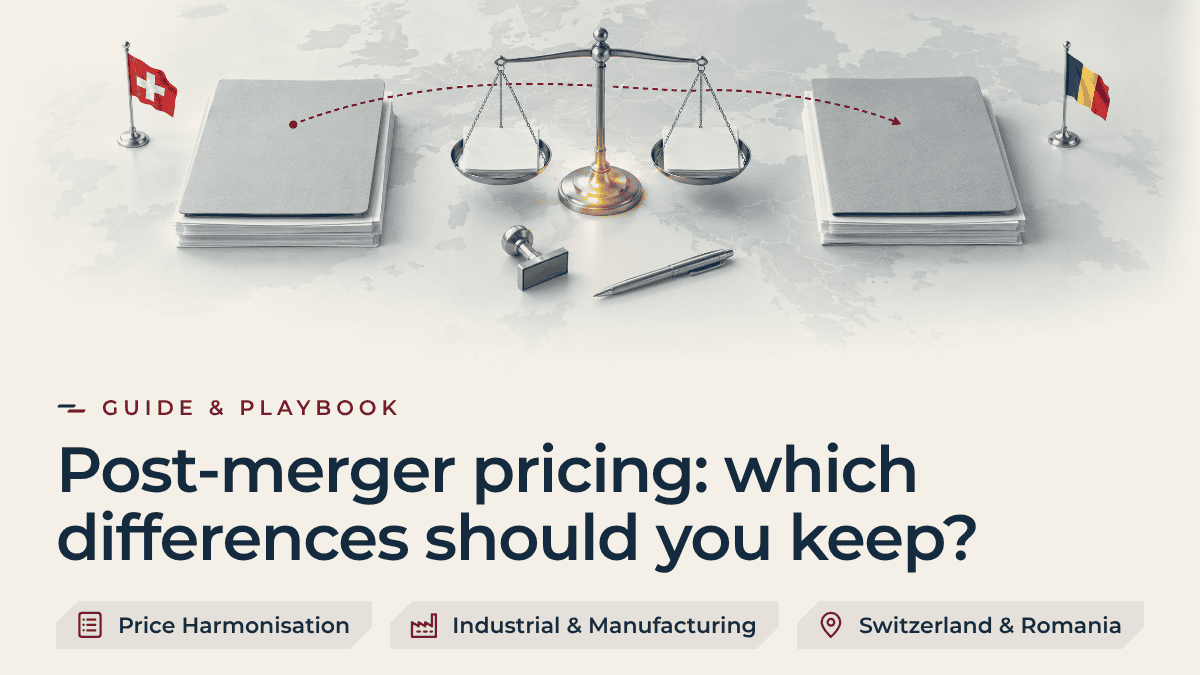
Post-merger pricing starts with a comparison, not a decision. Two legacy price lists can differ because of tooling, service scope, delivery terms or contract commitments, not because of error. Harmonising before the comparison is complete can cost margin and customer trust. Before approving any change, compare the offers. Classify each difference as justified, reviewable or an error. Name who approves it, and agree a customer-specific transition.
Why Post-Acquisition Price Integration Requires Strategic Analysis
Within ninety days of closing, the finance team completes its first commercial audit. It finds two businesses selling comparable components to overlapping industrial customers at different prices, margins and payment terms.
To a Group CFO or private equity operating partner, post-merger pricing seems to have an obvious next step. A single group price book, the usual form of price harmonisation, would remove the anomaly. The instinct is reasonable. Consistency supports margin discipline and a credible reporting line to the owner.
The difficulty is that industrial buyers read the same spreadsheet from the other side. Kearney's top-line synergies guidance describes a combined company that compares price points and "harmonizes up" to the higher one, which it says works best with increased pricing power. It also warns that customers may press for lower prices or move volume to other suppliers. McKinsey's 2018 research on revenue synergies advises complementing top-level estimates with detailed bottom-up customer insight.
A merger does not automatically create pricing power. The business you bought has customers, not an obligation on those customers to accept every integration change.
Aligning Corporate Governance with Plant-Level Operational Pricing
Headquarters needs reliable margin reporting, group standards and consistency across entities. The operating plant needs its contracts honoured, its capacity filled and one clear voice towards each customer. The decision record below puts both on one page.
Cross-Border Industrial Pricing Case Study: Romanian and Polish Subsidiaries
Post-Merger Commercial Audit Findings Across Manufacturing Units
The operational reality of post-merger pricing becomes visible when examining cross-border industrial manufacturing. Consider an illustrative, representative operating setting. A Swiss or French precision industrial group runs a primary plant in Western Europe. It acquires an established industrial supplier with manufacturing facilities in Sibiu, Romania, and Silesia, Poland.
After closing, corporate commercial auditors examine a core line of hydraulic valve fittings sold to an international agricultural machinery manufacturer. The audit shows the following.
- The Swiss parent entity invoices the client at 48 euros per unit on 30-day payment terms, ex-works.
- The Romanian manufacturing subsidiary invoices the identical customer at 36 euros per unit. Terms are 90-day payment, delivered duty paid (DDP).
On paper, the corporate commercial team concludes that the Romanian subsidiary has underpriced the product by 25 percent. It has also granted excessive working capital terms. Corporate leadership drafts a communication. It mandates that all Romanian orders immediately align with the Swiss list price of 48 euros on standard 30-day terms.
The conclusion is understandable. The same fitting appears on both price lists, and the group wants a single list.
Customer Risks associated with Unilateral Price Harmonisation
The customer's procurement response is immediate and severe.
- Contractual exposure: The customer produces a multi-year master agreement signed by the Romanian plant prior to acquisition. The 36-euro price stays legally locked for 18 more months, tied to an agreed annual volume threshold of 500,000 units.
- Hidden scope variances: The client funded 180,000 euros of specialised multi-cavity tooling upfront. That explains part of the lower Romanian price. The Swiss price includes continuous amortisation of company-owned tooling and on-site application engineering support. It also covers safety-stock buffer warehousing that the Romanian entity never provided.
- Logistics and freight penalties: Forcing the client to switch to ex-works terms breaches the customer's standardised inbound logistics framework. It triggers freight non-compliance penalties that remove the theoretical margin gain.
The acquirer now faces a fractured commercial relationship. The customer freezes new project tenders with the Swiss parent. The Romanian plant faces unabsorbed factory overheads as the customer pauses orders to renegotiate terms across the entire group.
Financial Reconciliation Method for Legacy Commercial Terms
Finance can repeat the audit like for like before anyone writes to the customer. The figures below are illustrative assumptions that show the method, not pricing benchmarks.
The headline gap is 12 euros per unit. At 500,000 units, that looks like a 6.0 million euro annual synergy. The Romanian price already includes delivery worth 2.10 euros a unit. Its 60 extra days of credit are worth 0.30 euros a unit. That assumes a 5 per cent cost of capital. On Swiss terms, the Romanian price falls to 33.60 euros and the gap widens to 14.40 euros. Finance then sorts that gap into three amounts.
- Justified scope, 4.50 euros: tooling recovery, application engineering and safety-stock warehousing, which only the Swiss offer carries. They cost 1.20, 2.40 and 0.90 euros a unit.
- Cost-base difference, 6.40 euros: labour, energy and overhead between a Swiss and a Romanian plant. It reflects plant location, so no group price book can remove it.
- Unexplained residual, 3.50 euros: a missing indexation clause, a legacy discount, or both. Across 500,000 units, that is 1.75 million euros a year.
Only 3.50 of the 14.40 euros is open to challenge. That is a conversation for contract expiry, not a letter this quarter. Until then, the group runs two price lists for one fitting, which costs less than the alternative.
Evaluating Revenue Risks in Acquisition Pricing Integration
Nobody can collect the 6.0 million euros for 18 months because the price stays locked. The risk starts now: every 10 per cent of volume that leaves costs the Romanian plant 1.8 million euros of revenue. That is 50,000 units at 36 euros. Procurement may then ask the Swiss parent to match 36 euros. On 80,000 units a year, that costs the parent 0.96 million euros. The request can reach the Silesian plant too, because procurement benchmarks every group entity.
Six-Step Implementation Process for Price Harmonisation
The Group Commercial Director and the Romanian Managing Director lead the account together, in six modelled steps.
- Woche 1: the Group CFO withdraws the draft communication. No price notice leaves the group until the approvers sign the decision record.
- Weeks 1 to 3: legal counsel reads the master agreement and finance builds the reconciliation.
- Week 4: the account lead speaks in confidence to the customer's operations lead, not procurement, about tooling and logistics.
- Weeks 5 and 6: the Group Pricing Committee classifies the three amounts. It preserves the first two and schedules the third for review at expiry.
- Month 15: renewal talks open. The offer pairs indexation, volume tiers and consolidated warehousing with the unexplained 3.50 euros.
- 90 days after the first renewed order: finance measures realised cash margin and order volume. Only then does the group book any synergy.
In the modelled base case, the customer keeps its 500,000-unit programme. Renewal opens with a defensible 3.50 euro question instead of a 12 euro demand. This outcome comes from a model. It is not an achieved result, and it is not a CE Interim result.
Evaluating Legacy Customer Contract Terms: Tooling, Freight, and Rebates
A price is the commercial summary of contractual rights, operational risks and technical obligations. Before leadership calls a difference an error, the commercial team reconciles five dimensions.
- Tooling ownership and amortisation. Did the customer fund tooling upfront? Then the lower price may reflect capital the supplier did not spend.
- Technical and after-sales service. Does the higher price include on-site engineering, consignment stock or extended warranty? Stripping them weakens the premium offer.
- Delivery terms. Ex-works, free on board and delivered duty paid carry different freight, duty and risk.
- Payment terms. A 90-day term carries a financing cost that a 30-day term does not.
- Volume tiers and rebates. Retrospective rebates and early-payment discounts hide net realised margin.
Once finance has normalised these variables, the genuine anomalies show. They include uncoordinated discounting, missing inflation pass-through clauses and commissions that rewarded volume over margin.
Treat the first explanation with caution. In the case above, tooling comes to mind first, yet it accounts for 1.20 euros of a 14.40 euro gap. Size each difference before accepting any.
The M&A Price-Difference Decision Record Framework
The record puts post-merger pricing analysis before the customer letter. Finance completes one per account, and the people named in each line sign it off.
- Comparable offer. Check specification, tolerances, material grades and certifications.
- Existing obligations. Read long-term agreements, price-validity clauses, indexation and notice periods. Legal counsel confirms what binds before any customer hears of a change.
- Reason for the difference. Classify it as justified, cost-base driven or a commercial error. The CFO and the Commercial Director decide jointly.
- Proposed transition. Model margin and volume retention in best, base and downside cases.
- Customer impact. Assess switching costs, dual-sourcing options and the customer's position.
- Approval path. The plant Managing Director and the Group Commercial Director approve together. No headquarters price instruction proceeds without plant sign-off.
- Customer engagement plan. Build one proposal from technical capability, volume tiers or indexation.
- Post-implementation gate. Review accepted terms, realised margin and order volume after 90 days.
Post-Merger Commercial Governance and Pricing Authority Structure
In the weeks after Day 1, commercial authority for pricing integration after acquisition can be unclear. Sales teams in both entities then wait for instructions or make ad hoc concessions to hold volume.
Three roles close that gap. They separate recommendation from approval, which gives headquarters one view of margin and each customer one voice from the plant.
- The Commercial Integration Director analyses the portfolio, finds margin leakage and proposes pricing corridors and timelines, but sets no binding prices.
- The operating entity Managing Director keeps responsibility for capacity utilisation and plant margin, with review rights over any change that affects its volume.
- The Group Pricing Committee brings together the Group Commercial Director, the CFO and the business unit heads. It reviews each decision record and approves exceptions and multi-year customer agreements.
Neither a job title nor an ownership percentage creates a right to change a customer contract. Authority sits with the contracting entity, and qualified legal advice applies wherever contract rights or competition restrictions matter.
One escalation rule helps: a customer request for group-wide price transparency goes to the committee within five working days.
Phased Commercial Integration to Protect Customer Retention
Some post-merger pricing differences will prove to be genuine leakage. Correct those through a phased transition, not an ultimatum. Honour existing commitments and adjust at the natural renewal date. Pair any term change with added value, such as prototyping capability or consolidated warehousing.
Count a price increase as synergy only after delivery.
Frequently Asked Questions: Post-Merger Pricing Integration
Does a Corporate Acquisition Justify Standardised Pricing Across Entities?
No. Common ownership does not change specification, cost, delivery terms or contract commitments. Identical prices suit only offers that are identical in all of those respects. A common post-merger pricing policy can still allow customer-specific terms if the group records the reason for each.
Which Criteria Determine Comparable Legacy B2B Pricing Offers?
Offers are comparable once finance normalises them across five dimensions. These are specification and tolerances, tooling ownership, delivery terms, payment terms and rebates. In the case above, delivery and credit terms alone moved the gap from 12 euros to 14.40 euros.
Who Has Authority to Approve Exceptions to Group Pricing Policies?
The Group Commercial Director and the plant Managing Director approve it together, using a completed decision record.
When Can Post-Merger Pricing Synergies Be Formally Recognised?
Only after the customer accepts the revised terms and the group collects payment for orders under them.
Weiterführende Informationen und nächster Schritt
Internal leaders can run this process where they have the capability, authority and time. A single routine price difference does not justify an interim appointment.
The picture changes when commercial teams split between headquarters directives and plant loyalties, and no available executive owns the decision across both businesses. An interim mandate then becomes relevant. An Interimistischer kaufmännischer Direktor can lead the price-difference audit, set the governance and lead customer conversations within the authority the client grants. Where the decision depends on wider Post-Merger-Integration work, an Integration Director coordinates those dependencies.
If post-merger pricing decisions across the acquired businesses lack an experienced, available owner, the first customer letter can cost more than the synergy it targets.
Weiterführende Literatur:
- Der ERP-Meilenstein wurde als abgeschlossen markiert. Was akzeptiert das Unternehmen eigentlich?
- Eine ERP-Umstellung scheint eine Kleinigkeit zu sein. Wer genehmigt die Auswirkungen auf die Kosten und die Einführung?
- Die ERP-Vorlage der Gruppe wurde genehmigt. Welche Ausnahmen für das tschechische Werk sind gerechtfertigt?
CE Interim provides cross-border executive leadership for critical business transformations. It offers an already vetted, mandate-matched, NDA-bound executive, ready to start after the completed mandate brief. A Partner stays involved in mandate alignment, reporting and escalation. The mandate ends when the record, the committee and the customer plans pass to a permanent owner.
Sprechen Sie mit einem CE-Interimspartner about the commercial mandate your post-merger pricing decisions need.
 EN
 DE
 FR
 IT
 PL
 RO
 CS
 SK
 HU
 ES
 RU
 AR
 SL