

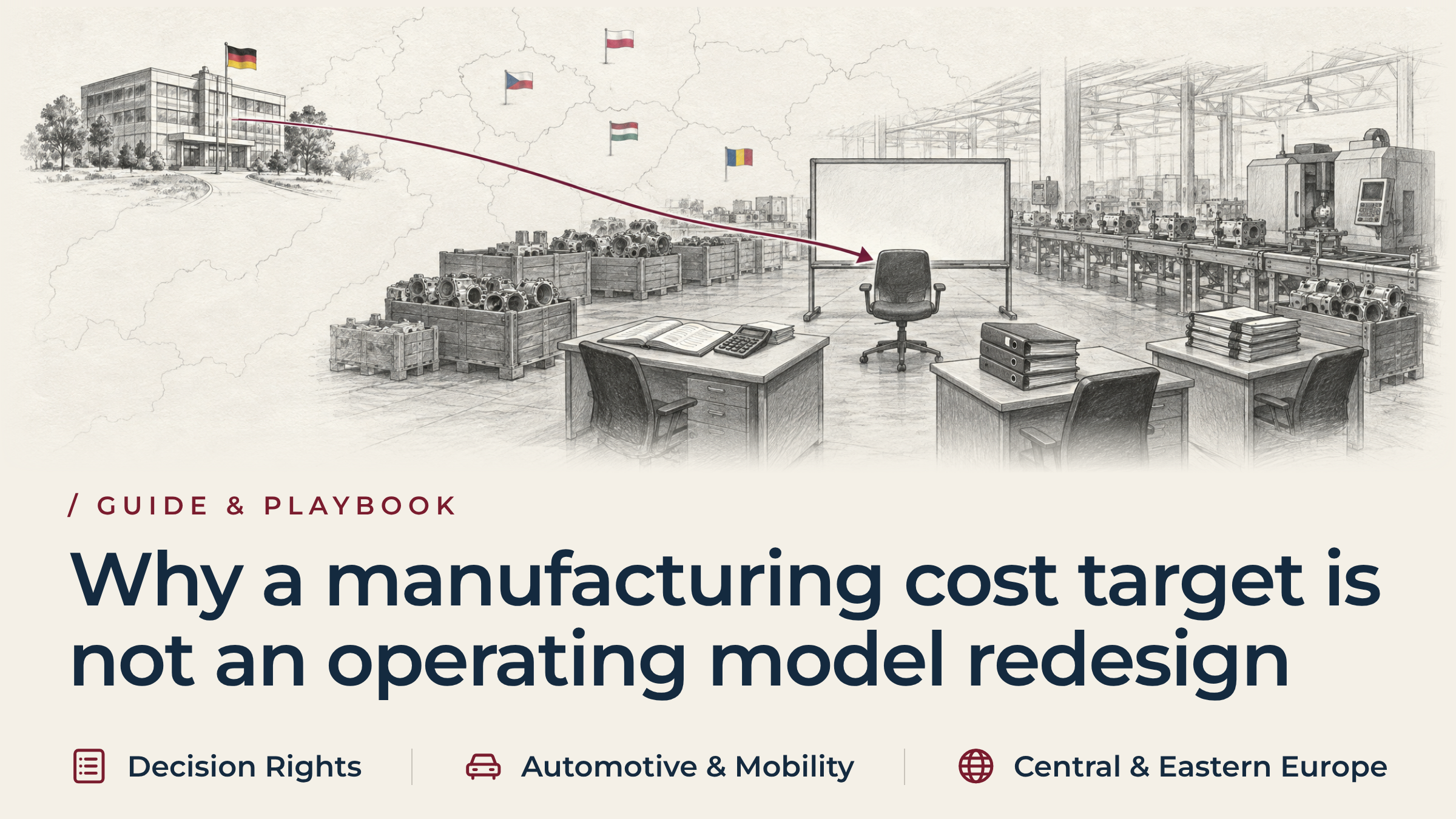
Warum ein Ziel für die Herstellungskosten keine Neugestaltung des Betriebsmodells darstellt
Kurz gesagt
Finance sets the savings target. Human resources executes the headcount reductions. Procurement renegotiates supplier terms. Each function completes its mandate on time, yet the factory floor slides into delivery arrears and margin erosion. This is the real distinction behind manufacturing cost reduction vs operational restructuring. Setting a cost target is a financial decision.
Designing how a smaller factory runs afterwards is an operational one. Headquarters cuts inputs without reconfiguring assembly sequencing, maintenance cycles or supervisory escalation. That leaves the plant running its old operating system with fewer people. Closing that gap needs one mandate for the operating design, with the authority to make trade-offs across functions.
The trigger: uncoordinated functional cost cuts vs. single-owner design
The executive board approves a mandatory cost reduction programme. Automotive volumes have softened. Input prices across Central and Eastern Europe have risen sharply. Group headquarters instructs every function to cut its own budget by a set percentage. Group finance tracks the run rate on weekly dashboards. Human resources manages the notice periods, statutory social plans and agency worker releases. Procurement negotiates ten per cent concessions from sub-tier suppliers.
On the executive committee's reporting deck, every milestone shows green. Project managers confirm that each function is meeting its targets on schedule. Yet inside the boardroom, senior leaders feel a quiet unease. Every function has delivered its number. Nobody can describe the physical operating model that will produce customer orders six months from now. The board hesitates to question the operational reality. Doing so would seem to challenge functional leaders who did exactly what headquarters asked.
This gap carries real risk. Finance does not design manufacturing systems; it measures their cost. Human resources does not calibrate cycle times against customer takt time; it manages employment contracts. Treating a financial target as if it were an operating plan leaves the factory floor without an owner. What results is not a redesigned operating model. It is the accidental residue of uncoordinated departmental cuts.
Why operating models fracture across cross-border matrix operations
The gap between a cost target and operating reality widens across borders. Headquarters sits in Germany, Switzerland, France or Austria. The plant sits in Poland, Czechia, Hungary or Romania. Functional leaders report through departmental lines at headquarters. The operating model exists as one connected system on the distant factory floor.
In a functional matrix, cross-departmental coordination breaks down under pressure. It breaks down in four recurring ways.
- Finance cuts the plant's maintenance and spare parts budget by fifteen per cent to meet a quarterly cash target. Nobody tells finance that ageing stamping presses need continuous calibration to hold customer tolerances.
- Human resources agrees the departure of indirect support staff. That removes the tooling technicians who perform rapid line changeovers.
- Production managers have fewer hands for the same daily volume. They extend production runs to avoid changeover downtime, building large batches of semi-finished inventory that absorb working capital.
- Nobody consults quality leaders on the workforce decisions. They end up running offline sorting tables to catch parts drifting out of specification.
Each function reports upward to its own head at headquarters, not sideways to an operational leader on site. So nobody at the plant holds the authority to stop the cycle. Local management, reluctant to look uncooperative to the group, rarely flags that these decisions contradict one another. The plant keeps producing through manual workarounds, until a customer experiences a line stop or issues a quality notice.
Manufacturing cost reduction vs. operational restructuring: industry evidence
Two external sources support the distinction this article makes. BCG's 2026 Global Automotive Supplier Study found that European suppliers report the most negative sentiment of any region. Sustained economic and financial pressure is the cause. It concludes that tier-one suppliers must fundamentally rethink their operating model, rather than rely on one-off cost cuts. The recommended path runs through plant and footprint consolidation, building a redesigned earnings base that holds under continued demand volatility.
Eurofound's European Restructuring Monitor shows the same pattern in a named case. Its factsheet on JTEKT Czech Republic records roughly 300 positions eliminated at the Plzeň site in August 2026. The site employed 620 staff before the cuts. The facility remained operational, even though the reduction was close to half the site's workforce.
Neither source states how that work was redesigned. No threshold exists at which cost reduction becomes restructuring, and nobody should invent one. What both confirm is the underlying condition this article addresses: a company can resize a site by close to half and still expect it to run.
Departmental spreadsheets cannot deliver that outcome alone. Holding a production schedule together while a workforce halves needs a total redesign of the operating architecture, not a set of separate functional cuts.
Cost target vs. operating model transformation: comparing the two playbooks
The difference becomes clear once the two approaches sit side by side: two distinct sequences, not one.
The functional approach treats cost reduction as a sum of separate departmental actions. Finance sets the target. Human resources cuts headcount. Supply chain cuts inventory. Each runs on its own timetable. The result is fragmented shopfloor execution: broken changeovers, hidden scrap and escalating emergency freight.
The operating model approach treats the same target as one integrated transformation. A single mandate rebalances takt times, synchronises maintenance and spares, realigns decision rights and validates the footprint, in that order. The result is predictable output, stable first-pass yield, low work in progress, and savings the business actually keeps in cash.
Key symptoms indicating an operational redesign is missing
A board does not need to wait for a financial audit. Four operational symptoms already show that the manufacturing cost reduction vs operational restructuring line has been crossed:
- Conflicting success metrics mask operational decay. Finance reports that the function is meeting its labour targets on schedule. Logistics reports that premium air freight charges have doubled, to bypass production bottlenecks.
- Work in progress rises as throughput stalls. Unfinished assemblies pile up between production bays, because parts cannot move forward without missing components. That ties up cash and blocks the aisles.
- Informal escalation replaces standard procedure. When equipment faults occur, shift leaders skip the normal escalation route, because the engineering specialists who owned it have gone. They override the machines themselves instead.
- Morning meetings debate fault instead of flow. Production, maintenance and quality supervisors spend daily meetings assigning blame for downtime, rather than resolving the bottleneck behind it.
Establishing a single mandate for factory operating design and trade-offs
Moving from a blunt cost cut to a durable restructuring needs one mandate for the operating design, with authority to make binding trade-offs. The Board is not really choosing between a bigger saving and a smaller one. It is choosing between the original timetable and a mandate sized to hold once the people are gone.
This is also the practical test for when cost cutting needs restructuring: whether the trade-offs cross reporting lines. Four areas carry that authority most often:
- Synchronising production takt time with customer demand. If customer volumes have dropped by twenty per cent, keeping lines at the old pace for fewer hours creates stop-start friction that damages equipment and generates scrap. The mandate resets line stations around real, current demand.
- Unifying maintenance, tooling and operational capacity. If the plant moves from three shifts to two, maintenance cannot simply absorb a proportionate budget cut. Changeover windows, predictive checks and critical spares need scheduling into the downtime that remains.
- Redefining shopfloor decision rights. When five management layers compress into three, the mandate states who can stop a line for a quality deviation. It also states who approves an emergency substitution, and who moves operators between cells.
- Harmonising inventory buffers against supply constraints. A smaller footprint runs on thinner margins. The redesign sets delivery frequency, kitting routes and finished goods buffers, so one supplier delay cannot halt final assembly.
Case study: CE Interim mandate in European automotive manufacturing
The €5.5m cost cut mandate and initial operational performance
A Tier 1 European automotive supplier of mechatronic sub-assemblies operated a facility of 720 employees in Central Eastern Europe. It supplied major German and French vehicle manufacturers. Facing customer price cuts and escalating power tariffs, the group executive committee mandated a €5.5 million operational expenditure reduction within six months.
Group finance and group human resources executed their programmes rigorously. Direct headcount fell by 18 per cent. Human resources trimmed indirect engineering positions by 22 per cent, and finance reduced facility maintenance budgets by 15 per cent.
Corporate dashboards declared the project complete. Within eight weeks of the final staff departures, though, the plant's operational performance deteriorated sharply. Delivery compliance fell from 98.8 per cent to 81.2 per cent. Work-in-progress inventory rose by €3.2 million, and scrap rates tripled. The plant was burning €250,000 monthly in emergency weekend shifts and express road freight to Germany.
Interim COO operational diagnosis and diagnostic assessment findings
Recognising that functional targets had dismantled the plant's operational architecture, the Group Chief Executive Officer engaged CE Interim. CE Interim deployed an already vetted, mandate-matched, NDA-bound executive, ready to start after the completed mandate brief. That executive took the role of Interims-Geschäftsführer on site. Full operational authority covered production, engineering, quality and supply chain.
The interim executive's initial four-day assessment exposed the operational disconnect. Human resources had eliminated twenty setup mechanics, expecting machine operators to handle their own line tooling adjustments. Finance had separately reduced tooling spare parts inventory, to hit working capital targets.
When high-speed automated winding machines suffered routine tool wear, operators lacked the specialised gauges to calibrate the heads. They also lacked the replacement components to repair them. Machines sat idle for hours while supervisors scrambled for parts. Hurried setups followed, producing defective coils.
Executing three structural interventions for operational turnaround
The interim executive carried out three structural operational interventions over a twelve-week mandate:
- Re-engineered the operating cadence and line balance. Production consolidated from three erratic, partially staffed shifts into two fully supported shifts with synchronised takt times, which eliminated stop-start machine cycles.
- Re-integrated tool setup into a dedicated operational cell. The executive restored eight specialised setup mechanics, restructured quick-die-change protocols, and ring-fenced critical machine tooling spares. Average changeover time fell from 110 minutes to 38 minutes.
- Re-aligned cross-functional decision rights and shopfloor metrics. The executive dissolved isolated departmental targets and introduced a single operational control board, focused on first-pass yield and customer schedule adherence. Shift supervisors gained the authority to halt and correct line drift immediately.
Turnaround results: restoring on-time delivery, scrap rates, and cash flow
Within twelve weeks, the facility regained full operational control. Delivery compliance recovered to 99.4 per cent. Scrap fell back below 1.2 per cent. Work-in-progress inventory decreased by €2.8 million, and emergency freight ceased entirely. The site secured €4.9 million in verified, sustainable annualised savings. That outcome shows cost reduction only endures when an integrated operating model delivers it.
When internal management is sufficient vs. when independent authority is required
A plant having a cost target is not, by itself, a reason to bring in an outside executive. Local functional leaders sometimes already coordinate well across departments, and customer volumes stay predictable. In that case, the existing plant management team should hold the mandate and the autonomy to redesign its own operations.
Independent executive authority becomes necessary when the required trade-offs cross functional reporting lines that the site itself cannot resolve. A plant manager rarely has the standing to overrule corporate finance on maintenance spend. The same manager cannot easily challenge corporate procurement on batch sizes, or direct corporate human resources on organisational design.
In a cross-border matrix, these decisions stall in political deadlock. The practical trigger is simple: the first trade-off that stalls this way. Two functions each cite their own mandate, and neither can move the other. An interim executive brings authority that sits outside corporate career considerations, connecting group strategy to factory floor execution, until the operating model holds on its own.
A CE Interim Partner stays engaged through that mandate. The Partner confirms scope and keeps the escalation route open to the Group Chief Executive. The Partner also checks that the executive's authority has not quietly narrowed.
This is what separates manufacturing cost reduction vs operational restructuring in practice. It is not the size of the number. It is who owns the design that has to deliver it.
Frequently asked questions on cost targets vs. operating models
When does a cost reduction plan transition into full operational restructuring?
There is no fixed percentage or headcount threshold, and nobody should invent one. The signal is when production sequencing, maintenance, decision rights and inventory all have to move together, so no single function can own the result. At that point, a cost target has become an operating model decision, and it needs its own mandate.
What is the functional definition of a manufacturing operating model?
An operating model defines how a plant configures its people, processes, maintenance, tooling and decision rights to convert raw materials into finished products reliably.
Why are functional cost reduction targets insufficient for plant turnaround?
Functional targets optimise departments in isolation. Finance can cut budgets, and human resources can cut payroll. But if machine setups, material handling and quality containment stay unchanged, the remaining system cannot hold.
Does challenging cost targets prevent achieving financial savings goals?
No. Redesigning the operating model is what makes the savings stick in net cash flow. Unengineered cuts create operational friction, scrap and overtime, which quickly erode the projected benefit.
When should a company appoint an external executive for operating model redesign?
Appoint one when the changes span production, engineering, maintenance and logistics at once. The same applies when local management lacks the authority, or the bandwidth, to execute while still meeting deliveries.
What are the risks of operating a lean factory using an outdated operating model?
The plant experiences chronic line stoppages, rising scrap, missed delivery windows and heavy overtime costs. That can force costly emergency re-hiring, or trigger a customer quality intervention.
Weiterführende Informationen und nächster Schritt
A cost target tells the organisation what to save. It does not say who owns the plant once the saving is in place. A cost target met on schedule can still leave a factory floor without an owner. That gap shows up first in delivery, scrap and cash.
Weiterführende Literatur:
- Wie man ein polnisches Produktionswerk umstrukturiert, ohne dessen technische Leistungsfähigkeit zu beeinträchtigen
- Werksumstellung: Der Interims-Werksleiter stellt die Produktionssteuerung in Ungarn innerhalb von 90 Tagen neu ein
- Operativer Turnaround: Interims-COO stabilisiert Werksausführung in 90 Tagen in den Vereinigten Staaten
CE Interim provides cross-border executive leadership for critical business transformations. It deploys an already vetted, mandate-matched, NDA-bound executive, ready to start after the completed mandate brief. Talk to a CE-Interimspartner about who should own the operating design before the next cost target arrives.
 EN
 DE
 FR
 IT
 PL
 RO
 CS
 SK
 HU
 ES
 RU
 AR
 SL