

Kurz gesagt
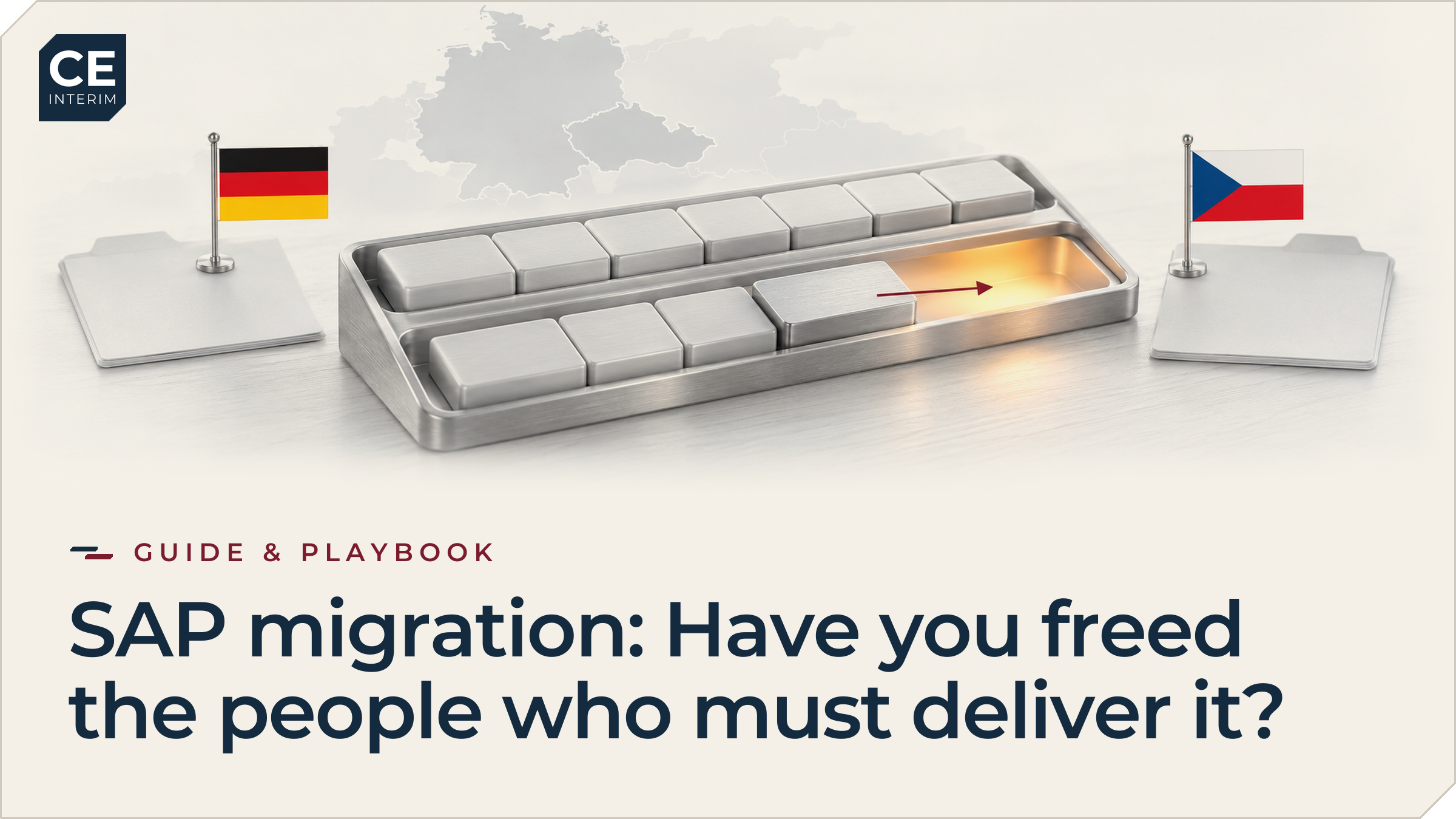
SAP migration resource planning starts inside the business, not with the partner contract. A funded integrator is not evidence that the business can spare its people. Plant finance, logistics, quality and planning leads must still make design decisions, cleanse data and accept delivery. Before the sponsor fixes a date, each contribution needs a named owner, protected time, operational cover and decision rights. If the business cannot commit, the sponsor can fund cover, resequence the work or move the date. More partner capacity does not replace an absent process owner.
Aligning ERP Migration Budgets with Business Team Availability
Many groups hold an approved migration budget and a named implementation partner. The steering committee sees a funded programme, and that reading is reasonable.
In our experience the programme plan covers partner effort in detail. SAP migration resource planning for the business side is thinner. ERP key-user capacity and process-owner availability appear with less precision. Yet the business must supply design decisions, data review, test validation and acceptance.
Those tasks fall to plant finance controllers, warehouse managers, quality leads and production planners. They already carry orders, deliveries and month-end close. No one has been careless. A budget line is visible. A process owner's working week is not.
The first sign of weak SAP migration business readiness rarely looks like a missed milestone. It is a design workshop where the right person is absent.
Impact of SAP Maintenance Timelines on Migration Planning
The pressure is real, but it is a planning pressure, not a countdown. SAP's announcement of 7 October 2026 confirms that Business Suite 7 maintenance dates have not changed. Mainstream maintenance runs through 31 December 2027, with optional extended maintenance through 31 December 2030.
DSAG's Investment Report 2026 covers 198 member companies, mostly headquartered in Germany, Austria or Switzerland. Of these, 54 per cent still use SAP ECC or an older Business Suite release (categories can overlap). For many German-speaking groups, the migration decision is still ahead.
The date gives a window. The binding constraints are customer peaks and the time needed to put tested cover in place. The sponsor can count back from the first design workshop to the day the signatures must exist.
Reconciling Group Standardization with Operational Plant Requirements
A headquarters in Germany, Switzerland or Austria usually frames the migration as harmonisation. One chart of accounts, one master-data standard and one view of the supply chain give the group reliable visibility. That aim is legitimate, and a single programme date helps the group hold it.
The plant sees the same programme through its customer orders. A few people carry its process knowledge, such as the shipping supervisor, the production scheduler and the plant purchasing lead. Temporary staff can absorb routine tasks, but not that knowledge.
Both priorities are sound, yet the programme budget funds the first and not the second. When a design workshop competes with a customer delivery, the plant protects what its targets reward today. That is a gap in programme design. It does not reflect on the plant's capability.
In a group with plants in Poland, Czechia, Hungary or Romania, the plant is often a separate legal entity. Its leader owns the customer calendar and targets, which headquarters often cannot see. Statutory set-up and routine filings need locally qualified cover.
That leader may also sit outside the group steering committee. The capacity agreement needs both lines of authority behind it. That raises a question the steering committee should put directly: who has the standing to bring both lines behind one page?
Identifying Early Indicators of ERP Key-User Capacity Shortages
A sponsor can see the shortage before a milestone slips.
- Key owners cancel design workshops or arrive late because plant escalations take priority.
- Functional sign-offs arrive quickly and with few questions, which suggests limited review time rather than agreement.
- Master-data cleansing falls behind because no one has protected hours to check records.
- The implementation partner reports waiting time or asks for scope extensions because decisions are not arriving.
An experienced sponsor distrusts the quick sign-off first. It deserves a closer look than a workshop that runs late.
Waiting has a cost the sponsor can name. Design built on partner assumptions can reach acceptance testing with the plant's requirements untested. Rework can then land close to cutover, in the busiest weeks, and customer deliveries carry the risk. For the Board that becomes a cutover choice with little information and little room. It can go live with open defects, or defer while the partner's cost continues.
Three Core Commitments for SAP Migration Resource Planning
Business-side resourcing needs the same discipline as the partner contract. The principle is not specific to SAP. Microsoft's guidance on organising a Dynamics 365 project team asks for a lead subject-matter expert per business stream. It also asks for planned availability for every contributor.
Three commitments do most of the work.
- Agree capacity in writing. The programme director, the group functional head and the plant leader sign one page per key user. It lists the task, the protected hours, the customer peak windows, the cover and the escalation route.
- Fund operational cover. Releasing a key user for half the week means someone else carries that half. That can mean a trained deputy, qualified temporary staff or external support for routine filings. Longer working weeks are not cover.
- Give process owners binding decision rights. The group keeps the template, data standards, date and funding. Plant owners decide how to sequence work around customer peaks and who leaves the line. A request that departs from the template and touches other plants goes to the sponsor.
Secure these in sequence. Start with the owners whom the first workshops and the data cleansing need, because both start earliest. Acceptance-testing and cutover commitments can follow once design closes, provided the sponsor reserves the dates now.
Developing an Actionable Business-Contribution Framework
The plan below turns the commitments into one page. It uses an illustrative plant scenario, not a client case. The figures show how a plan reads, not a market benchmark. Each owner must confirm the real ones.
| Programme task | Internal owner and decision right | Protected time to confirm | Operational cover | Consequence if unavailable |
|---|---|---|---|---|
| Material master data cleansing | Plant materials and procurement lead (sets lead-time parameters) | 40% protected time (16 hours a week for 10 weeks) | Contract junior buyer handles daily purchase-order expediting | Customer supply suffers if corrupted lead-time parameters trigger wrong automatic reordering |
| Shop-floor production blueprinting | Plant operations and scheduling manager (approves the production template) | 50% protected time during the 8-week design phase | Shift supervisors take daily line balancing and production-log sign-offs | Line plans fail at cutover if the standard template does not support multi-stage assembly changeovers |
| End-to-end user acceptance testing | Quality assurance and logistics specialist (signs off dispatch tests) | 80% dedicated time during the 6-week testing window | Temporary logistics coordinator handles carrier dispatch logging | Customer shipments slip if unidentified scanner latency creates bottlenecks in dispatch staging |
| Statutory local financial configuration | Regional financial controller, Czechia (approves statutory set-up) | 30% protected time across the 12-week build phase | External accounting firm handles routine VAT filing reconciliations | The first month-end close is at risk if statutory reporting reaches cutover untested against local requirements |
Strategic Options for Resource Allocation and Schedule Adjustments
Conflicts will still arise, and the sponsor then has three legitimate choices. Each suits a different condition.
- Fund the cover when it can be in place before the first workshop, as with the cleansing row. This protects the key user and the customer. It adds cost and onboarding time.
- Resequence the workstreams when two windows need the same owner. Cleansing and design may both draw on the materials lead. Staggering the demand eases the strain. It can delay dependent workstreams.
- Extend the timetable when cover cannot absorb the task. At 80 per cent, the testing owner has one day a week left for the day job. A temporary coordinator can log dispatches but cannot sign off a test. This extends partner cost and can push cutover into a later customer peak or statutory close. Confirm the new window before agreeing.
First, establish which owners are indispensable, which tasks can wait and what each delay costs. Then compare the cost of cover with the cost of partner waiting time and late rework.
Settle one collision in advance. A line stoppage or a missed dispatch can need a key user on the floor during a protected block. Give the plant leader the right to recall that person, with notice to the programme director. Log the recalled hours and report them at each steering meeting. If recalls exceed an agreed share in two consecutive periods, the sponsor chooses between cover, resequencing and the date. The sponsor sets that share at the start.
Establishing Executive Leadership for ERP Programme Governance
Start with the people already in place. When an internal programme leader and capable functional managers can honour these commitments, that is the better outcome.
The gap is narrower. An internal programme lead usually reports into one function and has limited standing with plant leaders. Group functional heads may agree in the steering committee. The plant leaders who release the people can sit outside that agreement.
Delegated Scope and Mandate of the Transformation Director
Where that gap exists, an interim Transformation and Programme Director can carry a defined mandate for the ERP programme. The executive answers to the sponsor alone, not to any one function or to the implementation partner. The role sits where group and plant authority meet, so one set of capacity facts serves both sides. The partner's programme manager answers for partner delivery, and a permanent search can run past the first design workshops. The sponsor delegates five things. Together they make this an executive mandate, not a coordination role.
- The right to convene group functional heads and plant leaders on capacity.
- The right to return a design sign-off that lacks evidence of the owner's review time.
- The right to escalate a missed commitment straight to the sponsor.
- Authority to decide cover and cross-workstream sequencing within the agreed budget. A change to date, scope or funding goes to the sponsor with the executive's recommendation.
- Authority to chair the business-readiness gate before design sign-off, acceptance testing and cutover, with accountability for its evidence.
CE Interim defines this mandate with the sponsor and assesses the executive against both the mandate and the group-to-plant corridor before any appointment. A CE Interim Partner reviews progress with the executive on a set cadence and escalates to the sponsor where commitments are not holding. Handover to an internal leader follows once plant leaders have held their agreements without help for a period the sponsor sets.
Where the gap sits in the technology function itself, an Interim CIO may fit better.
Two limits apply. The appointment does not create capacity or supply cover staff. Every key user still needs a head who releases them. And the sponsor keeps the decisions on scope, timing and funding.
Frequently Asked Questions About SAP Migration Planning
Does the 2027 maintenance date apply to every ERP system?
No. SAP's statement of 7 October 2026 covers SAP Business Suite 7, with mainstream maintenance through 31 December 2027. Other SAP releases and other vendors' systems follow their own lifecycle terms. Customers on third-party databases or Java face added constraints after 2030. A group should treat a date as its deadline only after confirming its product, release, database and contract. It can then plan business capacity backwards from that date.
Can an implementation partner replace internal process owners?
No. The partner supplies configuration skill, method and delivery effort. It can absorb data preparation and test-script work around an owner. It does not own the operating model, know the plant's customer commitments or carry accountability for plant throughput. Business readiness stays with the process owners. The partner's plan should state what it needs from them each week, and the steering committee should track those requests.
How should operational cover be planned for key users?
Plan cover for the work, not for the person. List the daily tasks a key user will leave, including unwritten ones such as expediting calls. Assign each to a trained deputy, qualified temporary staff or an external provider. Test the arrangement before the first workshop. Cover that starts in the same week has not yet learned the routine. Name the budget that funds the cover, or the plant carries it by default.
When should timing change rather than adding another workstream?
Move the date when core process owners cannot leave operations and cover cannot absorb their tasks. Peak customer demand and statutory close periods are common causes. Resequence instead when the clash is narrow, such as two windows on the same owner. A second external workstream adds cost without adding the decisions the programme waits for. It does not close a capacity gap in the business and adds one more team to coordinate.
Weiterführende Informationen und nächster Schritt
A migration date commits the business as well as the partner. Protected time, operational cover and binding decision rights decide whether it holds. SAP migration resource planning that stops at the partner contract can leave design, data and acceptance unowned until cutover exposes it.
Weiterführende Literatur:
- Ein Lieferant beliefert mehrere Werke in Mittel- und Osteuropa. Wie sollten die begrenzten Materialvorräte aufgeteilt werden?
- Wenn mehrere CEE-Werke gleichzeitig ihre Kapazitäten anpassen, wer legt dann die Reihenfolge der Änderungen fest?
- Die Produktion wird in die Slowakei verlagert. Wer ist für den Kapazitätsplan am Zielstandort verantwortlich?
CE Interim provides an already vetted, mandate-matched, NDA-bound executive, ready to start after the completed mandate brief. When a funded migration has no workable agreement on internal participation and decision ownership, discuss a customer-side programme mandate with a CE-Interimspartner.
 EN
 DE
 FR
 IT
 PL
 RO
 CS
 SK
 HU
 ES
 RU
 AR
 SL