

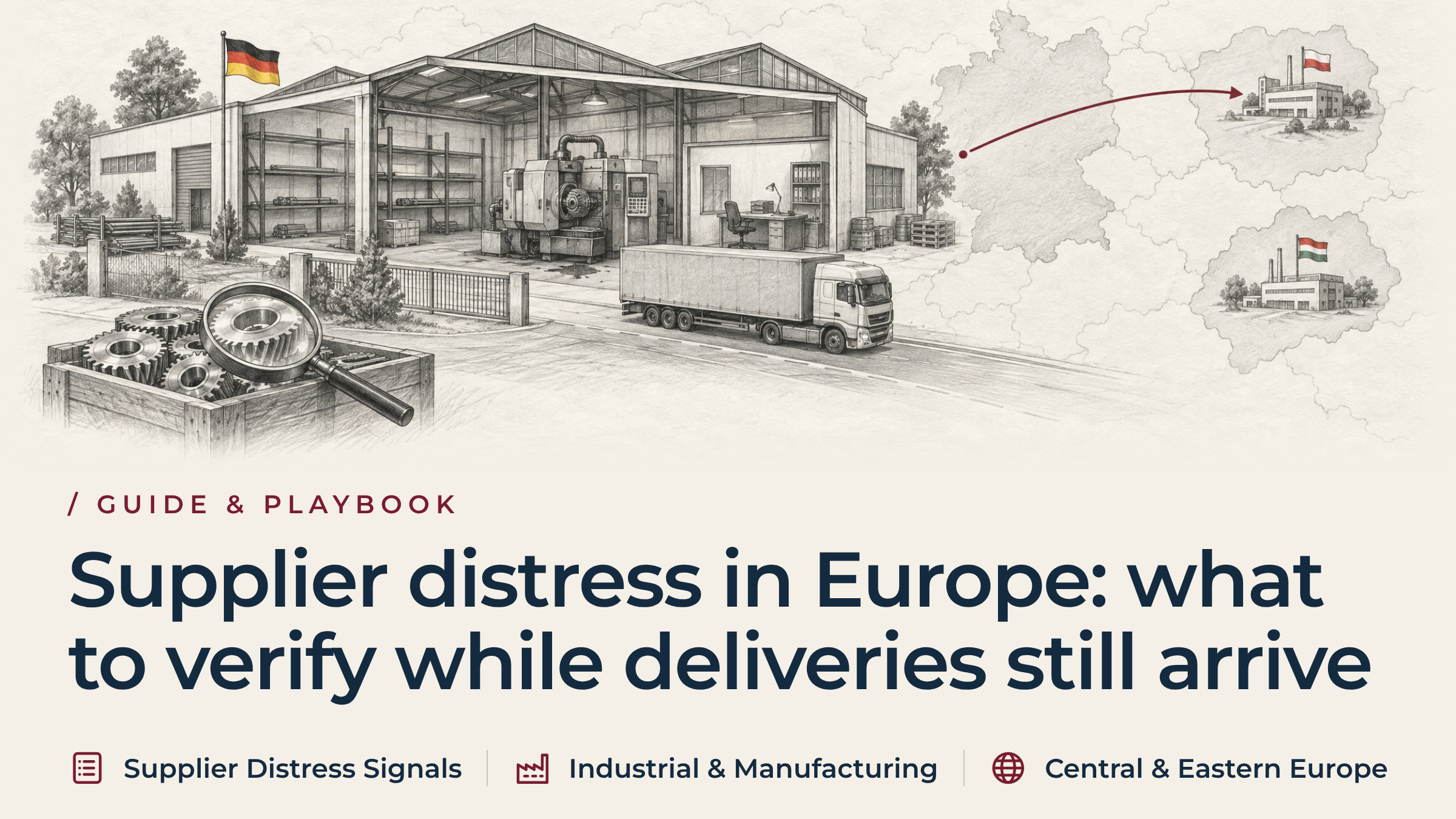
Lieferengpässe in Europa: Was ist zu prüfen, solange noch Lieferungen eintreffen?
Kurz gesagt
Supplier financial distress rarely stops a delivery before it stops almost everything else. A distressed vendor often keeps serving its most important customers for as long as it can. European manufacturers often depend on one critical supplier for a key component. Dispatches can keep arriving on schedule for months after that supplier's cash position starts to fail. The practical task for a CEO, CFO or COO is not predicting an individual supplier's failure. It is deciding which signals justify verification, who owns that verification, and when observation should become an active continuity review.
Why On-Time Deliveries Mask Critical Supplier Financial Risk
For executive boards in Munich, Paris, Zurich or Vienna, supplier risk usually registers only once a delivery stops. As long as shipping schedules hold, leadership assumes the relationship underneath them is stable.
That assumption leaves a gap. Financial deterioration rarely announces itself through a sudden operational break. It builds over several quarters: working capital erodes, maintenance budgets shrink and relations with upstream creditors come under strain. Behind the scenes, it typically defers payroll taxes, delays sub-tier suppliers and cuts preventative maintenance while deliveries keep arriving.
Purchasing teams that have worked with a supplier for years have good reason to trust that relationship. Raising a forensic question about a long-standing partner can feel disproportionate before there is a second data point. That reasonable caution is what lets the buyer's own operational runway quietly shrink.
Supplier failure is not the same question as supplier insolvency. A vendor can be formally insolvent and still deliver. A vendor can also be financially sound and still miss a shipment for an unrelated reason. This article is about the first condition, supplier financial distress, and the verification it calls for before it becomes the second.
Limitations of National Insolvency Data for Supplier Risk Assessment
Reading supplier financial distress correctly starts with separating macro signals from one counterparty's position. Three points matter before anyone uses a number to justify action.
National insolvency statistics describe economy-wide conditions, not one plant's solvency. The Leibniz Institute for Economic Research Halle (IWH) aufgezeichnet 1,666 corporate and partnership insolvencies in Germany in September 2026. The broader quarterly trend shows a slight easing. That figure says nothing about whether a specific plant in Silesia or Bohemia is under pressure. Nobody should generalise a German statistic into a claim about CEE supply risk.
A vendor-commissioned survey measures sentiment, not a verified national rate. Ivalua commissioned Sapio Research to survey 800 supply chain and procurement decision-makers in March 2026. The sample spanned the United States, United Kingdom, Germany and France, 200 respondents per country.
Seventy per cent said their organisation had between one and five critical supplier failures in the preceding twelve months. That is a useful signal of how exposed procurement leaders feel, but it is not an audited failure rate. The published results are also global, not broken out by country. Anyone citing it should include its sample size and commissioning context.
Financial distress does not automatically mean production has stopped. Germany's Amtsgericht Bayreuth appointed PLUTA as preliminary insolvency administrator for German packaging-components supplier ZIRBS on 30 September 2026. PLUTA confirmed that operations continued in full and that existing customer orders would still go out.
Under German insolvency law, a distressed business can often keep trading under court supervision while it addresses its debt position. The exact mechanism varies: ZIRBS used ordinary preliminary administration, while other companies use the formal protective shield procedure (Schutzschirmverfahren). A continued-trading supplier is not a resolved one, but it is also not a closed one.
Four Key Operational Indicators of Supplier Financial Distress
Financial statements filed with corporate registries are historical. They often appear twelve to eighteen months late. In an active liquidity crisis, leadership needs real-time operational and behavioural indicators instead. The operational signs fall into four broad categories. Each is a signal that calls for verification, not a finished diagnosis.
A plant manager, sourcing lead or finance controller closer to the relationship usually sees them first. That is why each signal needs a named, accountable owner, not just general awareness at Group level.
1. Commercial and Payment Terms Anomalies
A supplier under pressure often asks for different payment terms before it changes how it delivers. Watch for these specific shifts:
- A request to shorten payment terms, move to pro-forma advances, or offer a discount for immediate cash settlement.
- Remittance instructions suddenly move to a commercial factoring house or a secondary debt-recovery vehicle. That shift usually means the supplier has exhausted its bank credit lines.
- A refusal to take part in a routine annual credit check, or a delay in releasing audited accounts.
2. Sub-Tier Supplier Friction and Material Sourcing Disruptions
Distress at a supplier's own vendors eventually surfaces in how goods arrive. Three patterns are worth tracking:
- Consignments that previously arrived complete now split into fragmented batches across several days. The cause is usually that the supplier cannot source enough raw material at once.
- Parts arriving in generic packaging or unlabelled containers rather than standard returnable dunnage, because the supplier cannot fund proper packaging.
- Unexpected, non-contractual surcharges to cover raw material costs before a production run can start.
3. Quality Deterioration and Deferred Tooling Maintenance
Deferred maintenance shows up in the product before it shows up in the accounts. Two signs matter most:
- A rising trend in minor dimensional or cosmetic rejections at incoming inspection is one sign. It can indicate that cutting tools are running past their service life.
- Engineering change requests, sample submissions or quality corrective-action reports going unanswered for weeks.
4. Key Executive Turnover and Operational Instability
Leadership turnover is one of the more reliable early signals. It reflects decisions that people closest to the numbers are already making.
- The sudden departure of a managing director, finance director or operations director, often a sign of internal disagreement over solvency.
- The loss of key machine setters, toolmakers or quality managers is another indicator. It tends to show up afterwards as rising scrap and erratic output.
Evaluating Distress Signals to Corroborate Supplier Risk
One signal of supplier financial distress is a reason to look closer, not a conclusion. A changed payment term, a delivery revision or an unfamiliar factoring notice needs corroboration against at least one other source. Only then should it change a sourcing decision. None of this is a universal checklist to run against every supplier. It is a set of indicators to apply once a specific supplier has already raised a question.
Executives should resist generalising a national headline onto a named supplier. An escalating insolvency count or a concerning survey result is a reason to look at the suppliers that matter most. It is not evidence against any one of them. No one should use an indicator here to allege that a specific supplier is insolvent. That conclusion rests on a formal legal process, not an operational observation.
Mapping Financial Risk to Bill-of-Materials and Production Exposure
A warning sign only matters once it connects to what the business depends on. Annual spend is a poor proxy for criticality. A supplier providing fifty thousand euros of specialised seals can stop an assembly line. A supplier of two million euros in machined castings can cause the same disruption.
The useful exercise is mapping the supplier's part numbers against the bills of materials for active customer programmes. The next step is quantifying the margin and penalty exposure if supply stops.
A large spend figure is not a complete dependency picture. A low-value, single-source component with no qualified alternative often carries more risk than a high-value item does. That is especially true when the high-value item already has three approved suppliers in place.
Four Verification Steps for a Supplier Supply Chain Continuity Review
Observing a warning sign should not trigger an immediate contract termination or a visible supplier exit. Withdrawing volume abruptly from a fragile supplier can itself trigger the insolvency the buyer is trying to avoid. A structured, proportionate continuity review is the better path, built on four disciplined steps.
- Map the dependency. Connect part numbers to live customer programmes and quantify the margin and customer exposure if supply stops. Do this rather than relying on spend volume alone.
- Open a direct, non-adversarial enquiry. Engage the supplier's leadership at executive level, combining procurement and finance. Request verifiable data: raw material inventory, confirmed upstream credit lines and current shift staffing.
- Audit tooling and finished goods on site. Conduct a physical count of customer-owned tooling and finished goods at the supplier's facility. Confirm that ownership records are current and enforceable against a future creditor claim.
- Begin a quiet, shadow qualification of an alternative source. Without alerting the market, start pre-qualifying a second supplier. Update drawings, confirm machine capacity and establish the lead time a customer approval process would require.
Supplier Continuity Risk Register and Escalation Triggers
A short, consistently applied register keeps a continuity review proportionate and auditable. Each entry records a supplier financial distress signal, the verification required and the owner. It also records the trigger that moves the response from observation to action.
- Payment terms shorten from 60 days to 14. Verify with a bank reference check and a review of recent factoring notices. Owner: the sourcing director and group treasurer. Escalate on any formal factoring notice or second off-cycle cash request.
- Split shipments repeat across three consecutive weeks. Verify with an on-site check of raw material inventory and upstream credit holds. Owner: the plant materials manager. Escalate on a single line-side stockout or a missed weekly quota.
- The finance director and quality director resign within thirty days. Verify with a direct executive meeting and a review of statutory filings. Owner: the group chief operating officer. Escalate if the supplier cannot produce verifiable financial statements within ten days.
- The incoming defect rate doubles over sixty days. Verify with an on-site tooling inspection and maintenance logs. Owner: the plant quality director. Escalate if process capability falls below the agreed threshold on a safety-critical dimension.
No threshold in this register is a universal credit rule. Each is a prompt to verify one exposed relationship, set by the team that owns it.
Case Study: Mitigating European Supplier Insolvency with Shadow Dual-Sourcing
A major German-Swiss manufacturer of industrial automation systems and high-precision motion controls operated two large assembly plants. These sat in western Poland and northern Hungary. The company supplied mission-critical robotic drive systems to major industrial automation customers across Germany, France, and North America.
A sole-source German supplier of high-precision micro-machined planetary gear sets generated approximately €3.5 million in annual purchasing volume. The supplier continued shipping components on schedule. However, subtle commercial anomalies surfaced.
The supplier requested an immediate reduction in payment terms from sixty days to ten days, citing temporary working capital rebalancing. Two weeks later, payment remittance details changed to an unfamiliar Swiss factoring vehicle. Shortly thereafter, the supplier's veteran Chief Financial Officer and Plant Operations Director resigned within three weeks of each other.
The buyer's internal procurement team viewed the payment request as a routine commercial negotiation. Delivery compliance remained at ninety-eight per cent, so the team argued that no operational risk existed. Group executive leadership disagreed and suspected systemic liquidity failure.
A sudden stoppage of gear set deliveries would halt final assembly in Poland and Hungary within twelve days. That would jeopardise €18 million in customer quarterly shipments and trigger contract default clauses.
Deploying Independent Interim Supply Chain Leadership
Internal procurement was too close to the commercial relationship to conduct an objective, forensic assessment. The Group Chief Financial Officer and Chief Operating Officer therefore brought in independent interim leadership.
An already vetted, mandate-matched, NDA-bound executive took up the role of Interim-Direktor für die Lieferkette on site. The executive was ready to start once the mandate brief was complete. Partner-led transformation governance applied throughout the mandate, with a direct reporting line to the Group Executive Board.
Operational Diagnostic: Identifying Hidden Liquidity and Maintenance Risks
The interim executive arrived on site and executed an exhaustive, confidential forty-eight-hour operational and financial diagnostic:
- Severe liquidity exhaustion. The diagnostic revealed that the supplier was on informal credit hold with its primary European alloy steel rod supplier. To maintain shipments, the vendor had been liquidating all internal safety stocks. It was also factoring its customer receivables at high discount rates to meet weekly payroll.
- Critical maintenance neglect. CNC gear-hobbing machines had deferred scheduled spindle maintenance for six months. Machine capability studies revealed that cutting tools were operating at the absolute limit of dimensional tolerances. Impending bearing failures would halt machining within four to six weeks.
- Component exposure. The buyer's Polish and Hungarian facilities held an aggregate buffer inventory of only eleven days of production stock. The team had qualified zero alternative sources.
Interventions for Preventative Supply Chain Continuity and Tooling Ring-Fencing
The interim executive executed three decisive operational interventions over a ten-week risk mitigation mandate:
- Structured financial verification and raw material ring-fencing. Rather than refusing the supplier's plea for cash, the interim executive negotiated a ring-fenced commercial agreement. The buyer purchased €400,000 of specialised alloy steel rods directly from the primary mill. It then consigned the material to the supplier under formal retention-of-title protection. In exchange, the supplier agreed to produce an emergency forty-five-day buffer stock of finished gear sets. The buyer paid for this under an audited piece-part escrow account upon physical delivery to the Polish plant.
- On-site tooling audit and legal asset ring-fencing. The interim executive dispatched an industrial engineer to the supplier's facility. The engineer inspected and photographed all customer-owned gear-hobbing dies, broaching tools, and testing fixtures. Legal ownership plates were refreshed, and an updated bailment agreement was signed by the supplier's managing director. This legally immunised the tooling against potential creditor seizure.
- Rapid shadow dual-sourcing industrialisation. Working confidentially with engineering, the executive identified an audited precision gear specialist in the Czech Republic. The team transferred duplicate tool drawings, pre-ordered raw alloy forgings, and initiated coordinate-measuring machine (CMM) programming. This prepared the alternative vendor to achieve full PPAP Level 3 compliance within eight weeks if the primary supplier failed.
Results: Zero Delivery Disruption During Insolvency Administration
Nine weeks into the mandate, the German gear supplier formally filed for insolvency administration under protective shield proceedings (Schutzschirmverfahren):
- Zero production line stoppages. The interim executive had successfully built and extracted the forty-five-day finished component buffer before the filing occurred. As a result, the Polish and Hungarian assembly plants operated without a single hour of downtime.
- Complete capital protection. The buyer fully recovered all advance material expenditures in conforming finished parts, with zero capital lost in the insolvency proceedings.
- Tooling secured without legal friction. The court-appointed insolvency administrator immediately honoured the refreshed tooling bailment agreements, allowing the orderly, uncontested retrieval of secondary dies.
- An orderly supplier migration. The shadow Czech supplier completed PPAP trials on schedule. It then scaled up serial production to absorb seventy per cent of the volume, securing the group's European supply corridor.
When to Engage External Expertise for Supplier Risk Mitigation
A mature procurement function can run on-site audits, trace sub-tier credit exposure and qualify a second source in parallel. With that capacity, it should lead this work itself. The internal team already holds the supplier relationship and the production context an outside party would need time to build.
The gap tends to open in three places. A long-standing relationship can make a forensic question feel disproportionate. A purchasing team may already have its hands full with daily firefighting. Or finance and operations may reach different conclusions about how serious a signal is.
Here, an interim Supply Chain Director gives the review one accountable owner, reporting to the Board or Group COO. That role is free of the relationship history that can make an early signal harder to act on. Speak with a CE Interim Partner once supplier financial distress needs a coordinated continuity review. This applies when the existing team cannot resource that review on top of its current workload.
Frequently Asked Questions: Managing Supplier Financial Risk
Does a request for changed payment terms prove supplier financial distress?
No. A request for shorter payment terms or a cash discount can reflect ordinary working capital management or wider interest-rate pressure. It is still a genuine signal. Rather than accepting or dismissing it on its own, the buyer should run a direct check. That check should cover the supplier's banking relationships and upstream credit lines.
Can a supplier keep trading after an insolvency application?
Yes. Under German, French and European restructuring frameworks, a company can continue manufacturing and fulfilling customer orders under court-supervised protective proceedings. An insolvency filing changes the legal and commercial rules that apply, but it does not automatically mean production has stopped.
How should the buyer link financial concern to production exposure?
Map the supplier's part numbers to the bills of materials for active customer programmes. Establish how many days of on-hand inventory exist. Quantify the customer penalty or margin at risk if supply actually stops. A concern that the buyer cannot connect to a specific component and programme is not yet actionable.
When should a continuity review become an active response?
Escalate once verification confirms one of the harder signals of supplier financial distress. These include a default on payments to the supplier's own sub-tier vendors, deferred critical maintenance, or assigned receivables. They also include a refusal to provide verifiable financial information. Before that point, a documented review with a named owner is the proportionate response.
Weiterführende Informationen und nächster Schritt
A verified continuity review answers one question: what to establish before supplier financial distress becomes a disruption. Once a supplier actually stops delivering, the decision moves from verification to a deliverable-order position.
Weiterführende Literatur:
- Wenn mehrere CEE-Werke gleichzeitig ihre Kapazitäten anpassen, wer legt dann die Reihenfolge der Änderungen fest?
- Wann wird aus einem Qualitätsproblem ein Problem, das eine Umstellung der Anlage erforderlich macht?
- Die deutsche Zentrale geht davon aus, dass das tschechische Werk die Planvorgaben erfüllt. Die Nachbearbeitungsstunden deuten darauf hin, dass die Kapazität bereits ausgeschöpft ist.
A critical dependency can produce an unresolved operating question that the current team cannot resource. When that happens, a conversation with a CE-Interimspartner is the proportionate next step. That conversation is not a substitute for the verification work above.
 EN
 DE
 FR
 IT
 PL
 RO
 CS
 SK
 HU
 ES
 RU
 AR
 SL