

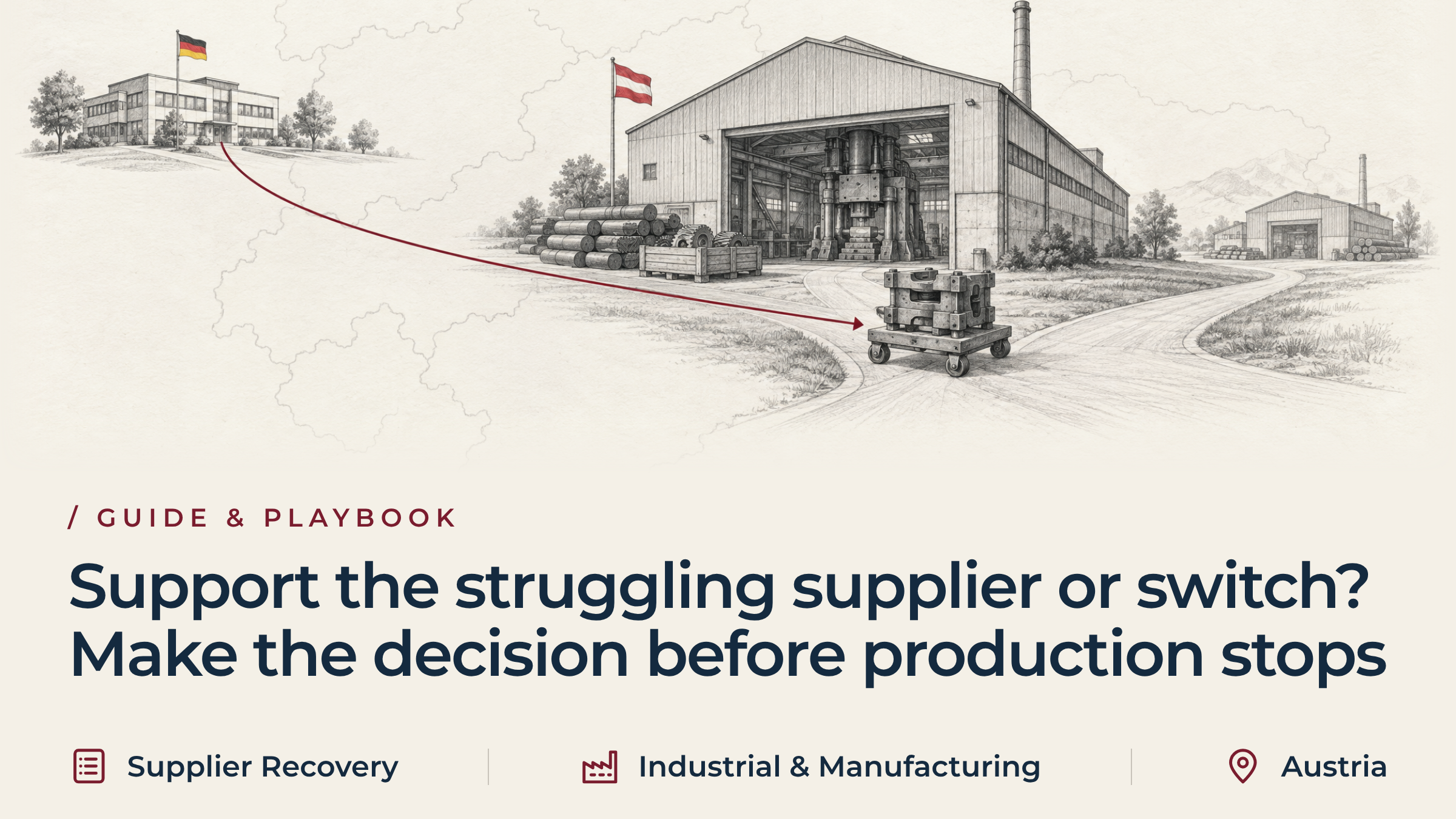
Wspierać borykającego się z trudnościami dostawcę czy zmienić dostawcę? Podejmij decyzję, zanim produkcja zostanie wstrzymana
W skrócie
When a critical supplier runs into financial distress, buyers often treat support and replacement as opposing choices. Effective distressed supplier management rejects that binary. The buyer compares verified supply capability, replacement readiness and financial exposure. It then runs bounded continuity support alongside accelerated qualification of an alternative source. Fixed review points decide whether to continue, change or end the approach. Specialist legal and financial review should confirm every commitment first.
Distress Signals: Identifying Supplier Continuity Risks Early
The warning signs rarely arrive as a formal notice. They surface as fragmented operational escalations. A supplier quietly reduces batch sizes, or suddenly asks for shorter payment terms. Its managing director may call the buyer directly, asking for help funding raw materials. Deliveries become erratic. Tier-one plants in Poland, Czechia, Hungary or Germany start operating from hand to mouth.
Inside the buying organisation, this usually splits the executive team into two camps. Commercial and procurement colleagues want quick action. They favour breach notices, recovery of customer-owned tooling, and orders moved to an alternative supplier at once. Manufacturing and sales colleagues urge caution. Available capacity at an alternative supplier is not the same as production readiness. Transferring tooling takes weeks. Completing automotive Production Part Approval Process (PPAP) documentation takes months. Walking away too early creates an immediate supply gap. Supporting an insolvent counterparty without oversight risks funding a business that cannot recover.
Both positions are reasonable responses to incomplete information. The problem starts when the committee compromises. It grants an informal cash advance without auditing the supplier's cost structure or production capacity. Within weeks, the supplier's other creditors usually absorb the funds. Deliveries stall again. The buyer has lost both the money and the time it needed to qualify a replacement.
Cross-Border Challenges in Distressed Supplier Management
Managing a distressed counterparty becomes harder once the buyer's headquarters sits in one country and the supplier operates in another. A German, French, Swiss or Austrian manufacturer often evaluates a distressed supplier in Austria, Italy or Central and Eastern Europe. The usual contractual remedies rarely work as the buyer expects.
Three structural issues distort the decision. Financial support without on-site oversight tends to leak away. A supplier's local banks or tax authorities often absorb unsecured cash transferred to it. Ring-fencing the support and tying it to verified output is the only way to prevent this. Tooling the buyer paid for is not automatically available to collect. Under most European insolvency and property regimes, an administrator can contest ownership or assert a lien. Recovered tooling often needs weeks of rework once hidden wear or missing documentation comes to light.
In regulated sectors such as automotive, a buyer cannot switch component suppliers unilaterally. It needs the customer's own approval first. Terminating a distressed supplier before that approval arrives shifts commercial liability for any resulting line stoppage onto the buyer.
None of this means headquarters is slow or the local team is careless. It means the usual commercial levers take longer to use across a border than a single-country playbook assumes. A breach notice, a tooling recovery and a supplier switch are all familiar tools. Each one simply takes longer once ownership and operations sit in different countries. Across a border, distressed supplier management depends on evidence the buyer can verify locally, not assurances relayed from head office.
Key Operational Warning Signs in Supplier Recovery Cases
A buyer is often already inside a distressed supplier management problem well before deliveries stop completely. The following signs matter most when they appear together, not alone:
- Repeated, off-cycle requests for price increases or surcharges, without an open-book cost breakdown to support them.
- Deliveries interrupted because the supplier's own raw material vendors have placed it on credit hold.
- Dedicated customer tooling used to produce parts for other clients paying faster.
- Rising rejection rates at incoming inspection, as the supplier defers maintenance and loses skilled operators.
- Verbal assurances from the supplier's leadership that conflict with what the buyer's own logistics team sees on the dock.
None of these signs alone proves insolvency. None should trigger an automatic switch on its own. Together, they justify the comparison set out below.
Supplier Continuity Support vs. Supplier Replacement Strategies
Distressed supplier management rarely fits one pathway for the life of the relationship. A buyer facing supplier distress generally has three options open. Each carries a different mix of readiness, exposure and governance need:
- Bounded continuity support fits when the supplier's technology and management are sound. Short-term liquidity pressure, not a failing business, is usually driving the distress. The route needs escrow, direct material consignment or secured liens. It still carries a real risk of cash loss if nobody monitors it.
- Accelerated switch fits when a fully qualified alternative already has spare capacity and current customer approval. The buyer must also be able to recover the supplier's tooling without dispute. This route carries one-off transfer and validation costs rather than ongoing counterparty risk.
- Dual-track bridge and transition fits when an immediate supply gap threatens customer delivery, but the supplier has no durable future. A qualified alternative can usually be ready inside two to four months under an accelerated plan. The buyer bounds working capital exposure and offsets it where possible against receivables. Oversight then sits on-site at the distressed supplier, while qualification runs in parallel at the alternative.
Where the supplier sits in a different country from the buyer, each option carries a different governance burden. Someone still needs standing authority to act daily, not a policy agreed only at headquarters.
No route removes risk entirely. Distressed supplier management means choosing deliberately between these three routes, not defaulting to whichever feels most urgent. The buyer should not choose on cost alone. Specialist financial and legal review should confirm the exposure under each pathway before the buyer commits to one.
Five Core Disciplines for Distressed Supplier Management
Most manufacturing crises make continuity support and replacement planning look mutually exclusive. In practice, they usually need to run together within defined limits. Five disciplines make distressed supplier management workable rather than open-ended:
- Tie every euro of support to a specific, verifiable outcome. The outcome should be a quantity of conforming goods physically received, not general balance-sheet relief.
- Ring-fence the money. Buy raw material directly and retain title to it. Pay sub-tier suppliers through escrow, and release production payments only against verified output.
- Place a resident engineer or supply-chain specialist inside the supplier's facility. They audit material allocation, scrap rates and shipping manifests in real time.
- Treat a replacement supplier's quotation as a starting point, not a delivery plan. Establish the real lead time for tooling transfer, dimensional testing and customer approval before relying on it.
- Set predetermined tripwires. If scrap rates, delivery volumes or administrator behaviour breach agreed limits, the buyer needs standing authority to respond. That authority should cover freezing support and activating the alternative without a further committee review.
Each discipline becomes harder to sustain when the buyer's decision-makers sit in a different country from the supplier's shop floor. That distance is exactly when a resident executive earns their place.
Setting Exit Criteria for Supplier Continuity Support
A continuity plan without a defined exit is simply an open-ended subsidy. Before committing any support, the buyer should agree the evidence that would justify continuing, adjusting or ending the chosen route. One named person should also hold standing authority to act on it without returning to committee:
- Continuing: verified output stays at or above the agreed bridge volume, and the supplier's reporting remains open-book.
- Adjusting: output or quality slips but remains recoverable with tighter on-site oversight or revised payment terms.
- Ending: scrap rates or missed deliveries breach the agreed threshold, or the administrator seeks to renegotiate agreed terms. It also applies once the alternative supplier reaches serial-production readiness ahead of schedule.
This decision should sit with one named executive, not a rotating committee. Across a border, a rotating committee is slower to convene, which is exactly the delay a distressed situation cannot absorb. A response that waits for consensus every week loses the time it is trying to protect.
Case Study: Supplier Recovery and Parallel Supplier Replacement
A German Tier 1 industrial systems and mobility manufacturer operates three final assembly plants across Czechia, Hungary and Poland. It supplies high-value mechatronic assemblies to global industrial equipment customers. Its sole-source Austrian supplier of precision hot-forged transmission gears enters acute financial distress.
Margin deterioration on legacy contracts and an aggressive debt recall by senior lenders push the supplier towards insolvency. The supplier's managing director makes two demands. He wants an unconditional cash subsidy of €1.2 million. He also demands a thirty per cent increase on all parts within five days, warning that production would otherwise stop.
The buyer's executive committee splits into two camps. Finance and legal want to refuse outright and move tooling to a secondary German forging house. Manufacturing engineering finds that this secondary supplier would need sixteen weeks to adapt the dies and secure customer PPAP sign-off.
Plant inventory across the three CEE assembly sites holds exactly fourteen days of stock. A full stoppage would force all three plants to shut within two weeks. The customer line-stop cost would then run at €380,000 per week.
Operational and Financial Diagnostic
The situation sits between an unmonitored bailout and an immediate line stoppage. Recognising this, the Group CEO and COO engage a CE Interim Partner. CE Interim places an already vetted, mandate-matched, NDA-bound executive on site as Interim COO. The executive is ready to start after the completed mandate brief, with Partner-led governance reporting directly to the Group Board.
The interim executive arrives at the Austrian forging plant within forty-eight hours and runs a full operational and financial diagnostic. The supplier's forging assets and technical capability prove competent. A separate, failing Western European subsidiary is consuming the supplier's cash.
Any unmonitored advance from the buyer would therefore end up seized by the supplier's lending syndicate. The forging presses have an unused weekend window. Given dedicated raw steel billets, that window could produce three months of bridge inventory within six weeks.
The alternative German supplier's engineering team has not yet received updated tool drawings. Its sixteen-week ramp-up is therefore already slipping towards twenty weeks.
Executing Dual-Track Supplier Continuity Support
Over a twelve-week crisis mandate, the interim executive takes three actions. First, they reject the €1.2 million subsidy and negotiate a tripartite agreement with the supplier's lending banks. The buyer purchases €650,000 of raw forging alloy directly and retains title to it. It reimburses production costs on a cost-plus basis through a dedicated escrow account, releasing funds only against verified, conforming output.
Second, the interim executive places a resident quality engineer inside the Austrian plant full time. This engineer audits material intake and heat-treatment cycles, and personally authorises daily shipments. First-pass yield rises as a result, from seventy-four per cent to ninety-one per cent. Third, a dedicated taskforce commissions duplicate tooling at the German alternative supplier. It also runs an accelerated dimensional testing schedule and secures customer PPAP sign-off within eleven weeks.
Key Outcomes of the Supplier Transition
Within twelve weeks, the dual-track response achieves zero assembly line stoppages. It maintains 100 per cent customer delivery compliance across all three CEE assembly plants throughout the sixteen-week transition window. The buyer builds a fifty-day buffer stock of critical transmission gears. It recovers one hundred per cent of the €650,000 raw material and production bridge expenditure. This matches the agreed value of finished parts received. It also transfers eighty per cent of production volume to the qualified German alternative supplier on schedule.
European Benchmarks for Distressed Supplier Management
European manufacturers recognise this pattern of distressed supplier management; it is not an isolated event. BME is Germany's main association for procurement and supply chain professionals. It treats supplier risk management, including supplier insolvency and crisis response, as a standing professional topic, not a one-off concern.
That general professional focus reflects practitioner experience rather than a single quantified benchmark. It does not establish a standard recovery timeline for any individual case.
Insolvency administration also does not automatically mean a stopped production line. German restructuring administrator PLUTA's handling of packaging supplier ZIRBS Verpackungen illustrates the point. The Amtsgericht Bayreuth opened preliminary insolvency proceedings at the end of September 2026. The business continued operating in full. PLUTA said it intended to keep meeting existing customer orders during the investor process.
The case shows that distress and continued delivery can coexist for a period. It says nothing about whether any individual supplier will eventually recover, close or lose its customers. A buyer should treat a parallel filing as a reason to verify delivery daily, not as proof of secure supply.
Leadership Ownership in Supplier Recovery and Switch Decisions
Distressed supplier management touches commercial negotiation, legal structuring, financial control and on-site operational engineering at the same time. An internal team should own this mandate wherever it already has the capacity. It also needs cross-functional authority to arbitrate between procurement, finance and plant operations.
In practice, three constraints usually prevent this. Corporate finance wants to limit balance-sheet exposure. Procurement wants to enforce the existing contract. Plant operations wants to protect line uptime. Without one accountable owner, these priorities compete rather than align. Few internal executives can give the supplier's site a daily, full-time presence.
Negotiating with banks, administrators and shopfloor supervisors requires exactly that. A procurement manager who has managed the relationship commercially for years can also find this difficult. Enforcing escrow and resident oversight requires a more adversarial posture than daily commercial contact does.
An Interim Dyrektor ds. łańcucha dostaw or Interim COO can take on this mandate with real independence. An existing commercial relationship does not always allow that independence internally. The same independence also lets this executive report one verified picture to headquarters while directing the supplier relationship locally. Otherwise, the buyer's own teams must reconcile two different versions of events across a border. Either role brings structured governance to the dialogue without acquiring any automatic authority over the supplier itself.
Frequently Asked Questions on Distressed Supplier Management
Does supplier continuity support hinder supplier replacement?
No. They run together. Bounded support maintains supply while qualifying a replacement, protecting customer lines in case recovery fails. Stopping support early creates a supply gap, while abandoning replacement leaves long-term counterparty risk. Each track needs clear limits and dedicated oversight.
What evidence is needed before funding supplier recovery?
Demand full operational and financial transparency. This includes open-book scrap and run logs, sub-tier payment records, verified inventory counts, and written bank standstill agreements. Verbal assurances are insufficient; verify all claims directly on the shop floor and despatch dock.
When is an alternative supplier replacement fully ready?
A replacement is ready when four conditions are met: tooling is commissioned, test reports meet tolerances, customer PPAP sign-off is complete, and repeatable serial production is demonstrated. Quotations, single samples, or spare capacity do not prove readiness.
Who leads distressed supplier management across functions?
Assign a single executive with cross-functional authority, such as an Interim COO or Group Supply Chain Director, supported by legal and finance specialists. Splitting ownership creates delayed decisions and conflicting directions, especially across international borders.
Powiązana wiedza i kolejny krok
A distressed supplier rarely announces its own decline in advance. Distressed supplier management works best as a standing discipline: verified facts before capital, and one accountable executive. The replacement plan should keep moving whether or not support is granted.
Warto przeczytać:
- Gdy kilka zakładów w Europie Środkowo-Wschodniej zmienia wielkość produkcji w tym samym czasie, kto ustala kolejność wprowadzania tych zmian?
- Produkcja zostaje przeniesiona na Słowację. Kto jest odpowiedzialny za plan wykorzystania mocy produkcyjnych zakładu przejmującego?
- W 2026 r. europejscy dostawcy z branży motoryzacyjnej nie będą mogli sobie pozwolić na wysoką produkcję przy niskich marżach
A distressed supplier can threaten customer delivery when the business lacks one accountable owner for the response. An already vetted, mandate-matched, NDA-bound executive is ready to start after the completed mandate brief. A conversation with a Tymczasowy partner CE is the useful next step.
 EN
 DE
 FR
 IT
 PL
 RO
 CS
 SK
 HU
 ES
 RU
 AR
 SL