

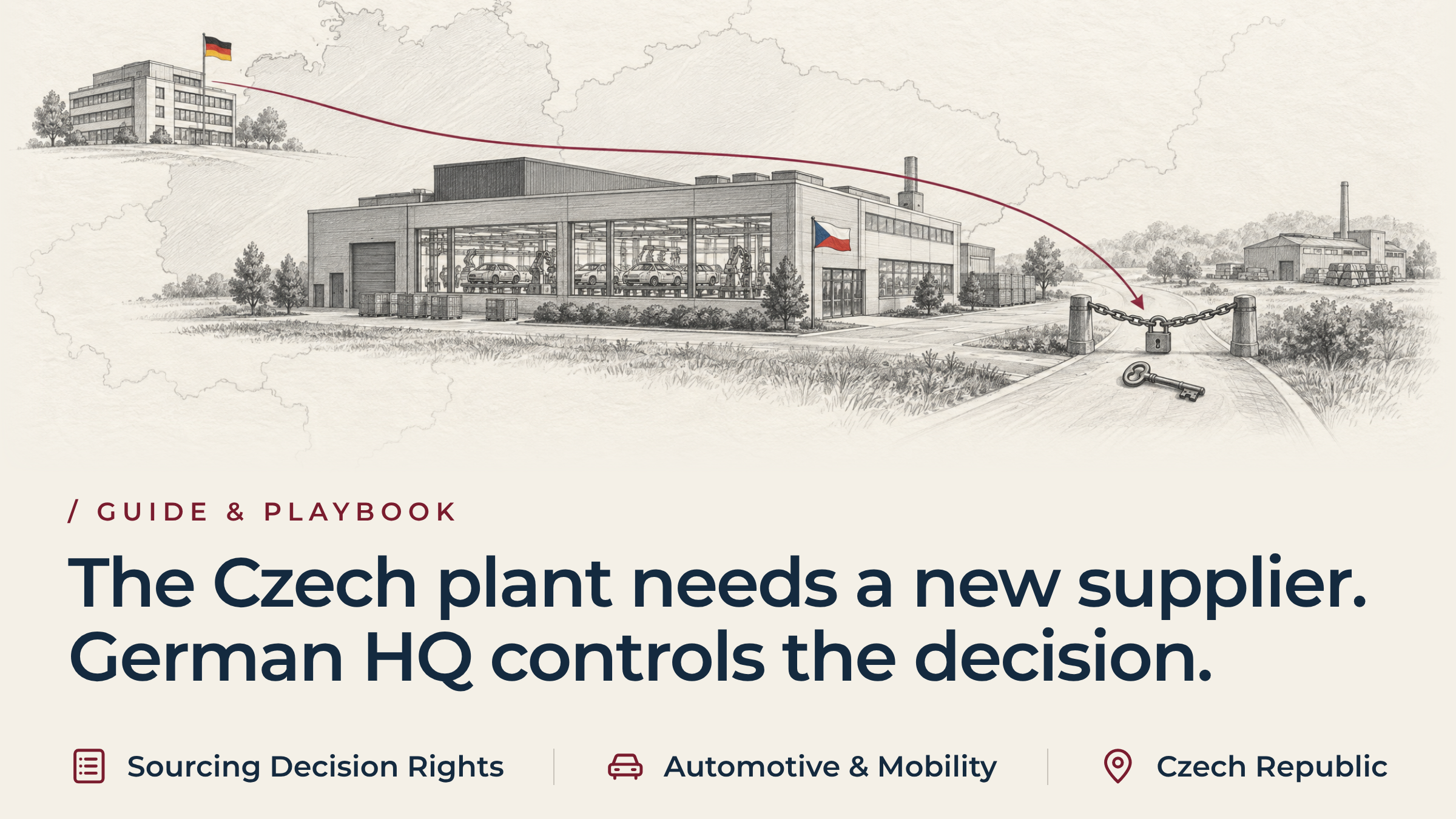
Czeski zakład potrzebuje nowego dostawcy. Decyzję podejmuje niemiecka centrala.
W skrócie
When a critical input stops arriving, a plant can often find a workable alternative within days. The emergency sourcing manufacturing decision that follows is not about whether to use that alternative. It is about who may commit to it, within what financial limit, and for how long. Headquarters still retains the commercial and compliance oversight it is accountable for. A bounded, time-limited delegation resolves this faster than escalating the whole purchasing policy. Give it a named approver and a fixed review date. Technical acceptance and customer approval remain separate, non-negotiable steps.
The Trigger: Identifying Alternative Suppliers vs. Supplier-Switch Authority
The disruption rarely starts with a shortage of alternatives. A sole-source supplier fails, loses capacity, or suffers a quality collapse. Within days, a plant's own engineers and buyers often identify a qualified, regional replacement with available capacity.
The difficulty begins once someone tries to place the order. A parent company's standard vendor-onboarding process exists to manage steady-state risk. It involves credit checks, compliance audits, framework-contract terms and several layers of sign-off. That process suits a planned sourcing decision made months ahead. It does not anticipate a plant counting down its remaining days of buffer stock.
This is not a story about one side being careless. Headquarters is protecting group-wide purchasing terms, compliance obligations and commercial liability, for good reason. The plant is protecting a customer delivery date it cannot move. Both positions are legitimate. What is missing is a route for a bounded emergency sourcing manufacturing commitment to proceed. The first set of protections stays intact throughout.
Key Approval Gates in Emergency Sourcing Manufacturing
Cross-border procurement disputes often happen because teams fold two different gates into one conversation. A commercial purchase order and a technical production release answer different questions. Conflating the two produces deadlock. The supplier will not commit raw material without a purchase order. The buyer will not issue one until technical and compliance paperwork is complete, which can take weeks.
An effective response separates four decisions that do not need the same owner or the same timeline:
- Commercial commitment: the authority to place a purchase order and agree commercial terms with the new supplier.
- Financial exposure: the ceiling on cumulative spend the business is prepared to carry before it reviews the position again.
- Technical acceptance: confirmation, through the applicable inspection and qualification steps, that the output meets specification.
- Customer permission: the sign-off a customer's own quality function must give before the part enters its supply chain.
Authorising the first does not authorise the last. A purchase order lets a supplier begin producing samples. It does not put a single unit into a customer's product.
Establishing a Group Purchasing Exception for Rapid Supplier Onboarding
Granting open-ended buying freedom is not the fix, and it is not what a well-run group purchasing function should accept. A better response is a formal, time-limited emergency sourcing manufacturing exception for the specific crisis at hand. A well-run group purchasing exception stays specific, bounded and time-limited throughout.
Before the business commits to anything under the exception, the delegated approver should put the following in writing:
- The exact part numbers or material categories the exception covers, and nothing beyond them.
- A fixed financial ceiling on cumulative purchase value.
- A volume limit, set at only what customer requirements need. It lasts until the primary supplier recovers or the business qualifies a permanent source.
- An expiry date, typically thirty to sixty days, after which authority reverts automatically to standard purchasing channels.
Each commitment under the exception should also produce a short decision record. It should state why the primary supplier could not deliver and why the business chose the alternative. It should also record the agreed pricing and the exit criteria. This is not paperwork for its own sake.
This record lets internal audit, the customer's quality function and, where relevant, tax authorities see what happened. They see what the business approved, by whom, and why, once the crisis has passed.
Aligning Procurement Timelines Between Headquarters and Local Operations
Headquarters and the affected plant are usually working to different clocks, and both are reasonable on their own terms. For a group procurement function, an emergency vendor nomination is one item on a long weekly agenda. For the plant, every shift consumes a finite stock of a component it cannot replace.
Waiting a week to negotiate a better price is a sound instinct in normal conditions. That instinct stops being rational once a stock-out is close enough to threaten a customer's own production line. At that point, the cost of waiting rarely compares to the saving in view.
The fix is not to remove headquarters from the decision. It is to give the plant a short, factual escalation route. State what has failed and what the alternative can and cannot yet confirm. Add what authority the plant is requesting, and by when it needs a decision. A workable emergency sourcing manufacturing route depends on that escalation reaching the right person quickly, not on removing oversight altogether.
Decision-Rights Map for Emergency Procurement and Sourcing
A decision-rights map makes the delegation explicit rather than something each crisis re-negotiates from scratch. It is a model for organising the conversation, not a claim about how any specific company already operates.
At minimum, record the following for each sourcing decision in play:
- Pre-qualification of the alternative supplier: plant engineering or quality starts this step, and the plant procurement lead recommends it. No financial commitment attaches at this stage. A dispute over fitness escalates to the corporate quality function.
- Tooling or prototype commitment: plant engineering recommends it, and the delegated interim or plant director approves it. The decision stays within the exception's financial ceiling. A cost above that ceiling escalates to group procurement.
- Initial production-bridge order: materials planning recommends it. The delegated owner and group commodity manager jointly approve it, up to the exception's volume limit. It needs an initial sample inspection to pass first.
- Serial production release: plant quality recommends it. Only the customer's own quality representative may approve it, against the customer's own approval requirements. No internal signature substitutes for this one.
Each row needs a named approver and a stated limit. A map without both is a diagram, not a delegation.
Case Study: Czech Automotive Supplier Switch and Emergency Sourcing
A major German Tier 1 automotive powertrain and thermal management systems supplier operates an 850-person precision machining and assembly plant in the Plzen region of Czechia, supplying critical engine modules to primary German vehicle assembly plants in Baden-Wuerttemberg and Bavaria.
Its sole-source German supplier of high-precision aluminium die-cast housings suffers a furnace explosion. The supplier announces a force majeure shutdown of at least twelve weeks.
The Czech plant holds five days of buffer inventory. Its Czech engineers quickly identify a capable aluminium die-caster sixty kilometres away in northern Bohemia. It has idle capacity and the ability to adapt tooling within ten days.
Corporate procurement, based in Stuttgart, normally requires every new vendor appointment to clear a Central Sourcing Committee that meets bi-weekly. Standard vendor verification takes eight weeks. Plant leadership warns that the line will stop within a week. The contractual cost is €50,000 per shift in customer penalties.
Bottlenecks in Standard Vendor-Onboarding Processes
Three things stalled the plant at once, reflecting a wider and understandable tension between headquarters purchasing and the plant's operating team rather than a failure on either side. Corporate procurement would not issue a vendor number until a twelve-week sustainability and financial audit was complete.
Plant engineers had already verified the new supplier's technical capability. The new supplier, in turn, would not buy specialised aluminium ingot or begin machine setup without a signed purchase order. Group purchasing would not raise an emergency vendor number in SAP without a signed multi-year master services agreement.
Once the team excluded quarantined and already-allocated material, the net conforming buffer stock covered only 3.5 production days. The team explored a Tier 2 alternative in Spain and ruled it out. Its twenty-day transit and tooling-adaptation lag was incompatible with the time available.
Implementing Time-Limited Emergency Procurement Approvals
Facing an imminent line stoppage, the business brought in an interim procurement director to lead the response, arriving on site within forty-eight hours. That director reported directly to the Group Chief Operating Officer. The Group Executive Board delegated authority to the role to approve emergency commitments up to €350,000 directly.
That single change broke the deadlock in Stuttgart. An emergency tooling and pilot-batch purchase order went out within six hours.
The ten-week engagement then ran in two stages. The first authorised commercial production of prototype and pre-series parts under a bounded sixty-day purchase contract. This let the new Czech supplier buy material and start tooling.
The second stage stayed ring-fenced to production-line release. It tracked, separately, coordinate-measuring machine (CMM) dimensional checks and an expedited Level 3 PPAP submission with OEM customer quality engineers. These were the two confirmations required before any part could enter a vehicle build.
A daily fifteen-minute standup connected the plant quality manager and the new supplier's technical director. It also connected the German group commodity lead and the customer's quality liaison. Through it, the group resolved tooling changes and commercial queries the same day. Nothing had to wait for a weekly review.
Results: Uninterrupted Production and Long-Term Cost Savings
Across the ten weeks from first disruption to confirmed stabilisation, the Czech plant held uninterrupted serial production throughout, avoiding customer line-stoppage claims that could have exceeded €2.5 million. The replacement Czech supplier completed tooling adaptation, sample verification and initial delivery within eleven calendar days.
The emergency price premium came in under four per cent above the previous contract. Subsequent volume scaling then delivered a net annualised saving of €320,000.
The German parent company later adopted the emergency decision-rights charter used in this scenario. It became the standard emergency procurement procedure across its European subsidiaries.
Closing the Group Purchasing Exception to Maintain Compliance
A bounded emergency sourcing manufacturing exception only stays bounded if someone is accountable for closing it. Build the review into the charter itself. On the expiry date, or sooner if the primary supplier recovers, procurement and plant leadership assess the replacement's performance together. They then decide, in writing, whether to qualify it permanently, extend the exception for a defined period, or close it.
Without that step, a temporary delegation quietly becomes the way the business always sources that category. It sits outside the governance anyone can see or audit. The habit, not the original decision, is usually what creates the compliance exposure a future review finds.
This is also where the group retains its authority. A mandate can coordinate the emergency response and keep the clock moving. It does not replace the sign-off the board, the customer or a specialist adviser genuinely reserved for themselves.
Leadership Roles: Interim Procurement Director vs. Supply Chain Director
Not every emergency sourcing manufacturing decision needs outside help. Where procurement and plant leadership already work closely together, that team should own the response. This holds when an internal commodity lead has the seniority, time and clear delegation to act. They already know the ERP systems, the budget codes and the supplier relationships involved. Bringing in outside leadership would simply add a handover cost, with no offsetting benefit.
The difficulty is that an acute shortage often arrives exactly when internal capacity is already at its limit. The same procurement managers are carrying annual savings targets and contract renewals. The same plant leaders are managing the operational fallout of the disruption itself. Neither function has the standing to overrule the other on its own. A decision that should take hours can drift for weeks.
An Interim Procurement Director can own a bounded buying decision like this one. A Dyrektor ds. łańcucha dostaw is the better owner for a wider response spanning several decisions. Either way, the business gets one accountable owner, holding clear supplier-switch authority, free of departmental history on either side. It is worth a conversation with a CE Interim Partner once a plant has identified a workable alternative. No route may yet exist to authorise it quickly.
Frequently Asked Questions About Emergency Sourcing Manufacturing
Who Should Approve Emergency Sourcing Decisions?
Approval should run through a dedicated route with exactly two signatures. One is the on-site operational executive, such as an Interim Procurement Director or plant director. The other is the group procurement director, or an equivalent authorised corporate executive. Give that channel a turnaround deadline measured in hours, not weeks. This removes the multi-layered committee delay that normally stalls emergency procurement approval. Corporate oversight, and the audit trail it produces, stays fully in place.
Can Local Purchasing Override Group-Nominated Suppliers?
In a genuine delivery crisis, yes, within bounded limits. The group can give local purchasing temporary authority to commit to an alternative supplier when the group-nominated vendor cannot meet its commitment. That authority needs a defined spending ceiling, a volume cap tied to actual customer requirements, and a fixed expiry date. This exception to standard policy is narrow and fully documented. It never becomes an open-ended authority to bypass group procurement whenever local teams judge it faster.
Does Procurement Approval Permit Immediate Production Use?
No. A commercial purchase order authorises the acquisition of material, tooling and capacity from the alternative supplier. It says nothing about whether that output belongs in a customer's product. Using it in active production still requires separate technical acceptance and customer sign-off. The part must still clear whichever qualification and inspection steps apply. Commercial urgency is never a reason to shorten that gate.
How Should Temporary Supplier-Switch Authority Be Reviewed?
Build a review date into the exception itself from the outset, typically thirty to sixty days out. At that point, procurement and plant leadership should assess together whether the primary supplier has recovered. They should also judge whether the alternative's performance to date justifies a permanent contract. The temporary authority can then close, extend for a further period, or convert into a standard supplier relationship.
Powiązana wiedza i kolejny krok
The decision this article covers stops at commercial authorisation. It does not extend to the separate question of when a qualified replacement may actually enter production. That depends on technical acceptance and customer sign-off, not on purchasing approval.
Warto przeczytać:
- Koniec z zarządzaniem zakładem z Francji: jak „zarządzanie z cienia” niszczy lokalną odpowiedzialność w polskich zakładach
- Jak należy regulować kwestie związane z transgranicznym zleceniem tymczasowego pełnienia funkcji kierowniczej?
- Słabe wyniki operacyjne czy kryzys strukturalny? Analiza sytuacji w węgierskim sektorze produkcyjnym przeprowadzona na szczeblu zarządu
CE Interim provides cross-border executive interim leadership for exactly this kind of situation. A plant may have a workable emergency sourcing manufacturing option and still have no fast, accountable route to authorise it. When the business needs a mandate, CE Interim can help. It places an already vetted, mandate-matched, NDA-bound executive, ready to start within 72 hours of the completed mandate brief.
To talk through a current sourcing decision in confidence, contact a CE Interim Partner.
 EN
 DE
 FR
 IT
 PL
 RO
 CS
 SK
 HU
 ES
 RU
 AR
 SL